 Colouring Nest
New Zealand and Australian Coins Chart
- Ages 5–8
- Easy
- 1 page
- Maths chart
- PDF: Letter & A4
- Updated


Tip: download the PDF for Letter or A4 paper, print it at 100% and use a pencil or crayon.
Up nextCounting NZ and Australian Coins →Advertisement
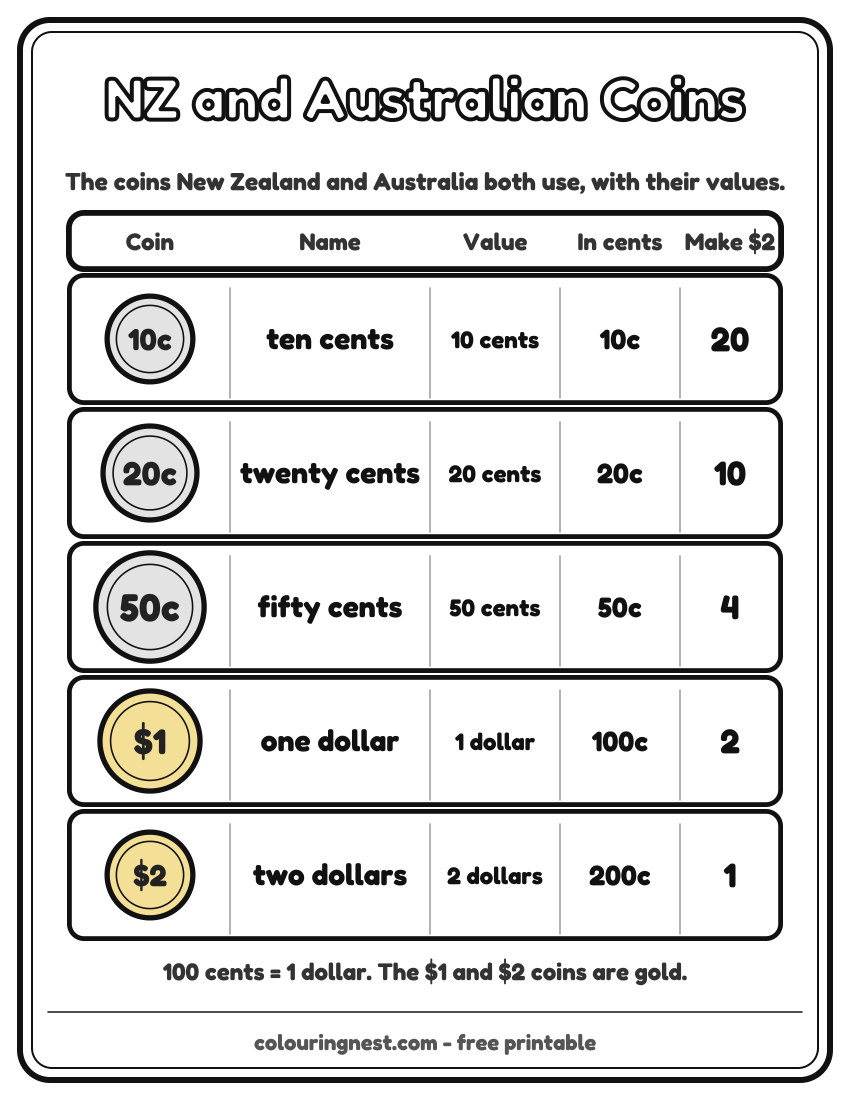
The five coins New Zealand and Australia both use, in one chart: 10 cents, 20 cents, 50 cents, one dollar and two dollars. Each row shows the coin, its name, its value in cents and how many make two dollars. The coins are simple drawings, not the real designs: the silver coins are drawn bigger for bigger values, and the gold 2 dollar coin smaller than the 1 dollar coin, as it is in both countries. Australia also has a 5c coin, which is not on this chart.
Also try: Counting NZ and Australian Coins · US Coin Value Chart · Skip Counting by 5s Hundreds Chart
Tips for this money chart
- Lay a real coin on each drawing and read its value aloud.
- Count the last column out loud: 4 fifty cent coins is 50, 1 dollar, 1.50, 2 dollars.
- Ask why the 2 dollar coin is smaller than the 1 dollar coin.
It is a one-page reference chart with nothing to mark. The skip counting by 5s chart helps with nickels and quarters. When this sheet feels easy, move on to the adding money worksheet and the making change worksheet. See all money worksheets.
For teachers and parents
- What it practises
- Coin names and values, counting coins to a dollar and comparing amounts, adding money, making change and word problems
- How to use it
- Keep real coins on the table and count biggest value first, saying the running total aloud. Play shop for the change and word problem sheets. Answers on page 2.
- Time
- About 10–15 minutes
Advertisement
More money worksheets


Seasonal: Back to School Coloring Pages
Collections: First Grade Math WorksheetsFree Homeschool Printables
You might also like


Printing tips
- Put real coins on the table next to each sheet.
- Count by 5s, 10s and 25s out loud before counting coins.
- Mark with page 2, then redo the wrong ones the next day.
Advertisement