 Colouring Nest
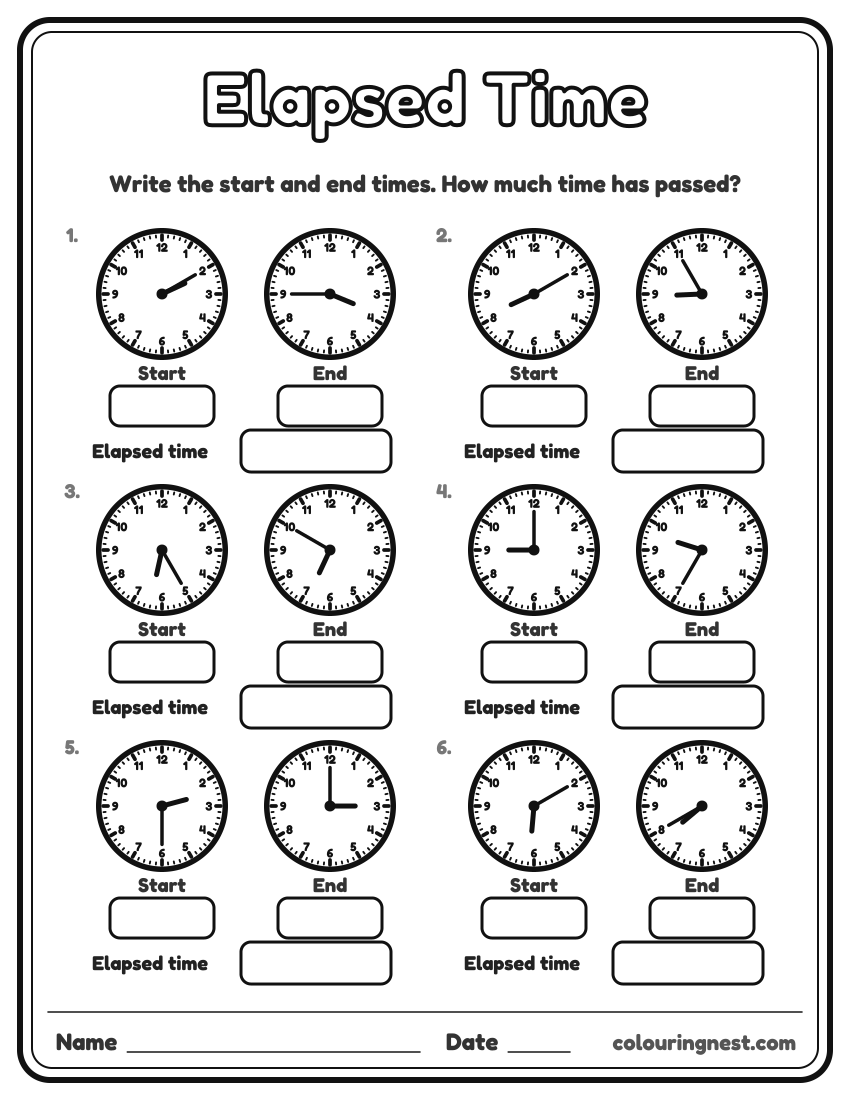
Elapsed Time Worksheet
- Ages 8–10
- Medium
- 2 pages
- Worksheet
- Answer key
- PDF: Letter & A4
- Updated


Tip: download the PDF for Letter or A4 paper, print it at 100% and use a pencil or crayon. Tap "Show solution" to check your answer, or print it as an answer key.
Up nextArea by Counting Squares →Advertisement
Six pairs of clocks: a start time and an end time. Children read each clock, write the time underneath, then work out how much time has passed, in minutes or in hours and minutes (from 15 minutes to an hour and a half). Count on in fives round the clock face, or jump to the next o’clock first and then add the rest. It builds on reading a clock to the minute and is the skill behind every “how long until” question. Page 2 is the answer key.
Also try: Area by Counting Squares · Area of Rectangles Worksheet · Write the Time: To the Minute
Tips for this measurement worksheet
- Read and write both times first.
- Count on in fives from the start time to the end time.
- Jump to the next o’clock first, then add the minutes after it.
Page 2 of the PDF is the answer key. Not sure about reading a clock to the minute yet? Start with the telling time to the minute worksheet. When this sheet feels easy, move on to the making change worksheet and the third grade math worksheets. See all measurement worksheets.
For teachers and parents
- What it practises
- Area by counting squares and by multiplying, perimeter of rectangles and other shapes, measuring to the nearest inch, half inch and centimeter, reading and making bar graphs, picture graphs and line plots, elapsed time
- How to use it
- Colour the squares for area and trace the edge for perimeter. Print the ruler sheets at 100% (Actual size). Read the scale or key before any graph. Answers on page 2.
- Time
- About 15–20 minutes
Advertisement
More measurement worksheets


See all measurement worksheets →
Seasonal: Back to School Coloring Pages
Collections: Third Grade Math WorksheetsFree Homeschool Printables
You might also like


Printing tips
- Colour the squares as you count them so none is counted twice.
- Trace round the edge with a finger for perimeter, saying each length.
- Read the scale of a graph before reading any bar.
Advertisement