 Colouring Nest
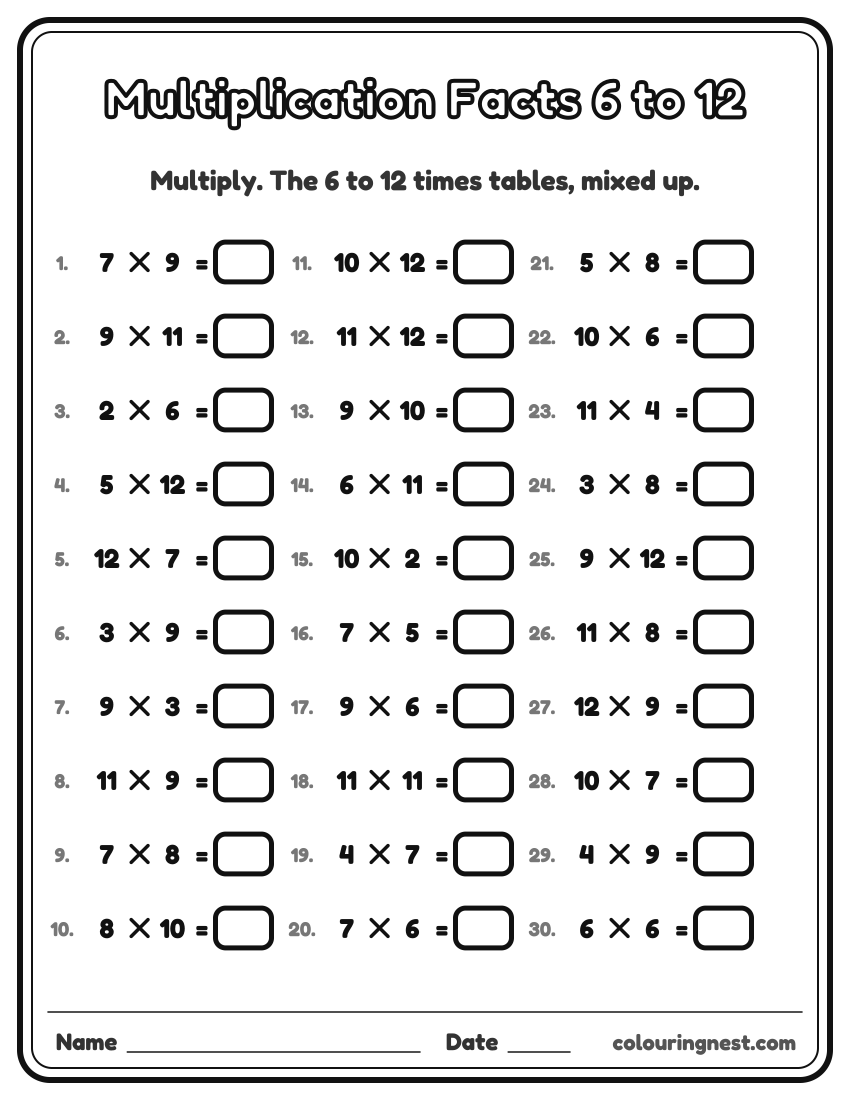
Multiplication Facts 6 to 12 Worksheet
- Ages 8–10
- Medium
- 2 pages
- Worksheet
- Answer key
- PDF: Letter & A4
- Updated


Tip: download the PDF for Letter or A4 paper, print it at 100% and use a pencil or crayon. Tap "Show solution" to check your answer, or print it as an answer key.
Up nextMixed Multiplication Facts 0–12 Worksheet →Advertisement
Thirty facts from the harder tables, 6 to 12, mixed up: 7 × 8, 9 × 6, 12 × 11. These are the facts children usually learn last, and the ones that come up most in long multiplication and division. Every fact has a 6, 7, 8, 9, 10, 11 or 12 in it, sometimes first and sometimes second, and the other number goes from 2 to 12. If a fact is slow, find it on the multiplication chart and say it aloud three times.
Also try: Mixed Multiplication Facts 0–12 Worksheet · Multiplication Chart 1–12 · 7 Times Table Flash Cards
Tips for this multiplication worksheet
- Use facts you know: 6 × 8 is 5 × 8 plus one more 8.
- For the 9s, the digits of the answer add up to 9.
- For the 11s up to 9 × 11, repeat the digit: 7 × 11 = 77.
Page 2 of the PDF is the answer key. To learn one table at a time, use the times tables worksheets and flash cards; for a colouring break, try the times tables color by number pages. When this sheet feels easy, move on to the 2-digit by 1-digit multiplication sheets and the division worksheets. See all multiplication worksheets.
For teachers and parents
- What it practises
- Arrays, equal groups and repeated addition, multiplication facts 0 to 12 and missing factors, word problems and multi-digit multiplication
- How to use it
- Build the first facts with counters in rows. For the 3 minute drill, an adult times it and the child beats their own score, never anyone else’s. Answers on page 2.
- Time
- About 10–20 minutes
Advertisement
More multiplication worksheets


See all multiplication worksheets →
Seasonal: Back to School Coloring Pages
Collections: Third Grade Math WorksheetsFree Homeschool Printables
You might also like


Printing tips
- Build each fact with counters, buttons or Lego in rows before writing it.
- Learn a few facts at a time and mix them with ones already known.
- Mark with page 2 and redo the wrong ones the next day.
Advertisement