 Colouring Nest
Reading a Bar Graph
- Ages 8–9
- Medium
- 2 pages
- Worksheet
- Answer key
- PDF: Letter & A4
- Updated


Tip: download the PDF for Letter or A4 paper, print it at 100% and use a pencil or crayon. Tap "Show solution" to check your answer, or print it as an answer key.
Up nextMake a Bar Graph →Advertisement
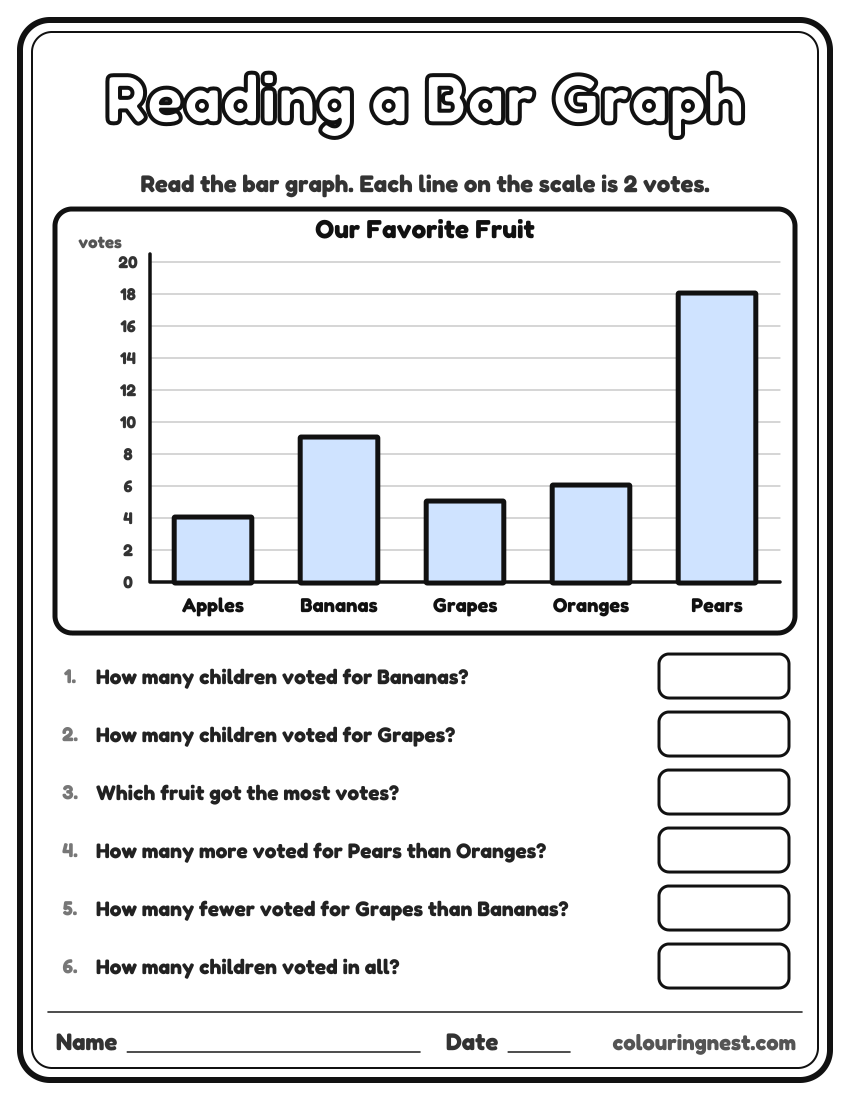
A bar graph of a class vote, with a scale that counts in twos, so some bars end halfway between two lines. Six questions follow: how many children voted for two of the choices, which one got the most votes, how many more voted for one than another, how many fewer, and how many voted in all. Reading the scale first, then going across from the top of each bar to the number, is the skill third graders need for every graph. Page 2 is the answer key.
Also try: Make a Bar Graph · Picture Graph Worksheet · Rounding to the Nearest 10 and 100
Tips for this measurement worksheet
- Read the scale first: each line here is 2.
- A bar that stops between two lines is the odd number in between.
- For “how many more”, take the smaller number from the bigger one.
Page 2 of the PDF is the answer key. Make your own graph afterwards: vote on something at home or in class and draw it. When this sheet feels easy, move on to the area and perimeter worksheet and the third grade math worksheets. See all measurement worksheets.
For teachers and parents
- What it practises
- Area by counting squares and by multiplying, perimeter of rectangles and other shapes, measuring to the nearest inch, half inch and centimeter, reading and making bar graphs, picture graphs and line plots, elapsed time
- How to use it
- Colour the squares for area and trace the edge for perimeter. Print the ruler sheets at 100% (Actual size). Read the scale or key before any graph. Answers on page 2.
- Time
- About 15–20 minutes
Advertisement
More measurement worksheets


See all measurement worksheets →
Seasonal: Back to School Coloring Pages
Collections: Third Grade Math WorksheetsFree Homeschool Printables
You might also like


Printing tips
- Colour the squares as you count them so none is counted twice.
- Trace round the edge with a finger for perimeter, saying each length.
- Read the scale of a graph before reading any bar.
Advertisement