 Colouring Nest
Brain breaks for the classroom: 50 printable brain break cards
A brain break is a short pause in a lesson, usually 1 to 5 minutes, when children move, breathe slowly or play a quick thinking game before going back to work. Below are 50 free brain break cards for the classroom, sorted into movement, calm and breathing, thinking, quick games and seated breaks, each with its time, the space it needs and how noisy it gets. Print them in A4 or US Letter, pick one on screen, or spin the wheel.
Inside this set
- 10 printables
- A4 and US Letter PDFs
- Colour and ink-saver versions
- Free, no sign-up
What is a brain break? The short answer
A brain break is a planned 1 to 5 minute activity between periods of focused work: a stretch, a movement game, slow breathing or a quick puzzle, followed by a clear signal to get back to learning. Teachers use them when a class has been sitting for 20 to 30 minutes, before a test, after lunch or whenever the room gets restless. Reviews of classroom movement breaks have found that children are often more on task afterwards, while effects on test scores are mixed, so treat them as a way to reset attention and add movement to the day, not as a cure for anything.
50 cards: 12 movement, 10 calm and breathing, 10 thinking and puzzles, 10 quick games, 8 seated and small-space. 43 work from a chair and 25 are quiet. Updated 13 November 2026.
Pick a brain break now
Or show it to the class: spin the wheel of quiet breaks from a chair, the choice board wheel, or put names on the random name picker to choose who leads. Every card’s minutes open the classroom timer set to that time.
Movement brain breaks (12)
Get the whole body moving for one to three minutes, then settle. Spin the wheel for a move break.
-
Mirror Me
Stand facing a partner. One leads with slow arm, face and body moves; the other copies like a mirror. Swap leaders after one minute. Moves must be slow enough to follow.
Adapt: Seated pairs mirror with hands and faces only.
-
Weather Workout
Call a weather word and everyone acts it: drizzle (tap fingers on shoulders), wind (sway), thunder (stamp three times), sunshine (stretch up tall). Go faster, then finish on sunshine.
Adapt: Desk taps replace stamps for anyone sitting down.
-
Count and Stretch
Count to 10 together while reaching high, back down from 10 while touching knees, then to 10 again leaning side to side. Older classes count in 2s, 5s or this week's times table.
Adapt: Reach only as far as is comfortable; arms alone are fine.
-
Shake Down
Shake the right hand 8 times, the left hand 8, the right foot 8, the left foot 8. Then 4 each, then 2, then 1. Finish in a still pose with one slow breath out.
Adapt: Seated version: hands and shoulders only, counting aloud together.
-
Animal Walks
Name an animal and move like it across the space: crab walk, bear crawl, frog hop, flamingo balance, tortoise creep. Always end with the tortoise so the room slows down.
Adapt: Children choose any animal move they can do, standing or seated, and others guess it.
-
Freeze Frame
Move on the spot while you clap a beat or play music. When it stops, everyone freezes in a shape. Give a theme for the shape: a letter, a tree, a number, a famous statue.
Adapt: Raise a hand as the stop signal as well as the sound, for students who are Deaf or hard of hearing.
-
Balance Challenge
Stand on one foot for a count of 10, then the other. Next round: arms folded, eyes closed, or spelling a word aloud while you balance. Anyone can hold a desk.
Adapt: In a chair, lift one foot just off the floor and hold it for the count.
-
River and Bank
Lay a rope or a tape line on the floor. Call "river" (jump to the river side) or "bank" (jump back). Call fast, slow or the same word twice to catch people out. Nobody is out.
Adapt: Step instead of jump, or point to the side from a chair.
-
Wall Push-Ups
Stand an arm's length from a wall or a heavy desk that will not move, hands flat on it. Bend your elbows to bring your chest close, then push back. Count 10 slow ones together.
Adapt: Anyone with a sore wrist does slow shoulder rolls instead.
-
Follow the Leader
One child leads a slow line round the room, changing the move every few steps: march, tiptoe, giant steps, wave. Everyone copies. A new leader takes the next lap.
Adapt: A wheelchair user can lead: others follow the route and copy an arm move.
-
Number Jumps
Hold up a number card or fingers: the class does that many jumps, claps or star jumps. Then use sums: "jump the answer to 3 + 4" or "clap the number of sides on a hexagon".
Adapt: Claps or desk taps count the same as jumps.
-
Cross the Middle
Touch your right hand to your left knee, then your left hand to your right knee, slowly, 10 times. Then elbows to opposite knees. Then hands to opposite heels behind you.
Adapt: Seated works well; reach to opposite shoulders if knees are hard to reach.
Print the movement cards
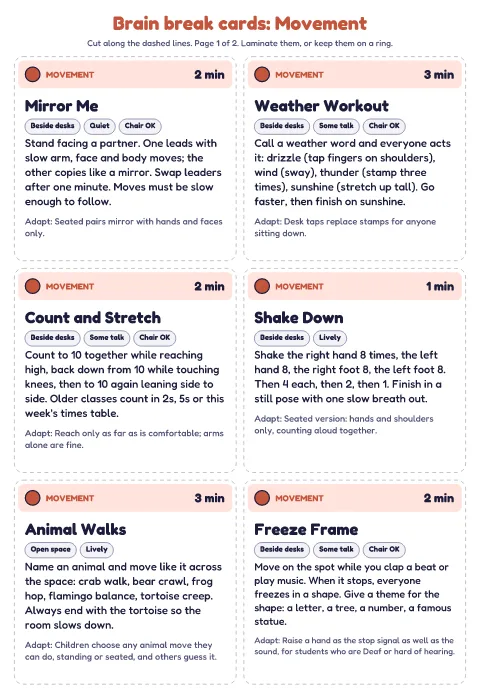
All 12 movement cards above, six to a page with dashed cut lines. Each card shows the minutes, the space and noise level, whether it works from a chair, the steps and one way to adapt it. The circle in the corner tells the types apart on a black-and-white copy.
Calm and breathing brain breaks (10)
Slow breathing, stretching and noticing, to bring the room down after lunch, a test or a noisy session. Spin the wheel for a calm break.
-
Balloon Breath
Rest your hands on your tummy. Breathe in slowly through your nose and feel your tummy rise like a balloon. Breathe out slowly and let it go down. Five slow breaths.
Adapt: Anyone who finds breathing exercises uncomfortable simply sits quietly instead.
-
Square Breathing
Trace a square on the desk with one finger. Breathe in for 4 along the top, hold for 4 down the side, breathe out for 4 along the bottom, hold for 4 back up. Four squares.
Adapt: Younger children count to 3 and can leave out the holds.
-
Five Senses Check
Quietly notice 5 things you can see, 4 you can hear, 3 you can touch, 2 you can smell and 1 thing you like about today. Share one with a partner, or keep them to yourself.
Adapt: Swap senses freely: a student who is blind might notice 5 sounds and 4 textures.
-
Slow Stretch
Reach up tall and hold for 3 breaths. Lean gently to the left, then the right. Roll your shoulders back 5 times. Let your arms hang loose and give them a soft shake.
Adapt: Every stretch works sitting in a chair; stop at any stretch that feels sore.
-
Hand Trace
Spread one hand flat on the desk. Slide a finger of the other hand up each finger as you breathe in and down as you breathe out. Five fingers, five slow breaths.
Adapt: Trace a hand drawn on paper if touching your own hand is uncomfortable.
-
Sound Hunt
Sit still with eyes closed or looking down. For one minute, count the different sounds you can hear: in the room, in the building, outside. Then share the farthest sound anyone heard.
Adapt: For students who are Deaf, play "colour hunt": count the shades of one colour around the room.
-
Squeeze and Let Go
Squeeze your hands into fists for a slow count of 5, then let go. Shoulders up to your ears, then drop them. Curl your toes, then relax. Notice how "letting go" feels.
Adapt: Skip any part of the body that hurts; hands alone are enough.
-
Picture a Cloud
Read slowly: "You are lying on soft grass, watching clouds drift by. One cloud slowly changes shape..." Pause for a minute of quiet. Then everyone has 30 seconds to draw the cloud they saw.
Adapt: Children who would rather not close their eyes look out of a window or at a plain wall.
-
Slow Motion
Do an everyday action in super slow motion: pick up a pencil, tie a shoe, wave hello, take a bite of an apple. The smoothest, slowest mover chooses the next action.
Adapt: Any action works, including ones with just the face or one hand.
-
Thank-You Minute
Think of someone who helped you this week: a friend, a family member, someone at school. Say a silent thank you. Then write or draw them on a sticky note for the class thank-you wall.
Adapt: Drawing, a word or a single letter on the note all count.
Print the calm and breathing cards
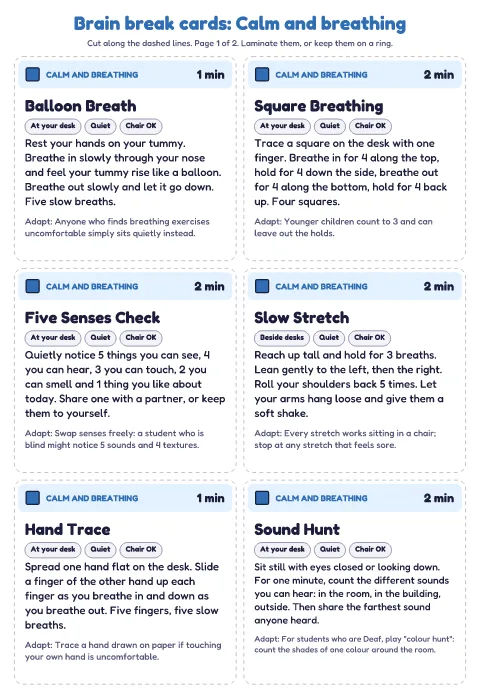
All 10 calm and breathing cards above, six to a page with dashed cut lines. Each card shows the minutes, the space and noise level, whether it works from a chair, the steps and one way to adapt it. The square in the corner tells the types apart on a black-and-white copy.
Calm and breathing cards PDF (A4)Calm and breathing cards PDF (US Letter)
Thinking and puzzles brain breaks (10)
Word, number and drawing challenges that rest the body and give the mind a different job. Spin the wheel for a think break.
-
Alphabet Chain
Pick a topic such as animals, food or places. Go round the room: each person names one that starts with the next letter, A to Z. The class can help anyone who is stuck, and Q, X and Z may be skipped.
Adapt: Students can point to a picture or write on a whiteboard instead of speaking.
-
Odd One Out
Say or show four things, such as cat, dog, carrot, cow. Partners decide which one does not belong and why. Any good reason counts, and there is often more than one answer.
Adapt: Show the four things as pictures as well as words for early readers and students learning English.
-
Guess My Thing
One person secretly picks an object in the room. The class asks yes or no questions to find it, with 15 questions in total. Whoever guesses picks the next object.
Adapt: Answer with thumbs up or thumbs down so students who do not speak aloud can lead.
-
Finish the Pattern
Clap, tap or draw a pattern: clap, clap, tap; or circle, square, square. The class continues it, then works out what comes tenth. A student makes the next pattern.
Adapt: Draw the pattern on the board as well as clapping it.
-
Word Ladder
Write a short word on the board, such as cat. Change one letter at a time to make a new word at each step: cat, hat, hot, dot. How long a ladder can the class build in 3 minutes?
Adapt: Younger classes change only the first letter; older classes use four-letter words.
-
Quick Draw
Call out an object. Everyone has 20 seconds to draw it on scrap paper or a whiteboard, then holds it up. Five rounds, and the funnier the drawings, the better.
Adapt: Allow a shape, a label or a mime for anyone who does not want to draw.
-
Would You Rather
Read a would you rather question. Children move to one side of the room for each choice, or hold up 1 or 2 fingers. One person from each side says why.
Adapt: Holding up fingers works for everyone and keeps the room quiet.
-
Higher or Lower
Think of a number from 1 to 100. The class guesses, and you answer only "higher" or "lower". Count the guesses and try to beat the class record next time.
Adapt: Show higher and lower with a thumb up or down as well as saying it.
-
Story Chain
Start a story with one sentence. Each person in turn adds one sentence. The last person has to finish the story in exactly five words.
Adapt: Anyone may pass, or add a sound effect instead of a sentence.
-
Think Fast
Name a category, such as things that are round. In pairs, list as many as you can in one minute. Compare lists: score a point for each item no other pair has.
Adapt: Pairs can draw items instead of writing them.
Print the thinking and puzzles cards
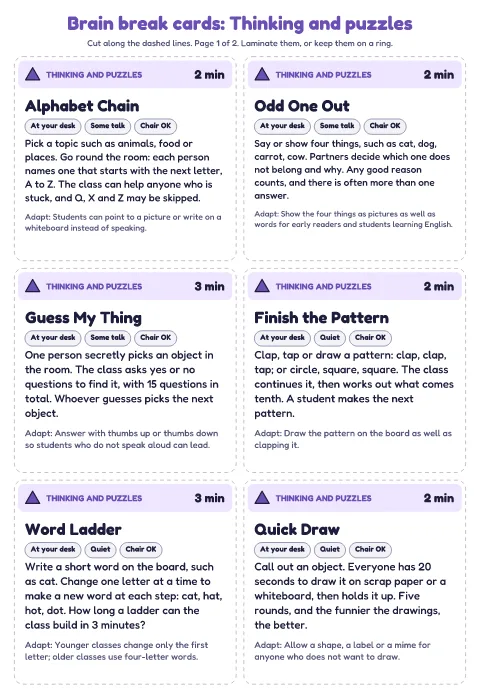
All 10 thinking and puzzles cards above, six to a page with dashed cut lines. Each card shows the minutes, the space and noise level, whether it works from a chair, the steps and one way to adapt it. The triangle in the corner tells the types apart on a black-and-white copy.
Thinking and puzzles cards PDF (A4)Thinking and puzzles cards PDF (US Letter)
Quick games brain breaks (10)
Short whole-class games where nobody sits out for long. Spin the wheel for a game break.
-
Teacher Says
Give actions that start with "Teacher says", such as "Teacher says touch your nose". If an action comes without "Teacher says", nobody should do it. Anyone caught does a silly pose and stays in.
Adapt: Show each action as you say it, and use actions that work seated.
-
Silent Ball
Pass a soft ball around the room in total silence. Every throw must be catchable. A sound or a wild throw means sitting down for one round, then you are back in.
Adapt: Roll the ball along desks, or pass it hand to hand, for students who find catching hard.
-
Heads Down Thumbs Up
Four children stand at the front. Everyone else puts their head down with one thumb up. Each of the four quietly presses one thumb and returns. Heads up: those tapped stand and guess who tapped them.
Adapt: Students who do not like being touched keep their thumb down and help the teacher watch.
-
Four Corners
Number the corners 1 to 4. While you count down from 10 with eyes covered, children walk to any corner. Call a number or roll a die: that corner does 5 star jumps, then everyone moves again.
Adapt: Make every corner reachable by wheelchair, or let a student call the numbers.
-
Clap Pass
Sit or stand in a circle. Pass one clap to the left as fast as you can, all the way round. Time a full lap, then try to beat it, then send it the other way.
Adapt: A tap on the desk or a wave can pass instead of a clap.
-
Find the Leader
One child covers their eyes. Point to a secret leader, who starts a move that everyone copies and changes it every few seconds. The detective opens their eyes and has 3 guesses to find the leader.
Adapt: Use hand and face moves so everyone can play seated.
-
Rock Paper Scissors Train
Play anyone. The person who loses joins behind the winner as their cheer squad. Winners find new opponents, so the trains grow until the last two face off.
Adapt: The game works seated: winners turn round to the next desk instead of walking.
-
Fizz Buzz Count
Count round the class. Say "fizz" for multiples of 3, "buzz" for multiples of 5 and "fizz buzz" for both. A slip just restarts the count at 1.
Adapt: Younger classes use one rule only, such as clap on every 5.
-
Silent Line-Up
Without talking, line up in order of birthday (month and day), first letter of first name, or number of letters in your name. Use hand signals only, then check by saying them aloud down the line.
Adapt: Choose an order nobody might feel awkward about: birthdays and names, not height or age.
-
Pass the Face
In a circle, the first person makes a funny face at their neighbour. The neighbour copies it, then turns and makes a new face for the next person. Keep it going all the way round.
Adapt: Hand shapes can replace faces for anyone who would rather not.
Print the quick games cards
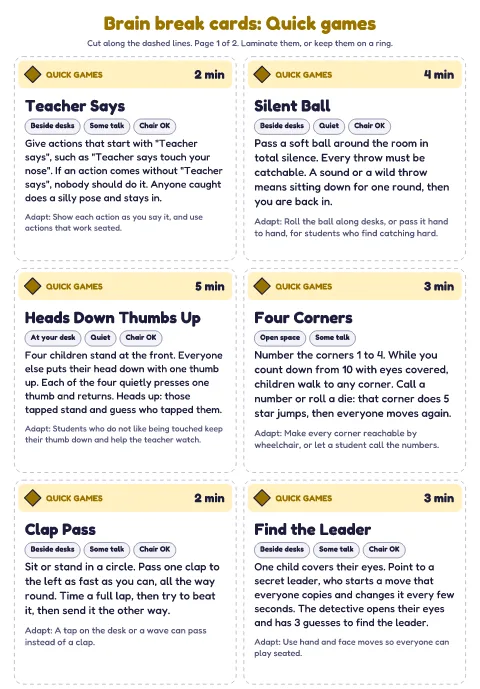
All 10 quick games cards above, six to a page with dashed cut lines. Each card shows the minutes, the space and noise level, whether it works from a chair, the steps and one way to adapt it. The diamond in the corner tells the types apart on a black-and-white copy.
Seated and small-space brain breaks (8)
Everything from a chair: for tight classrooms, wheelchair users, a child with a sore leg, or the bus. Spin the wheel for a seated break.
-
Chair March
Sit tall and march your feet on the floor while swinging your arms. Go fast for 10, slow for 10, then march on tiptoes, then on heels.
Adapt: Arms alone count as marching for anyone who cannot move their legs.
-
Seated Twist
Sit tall with feet flat. Gently turn your shoulders to the right and look behind you, hold for 3 breaths, then turn to the left. Twice each side.
Adapt: Turn only as far as is comfortable; turning the head alone is fine.
-
Finger Tap Race
Touch your thumb to each finger in turn and back again, first one hand, then both. Then try one hand going forwards while the other goes backwards.
Adapt: Tap fingers on the desk one at a time if thumb-to-finger is hard.
-
Air Writing
Write this week's spelling words, letters or numbers in the air with a finger, then an elbow, then a foot. Partners guess what was written.
Adapt: Write on a partner's palm with a fingertip, or on the desk, as another option.
-
Desk Drum
The leader taps a short rhythm on the desk and the class copies it. Add one beat each turn. Then a student leads the next rhythm.
Adapt: Students sensitive to noise tap with fingertips or on their knees.
-
Shoulder Reset
Roll your shoulders forwards 5 times and backwards 5 times. Shrug them up to your ears, hold for 3, and drop. Finish with slow head nods: yes, then no.
Adapt: Small movements are just as good as big ones.
-
Pat Clap Cross
Pat your knees twice, clap twice, cross your hands on your chest twice, wave twice. Repeat the pattern a little faster each round, then invent a new fourth move.
Adapt: Pat the desk instead of knees, and go at your own speed.
-
Ankle Alphabet
Lift one foot slightly and draw the letters of your name in the air with your toes. Swap feet and write your favourite animal.
Adapt: Draw letters with a finger or the nose instead of a foot.
Print the seated and small-space cards
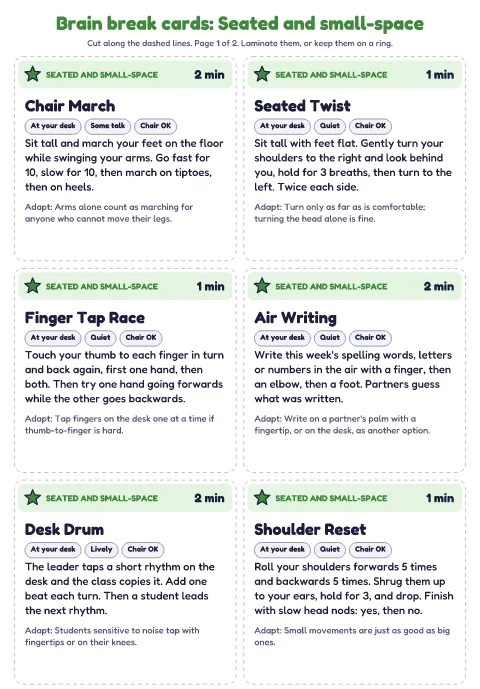
All 8 seated and small-space cards above, six to a page with dashed cut lines. Each card shows the minutes, the space and noise level, whether it works from a chair, the steps and one way to adapt it. The star in the corner tells the types apart on a black-and-white copy.
Seated and small-space cards PDF (A4)Seated and small-space cards PDF (US Letter)
Advertisement
More printables for brain breaks
Brain break choice board
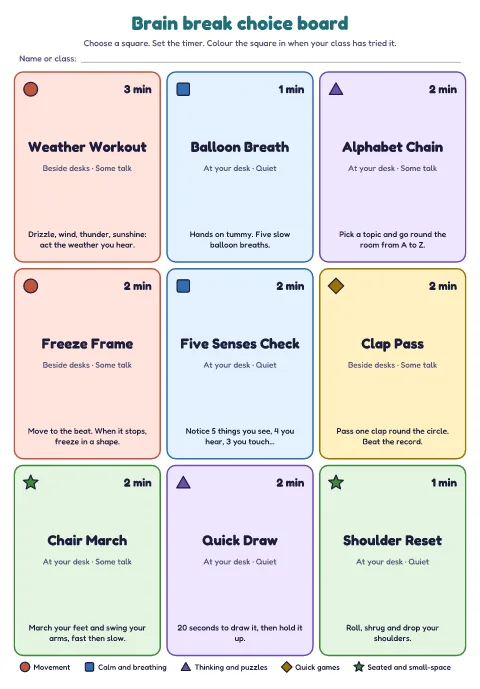
Nine favourites on one page, one or more of every type and all of them possible from a chair: children choose a square, you set the timer, and the class colours the square in once it has tried it. Page 2 is a blank board for your class to fill with its own nine.
Brain break routine poster
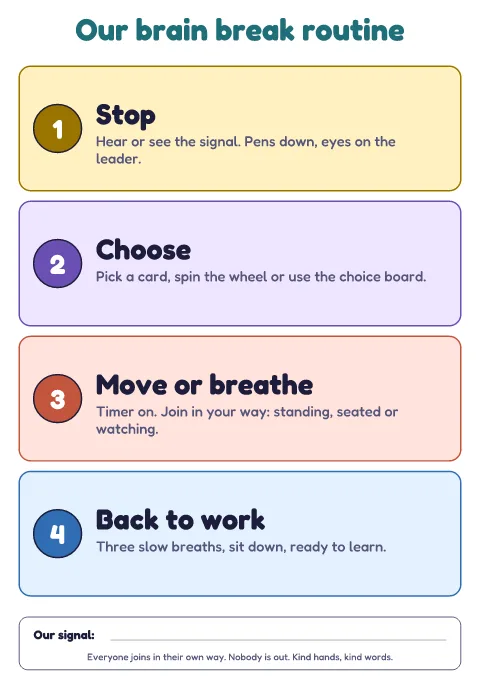
Four steps for the wall: stop, choose, move or breathe, back to work, with a line for your own signal (a chime, a clap pattern, a hand up). Teaching the routine once is what keeps a two-minute break at two minutes.
Blank brain break cards
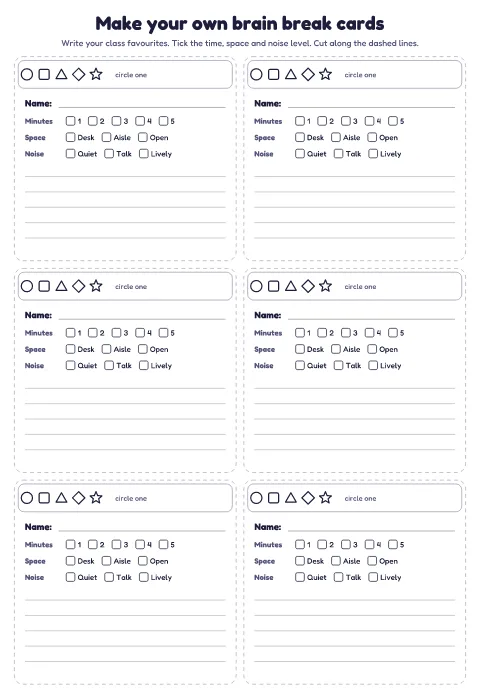
Six blank cards in the same layout as ours. Circle the shape for the type, tick the minutes, space and noise, and write the steps. Good for the class’s own inventions, a game from home, or a break in another language.
All 50 brain breaks at a glance
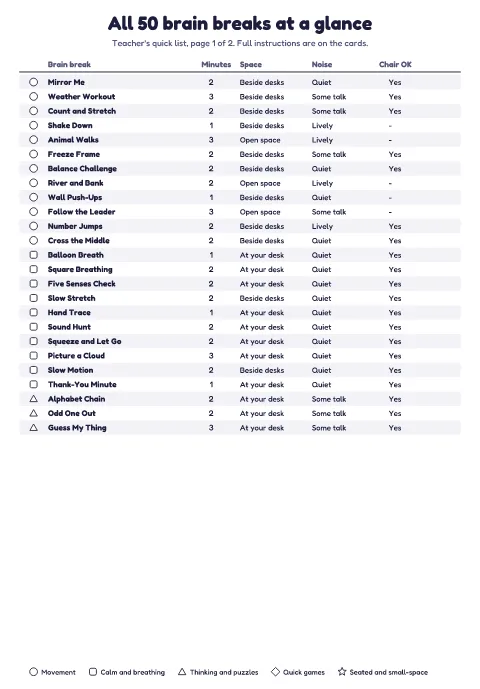
A two-page table of every card with its type, minutes, space, noise and whether it works from a chair. Keep it on the desk or in a relief (substitute) teacher folder so anyone can choose a break in seconds.
Brain break log
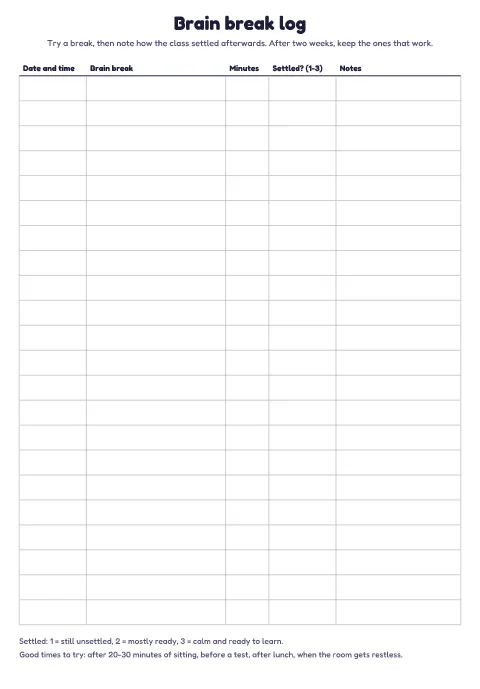
Note the date and time, the break, how long it took and how well the class settled afterwards (1 to 3). Two weeks of notes show which breaks suit your class and which times of day need one most.
Teacher’s guide: how to run brain breaks that work
When to use them
| Moment | Try | Why that type |
|---|---|---|
| After 20–30 minutes of sitting | Weather Workout, Count and Stretch | Whole-body movement, then a calm finish |
| After lunch or a noisy session | Balloon Breath, Sound Hunt | Calm breaks bring the volume down instead of up |
| Before a test or a big writing task | Square Breathing, Five Senses Check | Quiet, seated and predictable |
| Between two maths or literacy blocks | Number Jumps, Word Ladder | Keeps the subject going in a different form |
| Wet day or indoor break time | Silent Ball, Four Corners, Heads Down Thumbs Up | Longer games that still keep order |
| Tight room, assembly hall or bus | Any seated card | Everything from a chair |
How to run one
- Teach the routine first. Use the poster: one signal to stop, one way to choose, a timer, and the same three slow breaths to finish every time.
- Set a timer the class can see. The classroom timer shows a ring emptying on the board, so “when the circle is empty, we sit down” replaces calling out.
- Start calm, end calm. Begin with seated and calm cards for the first week. Add lively ones once the class has shown it can stop on the signal. Finish a lively break with a calm card.
- Let children lead. Once a card is known, a student can read it out, choose it on the choice board or spin the wheel. The random name picker chooses the leader fairly.
- Keep it short. Most cards take 1 to 3 minutes. A longer game is a reward or a wet-day activity, not a brain break.
Managing noise
Every card says how loud it gets: Quiet (25 cards), Some talk or Lively. Next door has a test? Tick “Quiet only” in the picker. For lively cards, agree the stop signal before you start and practise it once (freeze when the hand goes up, for example). Desk drums and stamps can be done with fingertips; claps can be silent “jazz hands”. If one break always makes the room too loud, swap it on your choice board.
Making every brain break inclusive
- Everyone joins in their own way. Every card has an “Adapt” line, and 43 of the 50 work from a chair. A student who uses a wheelchair, has a sore leg or simply needs to sit can do the seated version without being singled out. Watching or helping (timekeeper, caller) also counts as taking part.
- Nobody is out. The games here bring people back after one round or turn them into a cheer squad, so no child spends the break sitting out alone.
- Hearing and sight. Give every signal two ways: a sound and a raised hand. For a student who is blind or has low vision, describe moves aloud and use breaks built on sound and touch; for a student who is Deaf, show moves and use the visual versions on the cards.
- Sensory needs. Some children find noise, touch or spinning around hard. Offer the calm cards, let children choose, and never require touching a partner. Closing eyes is always optional: looking at the floor or a wall works just as well.
- Different cultures and beliefs. Families differ on music, dancing, touch between boys and girls, and closing eyes during quiet time. Our cards need no music, no partner touch and no particular belief, and the thank-you minute is a simple thank you, not a prayer. Students who are fasting, for example during Ramadan, may prefer the calm and thinking cards. When in doubt, ask the family.
- Language. Show the card as well as reading it. The actions carry the meaning for students learning English, and the blank cards can hold a game in a home language.
- Health. Brain breaks are gentle, but follow any care plan your school has for a student, and let anyone stop if something hurts.
By age
Preschool and kindergarten: one or two-minute movement and breathing cards, led by the teacher, with the same few repeated often (Balloon Breath, Animal Walks, Freeze Frame). Grades 1 to 3 (Years 1 to 4): the whole set, with children choosing from the choice board. Grades 4 and 5 (Years 5 and 6): thinking cards and games with a challenge (Fizz Buzz Count, Word Ladder, Think Fast) and students leading. Middle and high school: calm cards before tests, Would You Rather, Higher or Lower and Silent Line-Up; older students often prefer “a stretch and a reset” to “a brain break”, so name it that way.
What the research says about classroom movement breaks
Short bursts of activity in the classroom have been studied for about 20 years. In an early US study, Mahar and colleagues found that 3rd and 4th graders were more on task in the lesson after a 10-minute classroom activity break than before it, and the children who were least on task improved most (Medicine & Science in Sports & Exercise, 2006). A 2017 systematic review and meta-analysis of classroom physical activity found a positive effect on on-task behaviour, while effects on academic results and on total activity were small or unclear (Watson and colleagues, International Journal of Behavioral Nutrition and Physical Activity). A 2018 review of movement breaks and physically active lessons reached a similar view: behaviour in class often improved, while results for thinking skills and test scores were mixed (Daly-Smith and colleagues, BMJ Open Sport & Exercise Medicine).
Health guidelines in the UK, New Zealand, Australia and the US ask children and young people to be active for an average of at least 60 minutes a day (UK Chief Medical Officers’ physical activity guidelines, 2019), and a few two-minute breaks across a school day add some of that. In short: brain breaks are a sensible, low-cost way to help a class refocus and move more. They are not a treatment for attention difficulties or any medical condition.
More for the classroom
Use the brain break cards with the classroom timer, spin the wheel and random name picker. For longer games: would you rather questions for kids, roll and draw dice games and the free online games. For young children: the visual timetable and feelings chart. Everything else for teachers is on the teachers page, including classroom displays and certificates.
Questions
What is a brain break in the classroom?
A short, planned pause of 1 to 5 minutes between periods of focused work, when children stretch, move, breathe slowly or play a quick thinking game, then return to the lesson on a signal.
How long should a brain break be?
Most work best at 1 to 3 minutes; 5 minutes is the upper end. Every card on this page shows its time, and the minutes link opens the classroom timer set to that length.
How often should I give brain breaks?
Many teachers use one after every 20 to 30 minutes of sitting, and before or after a demanding task. Watch the class: restlessness and lost focus are the signal. The brain break log helps you see which times of day need one.
What are good brain breaks for kindergarten?
Short, teacher-led breaks repeated often: Balloon Breath, Animal Walks, Freeze Frame, Weather Workout and Teacher Says. Keep each to one or two minutes and use the same signal to finish every time.
What are brain breaks for middle and high school students?
Calm and thinking breaks suit older students: Square Breathing before a test, Would You Rather, Higher or Lower, Silent Line-Up and Think Fast. Many prefer calling it a stretch or a reset.
Are there brain breaks for students who cannot stand?
Yes. 43 of the 50 cards work from a chair, and every card has an adaptation line. Tick “Can be done from a chair” in the picker to show only those.
Can I use brain breaks with a spinner or wheel?
Yes. The links on this page open our free spin the wheel with a set of brain breaks already on it, without replacing your own saved wheel. You can also print the choice board and let children choose.
Are these brain break cards free?
Yes. Free for your own class, school and family, with no sign-up. Please don’t resell them or upload them to another site.