 Colouring Nest
EYFS observation templates, learning journal and early learning goals poster
Free EYFS observation templates for nurseries, pre-schools, childminders and Reception classes in England: a one-page observation form, a learning journal page to share with families, a seven-areas overview for each child, and a poster of the 17 early learning goal headings. A4 PDFs (US Letter too); free to download, no account.
Inside this set
- 4 printables
- A4 and US Letter PDFs
- Free, no sign-up
About this resource
Ages 1–5, prep, what you need and how to use it
- Ages
- 1 to 5 years (toddlers, preschool, school start)
- Prep
- Print and go: a few minutes.
- You’ll need
- Printer and paper
- A pen
- Supports
- EYFS (England)
How to use it in the room
- Note only what helps you plan: the framework asks for no written records of everyday observations.
- Share the learning journal page with families.
- Use the seven areas overview to see a child’s whole picture at a glance.
Show resources for
Remembered on this device only. It sets A4 or US Letter as the first download.
First: you do not have to write everything down
The September 2026 framework says assessment should not involve long breaks from interaction with children or excessive paperwork, that practitioners are not required to prove their judgements with physical evidence, and that there is no requirement to keep written records of everyday observations (paragraphs 2.2 and 2.5). So treat these templates as tools, not a duty: use the observation form for a moment that tells you something new, the learning journal to share a moment with home, and the overview when you plan for a child or prepare for a progress check or transition.
1. EYFS observation template
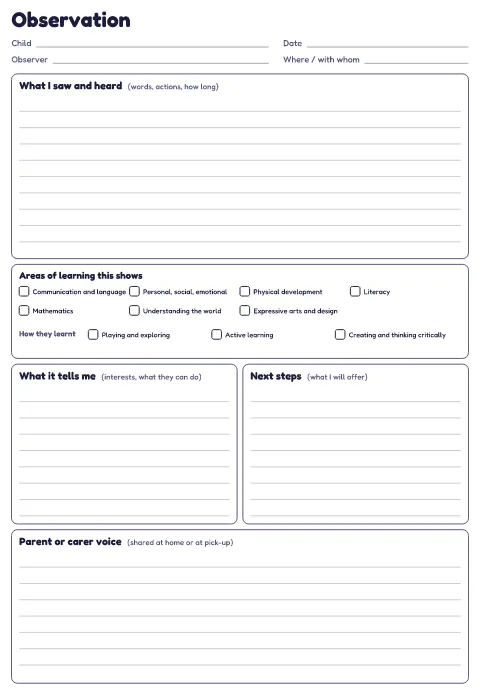
Child, date, observer and context; a large box for what you saw and heard (actual words are gold); tick boxes for the seven areas of learning and the three characteristics of effective teaching and learning; what it tells you; next steps; and a box for the parent or carer’s voice. One page, so it fits in a folder or a learning journal.
Observation template PDF (A4)Observation template PDF (US Letter)
2. Learning journal page
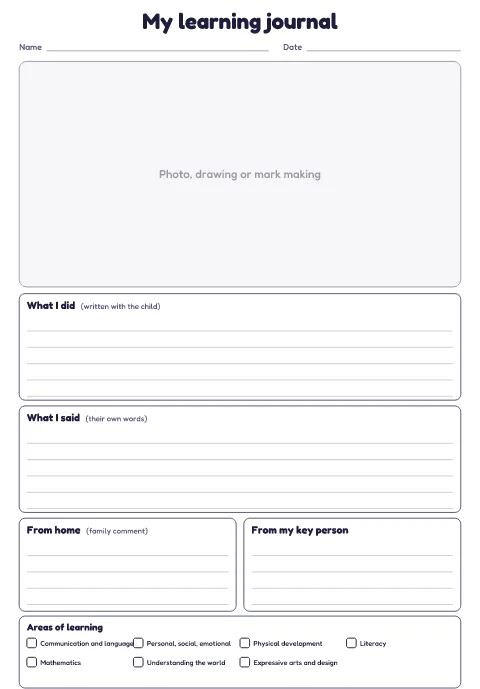
A big space for a photo, a drawing or the child’s own mark making, then “What I did” and “What I said” written with the child, a comment from home and one from the key person, and area tick boxes along the bottom. Families like to add to these at home; send a blank one home in the book bag now and then.
Advertisement
3. Seven areas child overview
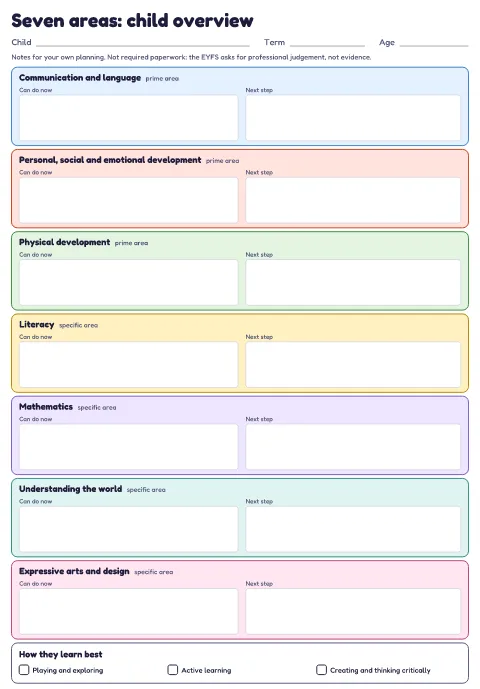
One row for each area of learning (three prime, four specific), split into “can do now” and “next step”, plus tick boxes for how the child learns best. Fill it in from what you already know about the child once a term, as a planning aid. It uses the areas of learning, not age bands, so it does not copy any tracker’s statements: use Development Matters or your own curriculum for the detail.
4. The 17 early learning goals at a glance
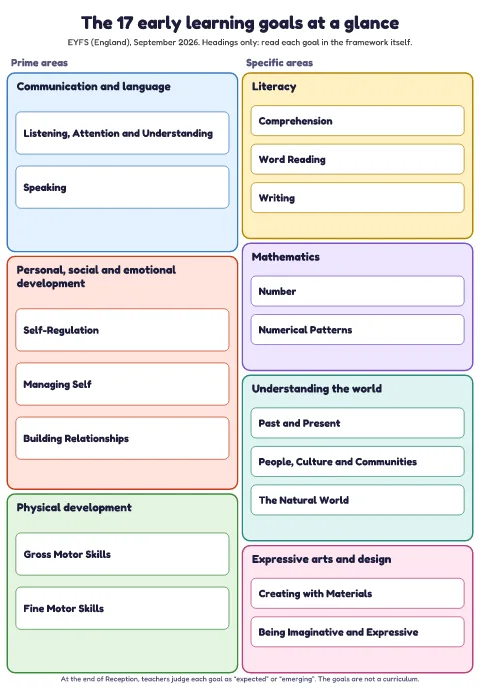
The headings of all 17 goals on one A4 page, grouped under the seven areas: prime areas on the left, specific areas on the right. Handy on a Reception planning wall. We print the headings only; read what each goal says in the framework.
The seven areas and their early learning goals
| Area | Prime or specific | Early learning goals |
|---|---|---|
| Communication and language | prime area | Listening, Attention and Understanding; Speaking |
| Personal, social and emotional development | prime area | Self-Regulation; Managing Self; Building Relationships |
| Physical development | prime area | Gross Motor Skills; Fine Motor Skills |
| Literacy | specific area | Comprehension; Word Reading; Writing |
| Mathematics | specific area | Number; Numerical Patterns |
| Understanding the world | specific area | Past and Present; People, Culture and Communities; The Natural World |
| Expressive arts and design | specific area | Creating with Materials; Being Imaginative and Expressive |
The goals describe the level of development expected at the end of Reception; teachers judge each as “expected” or “emerging” and the framework says they should not be used as a curriculum (paragraphs 1.8 and 2.15). For younger children, the areas of learning are what matter. Printables for each area are on the UK early learning page; for how children learn, see the characteristics of effective learning printables, and for fine motor skills the fine motor activities.
Related sets
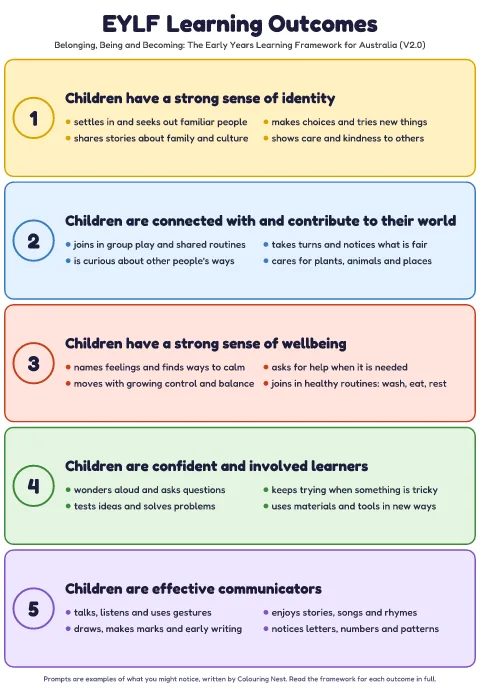 EYLF outcomes poster, cards and templatesTemplates · ages 1–5
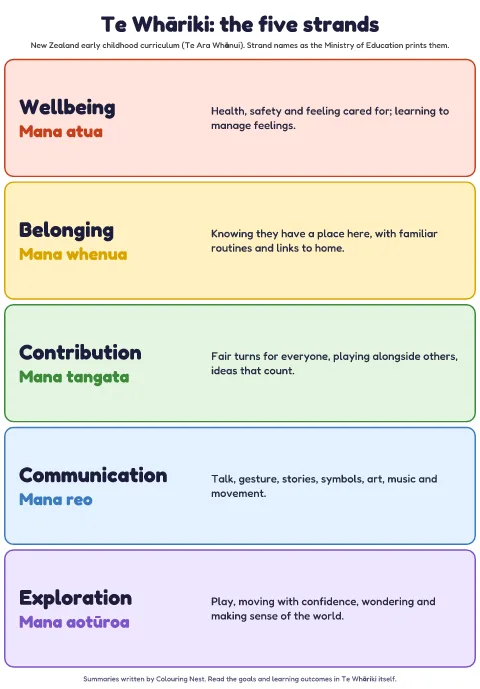 Te Whāriki learning story templatesTemplates · ages 1–5
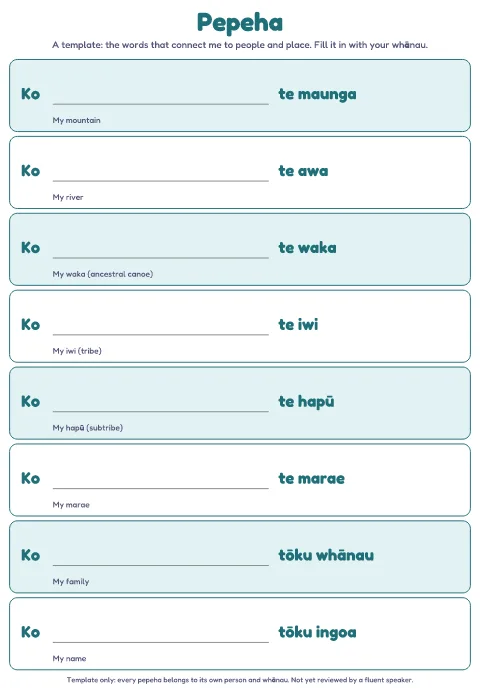 Pepeha template and mihi promptsTemplates · ages 3–6
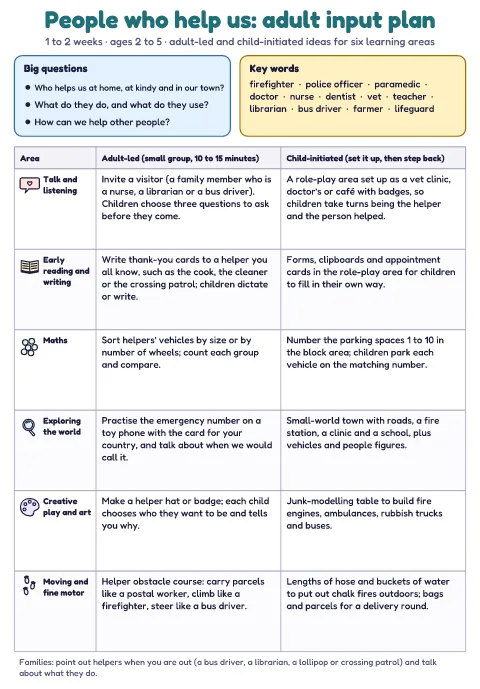 People who help us topic pack and emergency number cardsTemplates · ages 2–5
 Self-registration, welcome banner and birthday chartDisplays and charts · ages 2–6
 Classroom labels with pictures: area signs, trays, name tagsDisplays and charts · ages 1–6
Questions
What should an EYFS observation include?
What the child did and said, the context, what it tells you about their learning, and what you will offer next. Keep it short; the framework does not require written records of everyday observations.
How many early learning goals are there?
Seventeen, across the seven areas of learning. Teachers judge each at the end of Reception as expected or emerging.
Is this a Development Matters tracker?
No. The overview uses the seven areas of learning with space for your own notes. Development Matters is the Department for Education’s non-statutory guidance; use it, or your own curriculum, for detail.
Are the templates free?
Yes, for your own setting, school or childminding. Please don’t resell them or upload them to another site.
Sources
- EYFS statutory framework for group and school-based providers, from September 2026 (DfE) (dated 13 July 2026, effective 1 September 2026; read 2026-11-11)
- Development Matters: non-statutory curriculum guidance for the EYFS (Department for Education)
Learn more
- What is a learning story? How to write one, with an exampleWhere learning stories come from, notice-recognise-respond, a written example, how they fit Te Whāriki, the EYLF and the EYFS, and family voice.