 Colouring Nest
Human body worksheets: label the skeleton, organs, heart and more
Free human body worksheets with answer keys for grades 2 to 5 (Years 3 to 6): 16 printable resources for a whole science unit on the body. Label the skeleton with everyday names or with scientific names, label the major organs, follow blood through the heart, label the lungs and explain breathing, put the journey of food in order, sort the types of teeth, see how the biceps and triceps work as a pair, match the five senses and sort body parts into their systems. There are also word cards, a word search, a crossword, two reading texts with questions and a “body in numbers” poster. Every diagram is our own drawing, every label sheet comes with and without a word bank, and every PDF is in A4 and US Letter and prints well in black and white.
Inside this set
- 16 printables
- A4 and US Letter PDFs
- Free, no sign-up
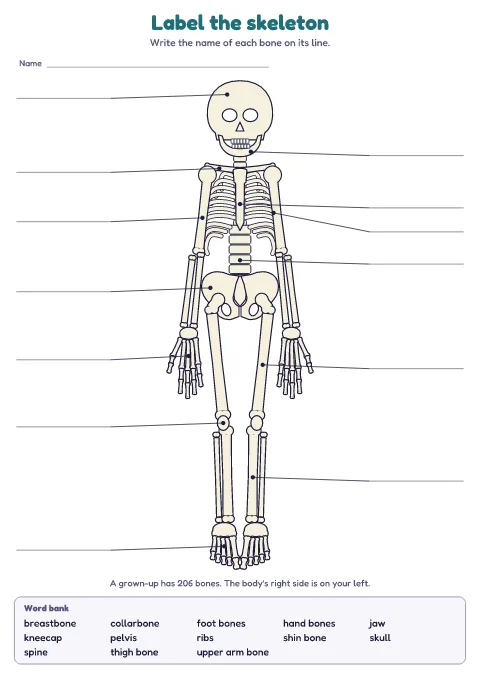 Label the skeleton
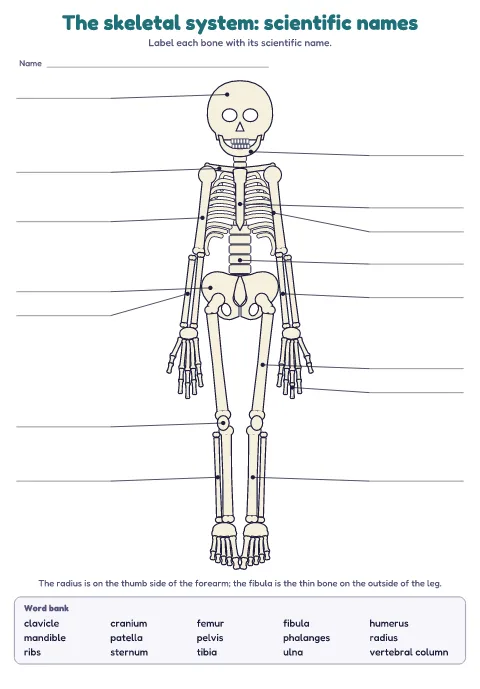 The skeletal system with scientific names
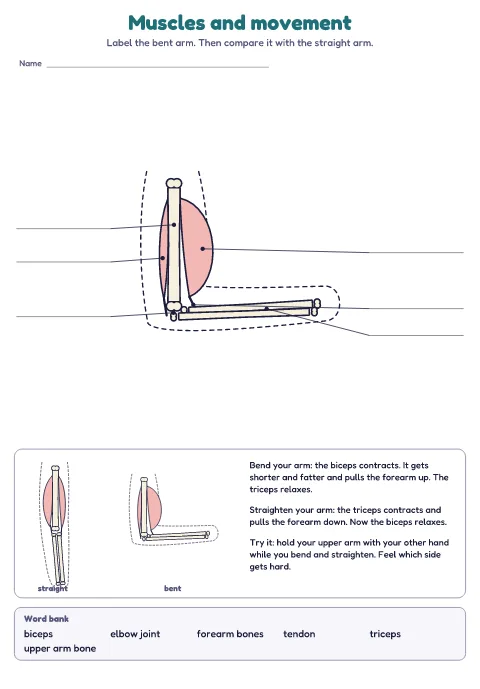 Muscles and movement
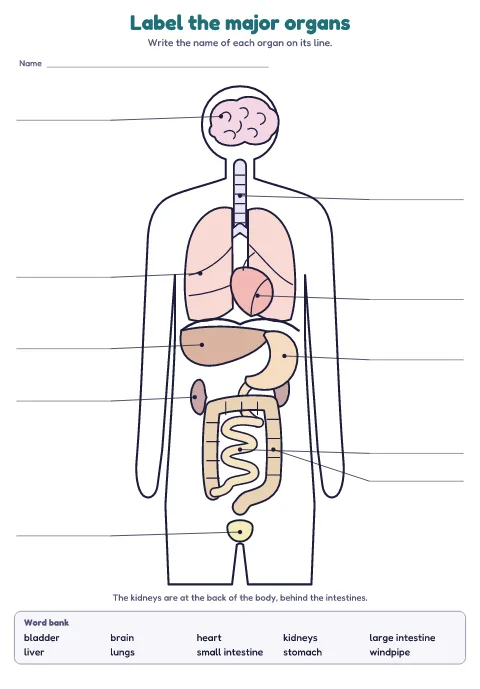 Label the major organs
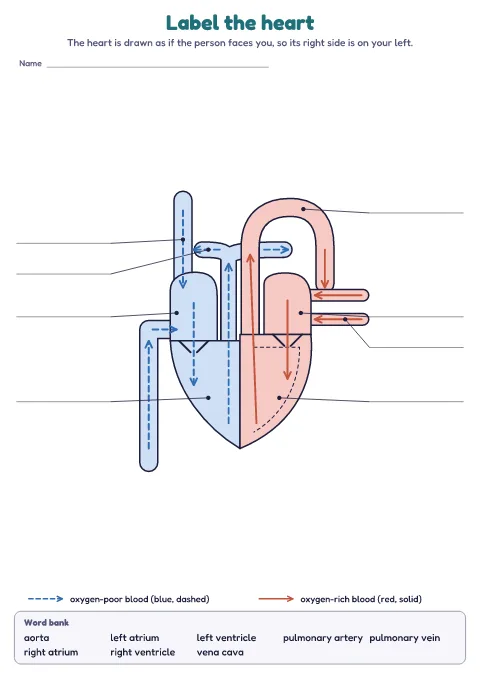 The heart and blood flow
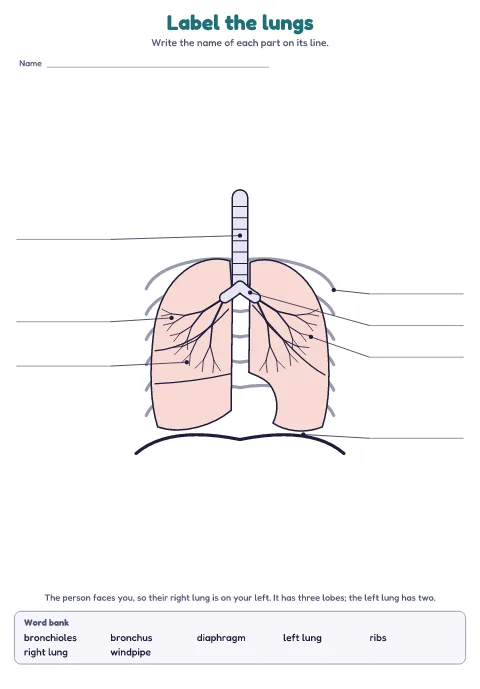 Lungs and breathing
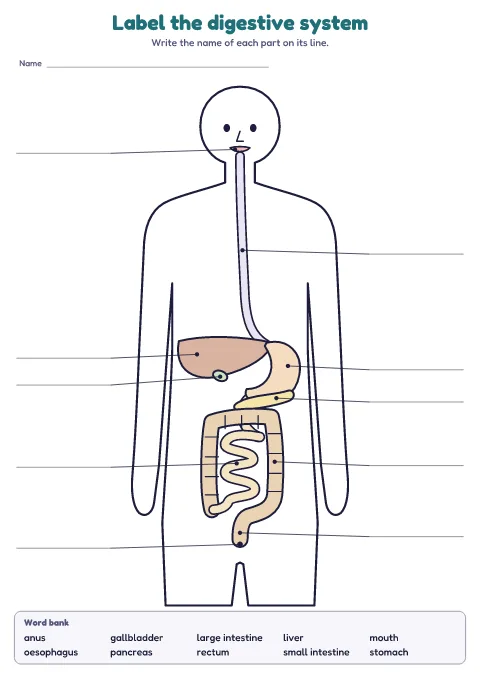 The digestive system
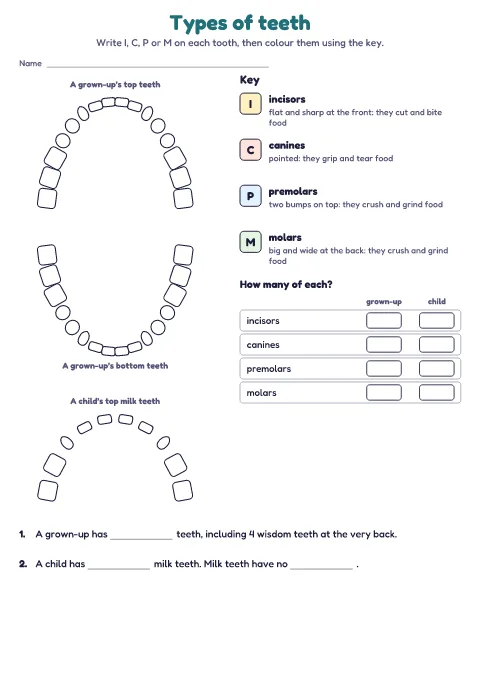 Teeth: types of teeth and inside a tooth
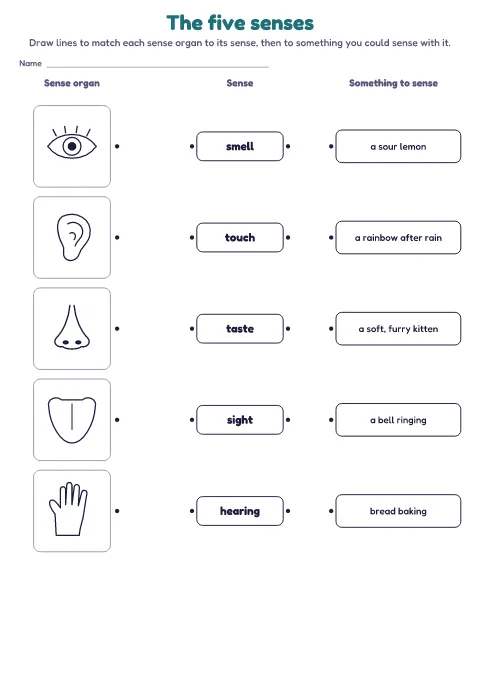 The five senses
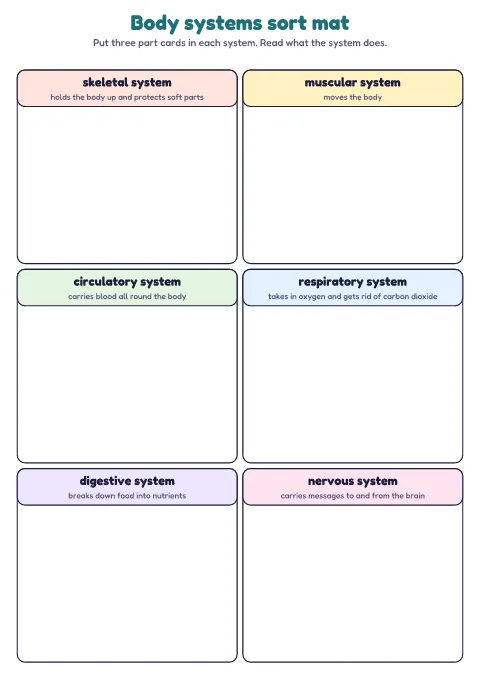 Body systems sort
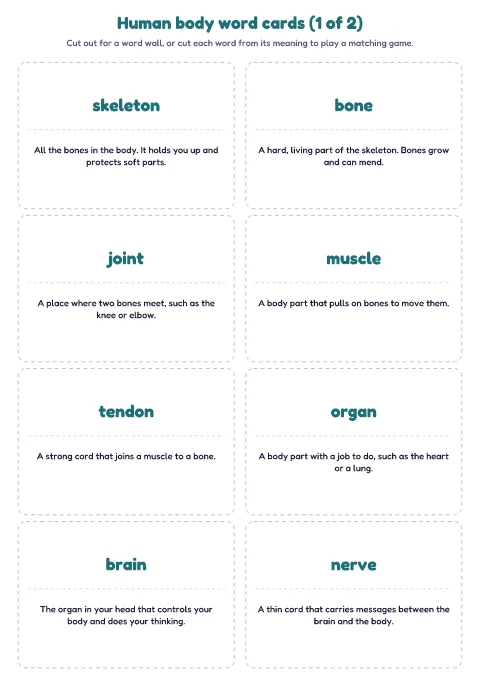 Human body word cards
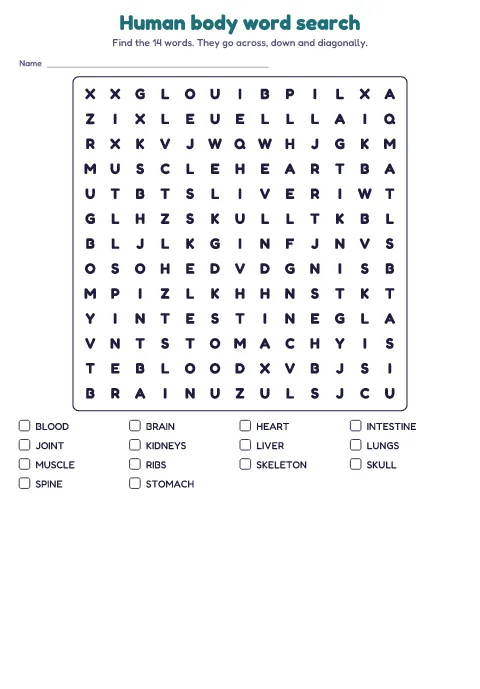 Human body word search
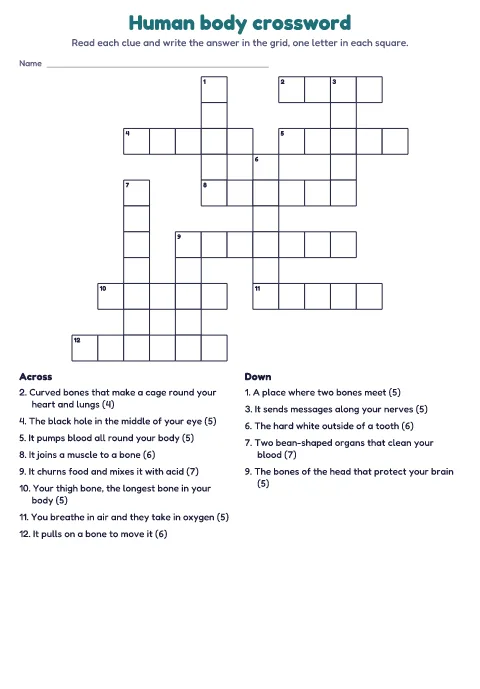 Human body crossword
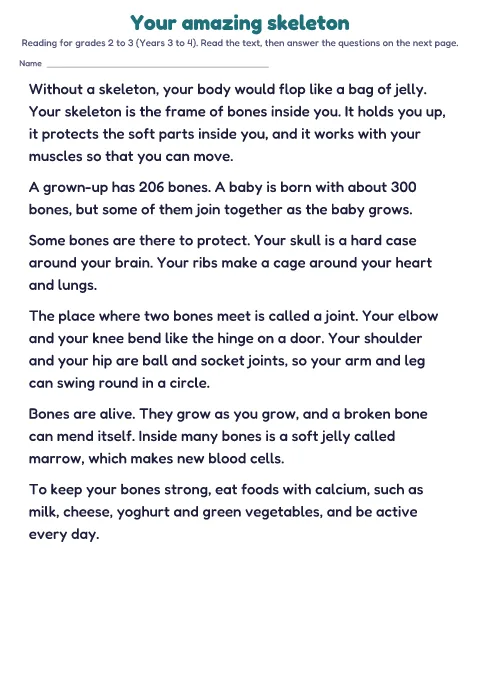 Reading: Your amazing skeleton
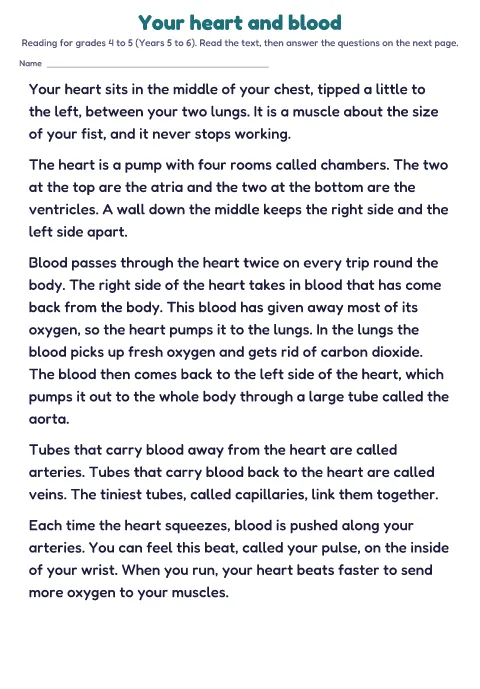 Reading: Your heart and blood
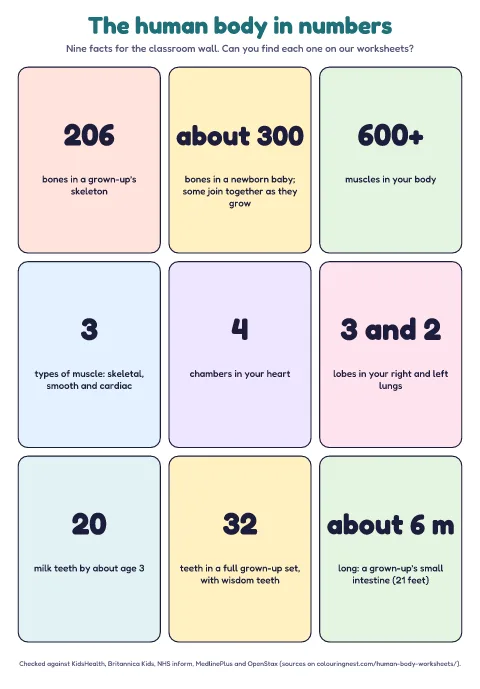 The human body in numbers
What makes these different
Most free human body sheets are a single page: one cartoon body, one list of words, and the answers somewhere else or behind a sign-up. Teachers then end up redrawing the skeleton for the children who don’t need the word bank, or for the class that is ready for scientific names. Here each label sheet comes three ways (with a word bank, without one, and the answer page), and the skeleton comes twice: with everyday names (skull, collarbone, thigh bone) for younger children and with scientific names (cranium, clavicle, femur) for grades 4 and 5.
The drawings are made to be right as well as clear. The diagrams face you, so the body’s right side is on your left, and the sheets say so, because it is the most common mix-up in a labelling lesson. The right lung has three lobes and the left lung two, with a notch for the heart. The radius is on the thumb side of the forearm and the fibula on the outside of the leg. The heart diagram uses dashed arrows for oxygen-poor blood and solid arrows for oxygen-rich blood, so it still makes sense on a black-and-white photocopy. Every leader line ends on the part it names; a test checks each one.
Every number printed on a sheet (206 bones, more than 600 muscles, 4 heart chambers, 20 milk teeth, 32 adult teeth, a small intestine about 6 metres long) is checked against a named source, listed at the end of this page.
Bones, muscles and movement
1. Label the skeleton
A full front-view skeleton with 13 label lines for grades 2 and 3: skull, jaw, collarbone, breastbone, ribs, spine, upper arm bone, hand bones, pelvis, thigh bone, kneecap, shin bone and foot bones. Page 1 has a word bank, page 2 has none, page 3 is the answer key.
Label the skeleton PDF (A4)Label the skeleton PDF (US Letter)
2. The skeletal system with scientific names
The same skeleton with 15 scientific names for grades 4 and 5: cranium, mandible, clavicle, sternum, ribs, vertebral column, humerus, radius, ulna, phalanges, pelvis, femur, patella, tibia and fibula. With and without a word bank, plus answers.
3. Muscles and movement
A bent arm to label (biceps, triceps, tendon, upper arm bone, elbow joint and forearm bones) beside a straight arm, so children can see which muscle is short and fat in each. Then six gap sentences (muscles only pull; they work in pairs) and a match of the three types of muscle: skeletal, smooth and cardiac.
Advertisement
Organs, heart and lungs
4. Label the major organs
A body outline with ten organs in their real places: brain, windpipe, lungs, heart, liver, stomach, kidneys, small intestine, large intestine and bladder. The liver is on the body’s right, the stomach on its left, and the kidneys sit at the back. With and without a word bank, plus answers.
5. The heart and blood flow
Label the four chambers and the four big blood vessels, then number the six steps of blood’s journey through the heart and finish the “double loop” diagram (body, heart, lungs, heart, body). For grades 4 and 5, and for the circulatory system in Year 6.
6. Lungs and breathing
Label the windpipe, a bronchus, the bronchioles, both lungs, the ribs and the diaphragm, then compare two pictures of the chest breathing in and breathing out and fill the gaps: the diaphragm tightens and moves down, the chest gets bigger and air rushes in.
Food, teeth and senses
7. The digestive system
Label ten parts from the mouth to the anus, then put seven cards in order to show the journey of food, from chewing to the large intestine taking back water. There is a US spelling version (esophagus).
Digestive system PDF (A4)Digestive system PDF (US Letter)
US spelling (esophagus) (A4)US spelling (esophagus) (US Letter)
8. Teeth: types of teeth and inside a tooth
Grown-up teeth drawn from above, top and bottom, to mark as incisors, canines, premolars and molars and colour with the key, which says what each type does. Count each type, then label a molar cut in half: enamel, dentine, pulp, crown, gum, root and jawbone. There is a US spelling version (dentin).
9. The five senses
Match each sense organ (eye, ear, nose, tongue, skin) to its sense and to something you could sense with it, then label the outside of an eye and finish three sentences about the pupil, the iris and the eyelashes. A good start for grade 2.
Advertisement
Systems, words and reading
10. Body systems sort
Eighteen part cards to cut out and sort onto a mat of six systems, each with what it does: skeletal, muscular, circulatory, respiratory, digestive and nervous. Spinal cord, nerves and blood vessels make children think beyond the organs on the diagrams.
11. Human body word cards
Sixteen words with short meanings for a word wall: skeleton, bone, joint, muscle, tendon, organ, brain, nerve, heart, artery, vein, lungs, diaphragm, oesophagus, stomach and nutrients. Cut along the dashed line to make a matching game. US spelling version included.
12. Human body word search
Fourteen body words in a 13 by 13 grid, across, down and diagonally, with the answer page.
13. Human body crossword
Thirteen clues about bones, organs, muscles and teeth, with the number of letters after each clue, and a filled-in answer grid.
14. Reading: Your amazing skeleton
A short non-fiction text for grades 2 and 3 about what the skeleton does, joints, marrow and keeping bones strong, with seven questions. The answer page quotes the sentence in the text that holds each answer.
15. Reading: Your heart and blood
A text for grades 4 and 5 about the four chambers, the trip to the lungs and back, arteries, veins and capillaries, and your pulse, with seven questions and quoted evidence on the answer page.
16. The human body in numbers
A classroom poster with nine checked facts, from 206 bones to a small intestine about 6 metres long. Print on A4 or Letter, or enlarge to A3.
Teaching the human body: a unit that works
- Start with the senses and the outside of the body (grade 2): the five senses match and the eye. Let children look at their own eye in a mirror before labelling.
- Skeleton and muscles (grades 3 and 4): feel your own bones first (skull, ribs, kneecap, the bumps of your spine). Use the everyday skeleton sheet with the word bank, then without. Bend and straighten your arm with a hand on your biceps, then do the muscles sheet.
- Digestion and teeth: look at your teeth in a mirror and count them, then the teeth sheets. Act out the journey of food before ordering the cards.
- Heart and lungs (grades 4 and 5): find your pulse, count it for 15 seconds before and after a minute of star jumps, then the heart and lungs sheets. Put a hand on your chest as you breathe in to feel your ribs move.
- Pull it together: the body systems sort, the word cards, the crossword and a reading text. The scientific-names skeleton is a good challenge for confident readers.
These resources support the science curriculum in many countries. In England, pupils in Year 3 learn that humans have skeletons and muscles for support, protection and movement; in Year 4 they describe the simple functions of the basic parts of the digestive system and identify the types of teeth and their simple functions; in Year 6 they identify the main parts of the circulatory system and describe the functions of the heart, blood vessels and blood. In the US, the Next Generation Science Standards ask grade 4 students to explain how internal and external structures support survival, growth and behavior (4-LS1-1) and how animals take in and respond to information through their senses (4-LS1-2). The sheets support that work alongside your own scheme; they do not replace it.
For more science and reading, try our reading comprehension worksheets, the solar system pages and planet facts and brain breaks for the classroom (a good way to get children moving after the heart rate activity). For handwriting the new words, print handwriting paper, and see more for teachers, third grade and fourth grade.
Sources we checked
Bones and joints: KidsHealth (Nemours): Your Bones; Britannica Kids: human anatomy. Muscles: KidsHealth (Nemours): Your Muscles; NIH NIAMS: Health Lesson, Learning About Muscles. Heart: MedlinePlus: Heart chambers; KidsHealth (Nemours): Your Heart and Circulatory System. Lungs and breathing: OpenStax Anatomy and Physiology 2e, 22.2 The Lungs; KidsHealth (Nemours): Your Lungs and Respiratory System. Teeth: NHS inform: Everything you need to know about teeth. Eyes: KidsHealth (Nemours): Your Eyes. Calcium: NHS: Calcium (vitamins and minerals). Facts checked on 17 November 2026. These sheets are for learning about the body, not for medical advice.
Questions
How many bones are in the human body?
An adult skeleton has 206 bones. A newborn baby has about 300 bones and parts of bones; some of them join together (fuse) as the child grows, which is why grown-ups have fewer. The number can vary a little from person to person.
What are the main parts of the skeleton to label?
For grades 2 and 3: the skull, jaw, collarbone, breastbone, ribs, spine, upper arm bone, pelvis, thigh bone, kneecap and shin bone, plus the bones of the hands and feet. For grades 4 and 5 use the scientific names: cranium, mandible, clavicle, sternum, vertebral column, humerus, radius, ulna, femur, patella, tibia and fibula.
Why is the heart’s right side on the left of the diagram?
Body diagrams are drawn as if the person is facing you, like a friend standing in front of you. Their right hand is on your left, so the right side of the heart, the right lung and the liver all appear on the left of the page.
How many teeth do children and adults have?
Children have 20 milk (baby) teeth by about age 3: 8 incisors, 4 canines and 8 molars. A full adult set is 32 teeth: 8 incisors, 4 canines, 8 premolars and 12 molars, including 4 wisdom teeth that not everyone gets.
What grade are these human body worksheets for?
Grades 2 to 5 in the US and Years 3 to 6 in the UK, Australia and New Zealand (ages 7 to 11). The five senses and the everyday skeleton suit the younger end; the scientific names, the heart and the heart reading text suit grades 4 and 5.
Are these human body worksheets free?
Yes. Free for your own class, school and family, with no sign-up. Please don’t resell them or upload them to another site.