 Colouring Nest
Number bond games, part-whole mats and posters
Free number bond games, part-whole mats and posters for Reception to Year 2, kindergarten to grade 2: 16 printables that sit around our number bonds worksheets. An anchor chart, posters for bonds to 10, 20 and 100, rainbow facts, part-part-whole and bar model mats, shake and spill sheets, bingo, pairs cards, a spinner game, “I have, who has?” loop cards, fact family triangles, doubles, make ten to add and a class record. A4 and US Letter PDFs, in colour and ink saver, with answers wherever there are answers.
Inside this set
- 16 printables
- A4 and US Letter PDFs
- Colour and ink-saver versions
- Free, no sign-up
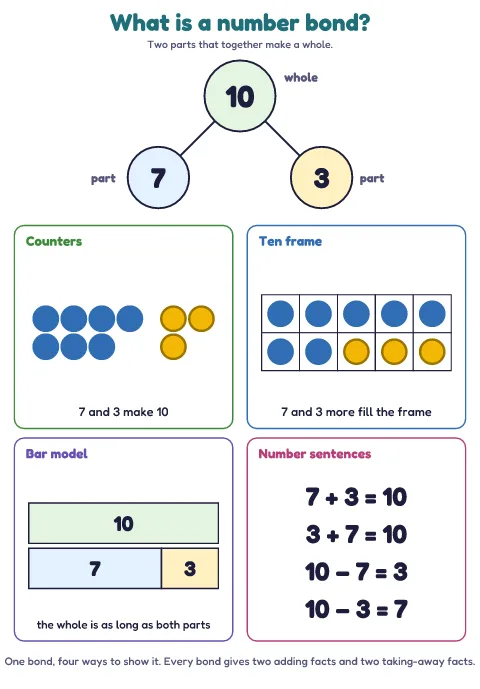 What is a number bond? Anchor chart
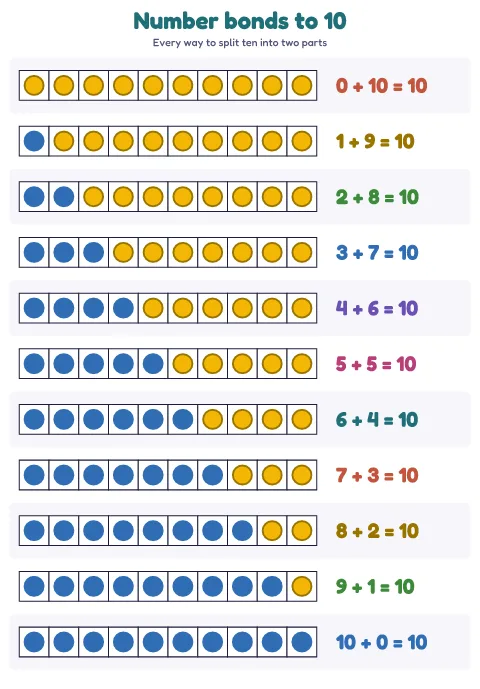 Number bonds to 10 poster
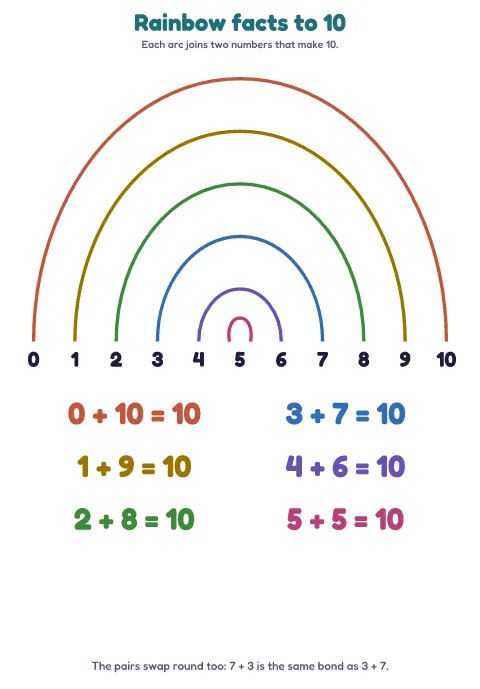 Rainbow facts
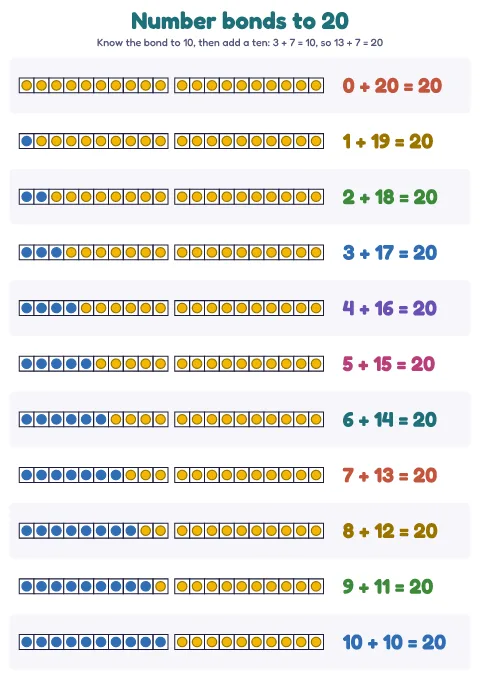 Number bonds to 20 poster
 Number bonds to 100 poster
 Part-part-whole mats
 Bar model mat and bar model sheets
 Shake and spill
 Number bond bingo to 10 and to 20
 Make 10 pairs cards
 Spin and make 10
 I have, who has? loop cards
 Fact family triangles
 Doubles and near doubles
 Make ten to add
 Class record and star chart
About this resource
Ages 4–6, prep, what you need and how to use it
- Ages
- 4 to 6 years (preschool, school start)
- Prep
- Ten to twenty minutes per game to print, cut and laminate the cards; posters and sheets print and go.
- You’ll need
- Printer, paper and thin card
- Two-colour counters or cubes and a cup
- A paper clip and pencil for the spinner
- Scissors and a laminator (optional)
- Supports
- Te Whāriki (NZ), EYLF (Australia), EYFS (England), ELOF (US)
How to use it in the room
- Start with objects on the part-part-whole mat and shake and spill, with bonds to 5 before 10.
- Put the anchor chart and bonds to 10 poster up where children can point to them.
- Play one game for five to ten minutes, little and often, and note quick recall on the class record.
How the kit fits together
Children learn number bonds in roughly this order: they make a number with real objects and split it (shake and spill, the part-part-whole mat), they see the split in a picture (ten frames, the bar model, the rainbow), they say the facts until they come without counting (bingo, pairs, the spinner, the loop cards), and then they use them to add bigger numbers (doubles, near doubles and making ten). Each printable below names the step it is for, so you can start where your class is rather than at the top.
All of the visual sheets use the same two colours for the two parts: blue and yellow, like double-sided counters. The ink-saver copies draw them as filled and open dots instead, so the parts are still clear on a black-and-white printer.
Posters and anchor charts
1. What is a number bond? Anchor chart
One bond, 10 split into 7 and 3, with “whole” and “part” labelled, then shown four ways: as counters in two groups, in a ten frame, as a bar model and as its four number sentences (7 + 3, 3 + 7, 10 – 7 and 10 – 3). Put it up when you introduce bonds and point back to it whenever a child says “but how do I know?”.
2. Number bonds to 10 poster
All eleven ways to split ten, from 0 + 10 to 10 + 0, each as a strip of ten counters. Read down the poster and the blue part grows by one while the yellow part shrinks by one: that pattern is what children should notice, because it means they never have to learn eleven separate facts.
Bonds to 10 poster PDF (A4)Bonds to 10 poster PDF (US Letter)
3. Rainbow facts
Three pages: the rainbow to 10 (0 and 10 joined by the outside arc, then 1 and 9, down to 5 with itself), a draw-your-own page where children join the pairs and write them, and a rainbow to 20 for the next step.
4. Number bonds to 20 poster
The eleven bonds from 0 + 20 to 10 + 10, each as two ten-strips. The subtitle shows the shortcut: know a bond to 10, add a ten to one part, and you have a bond to 20.
Bonds to 20 poster PDF (A4)Bonds to 20 poster PDF (US Letter)
5. Number bonds to 100 poster
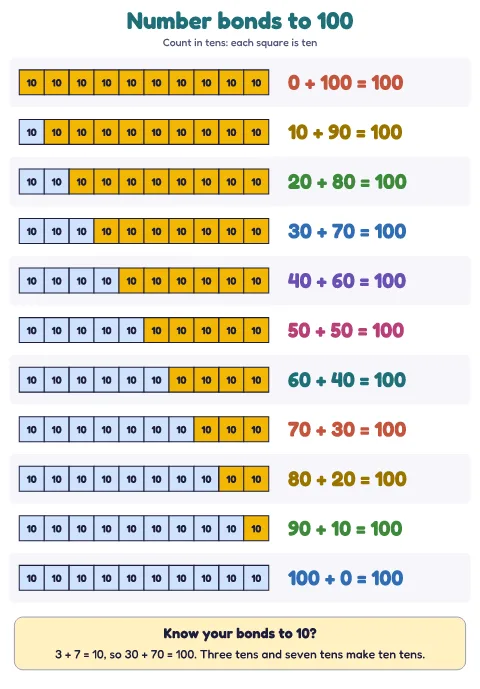
Multiples of ten that make 100, drawn as ten squares worth ten each, with a reminder underneath: three tens and seven tens make ten tens. Use it in Year 2 and grade 2 once bonds to 10 come quickly.
Bonds to 100 poster PDF (A4)Bonds to 100 poster PDF (US Letter)
Advertisement
Mats for hands-on work
6. Part-part-whole mats
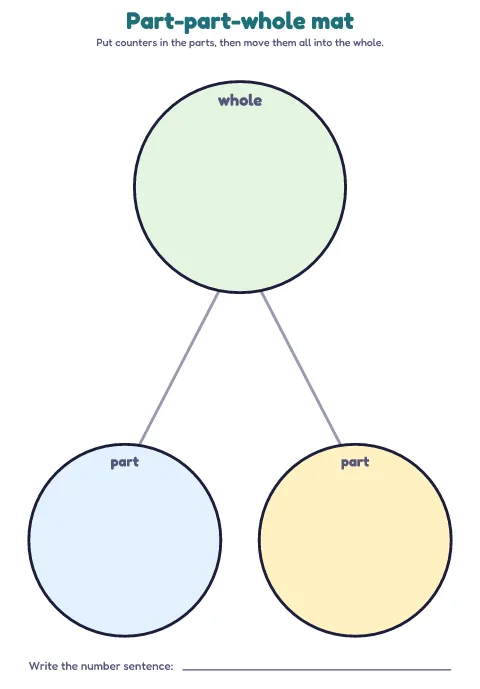
A big two-part mat with circles wide enough for a handful of counters, plus a three-part version for when children are ready to split a number three ways (10 is 5, 3 and 2). Slide it into a plastic sleeve and children can write the number sentence along the bottom with a dry-wipe pen.
7. Bar model mat and bar model sheets
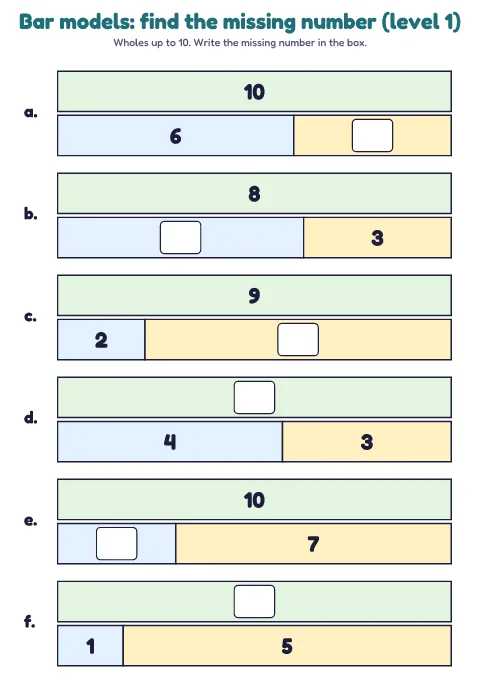
Page 1 is a mat: a whole bar of ten squares for cubes, two part bars below and space to draw your own. Pages 2 and 3 are six bar models each, with the whole or one part missing: level 1 has wholes up to 10, level 2 wholes from 11 to 20. Answers on pages 4 and 5. The bar model is the same idea as the part-whole circles, drawn to scale, and it is the picture children will meet again in word problems.
8. Shake and spill
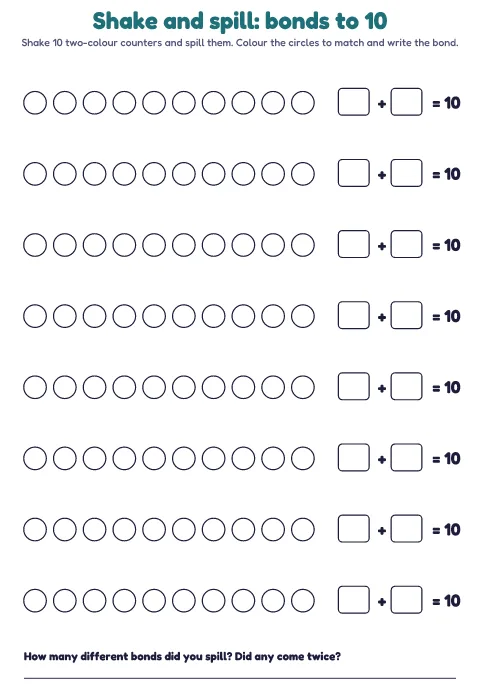
Recording sheets for 5, 10 and 20: shake that many two-colour counters in a cup, spill them, colour the circles to match and write the bond. Because the spills are random, the question at the bottom (“how many different bonds did you find?”) leads straight into talking about all the possible splits.
Games for fluency
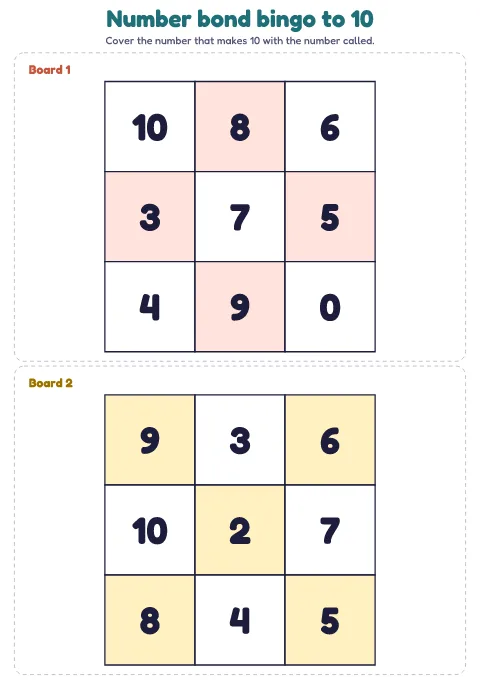
9. Number bond bingo to 10 and to 20
Twelve different boards (six for bonds to 10, six for bonds to 20) and caller cards. The caller reads “What makes 10 with 6?” and players cover 4. Each caller card has its answer in small print, so a child can run the game.
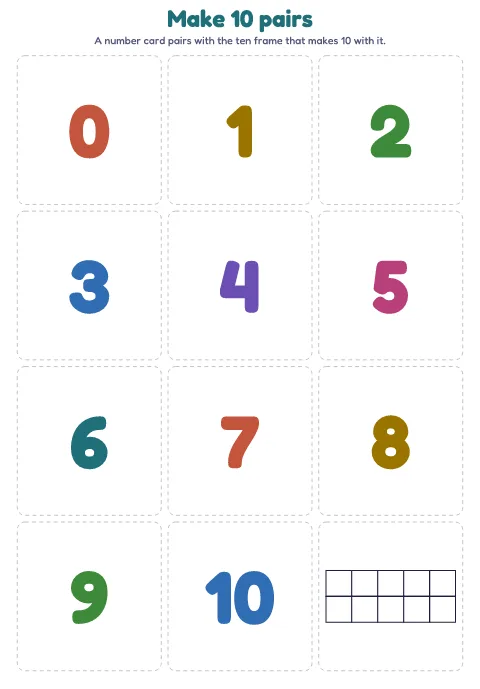
10. Make 10 pairs cards
Eleven numeral cards and eleven ten-frame cards. A numeral pairs with the ten frame that makes 10 with it: 3 goes with the frame showing 7. Play pairs (memory) face down, or go fish. The ten frames let a child check by counting the empty squares.
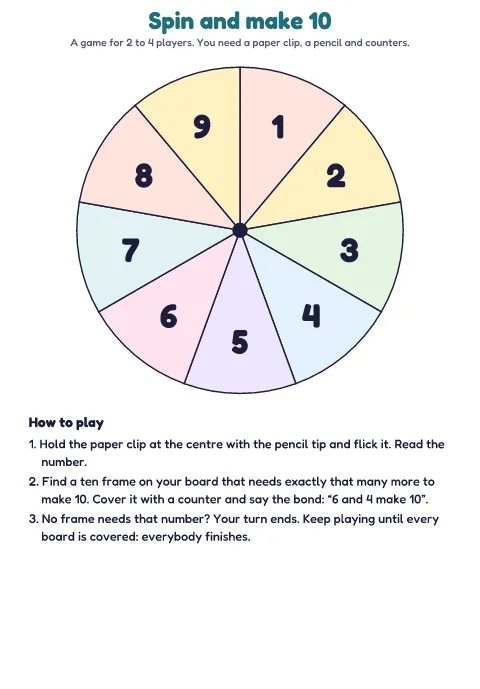
11. Spin and make 10
A spinner numbered 1 to 9 (a paper clip and a pencil make the pointer) and four player boards, each with six partly filled ten frames. Spin, find the frame that needs exactly that many more, cover it and say the bond. Everyone keeps playing until every board is covered.
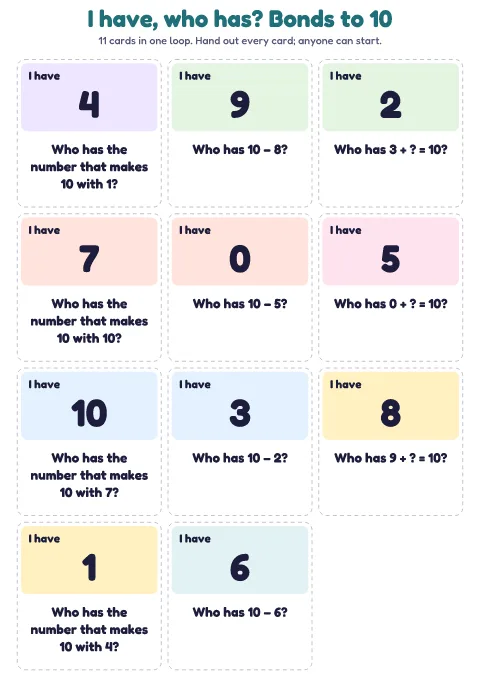
12. I have, who has? loop cards
A whole-class game in two sets: eleven cards for bonds to 10 and twenty-one for bonds within 20. Every card answers exactly one other, so the loop always comes back to the first card. Time the class and try to beat your own time; never a single child.
Fact families, doubles and making ten
13. Fact family triangles
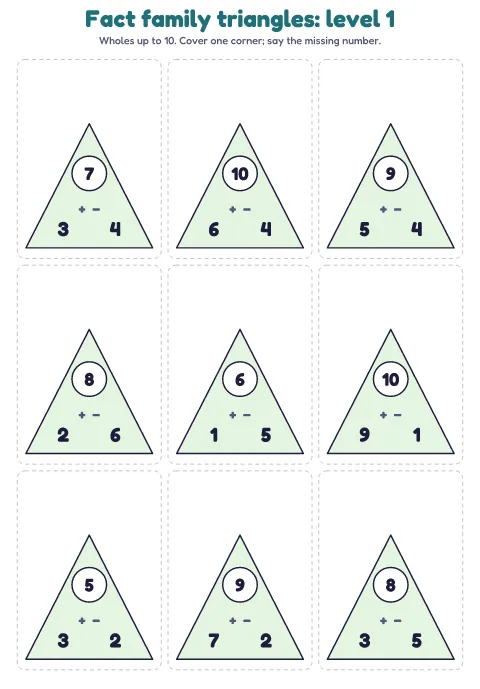
Nine triangles with wholes up to 10, nine with wholes from 11 to 20, and nine blank. Cover one corner with a thumb: if it is the whole, add the parts; if it is a part, take the other part from the whole. Each triangle is one fact family: four facts, three numbers. For fact family houses, missing-number sheets, word problems and times and divide families, see the fact families worksheets.
14. Doubles and near doubles
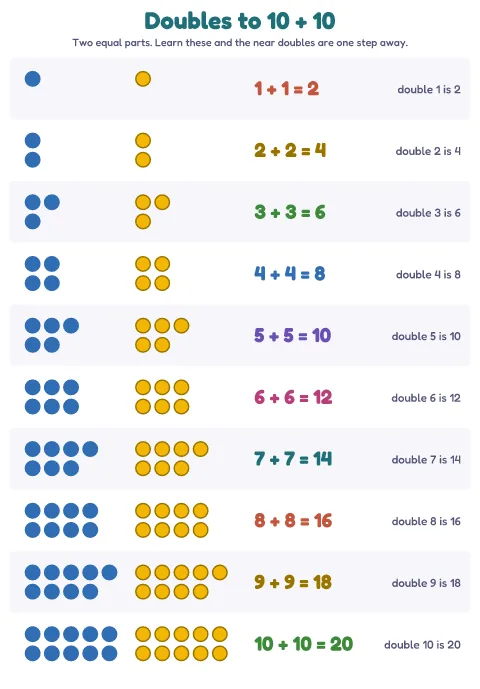
A doubles poster from 1 + 1 to 10 + 10, a sheet of doubles and halves, and a near doubles sheet (6 + 7 is double 6 and one more). Answers on the last two pages. Doubles are the bonds most children remember first, so they make good stepping stones.
15. Make ten to add
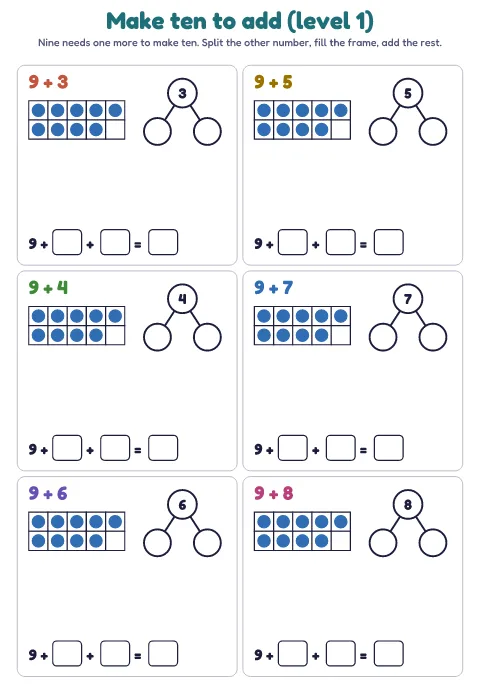
Bridging through ten: level 1 always starts with 9 (9 + 5 is 9 + 1 + 4), level 2 with 8 or 7. Each question has a ten frame to fill and a small number bond to split the second number. Answers on pages 3 and 4. This is where knowing bonds to 10 pays off for adding within 20.
16. Class record and star chart
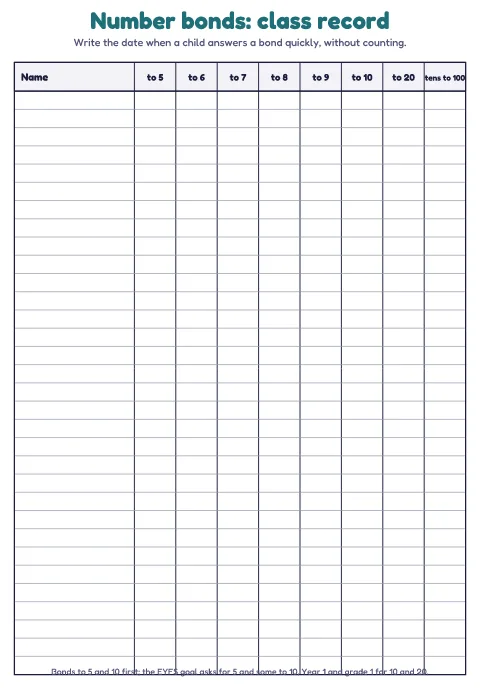
A class record with a column for each set of bonds (to 5, 6, 7, 8, 9, 10, to 20 and tens to 100): write the date when a child answers quickly without counting. The second page is a child’s own “My number bond stars” chart with a star to colour for each set.
Teaching number bonds: a sequence that works
- Make it with objects. Five cubes, two hands: how many in each hand? Write each split on the part-part-whole mat. Do 5 before 10.
- Find all of them. Use shake and spill, then ask children to order their bonds. The bonds to 10 poster and the rainbow show the pattern they should find.
- Say them without counting. Little and often: a round of bingo, a pairs game or the loop cards takes five to ten minutes. A child who still counts on fingers is not wrong; go back to the ten frame for a few days.
- Link adding and taking away. Fact family triangles and the anchor chart’s four sentences: if 7 and 3 make 10, then 10 take away 7 is 3.
- Use the bonds. Doubles, near doubles, making ten to add 8 + 5, then bonds to 20 and to 100.
Supports: Exploration | Mana aotūroa, Communication | Mana reo (Te Whāriki) · Outcome 4, Outcome 5 (EYLF) · Mathematics (EYFS) · Cognition (ELOF). In England, the EYFS early learning goal for number expects children to recall number bonds up to 5 and some to 10, including doubles, and Year 1 works on bonds within 20. In the US Common Core, kindergartners find the number that makes 10 with any number from 1 to 9 (K.OA.A.4), and first graders add and subtract within 20 using strategies such as making ten (1.OA.C.6). The printables support that work; they don’t replace your school’s scheme.
The worksheets with answer keys are in the number bonds section: bonds to 5, bonds to 10, bonds to 20, bonds to 100, fact families and a blank number bond template. For the next step: addition and subtraction worksheets, ten frames, the 0 to 20 number line, subitising cards and more for teachers.
Related sets
 Counting mats 1 to 20 and number formation rhymesWorksheets · ages 3–6
 Number tracks, subitising cards, one more one lessCards · ages 3–6
 Pattern cards: AB, ABB and ABC strips, cube cardsCards · ages 3–6
 Sorting mats, matching pairs, shadow matching, odd one outCards · ages 2–5
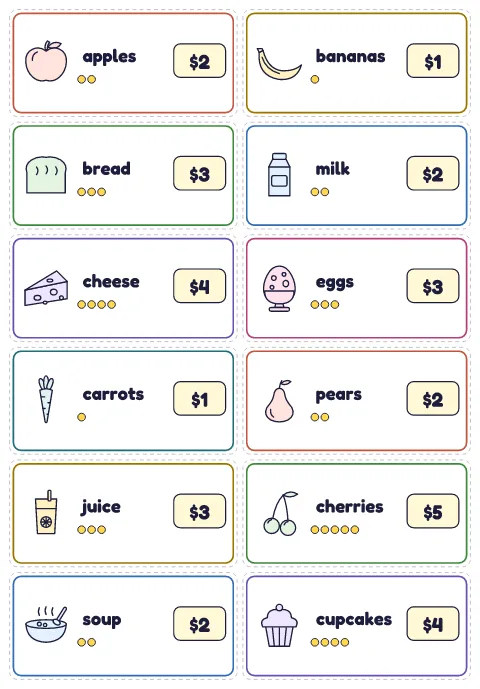 Shop role play: price labels, play money, shopping listsDisplays and charts · ages 2–6
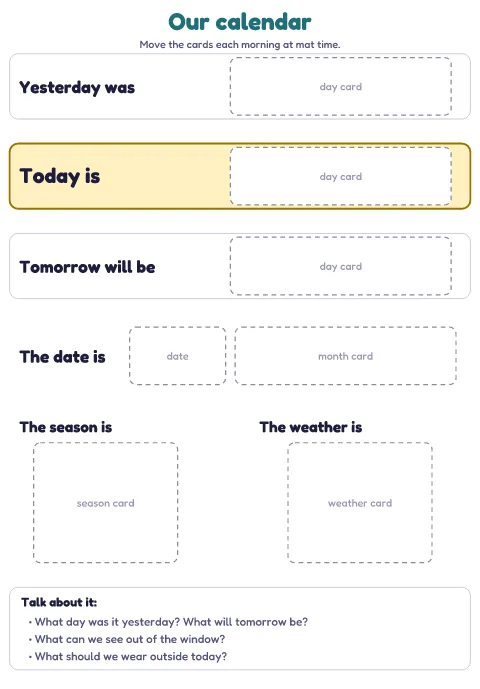 Circle-time calendar and weather boardDisplays and charts · ages 3–6
Questions
What is a number bond?
Two numbers (the parts) that together make a third number (the whole). 7 and 3 are a number bond to 10. The same three numbers give two adding facts and two taking-away facts.
What are rainbow facts?
A way to draw the number bonds to 10: write 0 to 10 in a row and join each pair that makes 10 with an arc. The arcs nest like a rainbow, with 5 joined to itself in the middle.
What is the difference between a part-whole model and a bar model?
Both show a whole split into parts. The part-whole model uses circles; the bar model draws the parts as bars whose lengths match their size, so it also shows which part is bigger.
Which number bonds should children learn first?
Bonds to 5, then to 10, then doubles. Bonds to 20 and to 100 build on bonds to 10.
Are these free for my class?
Yes. Free for your own class, school and family, with no sign-up. Please don’t resell them or upload them to another site.