 Colouring Nest
Goal setting worksheets and New Year 2027 resolution templates
Ten free goal setting worksheets for kids, students and adults: a draw-and-write New Year page for ages 5 to 7, goals for school and home, a SMART goal worksheet with a worked example, an action plan, a monthly tracker, a check-in, a year-in-review reflection, a vision page, 24 New Year writing prompts and a one-page resolution planner for grown-ups. Every printable is an A4 and a US Letter PDF, in colour or ink saver, with no sign-up.
Inside this set
- 10 printables
- A4 and US Letter PDFs
- Colour and ink-saver versions
- Free, no sign-up
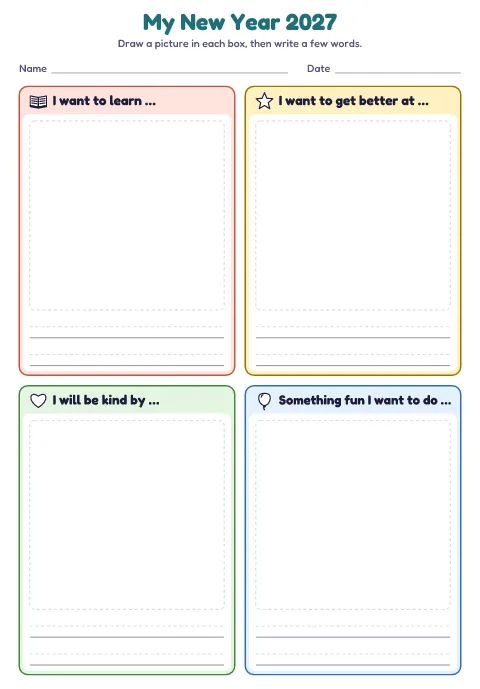 My New Year 2027: draw and write
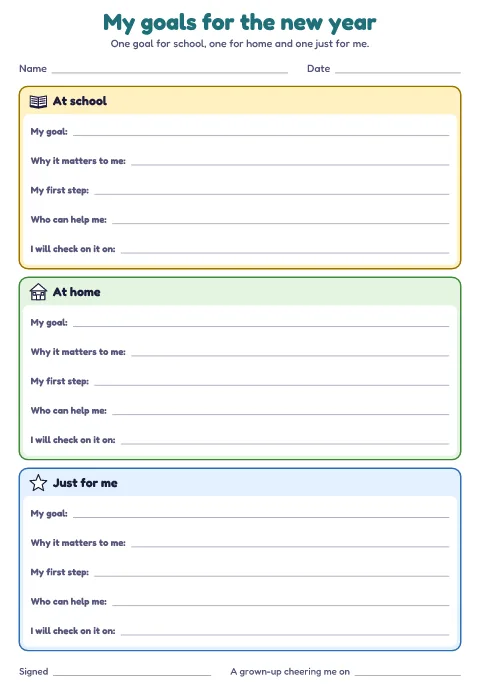 My goals for the new year: school, home and just for me
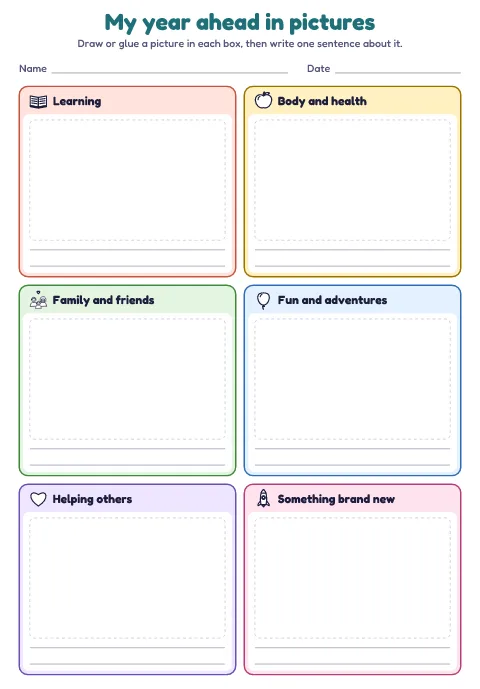 My year ahead in pictures
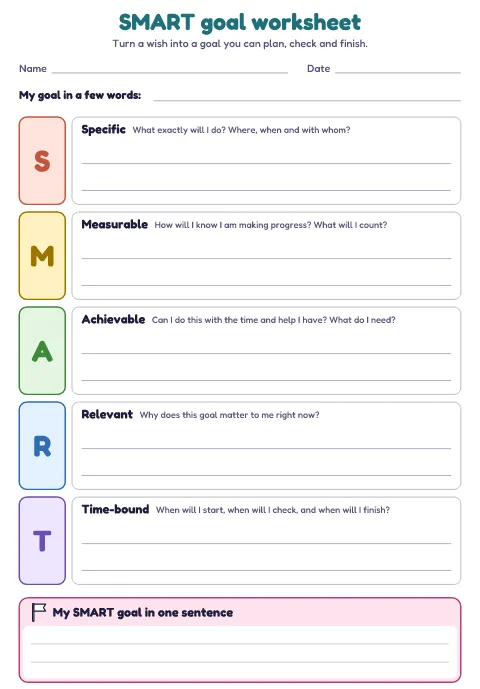 SMART goal worksheet, with a worked example
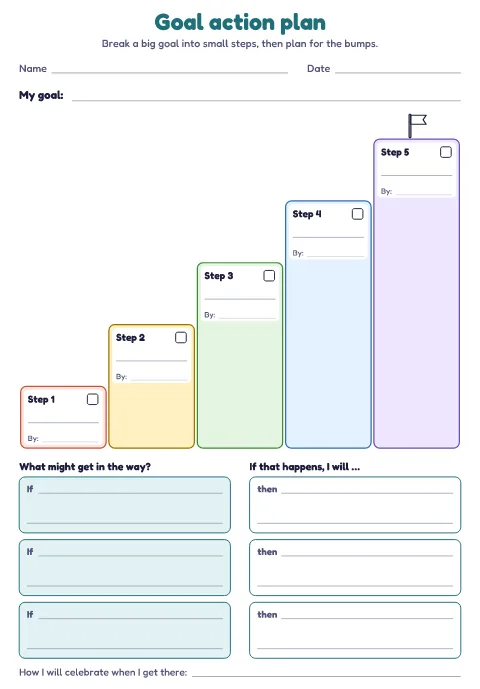 Goal action plan: five steps and if-then plans
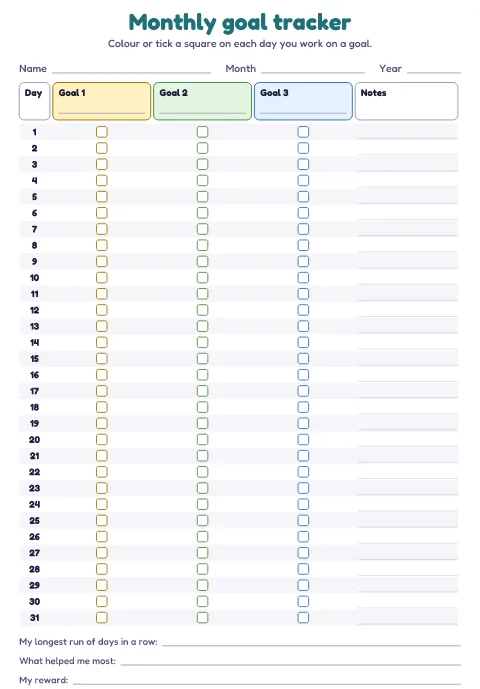 Monthly goal tracker
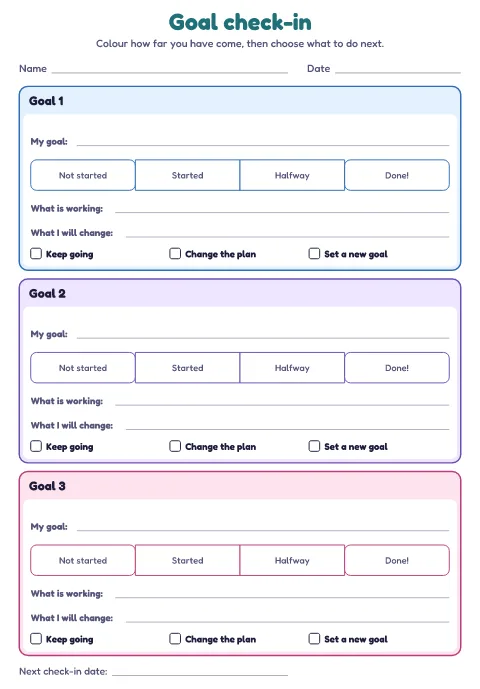 Goal check-in: how far have I come?
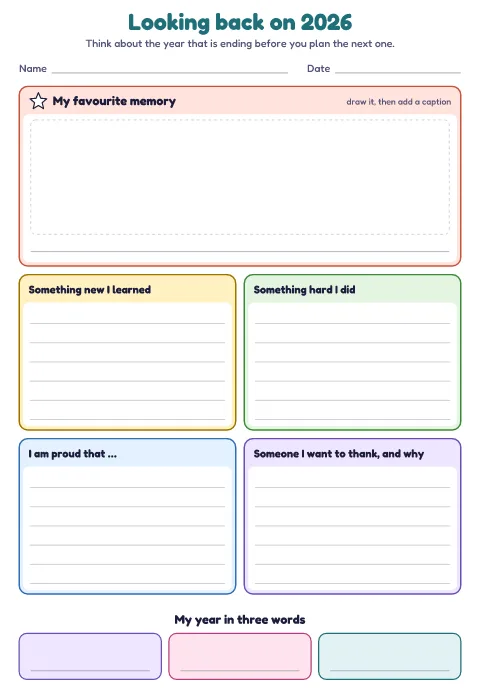 Looking back on 2026: year in review
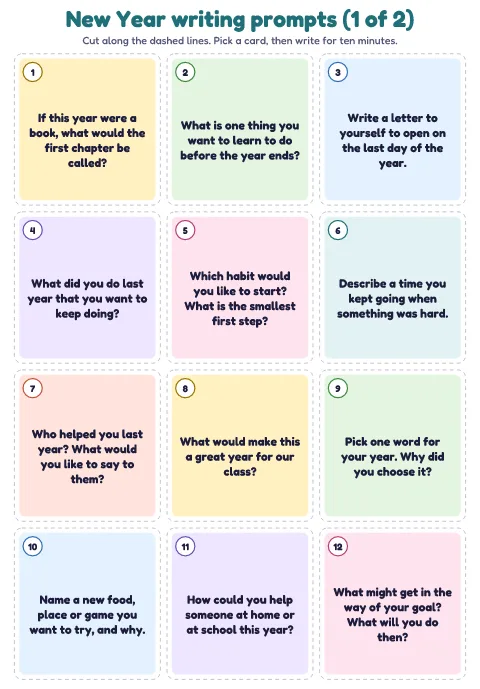 24 New Year writing prompt cards
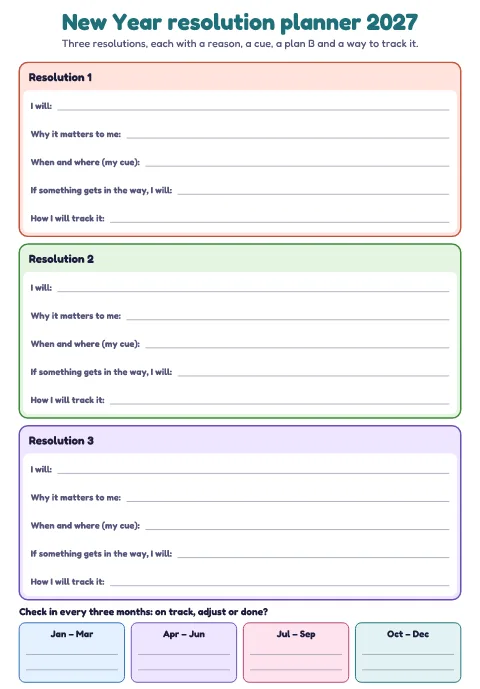 New Year resolution planner 2027 for adults
What makes a goal setting worksheet work? The short answer
A good goal sheet turns a wish into a plan you can check. It asks for one clear goal, a reason that matters to the person setting it, a first step small enough to do this week, a plan for what might get in the way, and a date to look again. A list of resolutions on its own rarely lasts past January; the check-in date and the first step are what keep a goal alive. That is why the set below starts with the goal and ends with a tracker and a check-in, rather than stopping at “my resolutions”.
For younger children, keep it to one or two goals they can draw. From about age 8, children can write a goal with a first step and a helper. From about age 10, and for teens and adults, the SMART questions and if-then plans add the detail that makes a goal finishable. Updated 13 November 2026, with 2027 versions of the New Year pages.
For ages 5 to 7: draw it first
1. My New Year 2027: draw and write
Four boxes: something I want to learn, something I want to get better at, a way I will be kind, and something fun I want to do. Each has room for a picture and two wide writing lines with a dashed middle line for early writers. Page 2 has no year on it, so it works for any January, a birthday or the first day of school.
For grades 2 to 6: goals with a first step
2. My goals for the new year: school, home and just for me
One goal for school, one for home and one just for me, each with five prompts: my goal, why it matters to me, my first step, who can help me, and the date I will check on it. The line for a grown-up who is cheering them on turns it into something to take home and share.
3. My year ahead in pictures
Six boxes to draw in or glue magazine pictures onto: learning, body and health, family and friends, fun and adventures, helping others, and something brand new. A one-sentence caption under each picture makes it a writing task as well as an art one. It suits a display wall in the first week back.
For grades 4 and up, teens and adults: plan it properly
4. SMART goal worksheet, with a worked example
S, M, A, R and T down the side, each with a plain question: what exactly will I do, how will I know I am making progress, can I do this with the time and help I have, why does it matter now, and when will I start, check and finish. Page 2 is the same sheet filled in for “read more”, so students can see a vague wish become a goal with a number and a date before they write their own.
5. Goal action plan: five steps and if-then plans
Five steps rising like a staircase to the goal, each with a “by” date and a box to tick. Below it, three if-then rows: “If I forget my reading book, then I will read the class book at break.” Planning the bump before it happens is the part most goal sheets leave out.
6. Monthly goal tracker
Days 1 to 31 down the side and a column of squares for each of three goals. Colour a square on each day you work on a goal; the notes column is for the day it went well or didn’t. At the bottom: my longest run of days in a row, what helped me most, and my reward. It has no month printed on it, so print one for every month.
Advertisement
7. Goal check-in: how far have I come?
Three goals, each with a four-part bar to colour from “not started” to “done”, what is working, what I will change, and one choice: keep going, change the plan, or set a new goal. Use it at the end of January, half-way through a term, or any time a goal has gone quiet.
Looking back, and writing about the year
8. Looking back on 2026: year in review
A box to draw a favourite memory, then four lined boxes: something new I learned, something hard I did, I am proud that, and someone I want to thank, and why. It ends with “my year in three words”. Do this before the goal sheets, in the last week of the year or the first week back: it is easier to choose what to do next once you have noticed what went well. Page 2 has no year printed.
9. 24 New Year writing prompt cards
Two pages of numbered cards to cut out, from “If this year were a book, what would the first chapter be called?” to “What might get in the way of your goal? What will you do then?” Pull one from a jar for a ten-minute quick write, use one a day for the first weeks back, or hand a card to each table to talk about first.
For grown-ups
10. New Year resolution planner 2027 for adults
One page, three resolutions. Each asks what I will do, why it matters to me, when and where I will do it (the cue), what I will do if something gets in the way, and how I will track it. Four boxes at the foot are for a check-in every three months. Page 2 has no year, for a birthday, a new job or any fresh start.
Resolution planner PDF (A4)Resolution planner PDF (US Letter)
How to run goal setting with a class
- Look back first. Ten minutes with the year-in-review sheet or a writing prompt gives everyone something to build on: a thing they are proud of is often the start of next year’s goal.
- Model one goal out loud. Write a goal of your own on the board, then make it better together using the SMART questions. The worked example on page 2 of the SMART sheet does the same thing on paper.
- Keep it to one to three goals. Young children manage one or two; older students three at most. A goal for school, one for home and one just for them covers the ground without turning into a list.
- Find the first step. “Get better at maths” becomes “practise my 7 times table for five minutes before reading time”. If the first step can’t be done this week, it is still too big.
- Plan for the bump. Ask “what might stop you?” and write an if-then plan for it. Psychologist Peter Gollwitzer calls these implementation intentions; people who decide in advance when, where and how they will act are more likely to follow through than people who only state the goal.
- Put the check-in on the calendar. Write the date on the sheet and in your planner, then use the check-in sheet. Celebrate “keep going” and “change the plan” equally: changing a plan is a skill, not a failure.
Where SMART comes from. The acronym was first set out by George T. Doran in the November 1981 issue of Management Review, as a way for managers to write objectives. The letters have been read in different ways since then (A for achievable, attainable or agreed; R for relevant or realistic); the questions on our sheet use the versions that make most sense to a student. SMART is a checklist, not a rule: a goal like “be braver at swimming” can be a good goal for a seven-year-old even if it isn’t measurable yet.
Goals and wellbeing. Keep goals about effort and habits (“read five nights a week”) rather than outcomes children can’t control (“get the top mark”), and never compare one child’s goal sheet with another’s. These sheets are for the person writing them; a tracker is a private record, not a chart for the classroom wall.
When to use them
New Year. In the US, Canada and the UK the first week back in January is the natural moment: the 2027 New Year page, the year-in-review sheet and the prompt cards are made for it. In New Zealand and Australia, New Year falls in the summer holidays, so families use the New Year pages at home and classes use the goal sheets when Term 1 starts in late January or early February.
Back to school and new terms. The goal sheets have no season on them: use the goals-by-area sheet in the first week of the school year, and the check-in at the end of each term or quarter. Adults use the resolution planner and the tracker for New Year, a birthday, or any new start.
More for the start of the year: printable 2027 calendars with school terms and public holidays, the January 2027 calendar, New Year colouring pages and the New Year activity pack, New Year’s Eve games, all about me worksheets for the first day back, certificates for when a goal is reached, the classroom timer for a ten-minute quick write, and everything else for teachers.
Questions
What should a goal setting worksheet include?
One clear goal, why it matters to the person setting it, a small first step, what might get in the way and what they will do then, and a date to check on it. A tracker and a check-in sheet help the goal last past the first week.
What are SMART goals?
Goals that are Specific, Measurable, Achievable, Relevant and Time-bound. The acronym comes from George T. Doran’s 1981 article in Management Review. “Read more” is a wish; “read for 20 minutes after dinner on 5 nights a week until the end of March” is a SMART goal.
How do you explain goal setting to kids?
A goal is something you want to be able to do that you can’t quite do yet, and a plan is the steps that get you there. Start with one goal they can draw, ask what the very first step is, and choose a day to look at it together again.
Is there a New Year’s resolution template for 2027?
Yes: the My New Year 2027 page for ages 5 to 7 and the New Year resolution planner 2027 for adults. Each PDF also has a page with no year, so it works for any year.
What is a good New Year writing prompt for students?
Try “If this year were a book, what would the first chapter be called?” or “Imagine it is the last day of the year: what are you proud of?”. There are 24 on the prompt cards, 12 to a page, in A4 and US Letter.
Are these goal setting worksheets free?
Yes. Free for your own class, school, family and personal use, with no sign-up. Please don’t resell them or upload them to another site.