 Colouring Nest
Reading comprehension worksheets for Year 1 and Year 2 (grades 1 and 2), with answers
Free reading comprehension worksheets for Year 1 and Year 2 (grades 1 and 2): 15 short texts we wrote ourselves, at three levels, each with a picture to colour, five to seven questions and an answer key. There are stories, fact texts, poems, instructions and a recount, with questions that ask children to find information, explain words, put events in order, read between the lines and predict. Every worksheet is a free A4 and US Letter PDF, with an ink-saver version and US spelling where it matters, and no sign-up.
Inside this set
- 16 printables
- A4 and US Letter PDFs
- Colour and ink-saver versions
- Free, no sign-up
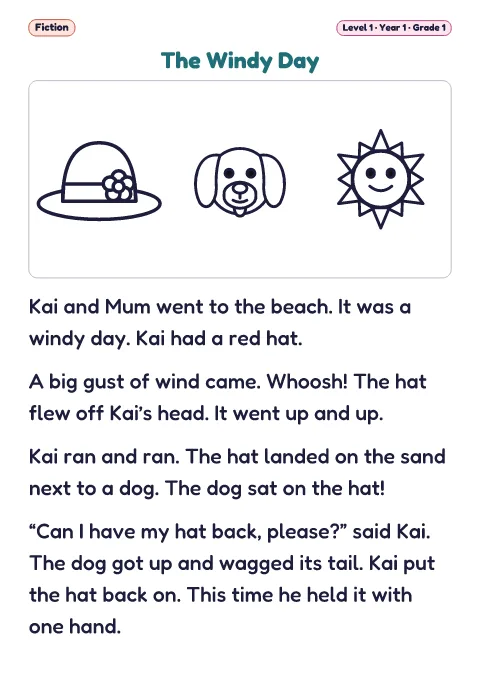 The Windy Day (fiction)
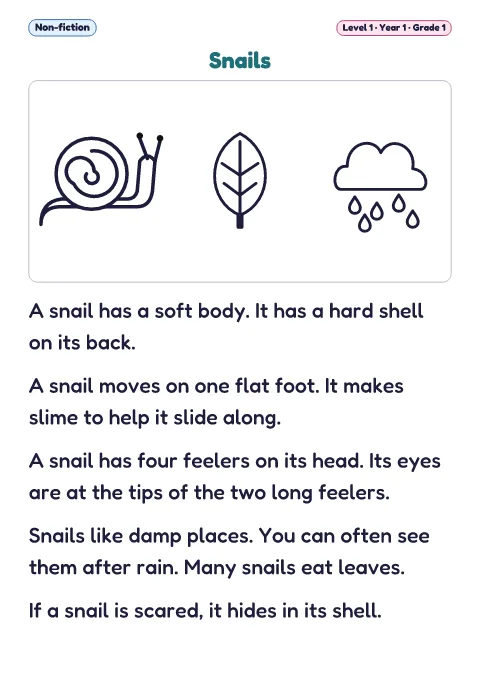 Snails (non-fiction)
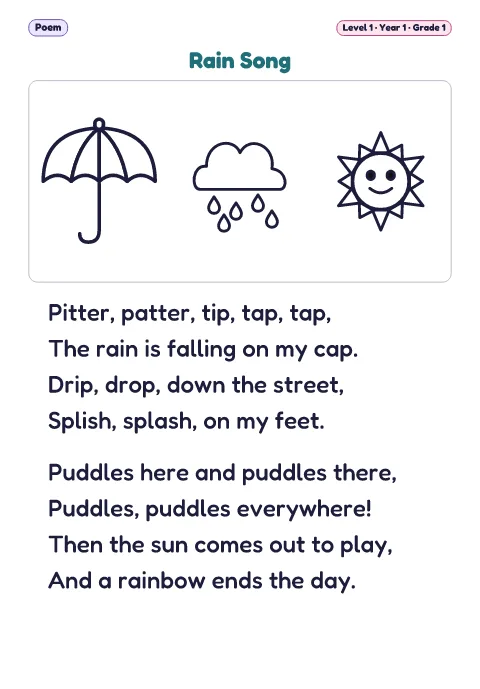 Rain Song (poem)
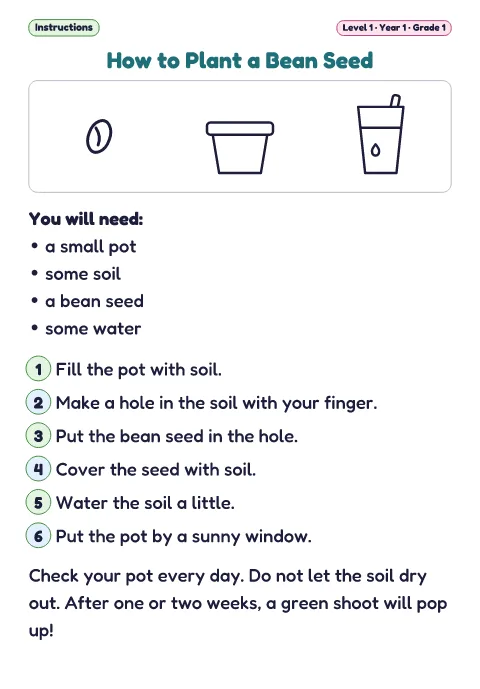 How to Plant a Bean Seed (instructions)
 The Big Box (fiction)
 Zara and the Kite (fiction)
 Penguins (non-fiction)
 Two Seasons, One Day (poem)
 How to Wash Your Hands (instructions)
 Our Visit to the Fire Station (recount)
 The Night the Lights Went Out (fiction)
 Busy Honeybees (non-fiction)
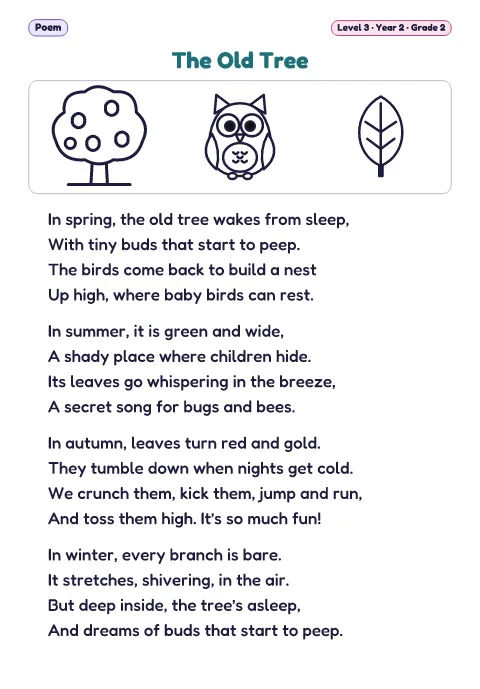 The Old Tree (poem)
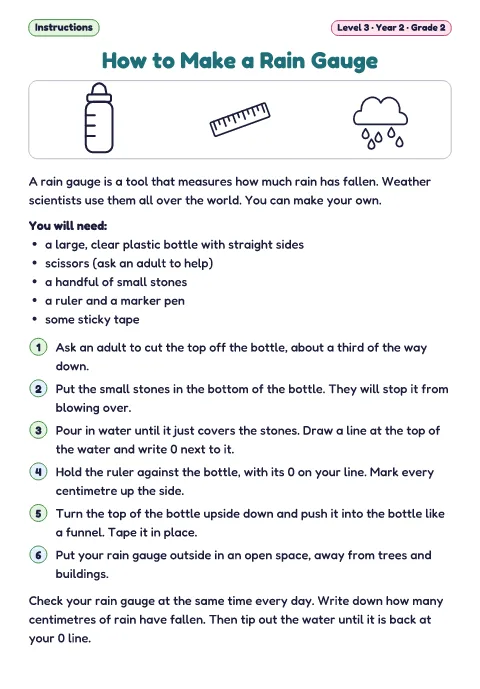 How to Make a Rain Gauge (instructions)
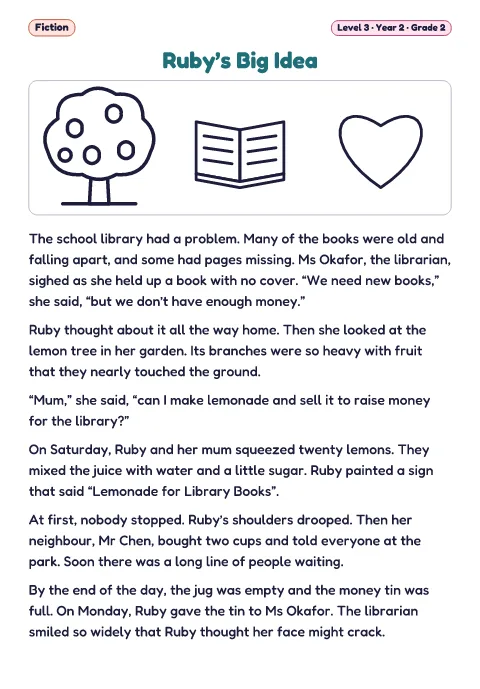 Ruby’s Big Idea (fiction)
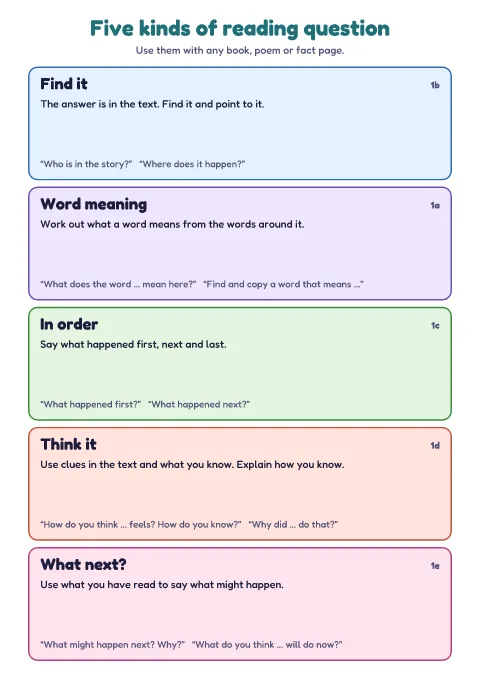 Reading question cards and bookmarks
What does reading comprehension look like in Year 1 and 2? The short answer
Reading comprehension is understanding what you read, not only saying the words. At five to seven, it grows through talk: children answer and ask questions about a text, explain what words mean, retell events in order, work out how a character feels from what they say and do, and guess what might happen next. A good first comprehension sheet uses a text children can decode, asks a mix of these questions, and shows where in the text each answer is, so children learn to go back and look.
That mix is exactly what the optional KS1 reading test in England measures: its framework sorts questions into vocabulary (1a), finding key information (1b), sequence (1c), inference (1d) and prediction (1e). In the US, the Common Core reading standards for grades 1 and 2 ask children to “ask and answer questions about key details in a text” and to retell and describe characters, settings and events. Each question on these sheets is labelled with its skill and its 1a–1e code. Updated 13 November 2026.
Which level should I print?
| Level | Who it is for | Texts | Questions |
|---|---|---|---|
| Level 1 | Year 1 (P2 in Scotland and Northern Ireland, Year 1 in NZ and AU); US grade 1 | about 40 to 90 words, short sentences | 5 per text, answer key included |
| Level 2 | end of Year 1 and Year 2; US late grade 1 and grade 2 | about 80 to 140 words, paragraphs and headings | 6 per text, answer key included |
| Level 3 | Year 2 and early Year 3; US grade 2 and early grade 3 | about 110 to 210 words, longer texts | 7 per text, answer key included |
Start one level lower than you think. A child who reads the text slowly and stops to sound out most words will spend their effort on decoding and have little left for meaning: give them the level below, or read the text aloud first and let them answer. Each level has a story, a fact text, a poem and a set of instructions, so a whole class can read the same kind of text at three levels on the same day. Our levels were checked with two simple measures (words per sentence and syllables per word, the Flesch–Kincaid grade); they are a guide, not a reading age.
Level 1: Year 1 and grade 1 reading comprehension
Five texts of about 40 to 90 words with short sentences, a big picture and five questions each. The words are common and mostly decodable by the end of Year 1; a few words such as whoosh and everywhere are worth reading together first.
1. The Windy Day (fiction)
A short story with one problem and a happy ending: Kai’s red hat blows away at the beach and lands under a dog. Questions ask for the colour of the hat, where they went, what a gust is, the order of three events and why Kai holds his hat at the end. 5 questions; 86 words. A US spelling version is under the main buttons.
The Windy Day PDF (A4)The Windy Day PDF (US Letter)
Read “The Windy Day” before you print
Kai and Mum went to the beach. It was a windy day. Kai had a red hat.
A big gust of wind came. Whoosh! The hat flew off Kai’s head. It went up and up.
Kai ran and ran. The hat landed on the sand next to a dog. The dog sat on the hat!
“Can I have my hat back, please?” said Kai. The dog got up and wagged its tail. Kai put the hat back on. This time he held it with one hand.
2. Snails (non-fiction)
A first fact text in five short paragraphs: shell, one flat foot, slime, four feelers with eyes on the long pair, damp places. Children tick where the shell is, count the feelers, decide what damp means, sort true and false, and explain why a snail hides. 5 questions; 73 words.
Read “Snails” before you print
A snail has a soft body. It has a hard shell on its back.
A snail moves on one flat foot. It makes slime to help it slide along.
A snail has four feelers on its head. Its eyes are at the tips of the two long feelers.
Snails like damp places. You can often see them after rain. Many snails eat leaves.
If a snail is scared, it hides in its shell.
Facts checked against Encyclopaedia Britannica: snail, Natural History Museum: garden snail.
3. Rain Song (poem)
An eight-line rhyming poem full of sound words (pitter, patter, drip, drop, splish, splash) that ends with the sun and a rainbow. Good for finding rhymes, for reading aloud with actions, and for a first “how do you know?” question. 5 questions; 43 words.
Read “Rain Song” before you print
Pitter, patter, tip, tap, tap,
The rain is falling on my cap.
Drip, drop, down the street,
Splish, splash, on my feet.
Puddles here and puddles there,
Puddles, puddles everywhere!
Then the sun comes out to play,
And a rainbow ends the day.
4. How to Plant a Bean Seed (instructions)
Instructions with a “you will need” list and six numbered steps, so children meet the features of instructions while they read. The questions check the order of the steps, where the pot goes and why you check it every day. Plant real beans alongside it. 5 questions; 61 words.
How to Plant a Bean Seed PDF (A4)How to Plant a Bean Seed PDF (US Letter)
Read “How to Plant a Bean Seed” before you print
You will need:
- a small pot
- some soil
- a bean seed
- some water
- Fill the pot with soil.
- Make a hole in the soil with your finger.
- Put the bean seed in the hole.
- Cover the seed with soil.
- Water the soil a little.
- Put the pot by a sunny window.
Check your pot every day. Do not let the soil dry out. After one or two weeks, a green shoot will pop up!
Facts checked against Royal Horticultural Society: runner beans.
5. The Big Box (fiction)
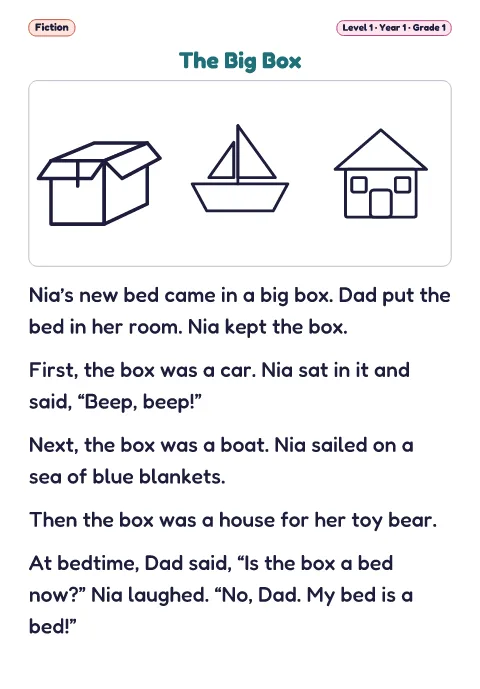
A story about play: Nia turns the box her bed came in into a car, a boat and a house for her bear, using first, next and then. Children number the three games, work out what sailed means and say why Nia kept the box. 5 questions; 76 words.
Read “The Big Box” before you print
Nia’s new bed came in a big box. Dad put the bed in her room. Nia kept the box.
First, the box was a car. Nia sat in it and said, “Beep, beep!”
Next, the box was a boat. Nia sailed on a sea of blue blankets.
Then the box was a house for her toy bear.
At bedtime, Dad said, “Is the box a bed now?” Nia laughed. “No, Dad. My bed is a bed!”
Advertisement
Level 2: Year 1–2 and grades 1–2 reading passages
Five texts of about 80 to 140 words with paragraphs, headings and speech, and six questions each. Two inference questions ask “how do you know?”, so children have to point to a clue in the text.
6. Zara and the Kite (fiction)
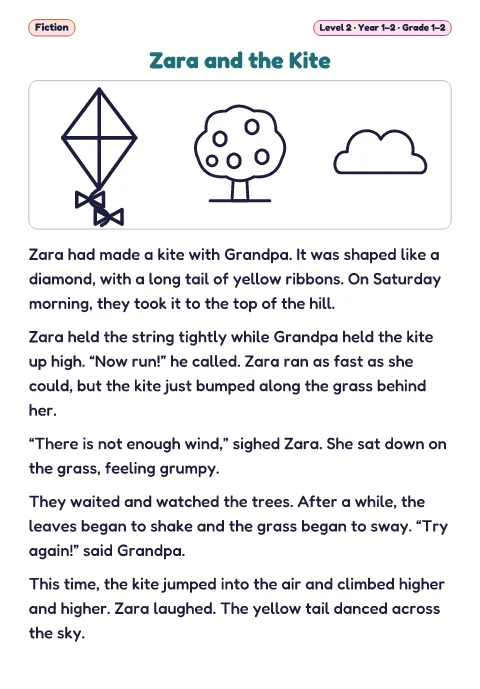
A story with feelings that change: the kite will not fly, Zara is grumpy, then the wind comes back. Six questions, including two inference questions that ask children to point to clues (the leaves shake, Zara laughs). 6 questions; 126 words. A US spelling version is under the main buttons.
Zara and the Kite PDF (A4)Zara and the Kite PDF (US Letter)
Read “Zara and the Kite” before you print
Zara had made a kite with Grandpa. It was shaped like a diamond, with a long tail of yellow ribbons. On Saturday morning, they took it to the top of the hill.
Zara held the string tightly while Grandpa held the kite up high. “Now run!” he called. Zara ran as fast as she could, but the kite just bumped along the grass behind her.
“There is not enough wind,” sighed Zara. She sat down on the grass, feeling grumpy.
They waited and watched the trees. After a while, the leaves began to shake and the grass began to sway. “Try again!” said Grandpa.
This time, the kite jumped into the air and climbed higher and higher. Zara laughed. The yellow tail danced across the sky.
7. Penguins (non-fiction)
An information text with three headings, a question heading and a map of where penguins live, from Antarctica to New Zealand, Australia, South Africa and South America. Children use the headings to find answers, sort true and false, and infer why penguins must swim well. 6 questions; 117 words. A US spelling version is under the main buttons.
Penguins PDF (A4)Penguins PDF (US Letter)
Read “Penguins” before you print
Penguins are birds, but they cannot fly. Instead, they use their wings as flippers to swim. Penguins are fast, strong swimmers.
Where do penguins live?
Almost all penguins live in the southern half of the world. Some live on the ice in Antarctica. Others live on rocky coasts. You can find them in New Zealand, Australia, South Africa and South America.
Big and small
The biggest penguin is the emperor penguin. It can be more than one metre tall. The smallest is the little penguin, which lives in New Zealand and Australia.
Keeping warm
Penguins have lots of thick, oily feathers. They also have a layer of fat under their skin. This keeps them warm in cold water.
Penguins eat fish and other small sea animals.
Facts checked against Encyclopaedia Britannica: penguin, NZ Department of Conservation: little penguin.
8. Two Seasons, One Day (poem)
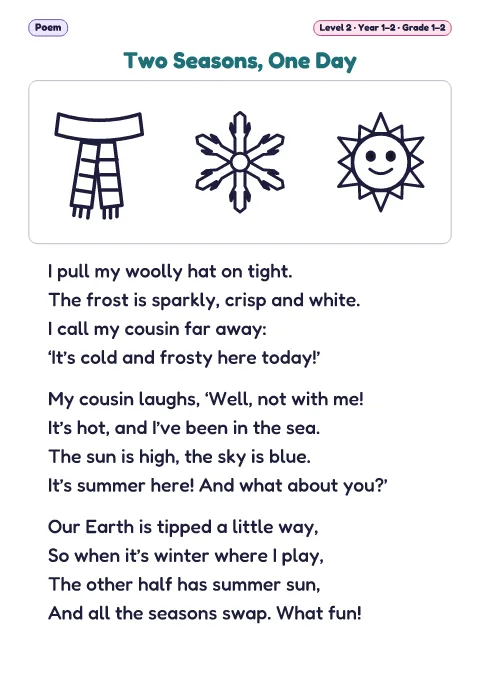
A three-verse poem in two voices: one child is in frost and a woolly hat while a cousin on the other side of the world swims in the sea. It explains, in the last verse, that the Earth is tipped, so the seasons swap. Written for classes in both hemispheres. 6 questions; 85 words.
Two Seasons, One Day PDF (A4)Two Seasons, One Day PDF (US Letter)
Read “Two Seasons, One Day” before you print
I pull my woolly hat on tight.
The frost is sparkly, crisp and white.
I call my cousin far away:
‘It’s cold and frosty here today!’
My cousin laughs, ‘Well, not with me!
It’s hot, and I’ve been in the sea.
The sun is high, the sky is blue.
It’s summer here! And what about you?’
Our Earth is tipped a little way,
So when it’s winter where I play,
The other half has summer sun,
And all the seasons swap. What fun!
Facts checked against NASA Space Place: What causes the seasons?.
9. How to Wash Your Hands (instructions)
Instructions with an opening that explains germs, a list and seven steps (wet, soap, rub for 20 seconds, rinse, dry), as the NHS and CDC describe them. Children find the time, copy a word that means very small and order four steps. 6 questions; 110 words. A US spelling version is under the main buttons.
How to Wash Your Hands PDF (A4)How to Wash Your Hands PDF (US Letter)
Read “How to Wash Your Hands” before you print
Washing your hands helps to wash away germs. Germs are tiny living things that can make you ill. They are too small to see.
You will need:
- soap
- water
- a clean towel
- Wet your hands with water.
- Put some soap on your hands.
- Rub your hands together until they are covered in bubbles.
- Rub the backs of your hands, between your fingers, your thumbs and your fingertips.
- Keep rubbing for at least 20 seconds. That is about as long as singing “Happy Birthday” twice.
- Rinse off the soap with water.
- Dry your hands with a clean towel.
When should you wash your hands? Wash them after you use the toilet, before you eat, and when they look dirty.
Facts checked against NHS: how to wash your hands, CDC: about handwashing.
10. Our Visit to the Fire Station (recount)
A recount written by a child about a class trip, with time words (first, next, after that, finally) and the fire services’ home advice. Questions ask children to order four events, find the word that ends the recount and explain how Leo felt. 6 questions; 135 words. A US spelling version is under the main buttons.
Our Visit to the Fire Station PDF (A4)Our Visit to the Fire Station PDF (US Letter)
Read “Our Visit to the Fire Station” before you print
By Leo, Class 2
On Tuesday, our class walked to the fire station. A firefighter called Sam met us at the big red doors.
First, Sam showed us the fire engine. It had a long ladder on the top and rolled-up hoses on the side. We each sat in the driver’s seat for a minute.
Next, Sam put on her helmet, her boots and her thick jacket. She told us the jacket keeps firefighters safe from the heat.
After that, we tested a smoke alarm. It made a loud beeping noise, and Amira covered her ears!
Finally, Sam taught us what to do if we ever hear a smoke alarm at home: get out, stay out, and call for help.
It was the best trip ever. I want to be a firefighter one day.
Facts checked against London Fire Brigade: fire safety at home, NFPA: escape planning.
Level 3: Year 2 and grade 2 reading comprehension
Five texts of about 110 to 210 words with longer sentences, similes, subject words and seven questions each, including a prediction. They suit the end of Year 2 and practice in the style of the KS1 reading papers, and grade 2 children reading at or above level.
11. The Night the Lights Went Out (fiction)
A longer story with a storm, a power cut and a little brother who is scared of the dark, told with similes (like a hungry wolf, as dark as the inside of a cupboard). Seven questions, including how Sami’s feelings change and a prediction. 7 questions; 206 words. A US spelling version is under the main buttons.
The Night the Lights Went Out PDF (A4)The Night the Lights Went Out PDF (US Letter)
Read “The Night the Lights Went Out” before you print
The storm had been growling all evening. Rain hammered on the windows, and the wind howled around the house like a hungry wolf.
Mia was halfway through her favourite book when, with a soft click, every light in the house went out. The room was suddenly as dark as the inside of a cupboard.
“Dad?” she whispered. Her heart was thumping.
“It’s all right,” called Dad from the kitchen. “It’s just a power cut. The storm must have knocked down a power line.” Mia heard him open a drawer, and then a beam of light swept across the hall. Dad came in holding a torch, with Mia’s little brother Sami close behind him.
“I don’t like the dark,” said Sami in a small voice.
Mia had an idea. She held up her hand in front of the torch, and a shadow rabbit appeared on the wall. Its long ears wiggled.
Sami giggled. “Make a bird!” he said.
For the next hour, they made shadow animals: a rabbit, a bird, a snapping crocodile and a very wobbly elephant. Sami laughed so much that he forgot all about the dark.
When the lights flickered back on, Sami groaned. “Oh no,” he said. “Can we turn them off again?”
12. Busy Honeybees (non-fiction)
A non-fiction text in four sections (who lives in a hive, making honey, the waggle dance, helping plants) with subject words to learn: colony, nectar, cells, drones, pollen. Children copy a word, sort true and false, order how honey is made and infer why a farmer wants bees. 7 questions; 198 words.
Read “Busy Honeybees” before you print
A honeybee is a small insect with six legs, four wings and a striped body. Honeybees live together in a big group called a colony. Their home is called a hive. In summer, a busy hive can hold more than 20,000 bees.
Who lives in a hive?
Every hive has one queen bee. Her job is to lay eggs. Most of the other bees are worker bees, and they are all female. Workers clean the hive, look after the young bees, guard the door and fly out to find food. The male bees are called drones.
Making honey
Worker bees visit flowers to drink a sweet juice called nectar. Back at the hive, they turn the nectar into honey. They store the honey in tiny six-sided boxes made of wax, called cells.
Dancing directions
When a worker finds lots of flowers, she flies back to the hive and does a special dance called the waggle dance. The dance tells the other bees which way to fly to find the flowers.
Helping plants
As bees move from flower to flower, they carry a yellow dust called pollen. This helps the plants to make seeds and fruit. Without bees and other insects, many plants would make much less fruit.
Facts checked against Encyclopaedia Britannica: honeybee, British Beekeepers Association, Encyclopaedia Britannica: pollination.
13. The Old Tree (poem)
A four-verse poem that follows one tree through spring, summer, autumn and winter without naming a month, so it works in the northern and southern hemispheres. Questions cover rhyme, word choice (whispering, bare), the order of the seasons and what “asleep” means. 7 questions; 113 words. A US spelling version is under the main buttons.
The Old Tree PDF (A4)The Old Tree PDF (US Letter)
Read “The Old Tree” before you print
In spring, the old tree wakes from sleep,
With tiny buds that start to peep.
The birds come back to build a nest
Up high, where baby birds can rest.
In summer, it is green and wide,
A shady place where children hide.
Its leaves go whispering in the breeze,
A secret song for bugs and bees.
In autumn, leaves turn red and gold.
They tumble down when nights get cold.
We crunch them, kick them, jump and run,
And toss them high. It’s so much fun!
In winter, every branch is bare.
It stretches, shivering, in the air.
But deep inside, the tree’s asleep,
And dreams of buds that start to peep.
Facts checked against Woodland Trust: why do leaves change colour?.
14. How to Make a Rain Gauge (instructions)
Science instructions with a purpose, a list, six steps and what to do each day, after the Met Office’s classroom activity. Questions ask what must happen before a step, why the gauge goes in an open space and why you read it at the same time every day. 7 questions; 169 words. A US spelling version is under the main buttons.
How to Make a Rain Gauge PDF (A4)How to Make a Rain Gauge PDF (US Letter)
Read “How to Make a Rain Gauge” before you print
A rain gauge is a tool that measures how much rain has fallen. Weather scientists use them all over the world. You can make your own.
You will need:
- a large, clear plastic bottle with straight sides
- scissors (ask an adult to help)
- a handful of small stones
- a ruler and a marker pen
- some sticky tape
- Ask an adult to cut the top off the bottle, about a third of the way down.
- Put the small stones in the bottom of the bottle. They will stop it from blowing over.
- Pour in water until it just covers the stones. Draw a line at the top of the water and write 0 next to it.
- Hold the ruler against the bottle, with its 0 on your line. Mark every centimetre up the side.
- Turn the top of the bottle upside down and push it into the bottle like a funnel. Tape it in place.
- Put your rain gauge outside in an open space, away from trees and buildings.
Check your rain gauge at the same time every day. Write down how many centimetres of rain have fallen. Then tip out the water until it is back at your 0 line.
Facts checked against Met Office: make a rain gauge.
15. Ruby’s Big Idea (fiction)
A story with a problem, a plan and a result: Ruby sells lemonade to buy library books. Children read body language (her shoulders drooped), order four events, copy a word and predict what the librarian will do with the money. 7 questions; 189 words. A US spelling version is under the main buttons.
Ruby’s Big Idea PDF (A4)Ruby’s Big Idea PDF (US Letter)
Read “Ruby’s Big Idea” before you print
The school library had a problem. Many of the books were old and falling apart, and some had pages missing. Ms Okafor, the librarian, sighed as she held up a book with no cover. “We need new books,” she said, “but we don’t have enough money.”
Ruby thought about it all the way home. Then she looked at the lemon tree in her garden. Its branches were so heavy with fruit that they nearly touched the ground.
“Mum,” she said, “can I make lemonade and sell it to raise money for the library?”
On Saturday, Ruby and her mum squeezed twenty lemons. They mixed the juice with water and a little sugar. Ruby painted a sign that said “Lemonade for Library Books”.
At first, nobody stopped. Ruby’s shoulders drooped. Then her neighbour, Mr Chen, bought two cups and told everyone at the park. Soon there was a long line of people waiting.
By the end of the day, the jug was empty and the money tin was full. On Monday, Ruby gave the tin to Ms Okafor. The librarian smiled so widely that Ruby thought her face might crack.
For any book: question cards and bookmarks
16. Reading question cards and bookmarks
A poster of the five kinds of question with what each one means, 30 question cards to cut out (six for each kind, such as “Which word tells you how … felt?” and “What clues tell you …?”) and five bookmarks of question starters for reading at home. Use them in guided reading, with a home reading book, or as a quick check after a class story.
How to use the worksheets
- Talk about the picture and the title first. Ask what the text might be about. That is the start of prediction, and it gives children words they will meet.
- Read the text twice. Once for the story or the facts, once with the questions in mind. With Year 1 and grade 1, read it aloud together first; Level 1 texts are short enough to read three times.
- Teach “go back and look”. For find-it questions, children point to the sentence or underline it before they write. The answer key shows the words in the text for each answer, so you can show them where to look.
- Talk through think-it questions. Inference answers are not in the text word for word. Accept any answer the text supports, and ask “how do you know?” The key gives a possible answer and the clues.
- Answer out loud before writing. Many children understand more than they can write in Year 1. Let them say the answer, then write a word or a short sentence; the tick-one questions need no writing.
- Mark together. Use the answer page with the child, not just for them: a wrong answer usually shows a word they didn’t know or a sentence they skipped.
Curriculum links
England (Year 1 and Year 2). The worksheets support the comprehension part of the national curriculum for English: discussing word meanings and linking new meanings to those already known, learning to appreciate rhymes and poems, becoming familiar with non-fiction books structured in different ways, discussing the sequence of events and making inferences on the basis of what is said and done. The question labels follow the content domains in the KS1 English reading test framework (1a to 1e).
United States (grades 1 and 2). They support Common Core RL.1.1 and RI.1.1 (ask and answer questions about key details), RL.1.2 (retell stories) and RL.2.2 (recount stories), RL.1.3 (describe characters, settings and major events), RL.1.4 (words in stories or poems that suggest feelings or appeal to the senses), RI.2.1 (who, what, where, when, why and how questions), RI.2.3 (steps in technical procedures) and RI.2.5 (text features such as headings).
Scotland, Wales, Ireland, Australia and New Zealand. Finding information, word meaning, sequence, inference and prediction are part of reading in each of these curricula for children of five to eight. The sheets support that teaching as practice texts; they are not a reading programme on their own.
More reading and writing
For children still learning to decode, start with the phonics worksheets and sight words. Festival non-fiction with questions and answer keys is in the What is …? festival readers (Hanukkah, Christmas, Kwanzaa, Lunar New Year and more), and seasonal grammar in the Christmas fill in the blank stories. For writing after reading: grammar worksheets, handwriting style charts and word mats. Maths for the same ages is in the first grade and second grade math worksheets, and everything else is under printables for teachers and homeschool printables.
Questions
What is reading comprehension in Year 1 and Year 2?
Understanding what you read: finding information, knowing what words mean, putting events in order, working out what a text suggests but doesn’t say, and predicting. In England these are the KS1 reading content domains 1a to 1e; in the US they are the Common Core reading standards for grades 1 and 2.
Do the reading comprehension worksheets have answers?
Yes. The last page of every PDF is an answer key. It ticks the right options, numbers the order questions, gives a model answer for written questions and quotes the words in the text where each answer is found.
What level are the passages?
Level 1 is for Year 1 and grade 1 (about 40 to 90 words), Level 2 for the end of Year 1 and Year 2, grades 1 and 2 (about 80 to 140 words) and Level 3 for Year 2 and grade 2 (about 110 to 210 words). Each level has a story, a fact text, a poem and instructions.
What are retrieval and inference questions?
A retrieval question has its answer in the text: children find it and copy or tick it. An inference question asks them to use clues in the text, such as what a character says or does, to work out something the text doesn’t say, like how the character feels.
Are the texts original?
Yes. We wrote every text and question ourselves; there are no characters from books or TV. The facts in the non-fiction texts were checked against sources such as Encyclopaedia Britannica, the NHS, NASA, the Met Office and the NZ Department of Conservation, named on each worksheet.
Is there a UK and US version?
The worksheets use UK spelling, and texts with words that differ (mum, colour, torch, power cut, fire engine, autumn) also have a US version with mom, color, flashlight, power outage, fire truck and fall. Every PDF comes in A4 and US Letter.
Are these reading comprehension worksheets free?
Yes. Free for your own class, school, homeschool and family, with no sign-up. Please don’t resell them or upload them to another site.