 Colouring Nest
Starting school booklet and transition to school printables
Free starting school printables for the year before school: a six-page starting-school booklet, an “all about me for my new teacher” page, a “getting ready for school” list of things to practise together, a sleeps-until-school countdown, a first-day sign and a tips sheet for families. The booklet, the all-about-me page and the sign come in New Zealand, Australian, UK and US versions with the right words for each country. A4 and US Letter PDFs, colour and ink saver.
Inside this set
- 6 printables
- A4 and US Letter PDFs
- Colour and ink-saver versions
- Free, no sign-up
About this resource
Ages 4–6, prep, what you need and how to use it
- Ages
- 4 to 6 years (preschool, school start)
- Prep
- A few minutes: print the booklet and sign for your country.
- You’ll need
- Printer and paper (card for the sign and countdown)
- Crayons and pencils
- A stapler for the booklet
- Supports
- Te Whāriki (NZ), EYLF (Australia), EYFS (England), ELOF (US)
How to use it in the room
- Fill the booklet in slowly over a few weeks, with the child drawing and an adult writing their words.
- Share the all about me page with the new teacher only with the family’s permission.
- Colour one countdown circle each night and take the first-day photo with the sign.
Show resources for
Remembered on this device only. It sets A4 or US Letter as the first download.
Starting school in each country
The first year of school has a different name, and often a different starting age, in each country. Our versions only change the words; they never assume how a particular school runs its day, its uniform or its lunches, because every school does that its own way.
- New Zealand. Children can start school once they turn five and must be enrolled by their sixth birthday. Many schools take new entrants on or after their fifth birthday; some use cohort entry, where children start together at the beginning of a term. Ask your school which it uses.
- Australia. The first year of school has a different name in each state and territory: kindergarten in New South Wales and the ACT, prep in Victoria, Queensland and Tasmania, reception in South Australia, pre-primary in Western Australia and transition in the Northern Territory. Starting ages differ too. Our Australian booklet says “my first year of school” so it works everywhere. Some states also ask early childhood services to complete an official transition statement; that is a separate form from your state, and these printables are not a substitute for it.
- United Kingdom. In England and Wales most children start in a Reception class in the September after they turn four. In Scotland and Northern Ireland the first year is Primary 1. The UK booklet says Reception; Scottish and Northern Irish families may prefer the New Zealand version, which just says school.
- United States. Most children start kindergarten at five, with age cut-off dates set by each state or district. Many have been to preschool or pre-K first.
Using the booklet
The booklet works best filled in slowly over a few weeks, at home or at the early childhood centre, with the child doing the drawing and an adult writing the child’s words. It has a cover with a space to draw yourself, all about me, things I can do (with “I can” and “I’m learning” boxes, so nothing reads as a fail), my new school, how I feel about school, and my first day. Bring it on a school visit, share it with the new teacher, and finish the last page after the first day.
Supports:
- Te Whāriki NZ
- Belonging | Mana whenua
- Contribution | Mana tangata
- Wellbeing | Mana atua
- EYLF Australia
- Outcome 1: Children have a strong sense of identity
- Outcome 2: Children are connected with and contribute to their world
- Outcome 3: Children have a strong sense of wellbeing
- EYFS England
- Personal, social and emotional development
- ELOF US
- Social and Emotional Development
- Approaches to Learning
1. Starting school booklet
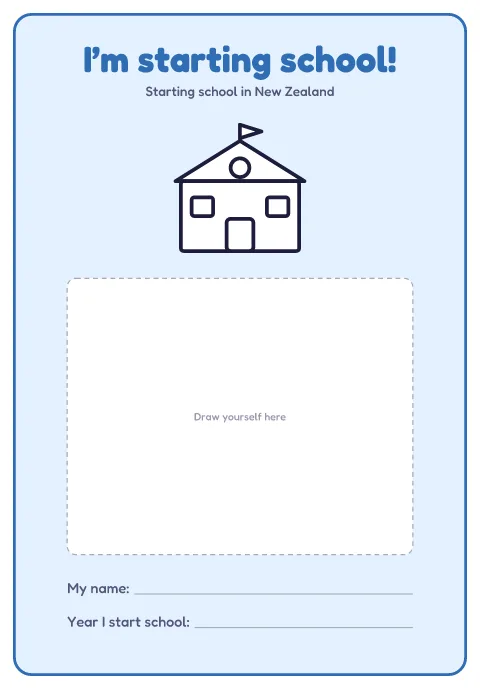
Six pages: cover, all about me, things I can do, my new school, how I feel about school, and my first day. Choose the New Zealand, Australian, UK (Reception) or US (kindergarten) version.
Starting school booklet PDF, New Zealand (A4)Starting school booklet PDF, New Zealand (US Letter)
Ink saver (A4)Ink saver (US Letter)
Australia (A4)Australia (US Letter)
Australia ink saver (A4)Australia ink saver (US Letter)
United Kingdom (A4)United Kingdom (US Letter)
United Kingdom ink saver (A4)United Kingdom ink saver (US Letter)
United States (A4)United States (US Letter)
United States ink saver (A4)United States ink saver (US Letter)
2. All about me for my new teacher
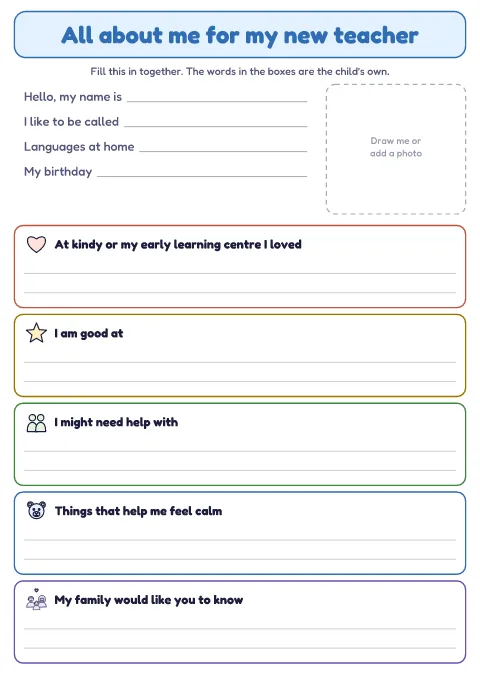
One page for the new teacher, filled in by the child and family together: what they loved before school, what they are good at, what they might need help with, what helps them feel calm and what the family would like the teacher to know.
All about me for my new teacher PDF, New Zealand (A4)All about me for my new teacher PDF, New Zealand (US Letter)
Ink saver (A4)Ink saver (US Letter)
Australia (A4)Australia (US Letter)
Australia ink saver (A4)Australia ink saver (US Letter)
United Kingdom (A4)United Kingdom (US Letter)
United Kingdom ink saver (A4)United Kingdom ink saver (US Letter)
United States (A4)United States (US Letter)
United States ink saver (A4)United States ink saver (US Letter)
Advertisement
3. Getting ready for school
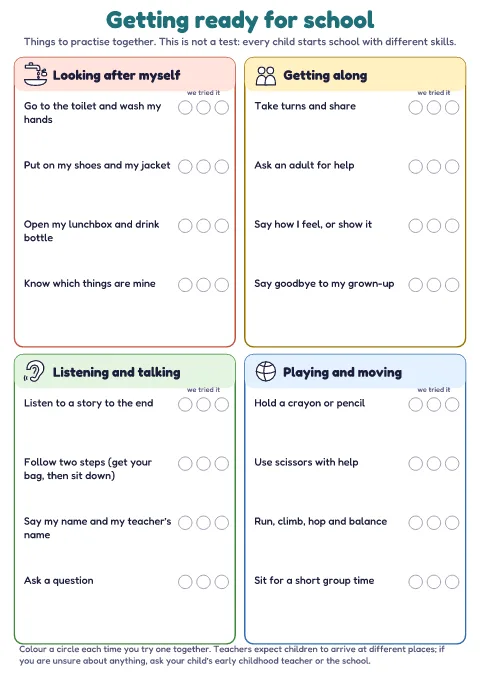
Sixteen everyday things to practise together in four groups (looking after myself, getting along, listening and talking, playing and moving), with circles to colour each time you try. It says on the sheet that it is not a test.
Getting ready for school PDF (A4)Getting ready for school PDF (US Letter)
4. Sleeps until school countdown
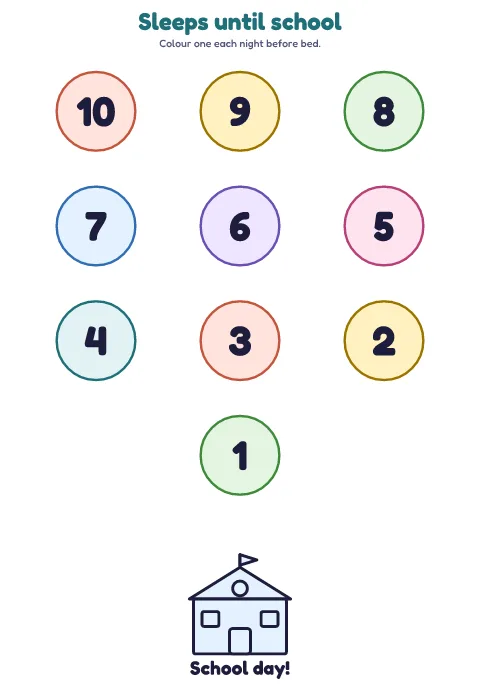
Ten big numbered circles to colour, one each night, ending at a school picture on the last day.
Sleeps until school countdown PDF (A4)Sleeps until school countdown PDF (US Letter)
5. First day of school sign
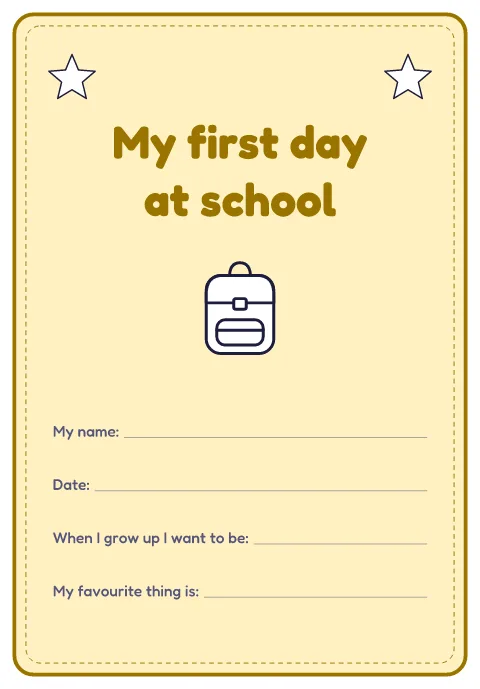
A sign for the first-day photo with lines for name, date, what I want to be and my favourite thing. Wording for each country: “at school”, “of school”, “in Reception” or “of kindergarten”.
First day of school sign PDF, New Zealand (A4)First day of school sign PDF, New Zealand (US Letter)
Ink saver (A4)Ink saver (US Letter)
Australia (A4)Australia (US Letter)
Australia ink saver (A4)Australia ink saver (US Letter)
United Kingdom (A4)United Kingdom (US Letter)
United Kingdom ink saver (A4)United Kingdom ink saver (US Letter)
United States (A4)United States (US Letter)
United States ink saver (A4)United States ink saver (US Letter)
6. Starting school
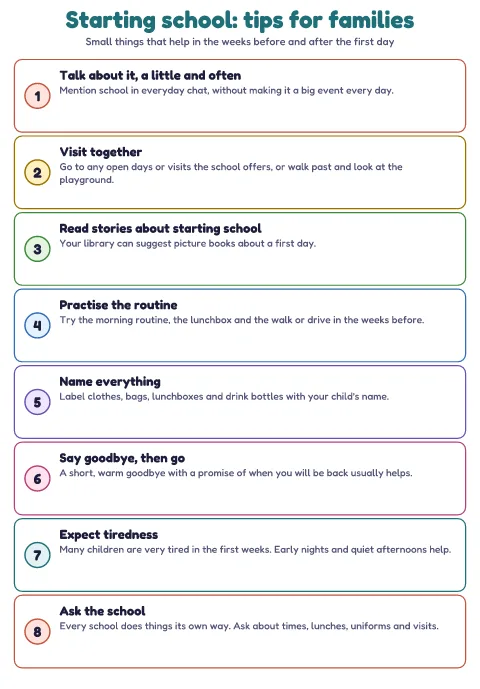
Eight short tips for families: talk about it a little and often, visit together, read stories, practise the routine, name everything, say goodbye then go, expect tiredness and ask the school.
For early childhood teachers
- Start in the last term. Bring out the booklet and the countdown in the final term before children leave, and talk about school at group time without rushing it.
- Invite the school in. A visit from a new entrant, prep or Reception teacher, or a walk to the school, helps more than any sheet.
- Share with permission. The “all about me” page is the family’s to share. Ask before sending anything to a school.
- Celebrate leaving. Pair the booklet with a preschool graduate certificate and a first day of school colouring page.
More for the year before school: letter of the week packs, counting mats, name tracing, visual timetable, all about me worksheets and early learning by country.
Related sets
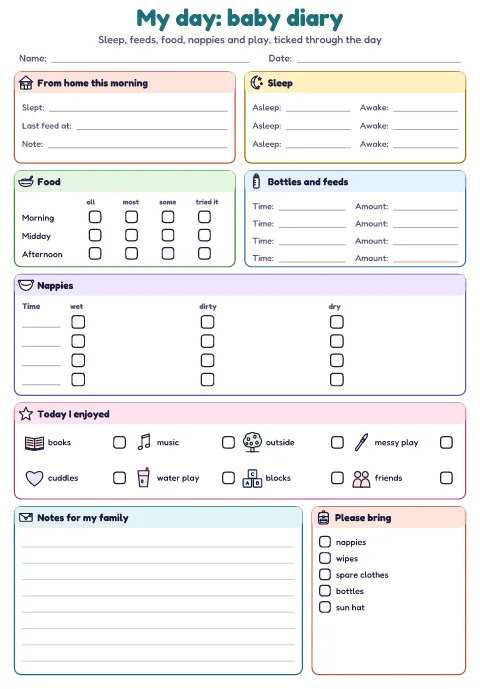 Daily care diary for babies and toddlers, family sheetsTemplates · ages 0–3
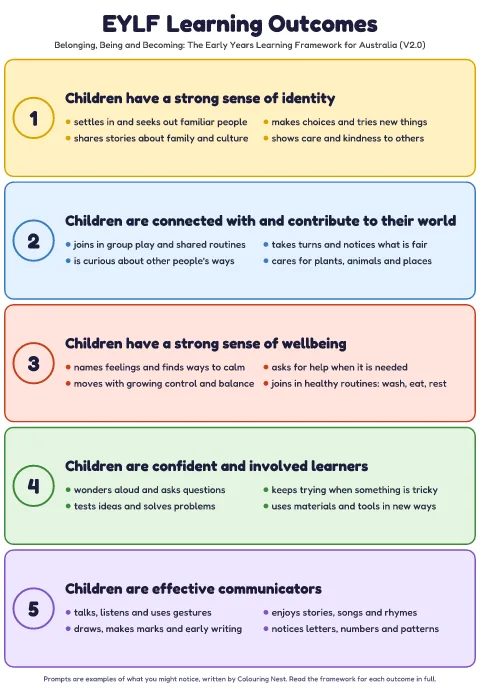 EYLF outcomes poster, cards and templatesTemplates · ages 1–5
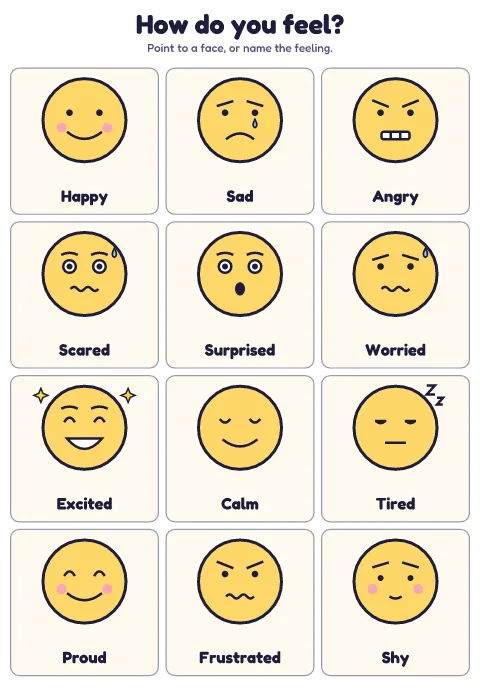 Visual timetable, now and next and feelings chartDisplays and charts · ages 2–6
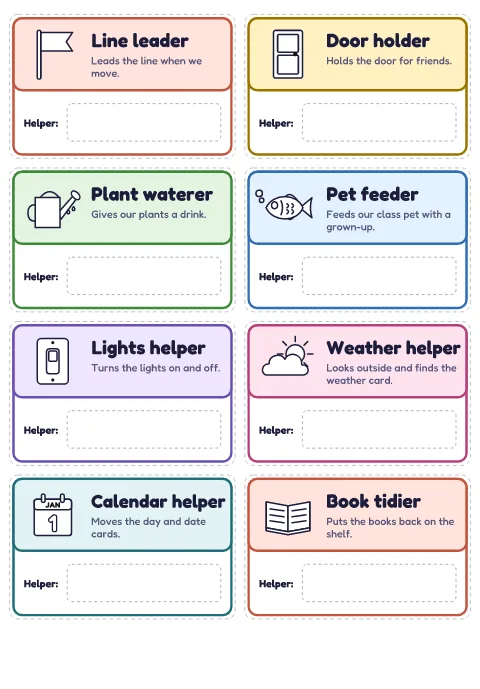 Classroom helper chart, job cards and routine chartsDisplays and charts · ages 3–6
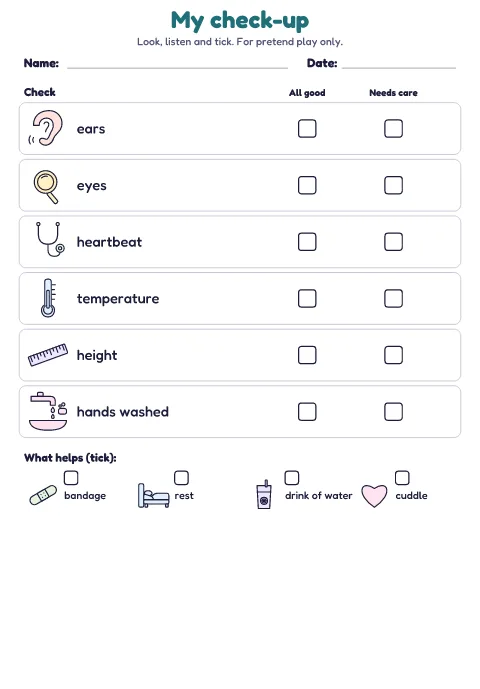 Doctor’s role play: check-up form, eye chart, signsDisplays and charts · ages 2–6
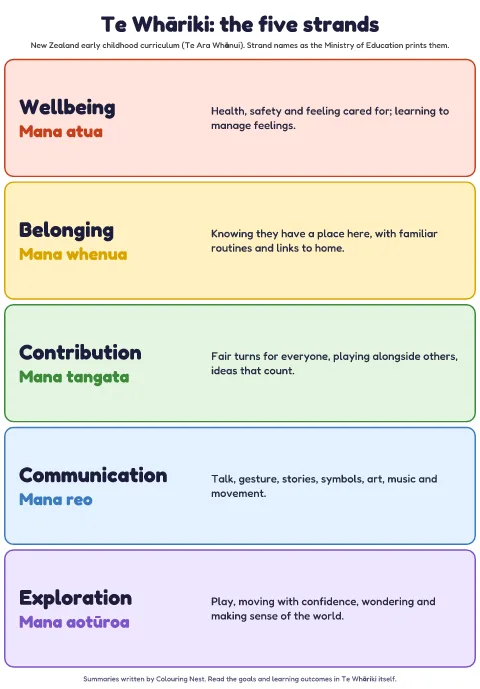 Te Whāriki learning story templatesTemplates · ages 1–5
Questions
What age do children start school in New Zealand?
Children can start school once they turn five and must be enrolled by their sixth birthday. Some schools use cohort entry, where children start together at the start of a term.
What is the first year of school called in Australia?
It depends on the state: kindergarten in NSW and the ACT, prep in Victoria, Queensland and Tasmania, reception in South Australia, pre-primary in Western Australia and transition in the Northern Territory.
Is the getting ready for school list a test?
No. It is a list of everyday things to practise together. Children start school with different skills and teachers expect that.
Are these free?
Yes. Free for your own centre, kindergarten, school, class and family, with no sign-up. Please don’t resell them or upload them to another site.