 Colouring Nest
Decodable sentences: Phase 2 and 3 sentence cards and CVC sentences
Free decodable sentences for Reception and Year 1 (kindergarten and first grade): 17 printables that take children from reading single words to reading sentences. Phase 2 and Phase 3 sentence cards for every set, with sound buttons on one copy and none on the other, tricky word cards, spot the tricky words, read and match picture sentences, Phase 2 captions with pictures, jumbled sentences, yes or no question cards, dictation with a teacher script, read and draw, build-up reading strips, decodable word lists, a sound-by-sound chart, a guide for parents, US CVC sentence strips by short vowel and a class tracker. Every sheet with answers has an answer page, and every file comes in A4 and US Letter.
Inside this set
- 17 printables
- A4 and US Letter PDFs
- Colour and ink-saver versions
- Free, no sign-up
 Phase 2 decodable sentence cards
 Phase 3 decodable sentence cards
 Tricky word cards
 Spot the tricky words
 Read and match: sentences and pictures
 Phase 2 captions and pictures
 Yes or no question cards
 Read and draw
 Jumbled sentences
 Dictation sentences
 Build-up reading strips
 Decodable word lists, set by set
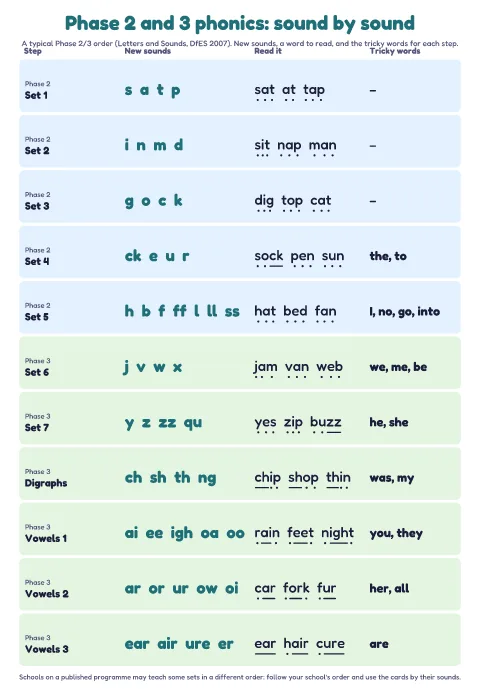 Sound-by-sound progression chart
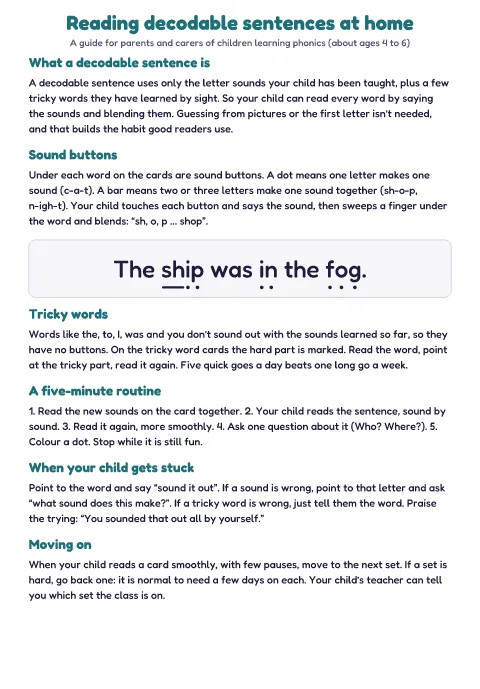 Parent guide
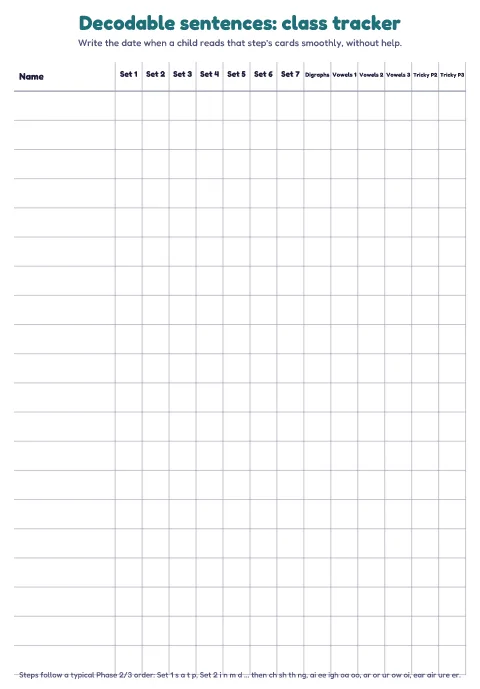 Class tracker
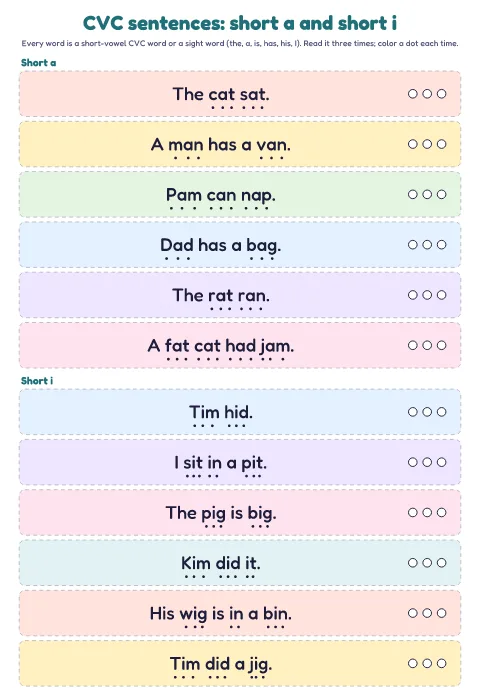 CVC sentence strips by short vowel
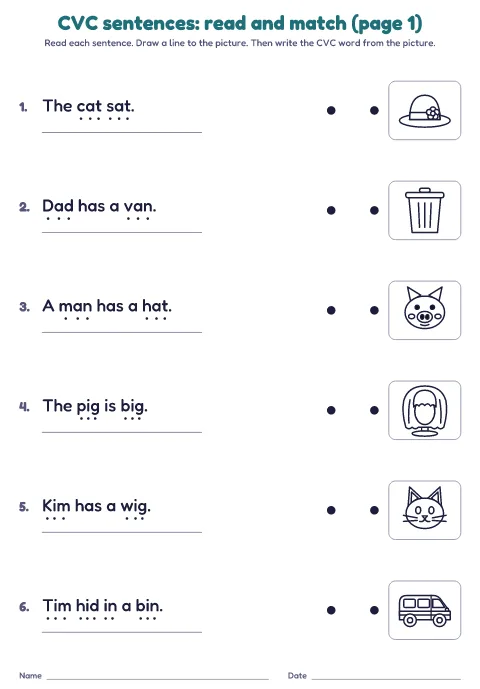 CVC sentences worksheet: read, match and write
Why every word is checked
A sentence is only decodable for a child if they have been taught every sound in it. Many free “decodable” sheets slip in a word the child can’t yet read: “stop” (two consonants side by side, which come in Phase 4), “have” (a silent e), “was” in Phase 2, or “car” before ar has been taught. When that happens the child is pushed back to guessing, which is the habit phonics is meant to replace.
So every sentence here goes through a check before it is printed. Each word must be a tricky word already taught, or split into sounds that have all been taught by that set, with no letters that make another sound in that word (the w in “was”, the a in “ball”, the ow in “snow”). The cards are cumulative: a Set 3 card uses s a t p i n m d g o c k and nothing else, and a card from the ai ee igh oa oo step can use anything from Phase 2 and the earlier Phase 3 steps. The same check draws the sound buttons, so the buttons always match the sounds.
Sentence cards
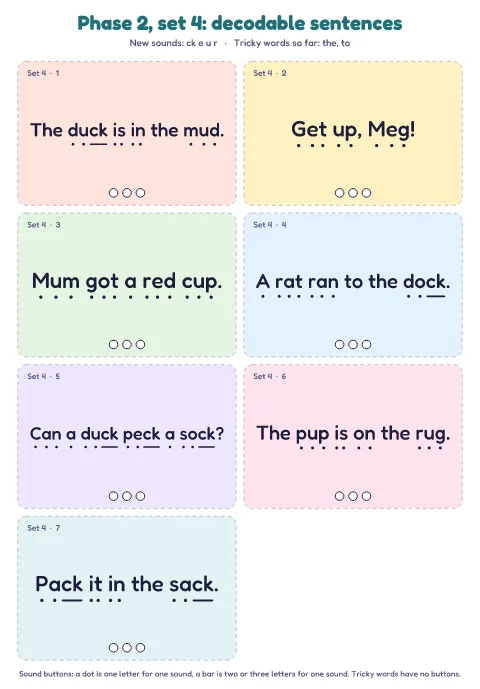
1. Phase 2 decodable sentence cards
One page for each set: four captions for set 1 (“Pat sat at a tap.”) and six or seven sentences for sets 2 to 5, such as “Did Tim nap?”, “Can a cat nap on a mat?” and “No, the bus is not red.” Each page lists the new sounds and the tricky words so far. The second download has the same cards with no sound buttons, for when children are ready to read without them.
Phase 2 sentence cards PDF (A4)Phase 2 sentence cards PDF (US Letter)
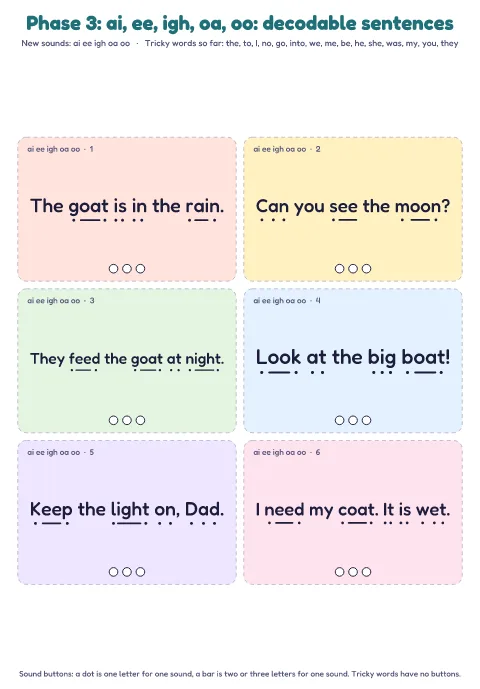
2. Phase 3 decodable sentence cards
Six pages: set 6 (j v w x), set 7 (y z zz qu), ch sh th ng, ai ee igh oa oo, ar or ur ow oi, and ear air ure er. “She is quick at the quiz.” “They feed the goat at night.” “Her hair is long and red.” Bars under two- and three-letter sounds show children where to look; the plain copy takes them away.
Phase 3 sentence cards PDF (A4)Phase 3 sentence cards PDF (US Letter)
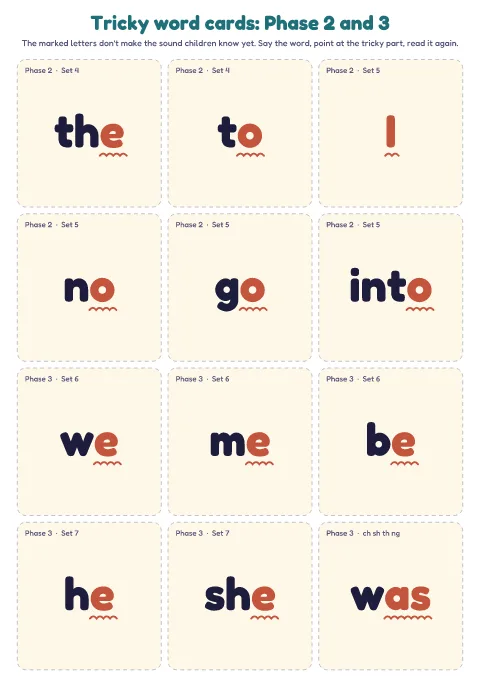
3. Tricky word cards
All 18 Phase 2 and 3 tricky words, from the and to to they, all and are, each on its own card with the tricky part marked by a wavy line (the e in “the”, the o in “to”, ey in “they”). Read the word, point at the tricky part, read it again.
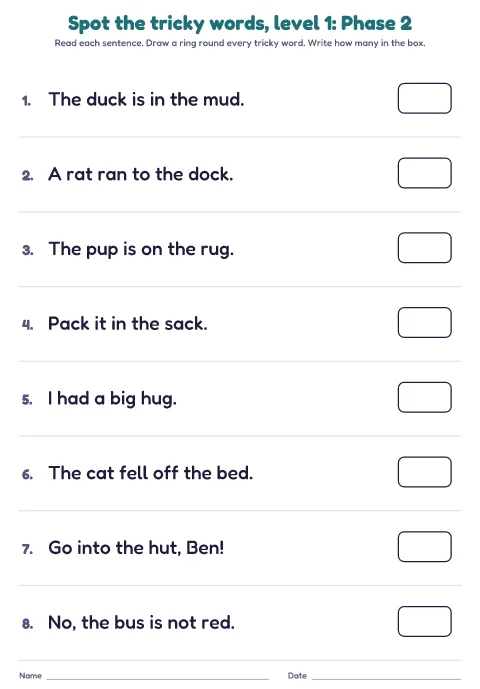
4. Spot the tricky words
Eight sentences per level with no sound buttons. Children ring every tricky word and write how many there are. Level 1 uses Phase 2 sentences; level 2 uses Phase 3 sentences with up to three tricky words each. The answer pages ring them all.
Spot the tricky words PDF (A4)Spot the tricky words PDF (US Letter)
Advertisement
Reading for meaning
5. Read and match: sentences and pictures
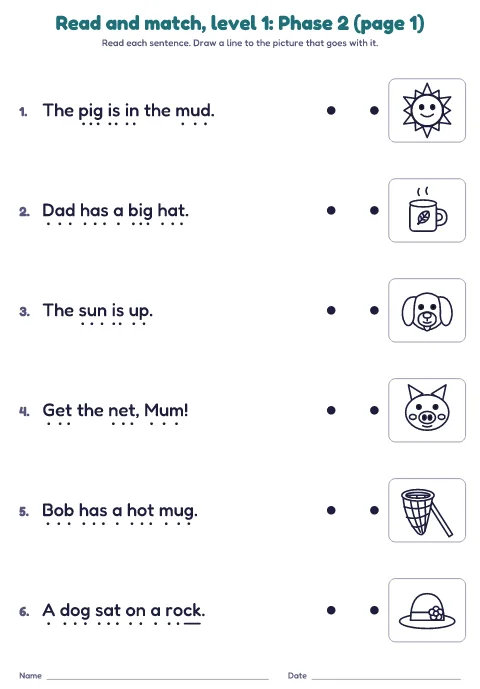
Two pages per level, six sentences and six pictures on each. Level 1 has Phase 2 sentences with sound buttons (“Dad has a big hat.”); level 2 has Phase 3 sentences without them (“An owl can hoot at night.”). Only one picture fits each sentence, and the answer pages draw the lines.
6. Phase 2 captions and pictures
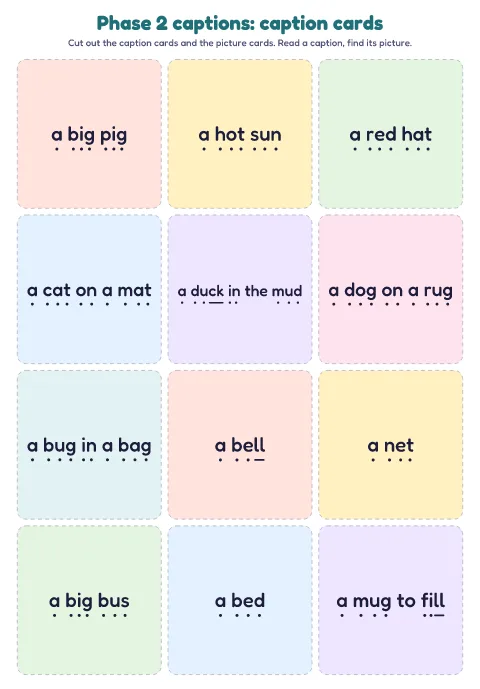
Twelve caption cards (“a big pig”, “a duck in the mud”, “a mug to fill”) and twelve picture cards, shuffled so no picture sits under its own caption. Use them for pairs, a matching game or a quick check of who can read a caption on their own. The answer page shows each pair.
7. Yes or no question cards
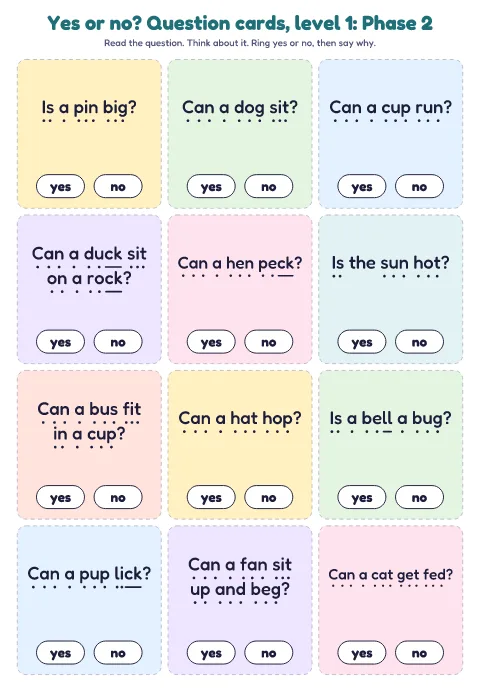
Twelve questions per level, such as “Can a hat hop?” and “Has a shark got fur?”. Children have to read every word to answer, so these show quickly who is decoding and who is guessing. Ask them to say why, too. Answer pages ring yes or no.
Yes or no questions PDF (A4)Yes or no questions PDF (US Letter)
8. Read and draw
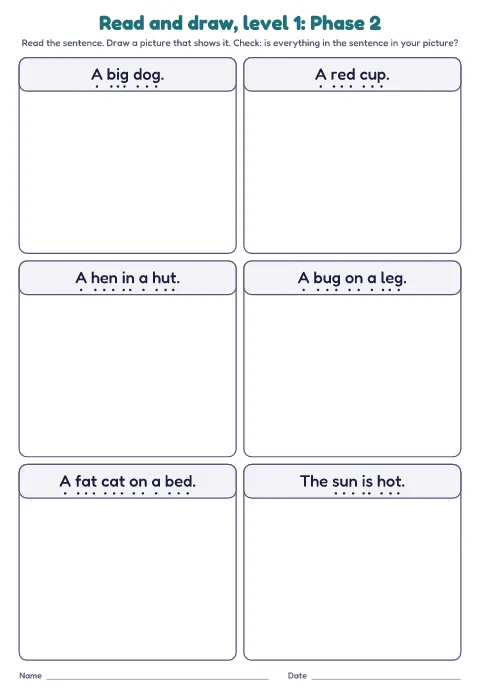
Six sentences per level to read and draw, from “A hen in a hut.” to “A chair with long hair!”. Drawing checks that the child understood the sentence, not just sounded it out: a fox in a box should have a box.
Building, writing and fluency
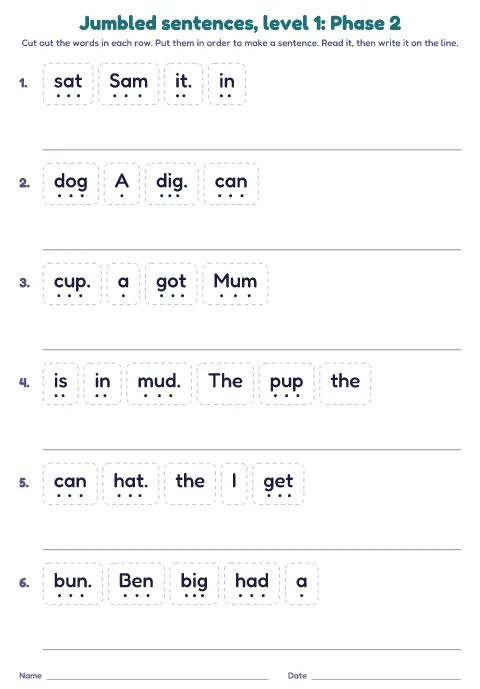
9. Jumbled sentences
Six sentences per level cut into word cards in a jumbled order, never the right one. The capital letter and the full stop give a clue to the first and last word. Children put the words in order, read the sentence and write it on the line. The answer page has both levels.
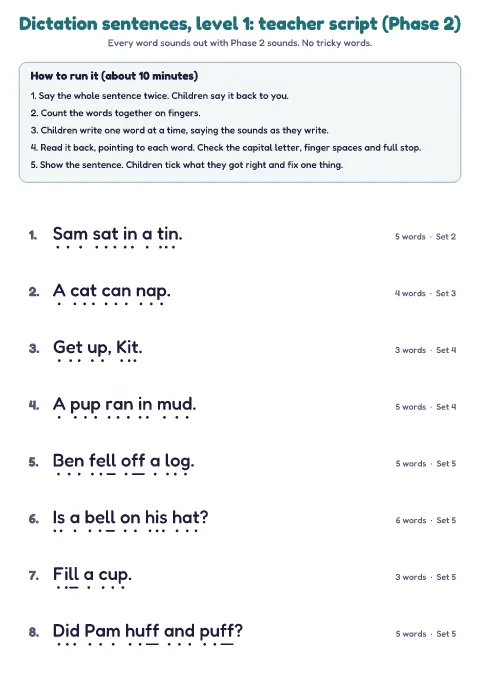
10. Dictation sentences
A teacher script for each level (five steps, about ten minutes) with eight sentences and the number of words in each, plus a writing sheet with handwriting lines and tick boxes for a capital letter, finger spaces and a full stop. Level 1 uses Phase 2 sounds and no tricky words; level 2 adds only the, to, I, no and go, the first tricky words children learn to spell.
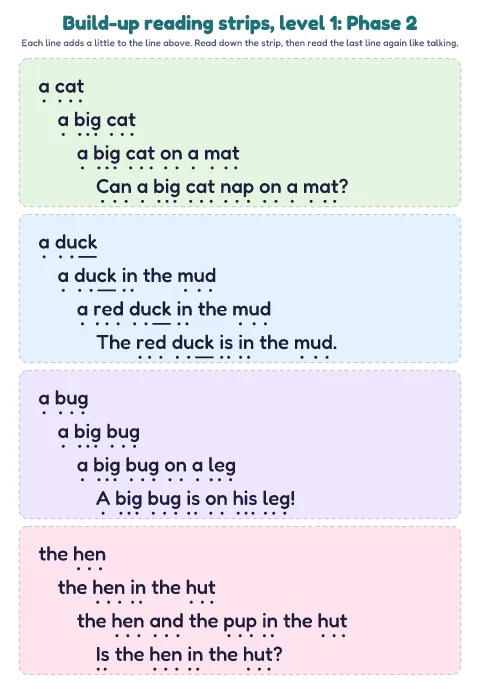
11. Build-up reading strips
Four strips per level. Each line repeats the one above and adds a little: “a goat”, “a goat in a boat”, “a goat in a big boat”, “A goat sat in a big boat.” Reading the same words again and again builds speed, so the last line can be read like talking.
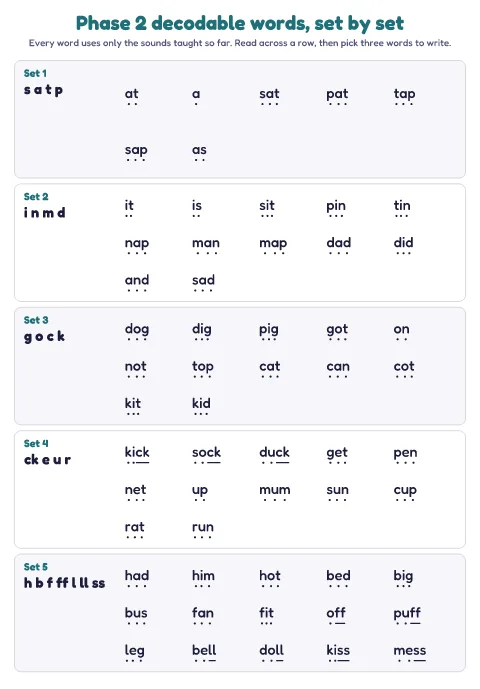
12. Decodable word lists, set by set
One page for Phase 2 and one for Phase 3: each set’s new sounds and 7 to 15 words that use them, with sound buttons. Read a row as a warm-up before the sentence cards, or pick three words for a quick spelling check.
For the classroom and home
13. Sound-by-sound progression chart
Eleven steps on one page, from s a t p to ear air ure er: the new sounds, three words to read and the tricky words for each step. Pin it next to your phonics display, or send it home so families know what comes next.
14. Parent guide
One page in plain words for families: what a decodable sentence is, how sound buttons work, tricky words, a five-minute routine and what to say when a child gets stuck. Print it with the set your class is on.
15. Class tracker
A grid for 20 children with a column for each step and for the Phase 2 and Phase 3 tricky words. Write the date when a child reads that step’s cards smoothly without help.
US kindergarten: CVC sentences
16. CVC sentence strips by short vowel
Thirty-six strips: six each for short a, i, o, u and e, and six that mix them. Every word is a CVC word with that short vowel or a common sight word (the, a, I, is, has, his), checked the same way. “The cat sat.” “His wig is in a bin.” “Jen met a vet.”
CVC sentence strips PDF (A4)CVC sentence strips PDF (US Letter)
17. CVC sentences worksheet: read, match and write
Two worksheets in US spelling: read each sentence, draw a line to its picture, then write the CVC word for the picture on the line. The answer pages draw the lines and write the words.
CVC read and match PDF (A4)CVC read and match PDF (US Letter)
From words to sentences: an order that works
- Warm up with the sounds. Show the new sounds for the set and read a row of the word list.
- Read the sentence card with buttons. Touch each button, say the sound, blend the word. Read the sentence again, smoothly.
- Check meaning. A yes or no question, a read and match sheet or a picture to draw: if the child can answer, they understood.
- Take the buttons away. When the button cards are easy, use the plain copy and the build-up strips.
- Write it. Dictation and jumbled sentences turn reading into spelling and sentence building.
The order follows a typical Phase 2/3 sequence as set out in Letters and Sounds (DfES, 2007). Since 2021 schools in England choose a phonics programme from the Department for Education’s validated list, and those programmes teach the same sounds in slightly different orders, so every card names its sounds rather than a week number. In the US, the Common Core foundational skills ask kindergarten children to know the sounds of letters and short vowels (RF.K.3a, RF.K.3b) and to read emergent-reader texts with purpose and understanding (RF.K.4); first graders decode regularly spelled one-syllable words and know common consonant digraphs (RF.1.3a, RF.1.3b). These resources support that work alongside your school’s scheme; they do not replace it.
For single-word practice, the phonics worksheets come first: beginning sounds, short vowels, CVC words, CVC read and match and digraphs. Before Phase 2, the Phase 1 phonics listening games build the sound talk children need. The sight words section has the Dolch lists, and the beginning sounds picture cards help with the first sound of each word. For handwriting the sentences they read, the handwriting paper has guide lines like the dictation sheet. More for teachers.
Questions
What is a decodable sentence?
A sentence in which every word can be read with the letter sounds a child has been taught so far, plus the few tricky words they have learned. “The duck is in the mud” is decodable after Phase 2 set 4 (ck, e, u, r and the tricky word “the”); “The duck swam in the pond” is not, because “swam” and “pond” have adjacent consonants, which come in Phase 4.
What are the Phase 2 and Phase 3 tricky words?
In the Letters and Sounds (2007) order the Phase 2 tricky words are the, to, I, no, go and into. Phase 3 adds he, she, we, me, be, was, my, you, her, they, all and are. Your school’s programme may teach some of them at a different point, or treat a few as decodable later on.
What are sound buttons?
Marks under a word that show its sounds: a dot under a letter that makes one sound on its own, and a bar under two or three letters that make one sound together, such as sh, ck, ee or igh. Children touch each button, say the sound and blend. Tricky words have no buttons.
What is the difference between Phase 2 and Phase 3?
Phase 2 teaches the first 23 graphemes in five sets (s a t p, i n m d, g o c k, ck e u r, h b f ff l ll ss), so children read short words like sat, pin and duck. Phase 3 adds the rest of the alphabet (j v w x y z zz qu), then sounds written with two or three letters (ch sh th ng, ai ee igh oa oo, ar or ur ow oi, ear air ure er).
Are CVC sentences the same as decodable sentences?
They overlap. US kindergarten “CVC sentences” use consonant-vowel-consonant words like cat, pig and sun plus a few sight words; UK Phase 2 sentences do the same with a fixed teaching order. The CVC strips on this page are grouped by short vowel, the way US classrooms teach them; the Phase 2 and 3 cards follow the set order.
Are these free for my class?
Yes. Free for your own class, school and family, with no sign-up. Please don’t resell them or upload them to another site.