 Colouring Nest
Free science experiment worksheets: scientific method, sink or float, plants, weather, magnets and fair tests
Free science experiment worksheets you can print as PDF files: a scientific method planner, predict and observe record sheets, sink or float, a plant growth diary, a weather observation chart, magnets, a materials sort and a fair test planner. Each experiment comes at up to three levels, pictures for pre-readers, kindergarten to grade 2, and grades 3 to 5, so a mixed class or a family with siblings can do the same investigation together. Every sheet is in A4 and US Letter, in colour or ink saver, with a grown-up guide to safe methods and the usual results. No sign-up.
Inside this set
- 24 printables
- 7 of them for early years (pre-readers)
- A4 and US Letter PDFs
- Colour and ink-saver versions
- Free, no sign-up
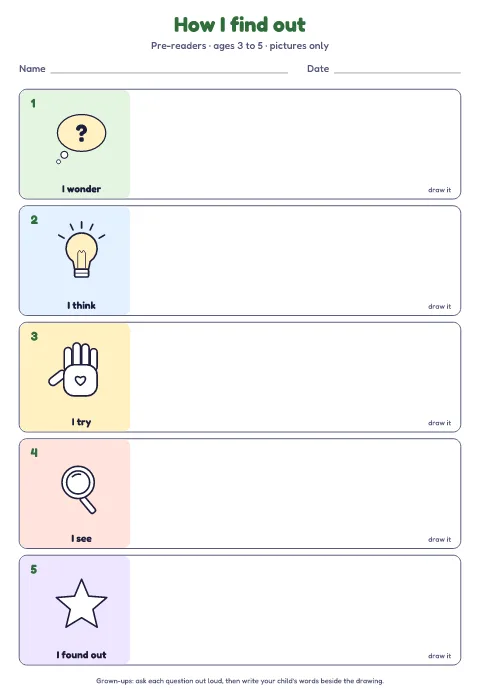 How I find out: a picture planner for pre-readers
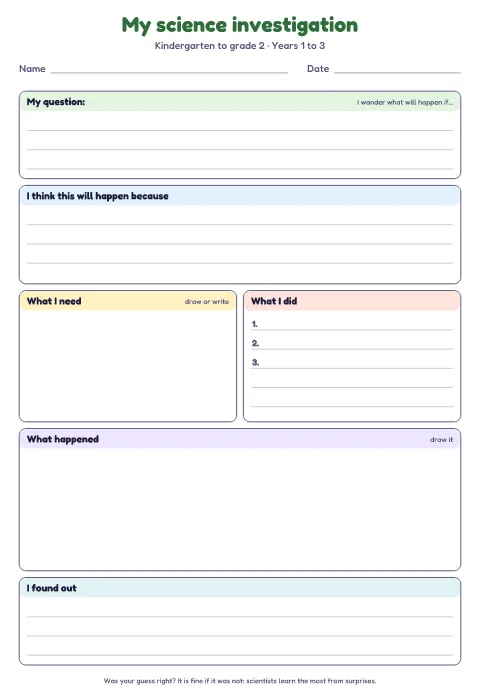 My science investigation planner, kindergarten to grade 2
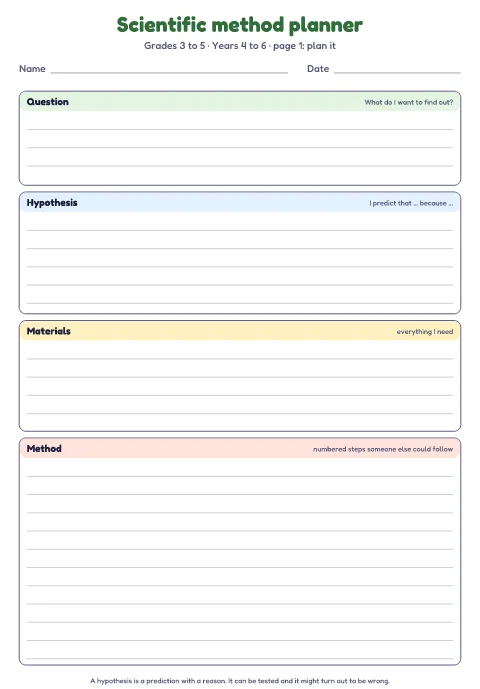 Scientific method planner for grades 3 to 5
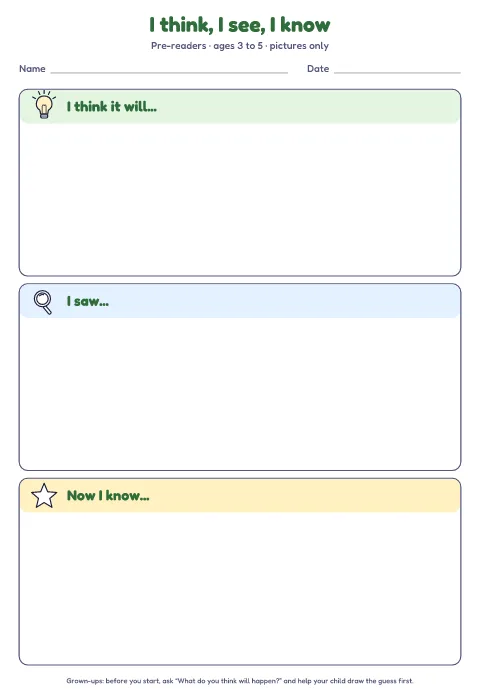 I think, I see, I know: draw-it record sheet
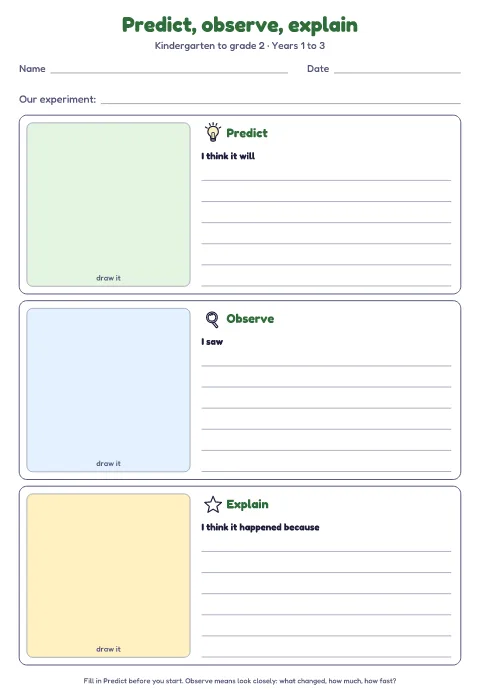 Predict, observe, explain sheet, kindergarten to grade 2
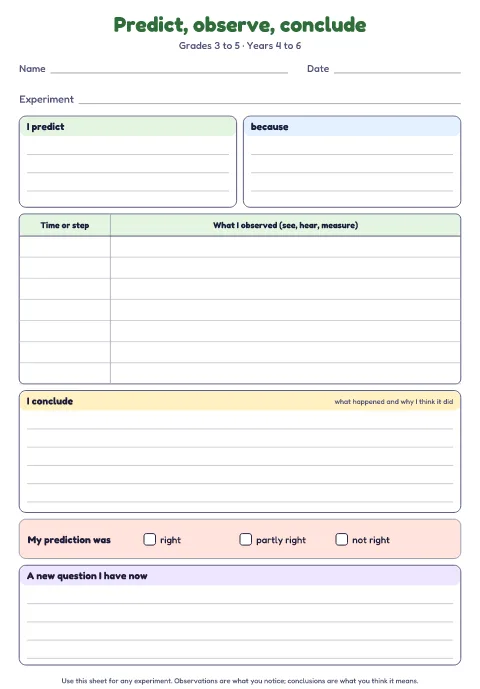 Predict, observe, conclude sheet for grades 3 to 5
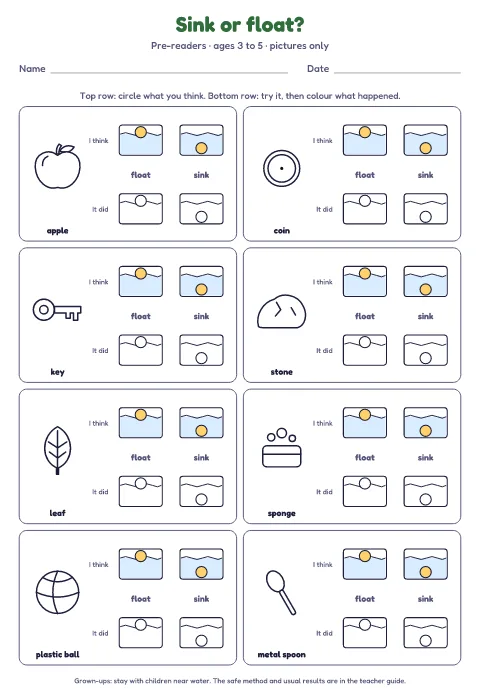 Sink or float? Picture sheet for pre-readers
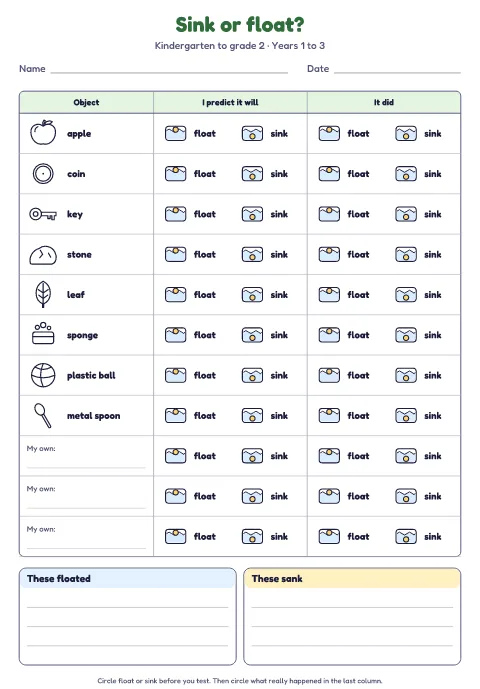 Sink or float recording sheet, kindergarten to grade 2
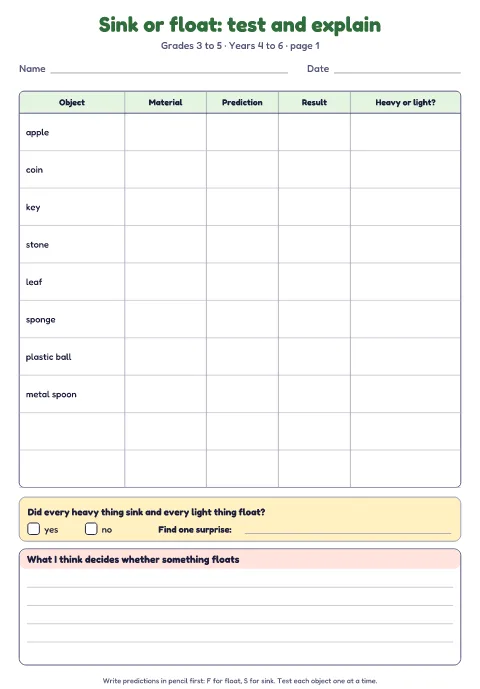 Sink or float for grades 3 to 5: test, explain and the clay boat challenge
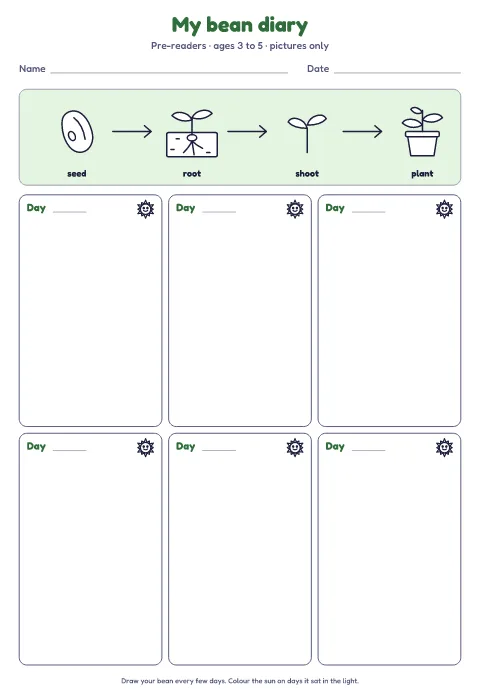 My bean diary for pre-readers
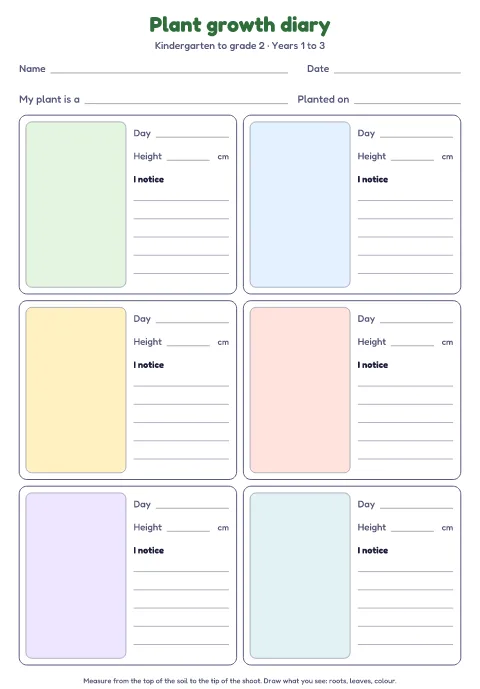 Plant growth diary, kindergarten to grade 2
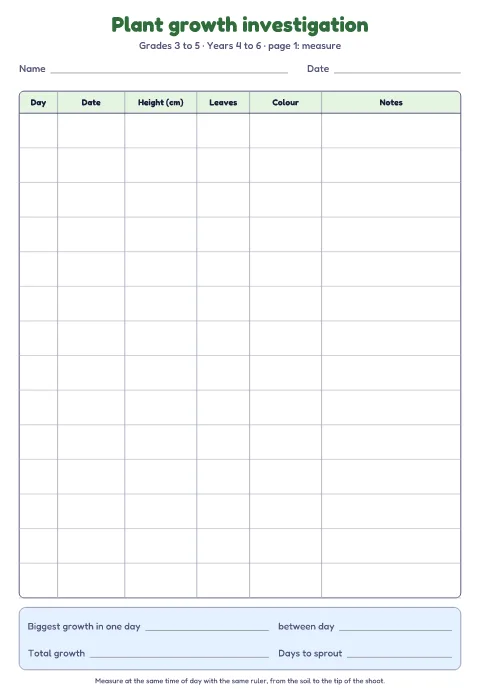 Plant growth investigation for grades 3 to 5
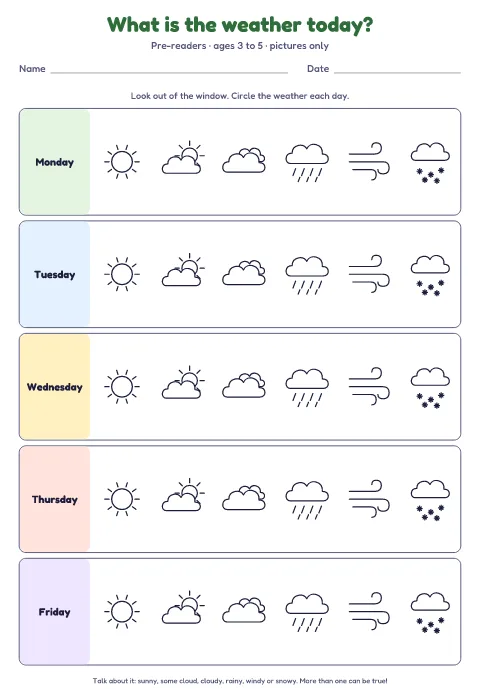 What is the weather today? Picture chart for pre-readers
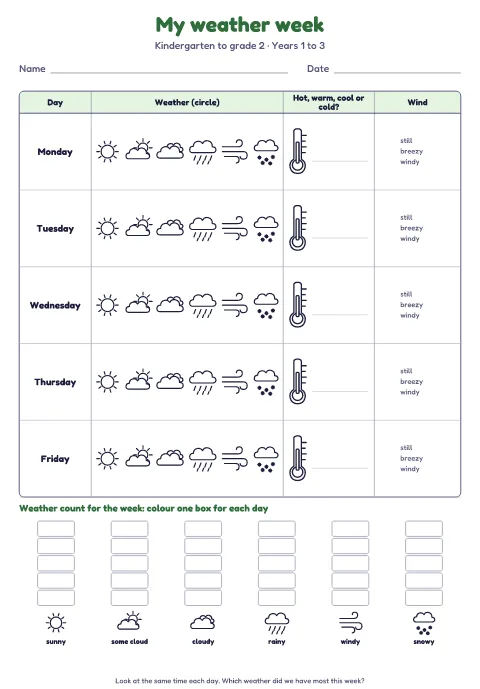 My weather week chart, kindergarten to grade 2
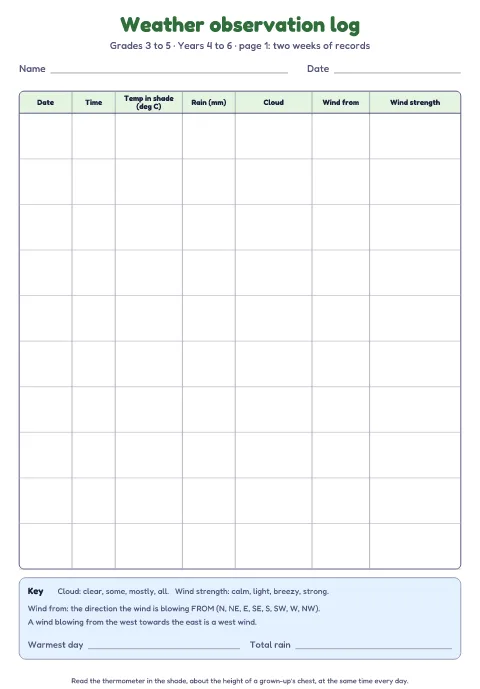 Weather observation log for grades 3 to 5
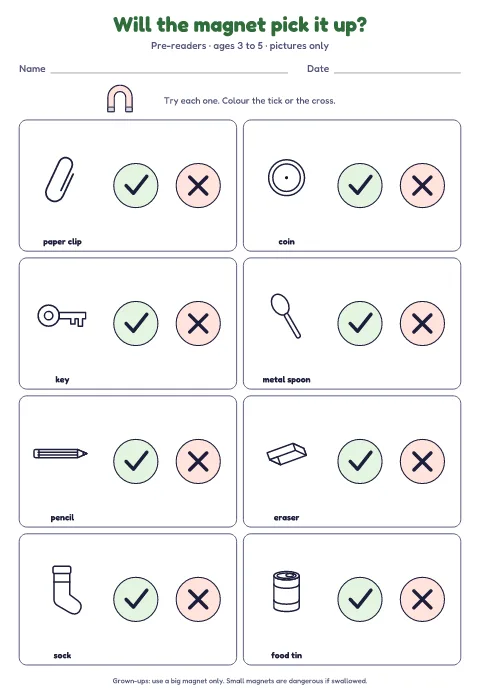 Will the magnet pick it up? Picture sheet for pre-readers
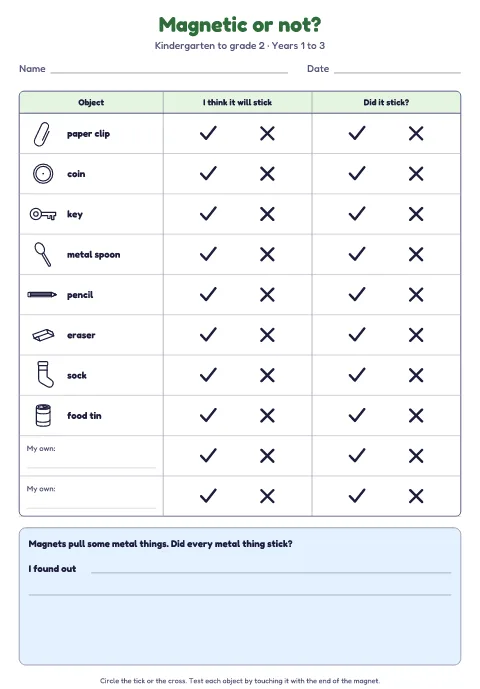 Magnetic or not? Recording sheet, kindergarten to grade 2
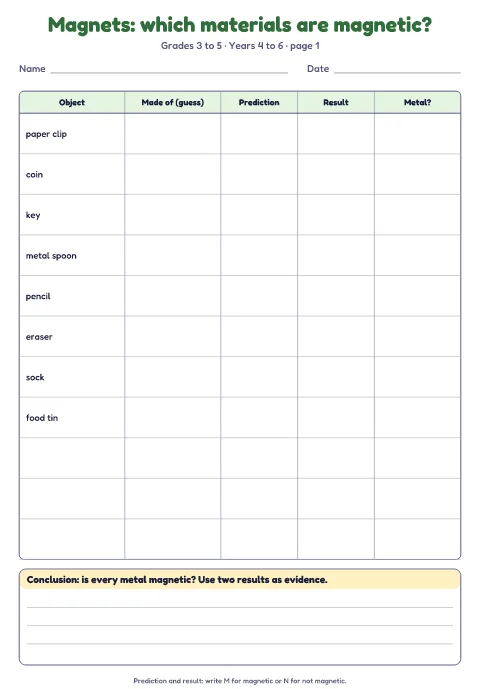 Magnets for grades 3 to 5: magnetic materials, strength and poles
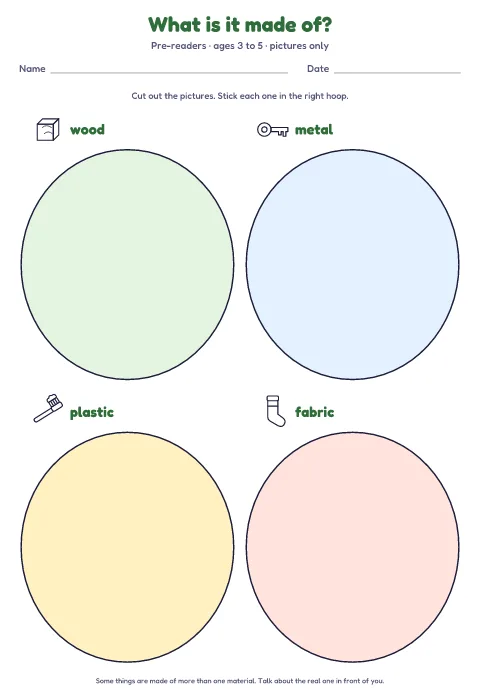 What is it made of? Sorting mat and picture cards for pre-readers
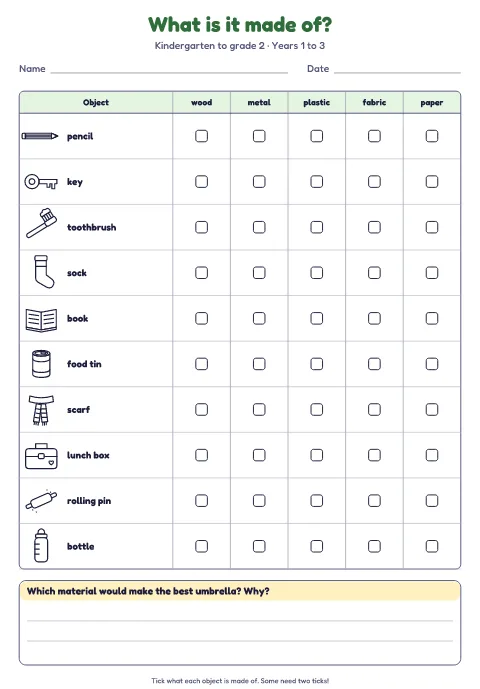 What is it made of? Tick sheet, kindergarten to grade 2
 Testing materials for grades 3 to 5
 Our fair test planner, kindergarten to grade 2
 Fair test planner for grades 3 to 5
 Teacher and parent guide: safe methods and usual results
About this resource
Ages 3–6, what you need and how to use it
- Ages
- 3 to 6 years (preschool, school start)
- You’ll need
- Printer and paper
- Pencils, crayons or felt-tips
- Supports
- Te Whāriki (NZ), EYLF (Australia), EYFS (England), ELOF (US)
How to use it in the room
- Print at 100% on A4 or US Letter.
- Choose the sheet that fits the child, starting a step easier than you think.
- Sit alongside and talk about what they are doing.
What makes a good science experiment worksheet?
It asks for a prediction before the test and evidence after it. Children learn the most when they commit to a guess, look closely, and then compare what happened with what they expected. Pre-readers can do all of that with pictures: circle a guess, try it, colour the result. Children of five to seven write a sentence or two and draw what they saw. From about eight, they plan a fair test, change one thing, measure with units, repeat each test three times and draw a graph. The sheets on this page follow that ladder, and every experiment uses things you already have at home or school. Updated 18 November 2026.
Which sheet for which child
| Level | What the sheets ask for | Start with |
|---|---|---|
| Pre-readers: preschool, EYFS, ages 3 to 5 | Circle, colour, sort and draw. No reading or writing; a grown-up reads the question aloud. | Sink or float pictures, will the magnet pick it up, the weather picture chart |
| Kindergarten to grade 2, Years 1 to 3 | Short sentences, tick tables, a drawing of what happened, measuring in centimetres | Predict, observe, explain; the plant growth diary; magnetic or not |
| Grades 3 to 5, Years 4 to 6 | Hypothesis with a reason, variables, three repeats, a typical result, line and bar graphs, a written conclusion | The fair test planner, the weather log, the magnet strength test |
Plan and record any experiment
1. How I find out: a picture planner for pre-readers
Five boxes down the page, each with a picture that stands for one step of finding out: a thought bubble with a question mark (I wonder), a light bulb (I think), a hand (I try), a magnifying glass (I see) and a star (I found out). Your child draws in each box while you write their words beside it. It turns any play with water, sand, shadows or bubbles into a small investigation, and shows three- and four-year-olds that a guess comes before the test.
Picture science planner PDF (A4)Picture science planner PDF (US Letter)
2. My science investigation planner, kindergarten to grade 2
One page that walks a young scientist from “I wonder what will happen if…” to “I found out”. There is a line for the question, a sentence starter for the prediction (“I think this will happen because”), a box to draw or list what is needed, three numbered steps for what we did, a big box to draw what happened and lines for the finding. The foot reminds children that a wrong guess is a good result, which takes the worry out of predicting.
K–2 investigation planner PDF (A4)K–2 investigation planner PDF (US Letter)
3. Scientific method planner for grades 3 to 5
Two pages. Page 1 plans the investigation: the question, a hypothesis written as “I predict that… because…”, the materials and a method in numbered steps that someone else could follow. Page 2 records it: a results table with three trials and a typical result, a graph grid with labelled axes, a conclusion that names its evidence, what went wrong or surprised me, and what I would do next time. It works for a science fair project as well as a class lesson.
Scientific method planner PDF (A4)Scientific method planner PDF (US Letter)
4. I think, I see, I know: draw-it record sheet
Three large boxes: “I think it will…” with a light bulb, “I saw…” with a magnifying glass and “Now I know…” with a star. Use it for any demonstration, from ice melting on a plate to a toy car rolling down a slope. Ask the first question before anything happens so the drawing in the top box is a true prediction, then come back to the sheet afterwards and compare the first and last pictures together.
Draw-it record sheet PDF (A4)Draw-it record sheet PDF (US Letter)
5. Predict, observe, explain sheet, kindergarten to grade 2
Predict, observe, explain is a routine teachers use to show children what they already believe before a demonstration. Each of the three rows has a drawing box and lines with a sentence starter: “I think it will”, “I saw” and “I think it happened because”. A line at the top names the experiment, so the same sheet serves for melting, mixing, rolling or growing all year.
Predict, observe, explain PDF (A4)Predict, observe, explain PDF (US Letter)
6. Predict, observe, conclude sheet for grades 3 to 5
A prediction with its reason in two boxes side by side, then a seven-row observation table with a column for the time or step, so children record changes as they happen rather than at the end. The conclusion box asks what happened and why, three tick boxes ask whether the prediction was right, partly right or not right, and the last box asks for a new question, because good investigations usually end with one.
Predict, observe, conclude PDF (A4)Predict, observe, conclude PDF (US Letter)
Advertisement
Sink or float
7. Sink or float? Picture sheet for pre-readers
Eight objects you will find at home or in a classroom: an apple, a coin, a key, a stone, a leaf, a sponge, a plastic ball and a metal spoon. Beside each one are two little tubs of water, one with a ball bobbing on top and one with a ball on the bottom. Children circle their guess in the top row, drop the real object in, then colour the tub that matches what happened in the row below. Lots of small children expect the big apple to sink and the tiny coin to float, which makes a lovely first surprise.
Sink or float pictures PDF (A4)Sink or float pictures PDF (US Letter)
8. Sink or float recording sheet, kindergarten to grade 2
A table of the same eight objects with float and sink to circle twice, once as a prediction and once as the result, plus three blank rows for objects children choose themselves. Below it, two boxes collect the things that floated and the things that sank, so children can look for what each group has in common. A clue they often find: being heavy is not the whole story.
Sink or float recording sheet PDF (A4)Sink or float recording sheet PDF (US Letter)
9. Sink or float for grades 3 to 5: test, explain and the clay boat challenge
Page 1 is a ten-row table for the object, the material it is made of, the prediction, the result and whether it felt heavy or light, then a question that tests the idea that heavy things sink. Page 2 is the challenge that settles it: a ball of modelling clay against the same clay pressed into a boat, and a foil boat test that counts how many coins each design holds before it sinks, with three tries per design and a box to explain why shape matters.
Sink or float, grades 3–5 PDF (A4)Sink or float, grades 3–5 PDF (US Letter)
Safe method for grown-ups: A tub or washing-up bowl of water, a towel, and things to test: an apple, a coin, a key, a stone, a leaf, a dry sponge, a plastic ball and a metal spoon. Stay with young children the whole time there is water out, and empty the tub as soon as you finish. Wipe up splashes straight away so nobody slips.
Plants and weather
10. My bean diary for pre-readers
A strip across the top shows the journey from a bean to a root, a shoot and a plant in a pot, with arrows to follow. Below are six diary boxes, each with a line to write the day and a sun to colour on days the bean sat in the light. Children draw their bean every few days and can see, by flicking back, how much it changed. Growing a bean in a clear cup against damp paper towel lets them watch the root appear.
Bean diary pictures PDF (A4)Bean diary pictures PDF (US Letter)
11. Plant growth diary, kindergarten to grade 2
Six entries on one page, each with a box to draw the plant, the day number, its height in centimetres and lines for “I notice”, such as a new leaf, a bent stem or a change of colour. A line at the top records what the plant is and when it was planted. It suits beans, cress, sunflowers or a cutting in a jar, and teaches the habit of measuring from the soil to the tip of the shoot each time.
Plant growth diary PDF (A4)Plant growth diary PDF (US Letter)
12. Plant growth investigation for grades 3 to 5
Page 1 is a fourteen-day table for the date, height, number of leaves, colour and notes, with boxes to work out the total growth, the biggest growth in a day and how many days the seed took to sprout. Page 2 has a graph grid for height against days and a light and dark test: grow two beans the same way, one on a windowsill and one in a dark cupboard, keep everything else the same and compare. The dark one usually sprouts but grows tall, thin and pale.
Plant growth investigation PDF (A4)Plant growth investigation PDF (US Letter)
Safe method for grown-ups: Runner or broad bean seeds from a seed packet, a clear cup or small pot, potting mix or damp paper towel, water and a ruler. Use seeds sold for planting and tell children never to eat seeds or beans from the experiment. Open potting mix away from faces, keep it damp, and everyone washes their hands after touching it.
13. What is the weather today? Picture chart for pre-readers
One row for each school day, Monday to Friday, with six weather pictures to circle: sunny, some cloud, cloudy, rainy, windy and snowy. It makes a good start to the morning: look out of the window together, talk about what you can see and circle it. Children soon spot that more than one can be true at once, such as sunny and windy.
Weather picture chart PDF (A4)Weather picture chart PDF (US Letter)
14. My weather week chart, kindergarten to grade 2
A week of weather in a table: pictures to circle, a thermometer with a line for hot, warm, cool or cold (or a number when children are ready), and still, breezy or windy. At the end of the week children colour one box per day in the weather count, which makes a simple bar chart and answers the question “what weather did we have most?”. Many classes keep it beside the calendar.
Weather week chart PDF (A4)Weather week chart PDF (US Letter)
15. Weather observation log for grades 3 to 5
A ten-day log, two school weeks, for the date, time, temperature in the shade in °C, rainfall in millimetres from a home-made rain gauge, cloud cover, wind direction and wind strength, with a key for each. Page 2 has two graph grids, temperature as a line and rain as bars, and a box for the patterns children notice. The key explains a point many adults get wrong: wind is named after the direction it blows from.
Weather observation log PDF (A4)Weather observation log PDF (US Letter)
Safe method for grown-ups: A window or a safe spot outside, a thermometer (digital or a red spirit one), a clear plastic bottle cut down as a rain gauge, a ruler and a ribbon or windsock. Never look straight at the sun. Grown-ups cut the bottle for the rain gauge and tape the cut edge. Observe from indoors when there is thunder or lightning.
Magnets and materials
16. Will the magnet pick it up? Picture sheet for pre-readers
A big magnet at the top and eight objects to try: a paper clip, a coin, a key, a metal spoon, a pencil, an eraser, a sock and a food tin. Each has a tick and a cross to colour after testing. Hold the magnet so your child can bring each object to it, and talk about what happens: it jumps, it slides, or nothing at all.
Magnet picture sheet PDF (A4)Magnet picture sheet PDF (US Letter)
17. Magnetic or not? Recording sheet, kindergarten to grade 2
The same eight objects in a table, with a tick and a cross to circle for “I think it will stick” and “Did it stick?”, two rows for objects children choose, and a closing question: did every metal thing stick? The answer is usually no, because coins, keys and spoons vary in what metal they are made of, and that is the most useful thing a young child can learn from this test.
18. Magnets for grades 3 to 5: magnetic materials, strength and poles
Page 1 sorts objects by what they are made of, the prediction and the result, and asks whether every metal is magnetic, with two results as evidence. Page 2 is a fair test of magnet strength: hang a chain of paper clips from the magnet with 0 to 10 sheets of paper in between, record three tries, find the typical result and plot the graph. A last table records what happens when two bar magnets meet north to north, north to south and south to south.
Magnets, grades 3–5 PDF (A4)Magnets, grades 3–5 PDF (US Letter)
Safe method for grown-ups: A large magnet (a bar, horseshoe or wand magnet), steel paper clips, a few sheets of paper, and things to test: coins, a key, a metal spoon, a pencil, an eraser, a sock and a food tin. Use large classroom magnets only. Never use small loose magnets, magnetic beads or toys with magnets that can come out: they are very dangerous if swallowed. Keep magnets away from bank cards and tablets.
19. What is it made of? Sorting mat and picture cards for pre-readers
A mat of four hoops, wood, metal, plastic and fabric, each with a picture to show which is which, and a second page of twelve picture cards to cut out: a pencil, a rolling pin and a wooden block; a key, a coin and a food tin; a toothbrush, a lunch box and a bottle; a sock, a scarf and a towel. Sorting real objects first, then the cards, helps children see that the same kind of thing can be made of different materials.
Materials sorting mat PDF (A4)Materials sorting mat PDF (US Letter)
20. What is it made of? Tick sheet, kindergarten to grade 2
Ten pictured objects with tick boxes for wood, metal, plastic, fabric and paper. A book is paper, a food tin is metal and a scarf is fabric, but some, like a pencil, need more than one tick, which leads to a good conversation. The last box asks which material would make the best umbrella and why, the first step towards choosing materials by their properties.
Materials tick sheet PDF (A4)Materials tick sheet PDF (US Letter)
21. Testing materials for grades 3 to 5
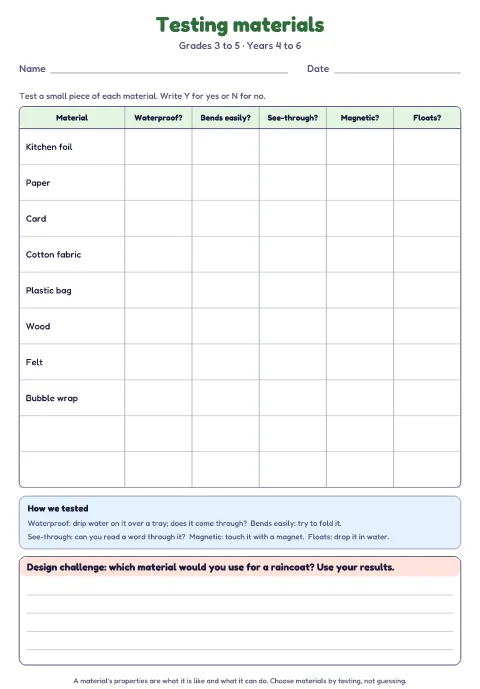
Eight samples, kitchen foil, paper, card, cotton fabric, a plastic bag, wood, felt and bubble wrap, tested five ways: is it waterproof, does it bend easily, is it see-through, is it magnetic and does it float. A panel describes a simple way to run each test so results are comparable, and the design challenge asks children to choose a raincoat material using their own results as evidence.
Safe method for grown-ups: Everyday objects or scraps of wood, metal (kitchen foil), plastic, fabric, paper and card, a jug of water and a magnet. Leave out glass, sharp edges and anything with batteries. Fold the edges of foil scraps. Do the water test on a tray.
Fair tests
22. Our fair test planner, kindergarten to grade 2
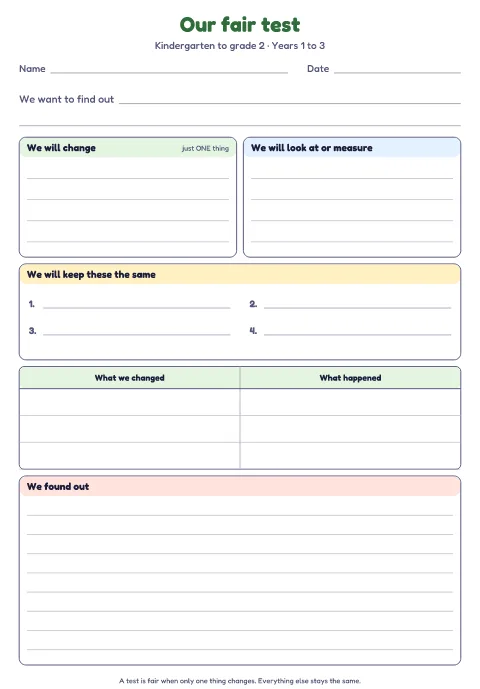
A first fair test in words young children can manage: we want to find out; we will change (just one thing); we will look at or measure; four lines for what we will keep the same; a three-row results table; and we found out. Rolling a toy car down a ramp onto different floors is a good first test, because children can see straight away why the ramp must stay the same height.
23. Fair test planner for grades 3 to 5
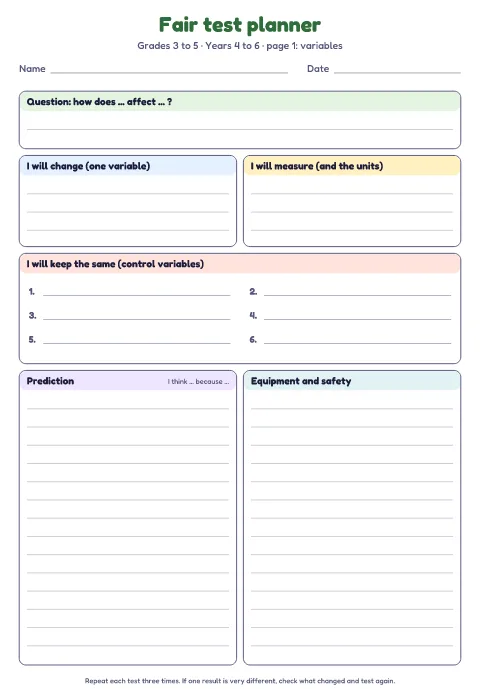
Page 1 sets out the variables: the question as “how does… affect…?”, the one variable to change, what to measure and its units, six control variables, a prediction with a reason, and equipment and safety. Page 2 has a results table for three repeat tests and a typical result, a graph grid, a conclusion frame, “was it fair?” and what to test next. It is the planner to use with the magnet strength test and the light and dark bean test above.
Safe method for grown-ups: Whatever the question needs. A good first test: a toy car, a ramp made from a board and books, a tape measure, and different floor surfaces. Keep ramps low and walkways clear. Run each test three times and keep everything the same except the one thing you change.
For grown-ups
24. Teacher and parent guide: safe methods and usual results
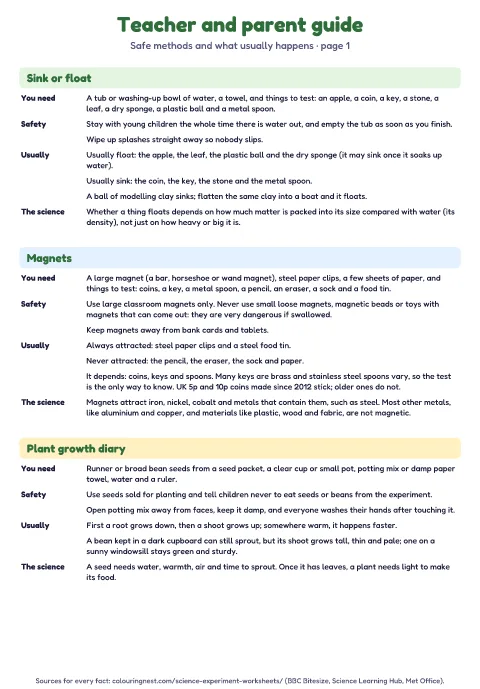
Two pages that go with every sheet: for each experiment, what you need, the safety points, what usually happens (the answers children will want to check) and the science in one sentence. It flags the results that vary, such as coins, keys and spoons with a magnet, so you can say “let’s test it” with confidence instead of guessing.
How we made these science sheets
We wrote and drew every sheet ourselves. The experiments use only safe household things: no heat, flames, chemicals, glass, small magnets or anything to eat, and each has a safe method written for the grown-up in charge. Each science statement was checked against a teaching source before it went on a sheet. For example, an object floats when it is less dense than the water it pushes aside, which is why a ball of modelling clay sinks but the same clay shaped as a boat floats; magnets attract iron, nickel, cobalt and steel, but not aluminium or copper; and weather stations measure air temperature in the shade, 1.25 m above the ground. Sheets print well in black and white: tints turn pale grey, and every sheet has an ink-saver version with no colour at all.
The levels are a guide, not a rule: an able five-year-old may enjoy the K–2 sheet, and a grade 4 class new to investigations may start with it too. The kindergarten to grade 2 sheets suit the Year 1 and 2 working scientifically aims in England and the early levels of the New Zealand and Australian science curricula; the grades 3 to 5 sheets add the fair testing, measuring and graphing that older primary children are asked for. Sources: Science Learning Hub (University of Waikato): Building Science Concepts, floating and sinking; BBC Bitesize: Buoyancy; BBC Bitesize KS2: Which materials are magnetic?; BBC Bitesize KS3: Magnets and magnetic materials; BBC Bitesize: What do plants need to grow?; Wikipedia: Germination; Wikipedia: Etiolation; Met Office: How we measure wind; Met Office: How we measure temperature; Met Office: How we measure rainfall; BBC Bitesize KS2: What is a fair test?.
More for curious children: the human body worksheets with labelled diagrams, the solar system colouring pages, the printable ruler that prints true to size for measuring plants, the measurement kit for younger measurers, and our teachers’ hub with every worksheet by subject and age.
Related sets
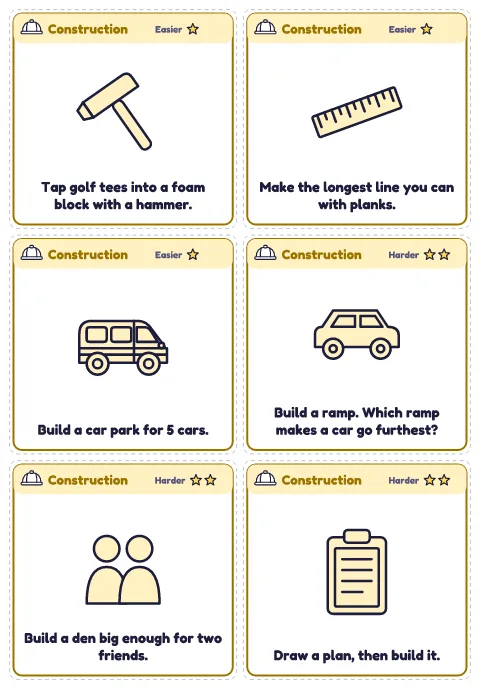 Continuous provision challenge cards for 10 play areasCards · ages 3–5
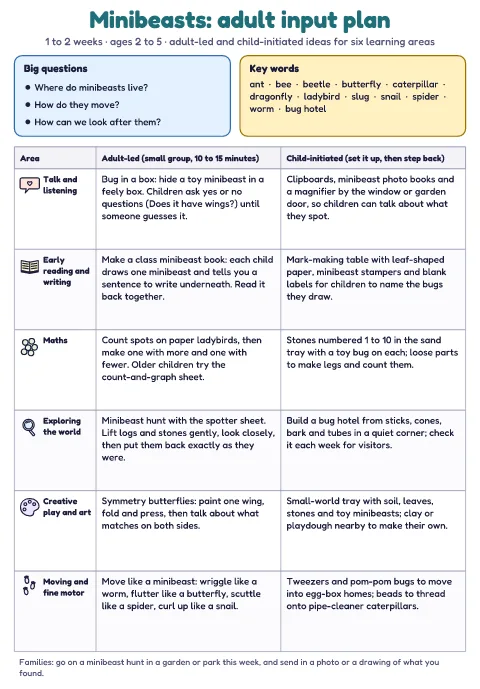 Minibeasts topic pack: adult input plan, word cards, sheetsTemplates · ages 2–5
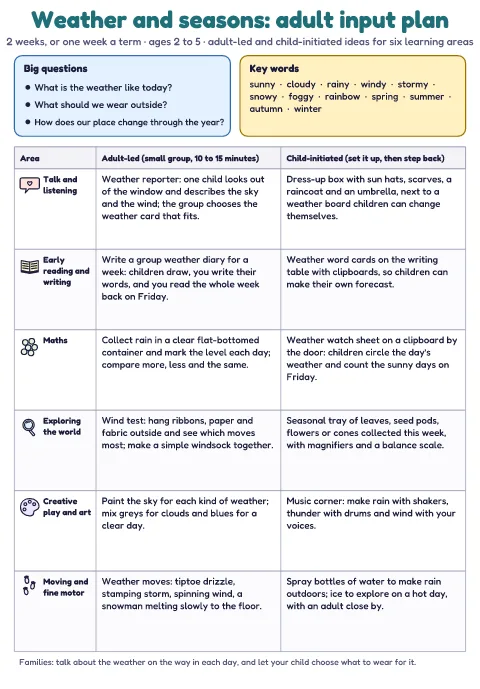 Weather and seasons topic pack (both hemispheres)Templates · ages 2–5
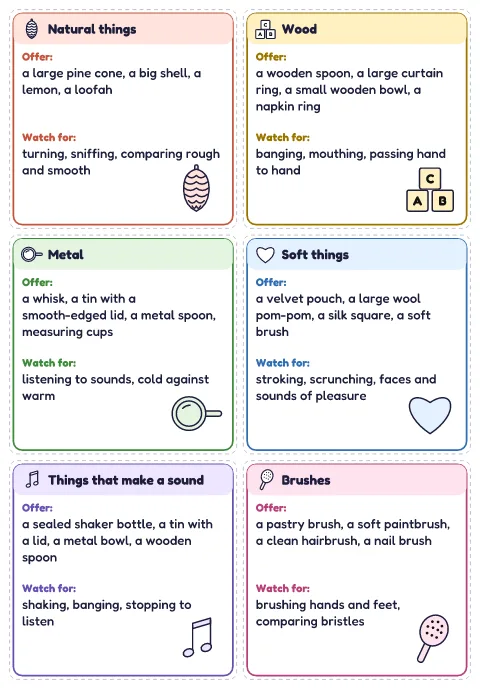 Treasure basket and heuristic play idea cardsCards · ages 0–2
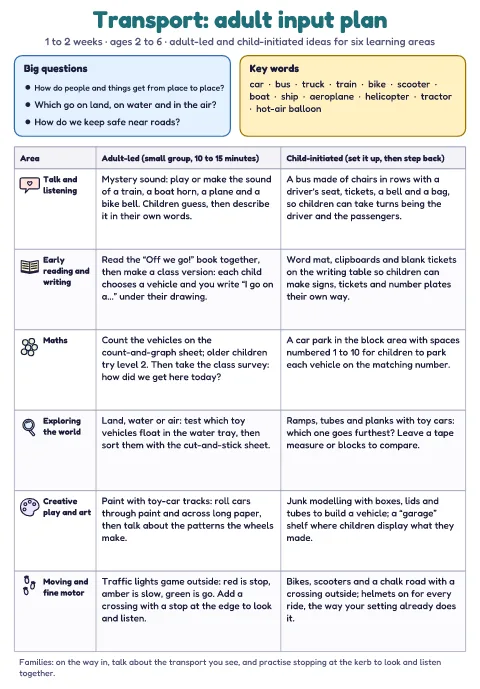 Transport topic pack: plan, word cards, road safety, sortsTemplates · ages 2–6
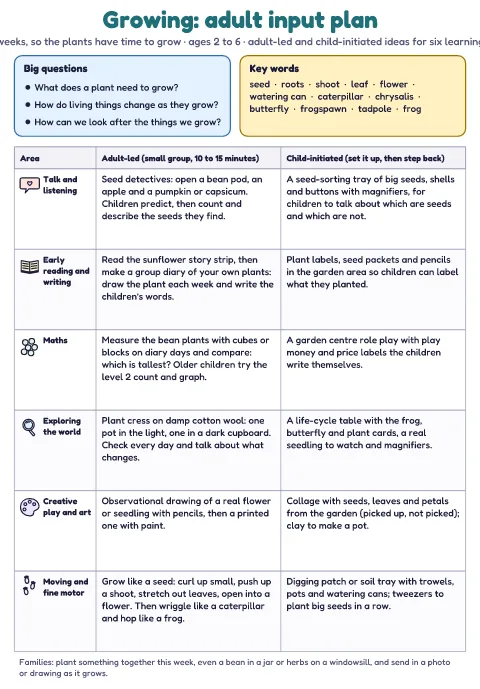 Growing topic pack: plant, butterfly and frog life cyclesTemplates · ages 2–6
Questions
What are the steps of the scientific method for kids?
Ask a question, make a prediction (a hypothesis) with a reason, plan and do a test, observe and record what happens, then draw a conclusion and compare it with the prediction. For young children the same steps are: I wonder, I think, I try, I see, I found out.
Why do some things float and others sink?
It depends on density: how much matter is packed into an object compared with the same amount of water. Objects less dense than water float. That is why a ball of modelling clay sinks but the same clay shaped into a boat, which holds air, floats.
Which objects are magnetic?
Things made of iron, nickel, cobalt or steel, such as steel paper clips and food tins. Aluminium, copper, gold and silver are not magnetic, nor are plastic, wood, paper and fabric. Coins, keys and spoons vary, so test them.
What is a fair test in science?
A test where you change only one thing, keep everything else the same and measure one thing, so you know the change caused the result. Repeating it three times makes the result more reliable.
Do beans need light to grow?
Most seeds sprout in the dark as well as the light, because they need water, warmth and air to start. After that a plant needs light to make its food, so a bean kept in the dark grows tall, thin and pale.
Are these science experiments safe for preschoolers?
Yes, with a grown-up. They use water, magnets, seeds and everyday objects only. Stay with young children near water, use large magnets only, and never let children eat seeds from an experiment.
Are these science worksheets free?
Yes. Print as many as your class, homeschool group or family needs, without an account. If you want to share them, send people the link to this page; the sheets are not for resale or re-uploading.