 Colouring Nest
Symmetry worksheets: lines of symmetry, mirror pictures and rotational symmetry
Free symmetry worksheets with answers for grades 1 to 6 and Years 2 to 6: 15 printable resources, from a first fold to rotational symmetry. A line of symmetry is a line that cuts a shape into two halves that match exactly, so that folding along it puts one half on top of the other. Here you will find anchor charts, word cards, “Is the dashed line a line of symmetry?”, draw every line of symmetry, symmetry tables for regular polygons and quadrilaterals, complete the symmetrical picture on a squared grid at three levels, symmetry in capital letters, mirror words, a symmetry sort, a mirror activity, rotational symmetry at two levels, two symmetry colouring pages, design grids and a symmetry hunt. Every PDF comes in A4 and US Letter and prints well in black and white.
Inside this set
- 15 printables
- A4 and US Letter PDFs
- Colour and ink-saver versions
- Free, no sign-up
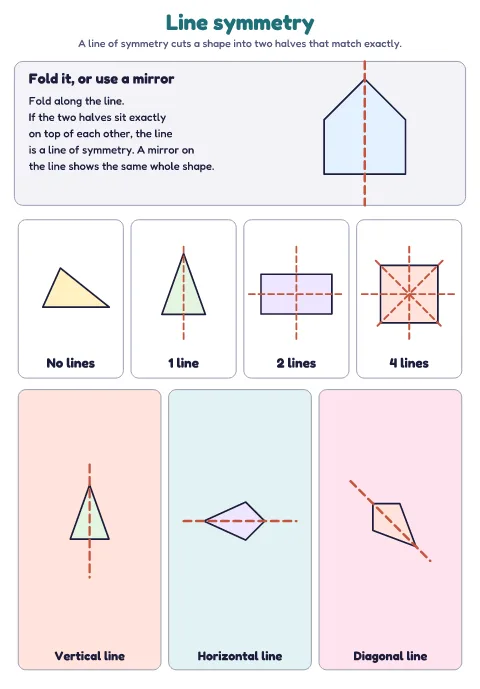 Symmetry anchor charts
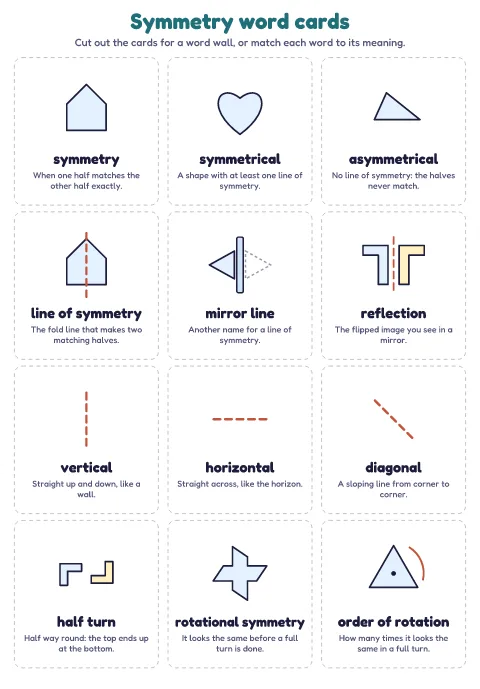 Symmetry vocabulary cards
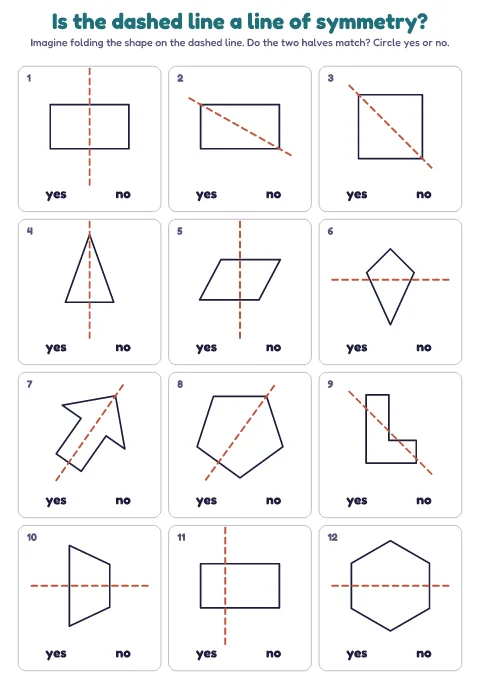 Is the dashed line a line of symmetry?
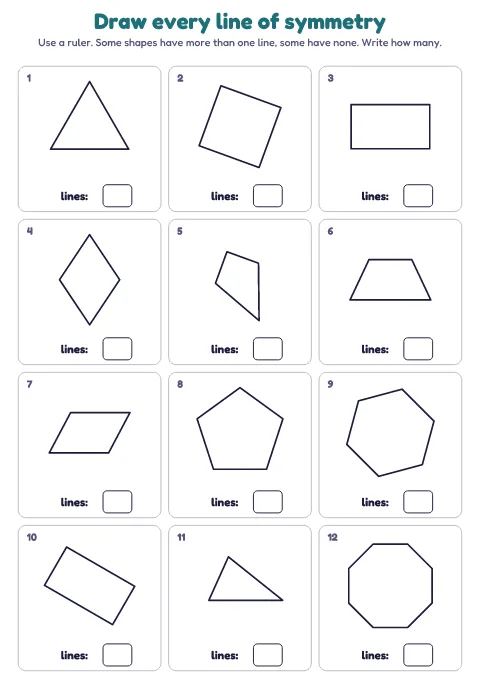 Draw every line of symmetry
 Symmetry tables: regular polygons and quadrilaterals
 Complete the symmetrical picture: levels 1 and 2
 Complete the picture: sloping and crossing mirror lines
 Symmetry in capital letters
 Mirror words
 Symmetry sort cards
 Mirror activity: make it whole
 Rotational symmetry: half turn and order
 Symmetry colouring pages
 Symmetry design grids
 Symmetry hunt
Why these sheets are different
Most free symmetry sheets test one thing: a picture beside a vertical line. Children get good at that and then stall when the line slopes, when the shape is turned, or when the mirror line sits a square away from the picture. In England’s Year 4 those are exactly the cases pupils are expected to handle, and a grade 4 class in the US works on the same idea in 4.G.A.3. So these resources move on deliberately: vertical lines first, then horizontal lines and half squares, then sloping lines, two lines at once and a picture that does not touch its line.
The answers are worked out, not typed. Every shape on the sheets is stored as its corner points, and the answer pages come from flipping those points over each possible line and checking whether the shape lands on itself; rotational symmetry comes from turning them. The grid pictures are stored square by square, so the answer is the reflection of the question. That is why a parallelogram is never shown with a line of symmetry (it has none, although it does look the same after a half turn), and why the regular hexagon has all six of its lines, including the three that pass through the middles of its sides.
Letters are a known trap. Whether an S, a K or a C is symmetrical depends on how it is written. Rather than leave letters out, we drew our own block capitals on a grid of squares and checked each one: A, H, I, M, O, T, U, V, W, X and Y have a vertical line; B, C, D, E, H, I, K, O and X have a horizontal line; H, I, N, O, S, X and Z look the same after a half turn. The sheet tells children that their own handwriting may give a different answer, which is a good conversation in itself.
Start here: charts and words
1. Symmetry anchor charts
Two posters. Line symmetry: the fold-and-match idea, a mirror on the line, shapes with no lines, one line, two lines and four lines (the lines are drawn from the shapes, not by hand), and vertical, horizontal and diagonal lines each shown on a shape. Rotational symmetry: order 1 to 4 with a kite, a rectangle, an equilateral triangle and a square, each beside a copy turned by the smallest step that matches. Print on A4 or Letter, or enlarge to A3 for the wall.
2. Symmetry vocabulary cards
Twelve cards, each with a small picture and a one-line meaning a seven-year-old can follow: symmetry, symmetrical, asymmetrical, line of symmetry, mirror line, reflection, vertical, horizontal, diagonal, half turn, rotational symmetry and order of rotation. Use them on a word wall, or cut the word from the meaning for a matching game.
Advertisement
Lines of symmetry in 2D shapes
3. Is the dashed line a line of symmetry?
Twelve shapes, each with one dashed line. Children decide whether folding along it would make the halves match and circle yes or no. Several are turned at an angle, and the near-misses are the ones that catch children out: the diagonal of a rectangle, the middle of a parallelogram, a line across a kite and a line that is in the right direction but not through the middle. On the answer page, each “no” shows in blue dashes where the shape would land if you flipped it.
4. Draw every line of symmetry
Twelve shapes to draw on with a ruler, with a box for how many lines each has: an equilateral triangle, a square on a slant, a rectangle upright and turned, a rhombus, a kite, an isosceles trapezium, a parallelogram, a scalene triangle and a regular pentagon, hexagon and octagon. Expect children to miss the diagonals of the square and the lines through the sides of the hexagon; the answer page draws them all.
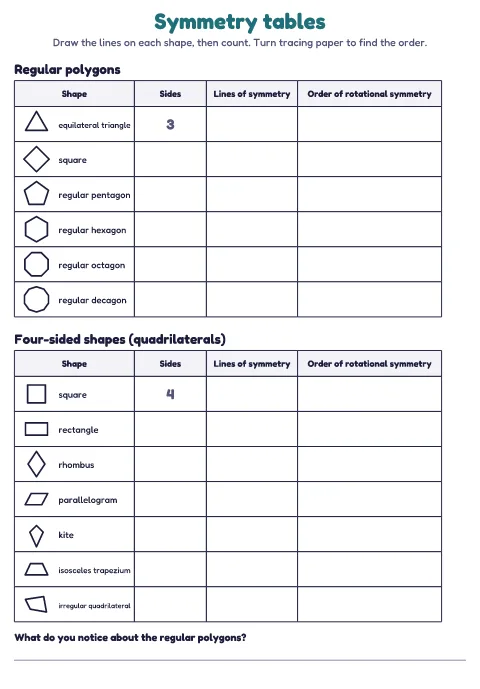
5. Symmetry tables: regular polygons and quadrilaterals
Two tables to fill in for upper primary: six regular polygons from the equilateral triangle to the decagon, then seven four-sided shapes from the square to an irregular quadrilateral. For each, write the sides, the lines of symmetry and the order of rotational symmetry, then say what you notice. A regular shape with n sides has n lines and order n; the rhombus and the rectangle each have 2 lines but in different places, and the parallelogram has none.
Complete the symmetrical picture
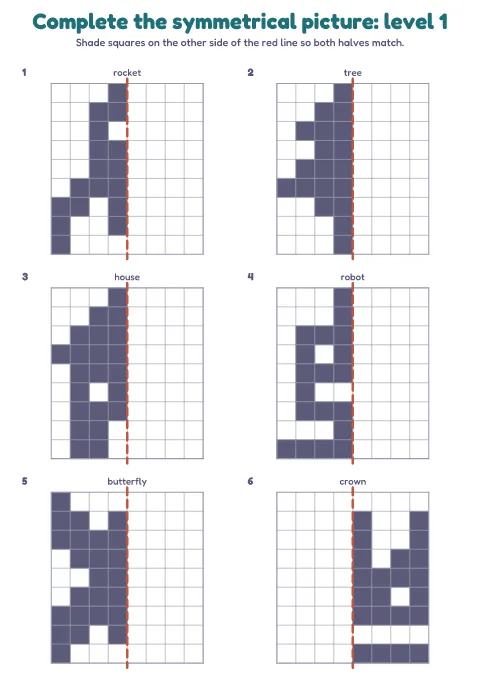
6. Complete the symmetrical picture: levels 1 and 2
Level 1 has six pictures made of whole squares beside a red vertical mirror line: a rocket, a tree, a house, a robot, a butterfly and a crown (the crown is drawn on the right, so children work right to left). Level 2 adds half squares cut on a slant and a horizontal line: an owl, a tulip, a fish and a mountain reflected in a lake. Each answer page shades the new squares in blue beside the given half.
Complete the picture PDF (A4)Complete the picture PDF (US Letter)
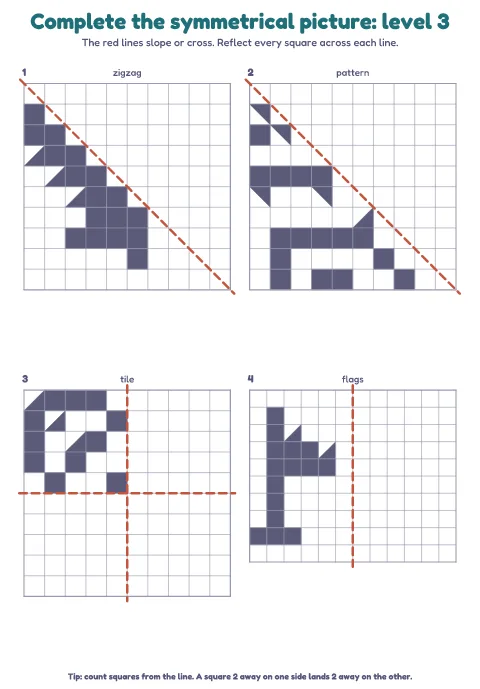
7. Complete the picture: sloping and crossing mirror lines
Four harder grids for confident pupils: two patterns to reflect across a diagonal line, a tile to complete across two lines that cross (reflect the quarter into all three other quarters), and two flags that sit a square away from the line, the case the Year 4 guidance mentions. The tip at the foot gives the method: count squares from the line.
Play online: the free symmetry game, “Mirror it” has the same kind of grid pictures to finish on screen, from a line down the middle to sloping lines, two lines and pictures away from the line, and checks each square. Its “Make your own pattern” mode mirrors as you draw.
Letters, words and sorting
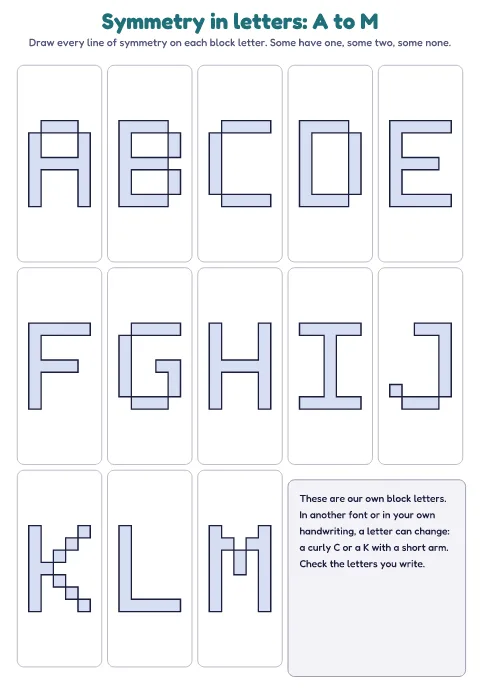
8. Symmetry in capital letters
All 26 block capitals over two pages, each in its own box, for children to draw every line of symmetry. The answer pages draw the lines and give the count. H, I, O and X have two lines in our letters; F, G, J, L, N, P, Q, R, S and Z have none.
9. Mirror words
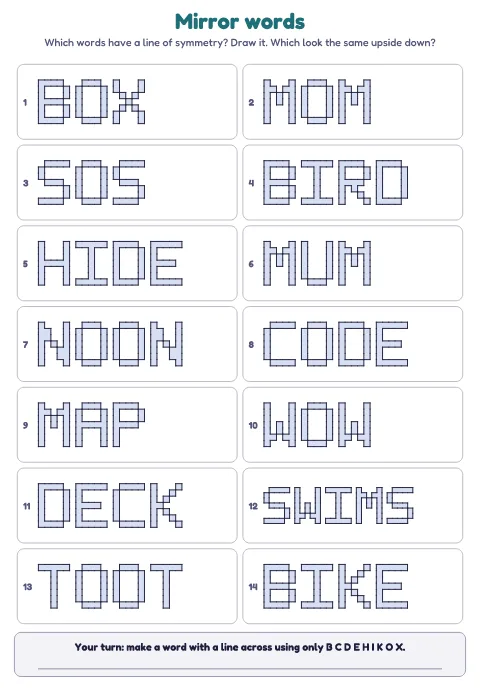
Fourteen words in block letters. Some have a line across the middle (BOX, HIDE, CODE, DECK, BIKE), some a line down the middle (MOM, MUM, WOW, TOOT), some look the same upside down (SOS, NOON, SWIMS) and two have no symmetry at all. Children draw the line or write “half turn”, then try to make their own word from the letters with a line across.
10. Symmetry sort cards
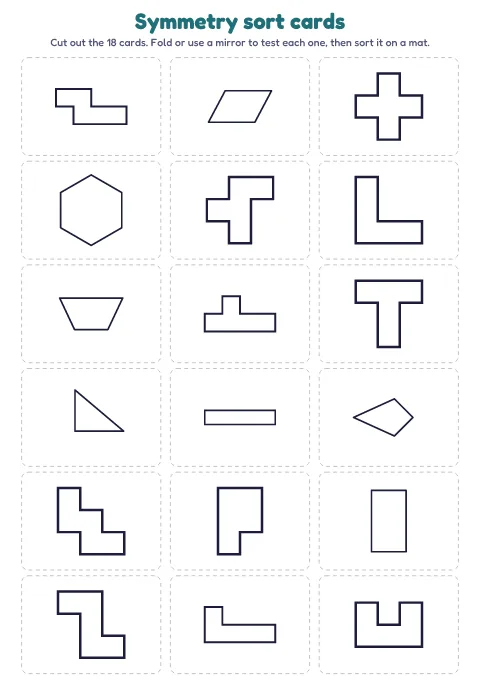
Eighteen cards: the twelve pentominoes and six shapes, including a parallelogram, a kite and a regular hexagon. Level 1 sorts them into symmetrical or not symmetrical; level 2 into no lines, one line, and two or more lines. The V and W pentominoes only have a sloping line, which is the point. Both answer mats place every card.
Mirrors, turning and making
11. Mirror activity: make it whole
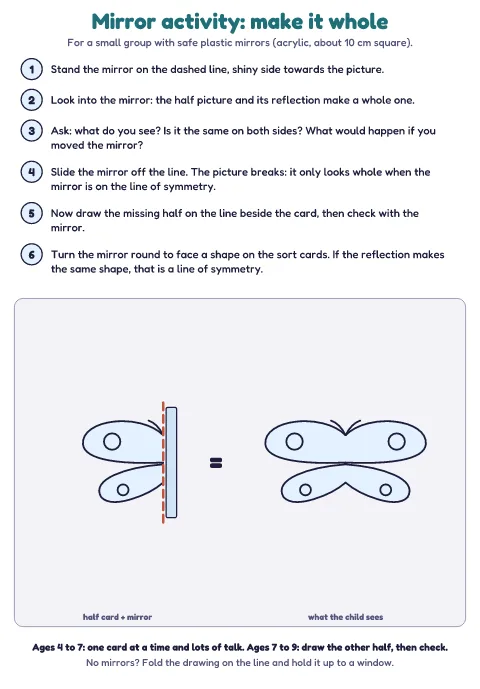
A one-page guide for a small group with safe plastic mirrors, in six short steps with questions to ask, and eight half-picture cards (butterfly, tree, house, rocket, face, tulip, crown and beetle) with a red line to stand the mirror on. Younger children look and talk; older ones draw the missing half and check it with the mirror. No mirrors? Fold the drawing and hold it up to a window.
12. Rotational symmetry: half turn and order
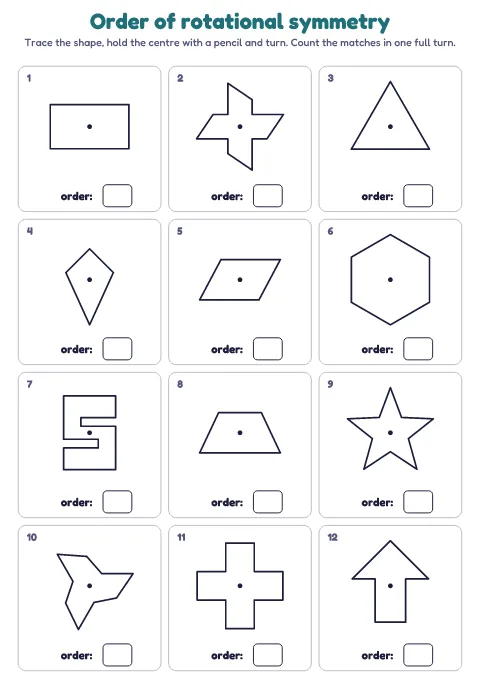
Twelve shapes on each level. Level 1 asks only whether the shape looks the same after a half turn. Level 2 asks for the order of rotational symmetry, from 1 (a kite, an arrow) to 6 (a regular hexagon). The two windmills turn onto themselves 3 and 4 times but have no line of symmetry at all, which shows that the two kinds of symmetry are different ideas.
Rotational symmetry PDF (A4)Rotational symmetry PDF (US Letter)
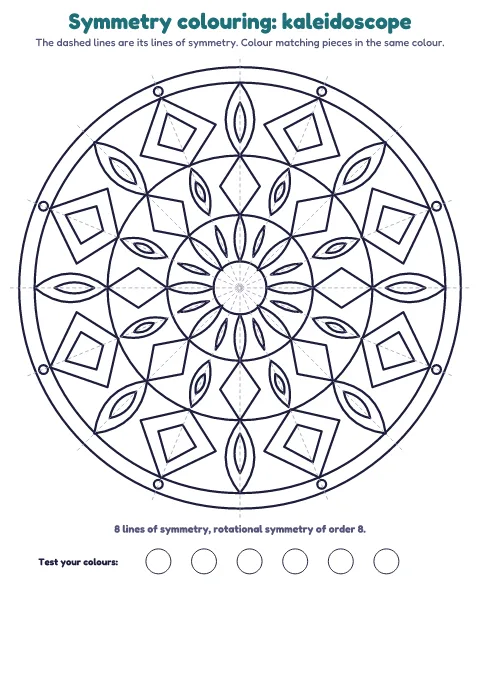
13. Symmetry colouring pages
Two detailed designs for older children and grown-ups: a kaleidoscope with 8 lines of symmetry, drawn with its lines faint and dashed so you can see the matching pieces, and a six-fold star without the lines. Colour one piece, then every piece that matches it. More designs like these are in our mandala colouring pages and geometric colouring pages.
Symmetry colouring PDF (A4)Symmetry colouring PDF (US Letter)
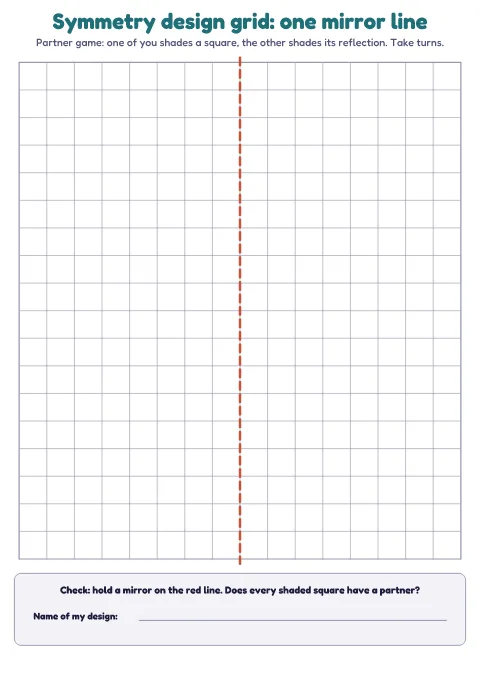
14. Symmetry design grids
Three squared grids with mirror lines already drawn: one vertical line, two lines that cross, and one sloping line. Use them for a partner game (one shades a square, the other shades its reflection) or to design a symmetrical pattern of your own.
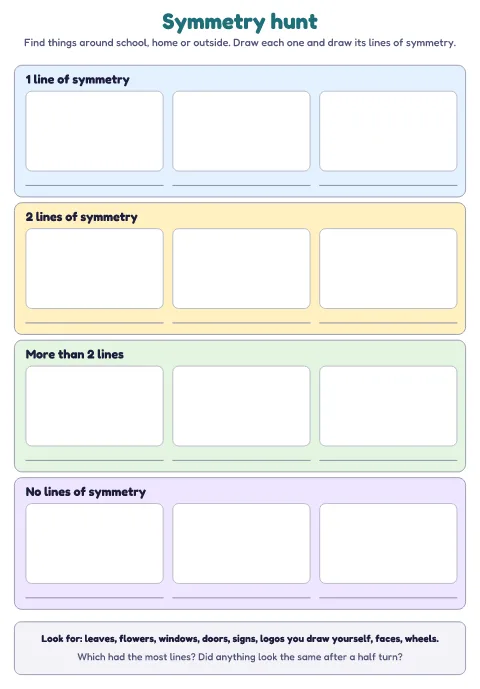
15. Symmetry hunt
A record sheet with rows for things with 1 line, 2 lines, more than 2 lines and no lines of symmetry. Children draw what they find and add the lines. Leaves, windows, doors, faces and wheels are good finds.
Teaching symmetry: an order that works
- Fold and look. Paint blobs on one half of a sheet, fold and press, then open it out. Use the mirror cards. Name the fold line: the line of symmetry, or mirror line.
- Find lines in shapes. Use the anchor chart, then “Is the dashed line a line of symmetry?”. Cut out shapes and fold them to check before drawing anything.
- Complete pictures on a grid. Level 1 with whole squares and a vertical line, counting squares from the line. Then level 2.
- Turn shapes round. Draw every line of symmetry, including shapes on a slant. Sort the cards, then try the letters and mirror words.
- Go further. Level 3 grids, the symmetry tables and rotational symmetry, with tracing paper to turn.
In England, Year 2 pupils should be taught to identify and describe the properties of 2-D shapes, including the number of sides, and line symmetry in a vertical line. In Year 4 they identify lines of symmetry in 2-D shapes presented in different orientations, and complete a simple symmetric figure with respect to a specific line of symmetry (national curriculum, mathematics programmes of study); the non-statutory guidance adds lines of symmetry that do not cut through the shape. At key stage 3, pupils describe polygons that are reflectively and rotationally symmetric. In the US Common Core, grade 4 students recognize a line of symmetry for a two-dimensional figure as a line across the figure such that the figure can be folded along the line into matching parts, identify line-symmetric figures and draw lines of symmetry (4.G.A.3). These resources support that work alongside your school’s scheme; they do not replace it.
Symmetry follows on from naming and sorting shapes: our 2D and 3D shapes anchor charts, nets and games and the shapes worksheets cover sides, corners and faces first. For grids and drawing, print graph paper; for turning and fitting shapes, try the tangram puzzles. More by grade: second grade, third grade and fourth grade math worksheets, including angles and lines in the measurement worksheets, and more for teachers.
Questions
What is a line of symmetry?
A line of symmetry is a line that cuts a shape into two halves that match exactly: if you fold along it, one half sits on top of the other, and a mirror on the line shows the whole shape. It is also called a mirror line. A shape can have no lines of symmetry, one line or several.
How many lines of symmetry does a rectangle have?
A rectangle that is not a square has 2 lines of symmetry: one down the middle and one across the middle. Its diagonals are not lines of symmetry, because folding along a diagonal does not make the halves match. A square has 4 lines: 2 through the middles of its sides and 2 diagonals.
How many lines of symmetry does a regular polygon have?
A regular polygon with n sides has n lines of symmetry and rotational symmetry of order n. An equilateral triangle has 3, a square 4, a regular pentagon 5, a regular hexagon 6 and a regular octagon 8. In shapes with an even number of sides, half the lines join opposite corners and half join the middles of opposite sides.
What is rotational symmetry?
A shape has rotational symmetry if it looks the same after a turn of less than a full turn about its centre. The order of rotational symmetry is how many times it looks the same in one full turn: a rectangle has order 2, an equilateral triangle order 3 and a square order 4. A shape with order 1 has no rotational symmetry.
Which capital letters are symmetrical?
In our block capitals, A, H, I, M, O, T, U, V, W, X and Y have a vertical line of symmetry, and B, C, D, E, H, I, K, O and X have a horizontal one. H, I, O and X have both. The answer can change with the font or handwriting, so check the letters children actually write.
Are these symmetry worksheets free?
Yes. Free for your own class, school and family, with no sign-up. Please don’t resell them or upload them to another site.