 Colouring Nest
Valentine’s Day and winter math mystery pictures
Free printable math mystery pictures for Valentine’s Day and winter: solve the problem in each square, find the answer in the key and colour the square, and a picture appears. There are 16 pictures, from adding within 10 for kindergarten to fractions of amounts for grade 4, and every one comes at two levels with the same colours, so one answer key serves the whole class. Each PDF has US Letter and A4 sizes, a colour version and a black-and-white version with patterns, and an answer key that shows the finished picture.
Inside this set
- 16 printables
- A4 and US Letter PDFs
- Free, no sign-up
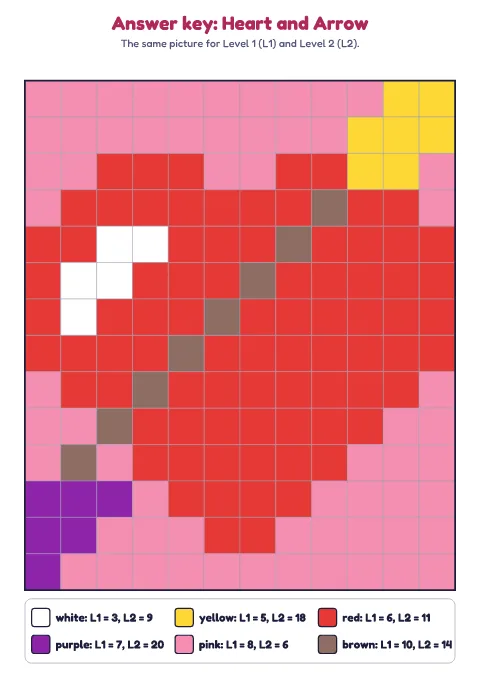 Heart and arrow: adding and taking away within 10 and 20
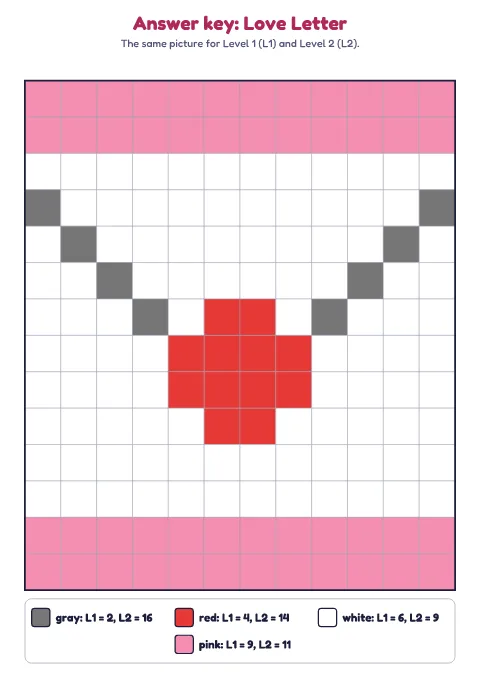 Love letter: adding and taking away within 10 and 20
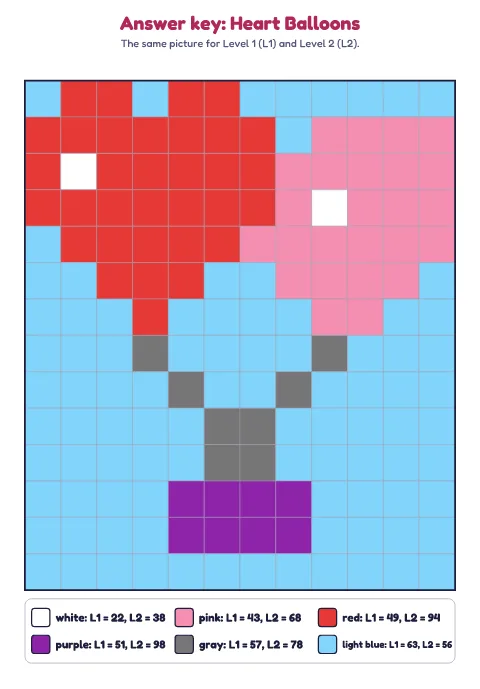 Heart balloons: place value, then two-digit sums
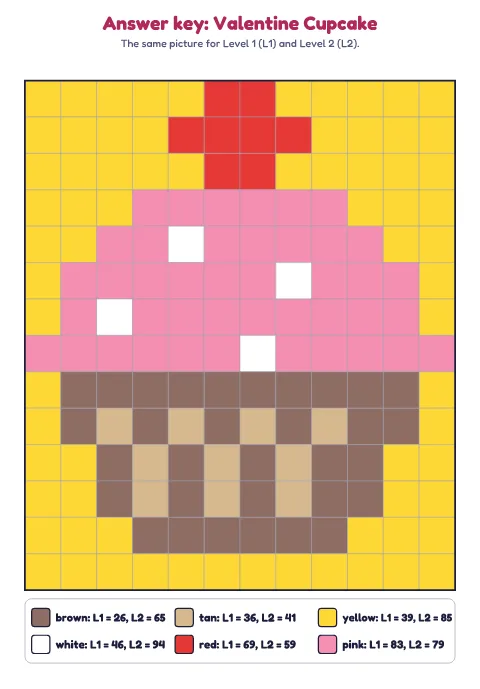 Valentine cupcake: place value, then two-digit sums
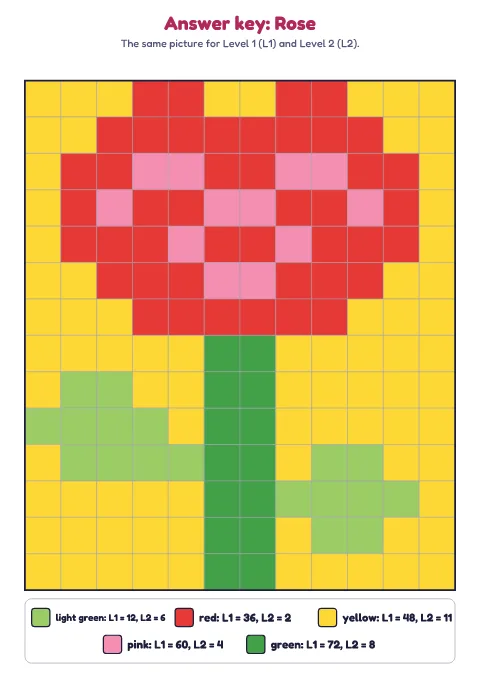 Rose: times tables, then division facts
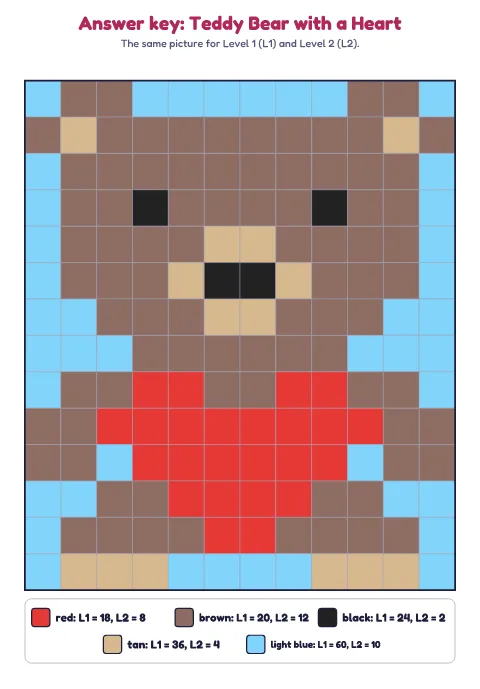 Teddy bear with a heart: times tables, then division facts
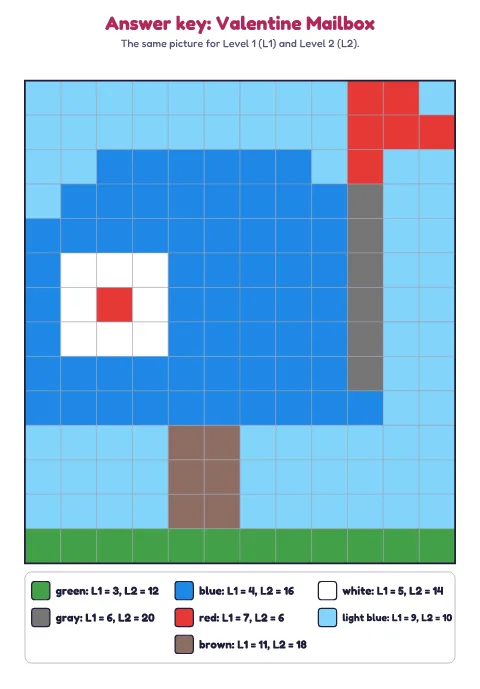 Valentine mailbox: fractions of amounts
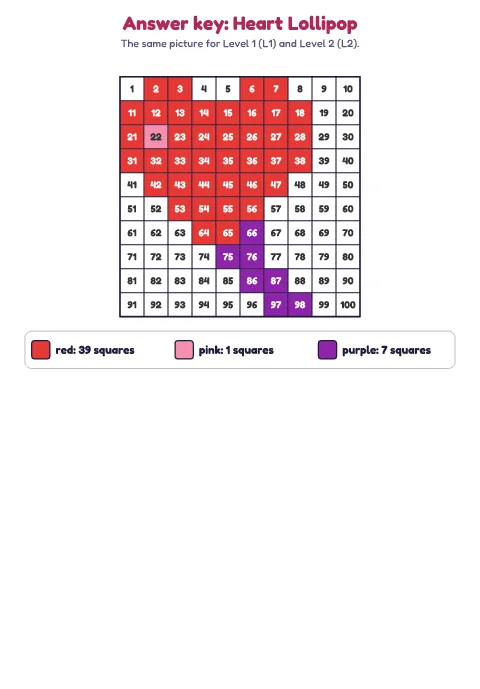 Heart lollipop: hundreds chart mystery picture
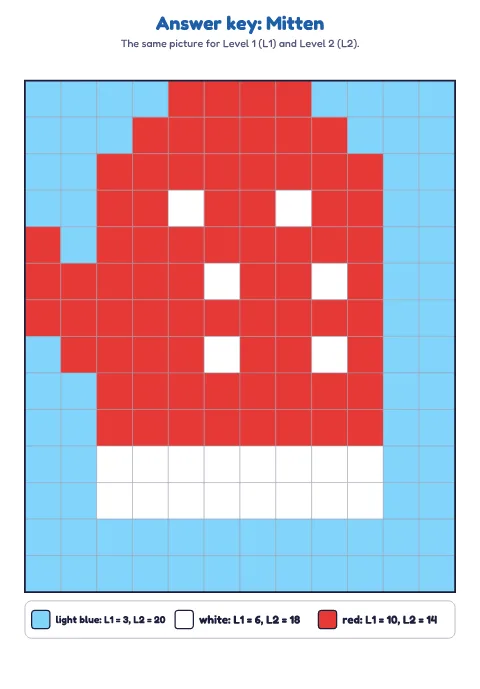 Mitten: adding and taking away within 10 and 20
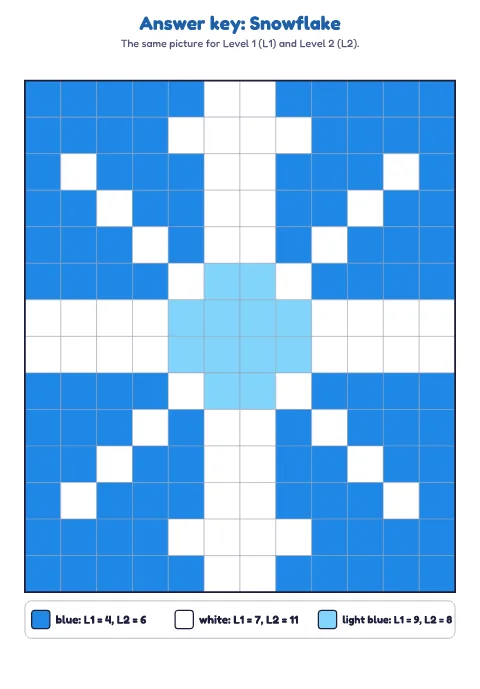 Snowflake: adding and taking away within 10 and 20
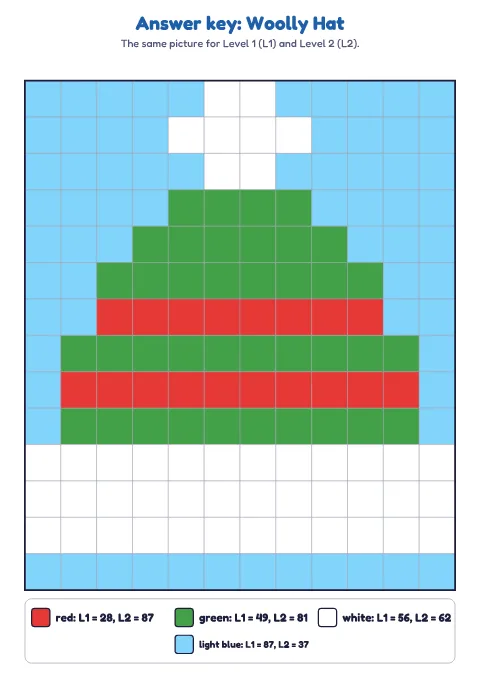 Woolly hat: place value, then two-digit sums
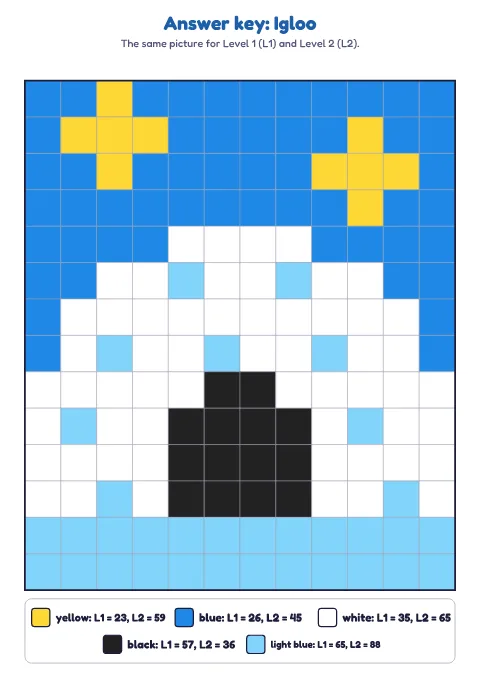 Igloo: place value, then two-digit sums
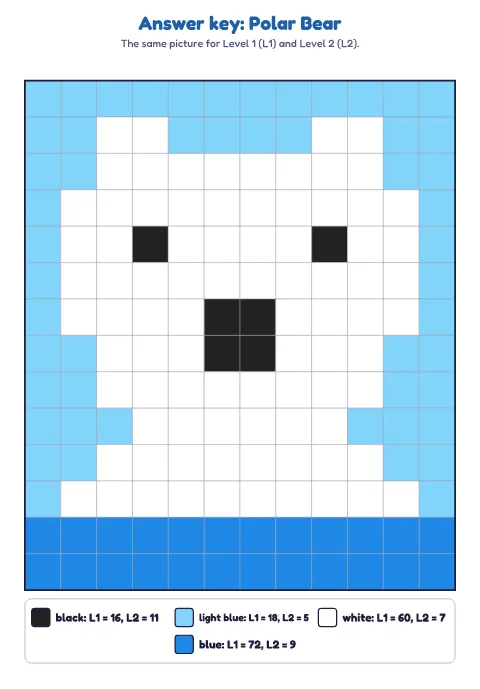 Polar bear: times tables, then division facts
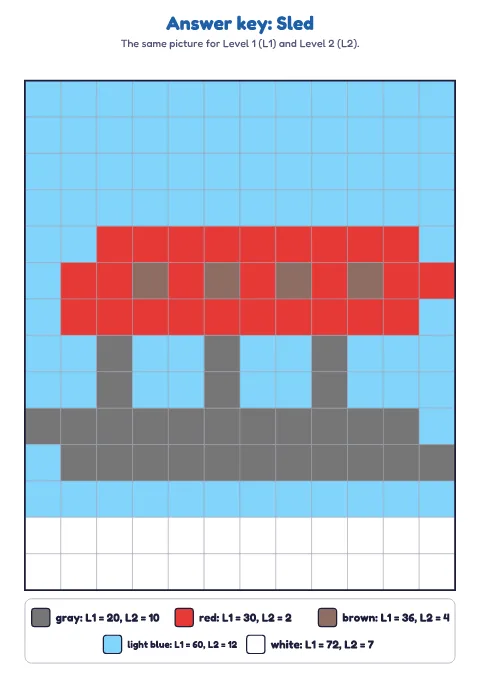 Sled: times tables, then division facts
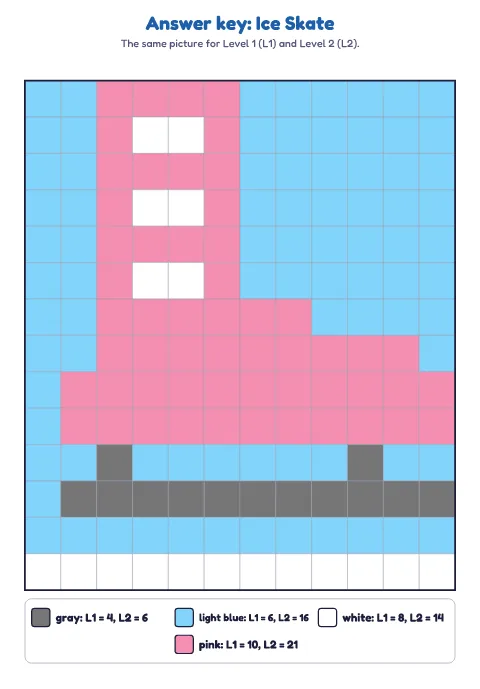 Ice skate: fractions of amounts
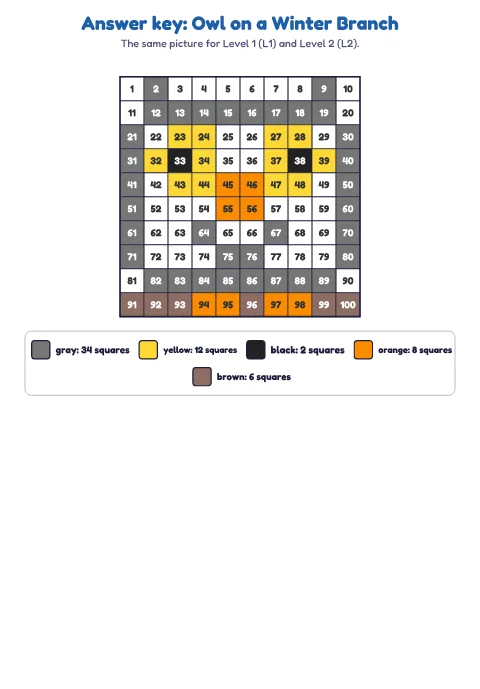 Owl on a winter branch: hundreds chart mystery picture
What is a math mystery picture?
A math mystery picture is a grid of problems where each answer tells you which colour to use. Every square holds a problem, the background squares too, so nothing gives the picture away until most of the grid is coloured. A child who gets an answer wrong sees a square in the wrong colour, which is the self-checking part teachers like: the mistake shows up on its own. They are also called colour by number with addition, colour by code, or solve and colour. Updated 13 November 2026.
How the two levels work
Each picture is printed twice. The colours and the picture are the same; only the problems change. On the heart and arrow, level 1 is adding and taking away within 10 and level 2 is within 20; on the rose, level 1 is times tables and level 2 the matching division facts. Give level 1 to some children and level 2 to others, and the pictures still match when the class is done. The answer key (page 3 of every PDF) shows the finished picture and both levels’ numbers for each colour, such as “red: L1 = 5, L2 = 11”.
Valentine’s Day math mystery pictures
Hearts, a love letter, balloons, a cupcake, a rose, a teddy bear and a classroom Valentine mailbox: nothing romantic, nothing religious, nothing that needs a card to be swapped, so they suit every class in the week before 14 February.
1. Heart and arrow: adding and taking away within 10 and 20
A first mystery picture for kindergarten and grade 1 (Reception to Year 2). Level 1 keeps every number in a problem to 10, such as 7 − 2 and 3 + 4; level 2 goes to 20 with facts such as 14 − 9. The picture uses six colours, so the key is short and a five-year-old can read it with a little help.
Heart and arrow PDF (A4)Heart and arrow PDF (US Letter)
Black and white, with patterns (A4)Black and white, with patterns (US Letter)
2. Love letter: adding and taking away within 10 and 20
An envelope with a heart seal and only four colours: pink, white, grey and red. Fewer colours mean more squares share an answer, which makes it the gentlest sheet on the page and a good one for children who are new to the idea that a square’s answer names its colour.
Love letter PDF (A4)Love letter PDF (US Letter)
Black and white, with patterns (A4)Black and white, with patterns (US Letter)
3. Heart balloons: place value, then two-digit sums
Level 1 practises tens and ones and adding or taking away 10 or 20: 40 + 7, 7 + 40, 37 + 10 and 67 − 20 all colour the same square. Level 2 moves to two-digit adding and taking away with no regrouping, such as 52 + 42 and 78 − 34. Grade 1 and 2 (Years 2 and 3).
Heart balloons PDF (A4)Heart balloons PDF (US Letter)
Black and white, with patterns (A4)Black and white, with patterns (US Letter)
4. Valentine cupcake: place value, then two-digit sums
The same two skills on a second picture, for the class that finishes the balloons and asks for more. The striped case has many squares in two close colours (brown and tan), so children have to check each answer rather than guess from the pattern.
Valentine cupcake PDF (A4)Valentine cupcake PDF (US Letter)
Black and white, with patterns (A4)Black and white, with patterns (US Letter)
5. Rose: times tables, then division facts
Level 1 is times tables to 12 × 12, and every colour has at least two different facts (36 is 4 × 9 and 6 × 6), so children can’t colour from one memorised fact. Level 2 is the matching division facts, such as 88 ÷ 8 and 55 ÷ 5. Grades 3 and 4 (Years 4 and 5).
Rose PDF (A4)Rose PDF (US Letter)
Black and white, with patterns (A4)Black and white, with patterns (US Letter)
6. Teddy bear with a heart: times tables, then division facts
A second times tables and division picture with five colours. Hand out level 1 to children still learning their tables and level 2 to those who know them: when both groups finish, every bear in the room looks the same, which makes a nice display.
Teddy bear PDF (A4)Teddy bear PDF (US Letter)
Black and white, with patterns (A4)Black and white, with patterns (US Letter)
7. Valentine mailbox: fractions of amounts
For older children. Level 1 is unit fractions of amounts: 1/2 of 18, 1/3 of 27, 1/4 of 36, 1/5 of 45 and 1/10 of 70. Level 2 uses fractions such as 2/5 of 40, 2/3 of 15 and 5/8 of 16, always in simplest form. Divide by the bottom number, multiply by the top. Grades 3 to 5 (Years 4 to 6).
Valentine mailbox PDF (A4)Valentine mailbox PDF (US Letter)
Black and white, with patterns (A4)Black and white, with patterns (US Letter)
8. Heart lollipop: hundreds chart mystery picture
A 1 to 100 chart with 47 problems listed by colour under it. Level 1: 10 more, 10 less, 1 more and 1 less (36 + 10, 45 − 1); level 2: add and take away 9, 11, 20 and 30. Children find each answer on the chart and colour it, which builds the “down a row is 10 more” idea that two-digit adding depends on. Tick boxes beside each clue help children keep their place.
Heart lollipop PDF (A4)Heart lollipop PDF (US Letter)
Black and white, with patterns (A4)Black and white, with patterns (US Letter)
Advertisement
Winter math mystery pictures (January and February in the northern hemisphere)
A mitten, a snowflake, a woolly hat, an igloo, a polar bear, a sled, an ice skate and an owl. They fit the winter months in the US, Canada, the UK and Europe. In Australia and New Zealand January and February are summer, so these suit a winter topic in June to August instead; there is no Christmas in them, so they work after the holidays.
9. Mitten: adding and taking away within 10 and 20
Three colours only (red, white and light blue), so it is the easiest winter sheet: a good first mystery picture for kindergarten, or a warm-up before a harder one. Level 1 within 10, level 2 within 20.
Mitten PDF (A4)Mitten PDF (US Letter)
Black and white, with patterns (A4)Black and white, with patterns (US Letter)
10. Snowflake: adding and taking away within 10 and 20
A six-armed snowflake that only appears once the blue background is coloured, so it rewards finishing the whole grid. Three colours; level 1 within 10 and level 2 within 20, such as 9 + 10 and 18 − 5.
Snowflake PDF (A4)Snowflake PDF (US Letter)
Black and white, with patterns (A4)Black and white, with patterns (US Letter)
11. Woolly hat: place value, then two-digit sums
Stripes make this one easy to check as you go: if one square in a stripe comes out a different colour, an answer is wrong. Level 1 is tens and ones and 10 or 20 more or less; level 2 is two-digit sums such as 26 + 11 and 77 − 40.
Woolly hat PDF (A4)Woolly hat PDF (US Letter)
Black and white, with patterns (A4)Black and white, with patterns (US Letter)
12. Igloo: place value, then two-digit sums
Ice blocks, a dark doorway and stars in a night sky. Five colours, the same two place value levels as the woolly hat, for a second sheet or a different group.
Igloo PDF (A4)Igloo PDF (US Letter)
Black and white, with patterns (A4)Black and white, with patterns (US Letter)
13. Polar bear: times tables, then division facts
Four colours and big white areas: a gentler times tables picture for children who have just learned the 2, 3, 5 and 6 tables, with the matching division facts on level 2.
Polar bear PDF (A4)Polar bear PDF (US Letter)
Black and white, with patterns (A4)Black and white, with patterns (US Letter)
14. Sled: times tables, then division facts
Five colours, products such as 20, 30, 36, 60 and 72 on level 1 and division facts such as 72 ÷ 6 and 144 ÷ 12 on level 2.
Sled PDF (A4)Sled PDF (US Letter)
Black and white, with patterns (A4)Black and white, with patterns (US Letter)
15. Ice skate: fractions of amounts
Four colours and fewer problems per answer than the mailbox, for a first go at fractions of amounts. Level 1 unit fractions (1/3 of 18), level 2 fractions such as 3/4 of 28 and 7/10 of 30.
Ice skate PDF (A4)Ice skate PDF (US Letter)
Black and white, with patterns (A4)Black and white, with patterns (US Letter)
16. Owl on a winter branch: hundreds chart mystery picture
62 problems on a 1 to 100 chart: the owl’s outline, eyes, beak and feet and the branch it sits on. Level 1 adds and takes away 10 and 1; level 2 adds and takes away 9, 11, 20 and 30. A longer task for a whole maths lesson or two early-finisher sessions.
Winter owl PDF (A4)Winter owl PDF (US Letter)
Black and white, with patterns (A4)Black and white, with patterns (US Letter)
How to use them in class
- Model one row. Solve the first three squares together, find each answer in the key and colour them. Then point out that the background has problems too.
- Solve, then colour. Some children like to write every answer first and colour after; others colour as they go. Both work. Writing the answer small in the corner makes checking easier.
- Use the picture to check. A square in the wrong colour stands out. Ask the child to find it and fix the problem, not just the colour.
- Black and white. If the printer is black and white or children only have pencils, use the pattern version: each colour in the key also has a pattern (stripes, dots, cross-hatch), and the finished picture shows up in patterns.
- Time. 168 squares take most children 25 to 45 minutes, about one maths lesson; the hundreds charts take less (47 and 62 problems).
Curriculum. In the US Common Core these sheets support 1.OA.C.6 (add and subtract within 20), 2.OA.B.2 (fluently add and subtract within 20), 1.NBT.C.5 and 2.NBT.B.8 (10 more and 10 less), 2.NBT.A.1 (tens and ones), 2.NBT.B.5 (add and subtract within 100), 3.OA.C.7 (multiply and divide within 100) and 4.NF.B.4 (multiply a fraction by a whole number). In England they support Year 1 and 2 number bonds, Year 2 place value, Year 3 and 4 times tables and Year 3 to 5 fractions of amounts.
More to colour and solve: the Valentine’s Day worksheets (heart sums, a candy heart graph and kindness bingo), the Valentine colour by number pages, the hundreds chart mystery pictures (colour the numbers in the key), colour by code, the fact families worksheets, multiplication worksheets, fraction worksheets and the winter colouring pages. December has its own Christmas math worksheets, and the Christmas math mystery pictures pack uses the same grid for 12 Christmas pictures at four levels.
Questions
Are these math mystery pictures free?
Yes. All 16 are free to print for your class, school and family, with no sign-up. Please don’t resell them or upload them to another site.
Do they have answer keys?
Yes. Page 3 of every PDF is the answer key: the finished picture in colour (or in patterns in the black-and-white version) and the number for each colour at both levels (L1 and L2).
What grade are they for?
Adding and taking away within 10 suits kindergarten and grade 1; within 20, grades 1 and 2; place value, two-digit sums and the hundreds charts, grades 1 and 2; times tables and division, grades 3 and 4; fractions of amounts, grades 3 to 5.
Can I print them in black and white?
Yes. Every picture has a black-and-white version where each colour in the key also has a pattern, such as stripes or dots, so children can shade with a pencil and the picture still appears.
Why are the winter pictures labelled northern hemisphere?
January and February are winter in the US, Canada, the UK and Europe but summer in Australia and New Zealand. The pictures have no dates in them, so southern classes can use them for a winter topic in June to August.
What is the difference between a mystery picture and colour by number?
In colour by number the number is printed in each space. In a math mystery picture each space holds a problem, so children work out the number first. That makes it maths practice with a built-in check.