 Colouring Nest
Measurement for Year 1 and 2: length, mass and capacity
Free measurement worksheets and classroom printables for Year 1 and Year 2 (kindergarten to grade 2, ages 5 to 8): 17 resources for length and height, mass and capacity, with answers. They start where children start, comparing and putting things in order, move on to measuring with cubes and paper clips, and finish with centimetres, kilograms and litres on rulers, scales and jugs. There is a printable ruler that prints true to size on A4 and US Letter, with a square to check it, and the worksheets that use units come in metric and in US units (inches, pounds and cups) as clearly labelled versions.
Inside this set
- 17 printables
- A4 and US Letter PDFs
- Colour and ink-saver versions
- Free, no sign-up
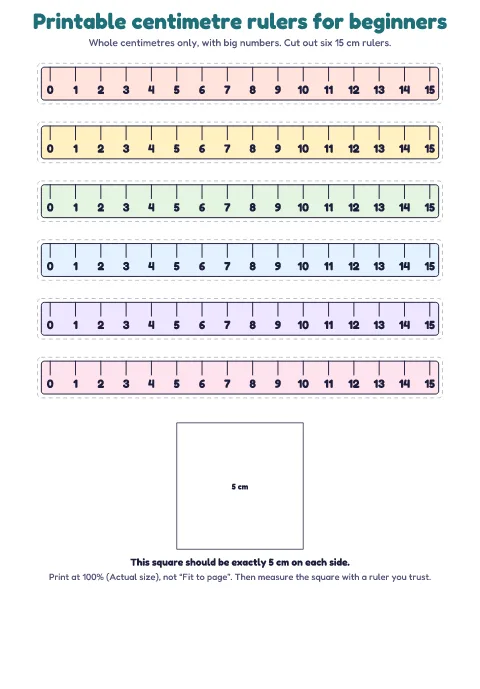 Printable ruler, true size, with a check square
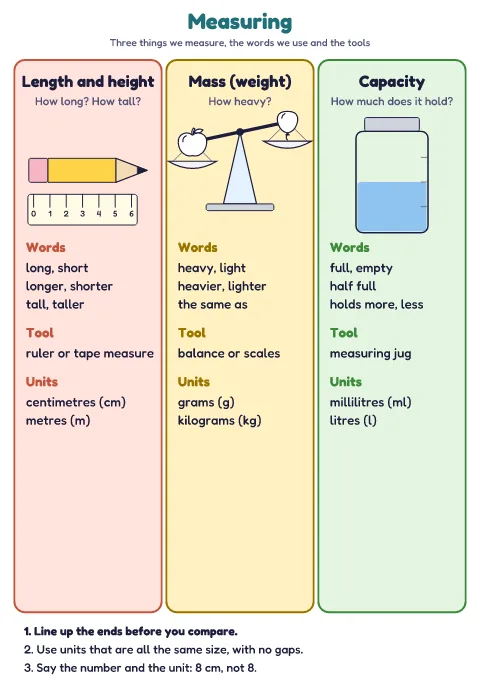 Measuring anchor chart
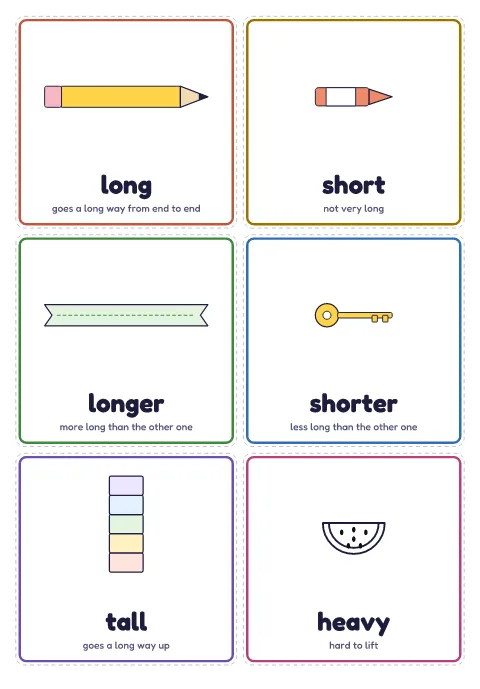 Measurement vocabulary word wall cards
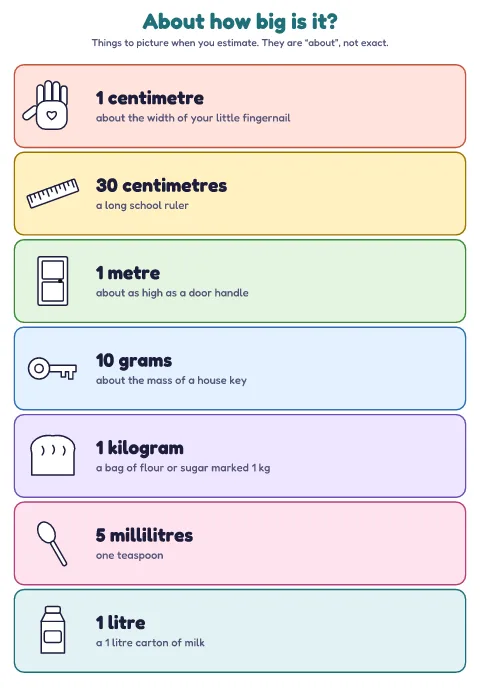 About how big is it? Benchmarks poster
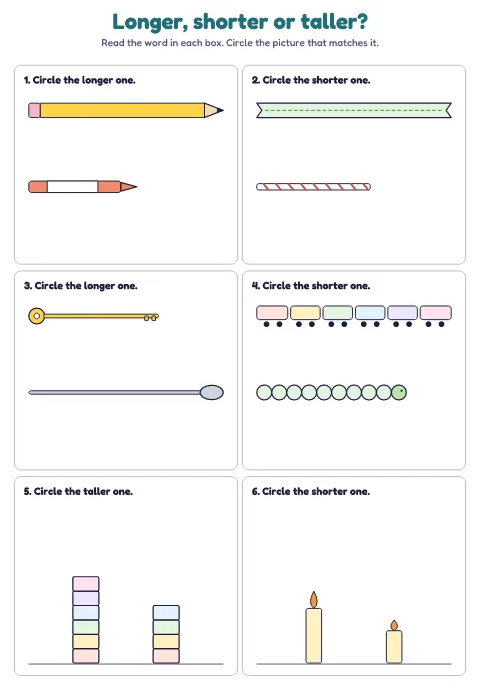 Longer, shorter, taller and shortest to longest
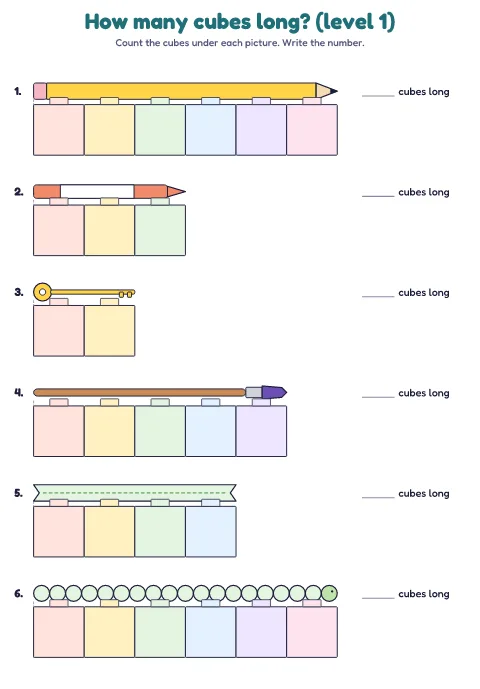 How many cubes long?
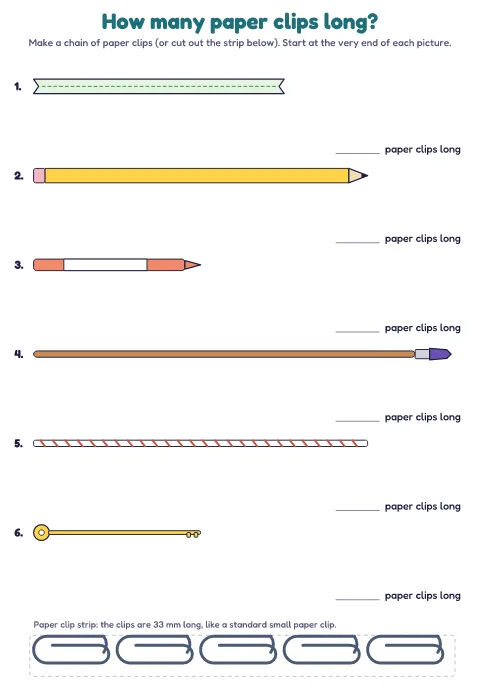 How many paper clips long?
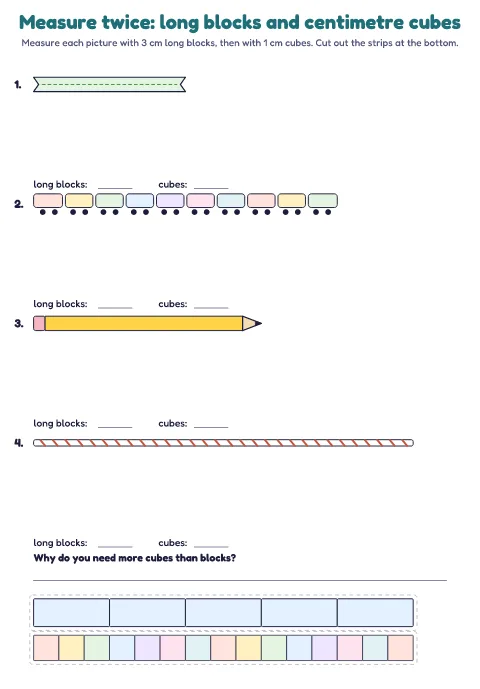 Measure twice: long blocks and centimetre cubes
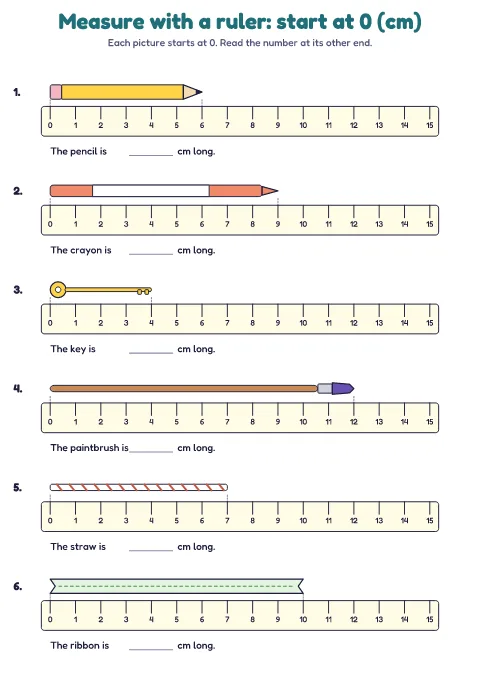 Measure with a ruler: start at 0, then broken rulers
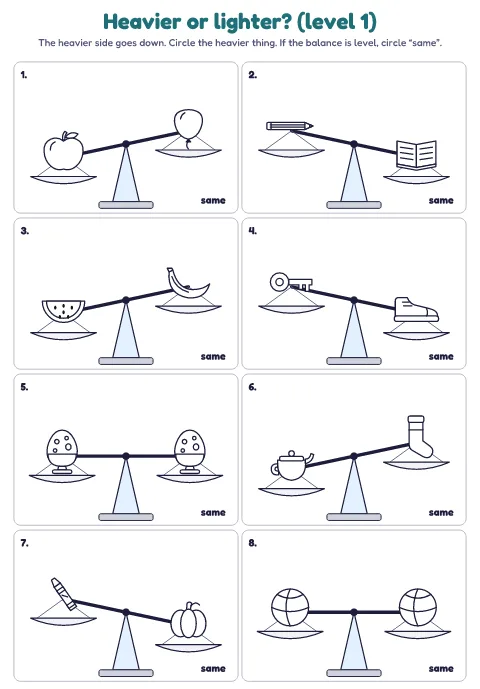 Heavier or lighter? Balance scales
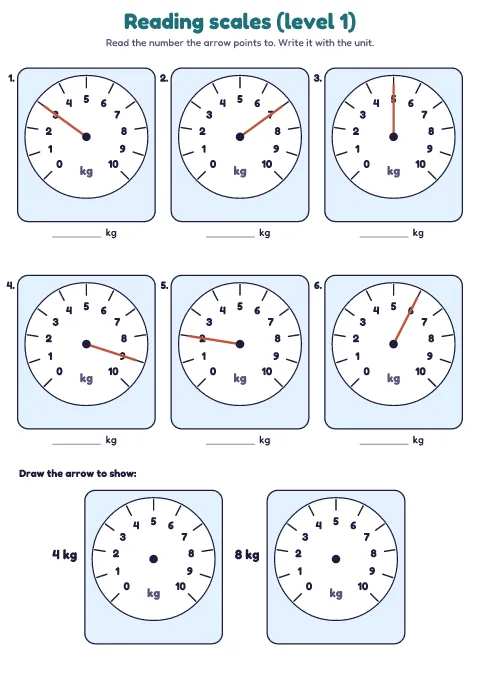 Reading scales
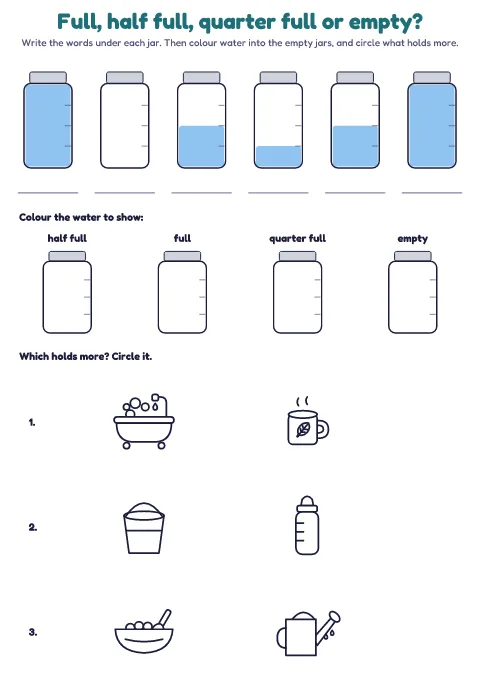 Full, half full, empty and reading a jug
 Compare measures with <, > and =
 Estimate and measure recording sheets
 Measuring hunt
 Measurement word problems
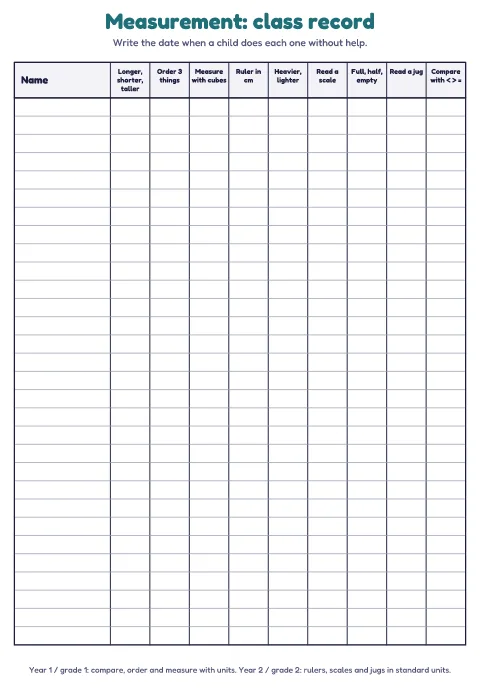 Class record and “I can measure” chart
Why the cubes and rulers on these sheets are real size
Most free measuring worksheets carry a note somewhere saying the ruler on the page is not accurate once printed, or they draw a crayon “6 cubes long” that is really five and a half. Children then do the right thing, lay real cubes along the picture, and get the wrong answer. Every unit in this kit is drawn from the size the PDF is printed at, separately for A4 and for US Letter. Printed at 100%, the cubes are 2 cm wide, like the linking cubes most classrooms already have; the paper clips are 33 mm, like a standard small clip; the rulers are true centimetres and true inches. Each picture is an exact whole number of units long, so the count always comes out clean, and our tests measure every drawing on both paper sizes before the files are built.
The same goes for the pictures children read: the arrow on every scale is drawn at the angle of its number, the water in every jug is drawn to its mark, and the heavier side of every balance is the side that hangs lower. The answer pages are made from the same numbers, so they cannot disagree with the sheet.
The printable ruler and the wall displays
1. Printable ruler, true size, with a check square
Four pages: six 15 cm rulers in whole centimetres with big numbers for beginners, six 15 cm rulers with millimetre marks, six 6-inch rulers marked in halves and quarters, and three rulers with centimetres on one edge and inches on the other. Each page has a check square (5 cm, or 2 inches, or both). Print at 100% or “Actual size”, never “Fit to page”, then measure the square: if it is right, every ruler on the page is right. Print on card, or glue onto a cereal box, so the rulers stay flat. For 20 cm, 30 cm and 12-inch rulers, rulers to 1/16 inch, a tape measure and a protractor, see the printable ruler page.
2. Measuring anchor chart
One poster in three columns: length and height, mass, and capacity. Each column has the question it answers (how long, how heavy, how much does it hold), the comparing words, the tool and the units, with three habits along the bottom: line up the ends, use units that are all the same size with no gaps, and always say the unit. The US version lists inches and feet, ounces and pounds, and cups, quarts and gallons.
Anchor chart PDF (A4)Anchor chart PDF (US Letter)
3. Measurement vocabulary word wall cards
Eighteen cards with a picture and a short meaning: long, short, longer, shorter, tall, heavy, light, heavier, lighter, full, empty, half full, ruler, balance, measuring jug, centimetre, kilogram and litre. The US set says measuring cup, inch, pound and cup in place of the last four. Put up the comparing words first and add the units when you start to use them.
4. About how big is it? Benchmarks poster
Seven things to picture when estimating: a centimetre is about the width of a little fingernail, a metre is about as high as a door handle, a house key is about 10 grams, a teaspoon holds 5 millilitres, a carton of milk is 1 litre. The US poster uses an inch, a foot, a yard, an ounce, a pound, a cup and a gallon. Every line says “about”, because these are for estimating, not for checking.
Benchmarks poster PDF (A4)Benchmarks poster PDF (US Letter)
Advertisement
Length and height
5. Longer, shorter, taller and shortest to longest
Level 1 has six boxes: circle the longer, the shorter or the taller of two pictures, with the question changing from box to box so children read it rather than always picking the bigger one. Level 2 orders three things from shortest to longest on a squared background. In two of the rows the ends do not line up, which is the trap: the one that reaches furthest is not always the longest. Two reasoning questions finish the page (the scarf is longer than the rope, the rope is longer than the belt). Answers on pages 3 and 4.
6. How many cubes long?
Six pictures per level. On level 1 the cubes are already drawn underneath to count. On level 2 children lay their own 2 cm cubes along each picture, or use the cut-out strip at the bottom, starting exactly at the end and leaving no gaps. Both levels have answer pages that show the cubes in place.
Measure with cubes PDF (A4)Measure with cubes PDF (US Letter)
7. How many paper clips long?
Six pictures from 1 to 5 clips long, measured with a chain of real paper clips or the strip of five printed clips (each 33 mm, the size of a standard small clip). A chain keeps the clips end to end, which is the point of the lesson. The answer page draws the clips under each picture.
Measure with paper clips PDF (A4)Measure with paper clips PDF (US Letter)
8. Measure twice: long blocks and centimetre cubes
Each picture is measured twice: once with 3 cm long blocks and once with 1 cm cubes, both on cut-out strips (base-ten unit cubes are 1 cm and work too). Children find that the smaller unit gives the bigger number, then explain why. The answer is written out on the key: one block is as long as three cubes.
9. Measure with a ruler: start at 0, then broken rulers
Six pictures lying on true-size rulers. On level 1 every picture starts at 0 and children read the number at the other end. Level 2 uses “broken” rulers, where the picture starts at 2 or 3 or 5: count the spaces, or take the start from the end. This is the mistake most children make with a real ruler, starting at the 1 or the edge, and it is worth a sheet of its own. Centimetres in the main version, inches in the US one.
Mass and weight
10. Heavier or lighter? Balance scales
Level 1: eight balances, each with two everyday things such as an apple and a balloon, a key and a shoe, or two eggs that balance. The heavier side always hangs lower; children circle it, or circle “same” when the beam is level. Level 2 balances four foods against linking cubes, puts them in order from heaviest to lightest, and ends with two puzzles where two balances share one thing, so the heaviest and lightest have to be worked out across both.
Heavier or lighter PDF (A4)Heavier or lighter PDF (US Letter)
11. Reading scales
Round kitchen scales with an arrow to read and two to draw. Level 1 is numbered every kilogram from 0 to 10. Level 2 is where reading scales gets hard: a 0 to 20 kg scale numbered only in fives, and a 0 to 1,000 g scale numbered in two hundreds with a mark at every hundred, so children first work out what each small mark is worth. The US version reads pounds, then ounces from 0 to 16.
Capacity and volume
12. Full, half full, empty and reading a jug
Level 1: six jars to label full, half full, quarter full or empty, four outlines to colour water into, and three pairs of containers to choose which holds more (a bath or a mug). Level 2: six measuring jugs to read, scaled 0 to 1,000 ml in hundreds and 0 to 500 ml in fifties, and two jugs to fill by colouring. The US version uses a 4-cup measuring cup with half-cup marks.
Comparing, estimating and solving problems
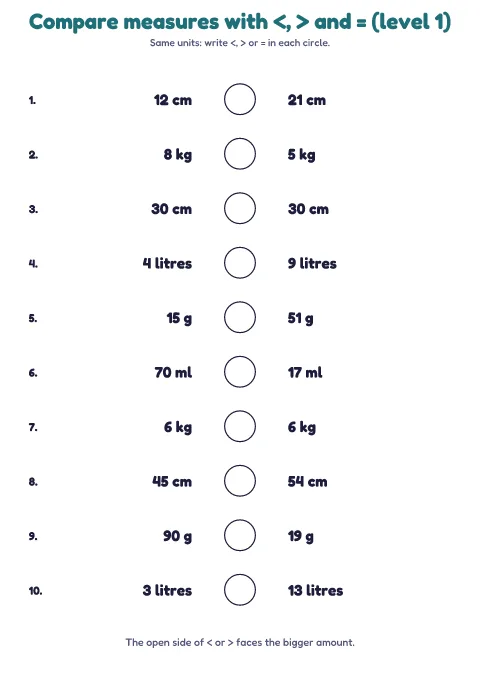
13. Compare measures with <, > and =
Ten pairs per level. Level 1 keeps the same units on both sides (12 cm and 21 cm). Level 2 mixes units that children meet in Year 2, so one side has to change first: 1 m and 100 cm, 500 g and 1 kg, 800 ml and 1 litre. The US version uses inches and feet, ounces and pounds, and cups and quarts.
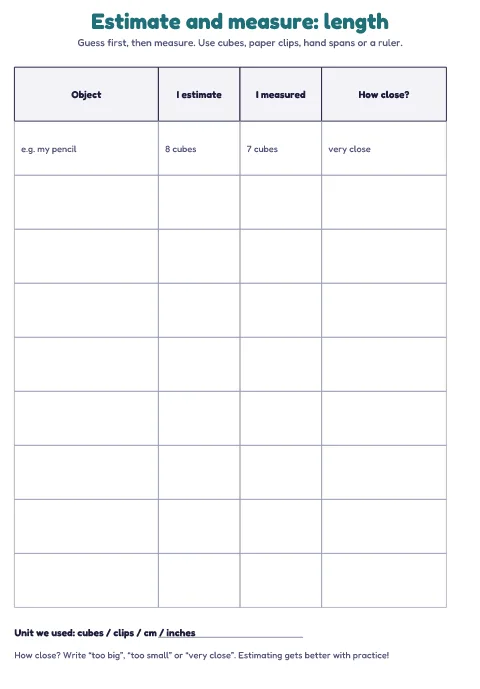
14. Estimate and measure recording sheets
Three recording sheets, one each for length, mass and capacity, with columns for the object, the estimate, the measurement and how close it was. The first row is filled in as an example. Use them with any unit, from hand spans and cupfuls to centimetres and grams: there is a line to write which one you used.
Estimate and measure PDF (A4)Estimate and measure PDF (US Letter)
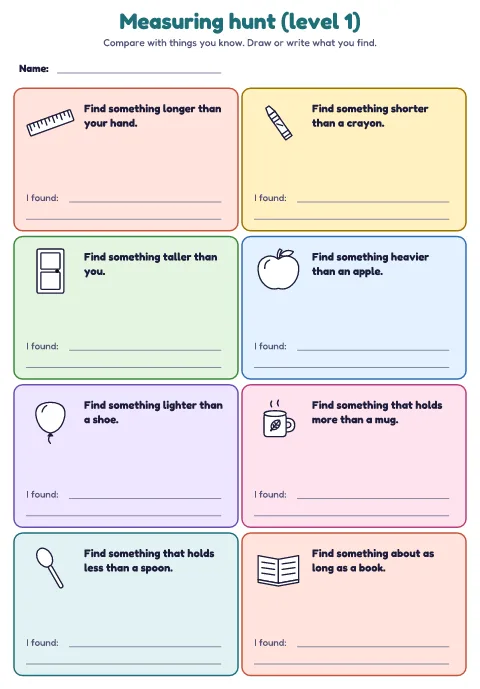
15. Measuring hunt
Eight things to find around the room or the house. Level 1 compares with known objects: something longer than your hand, heavier than an apple, that holds less than a spoon. Level 2 uses standard units: something about 10 cm long, about 1 metre tall, about 1 kg, that holds about 1 litre. The US version asks for inches, feet, pounds, ounces, cups and a gallon.
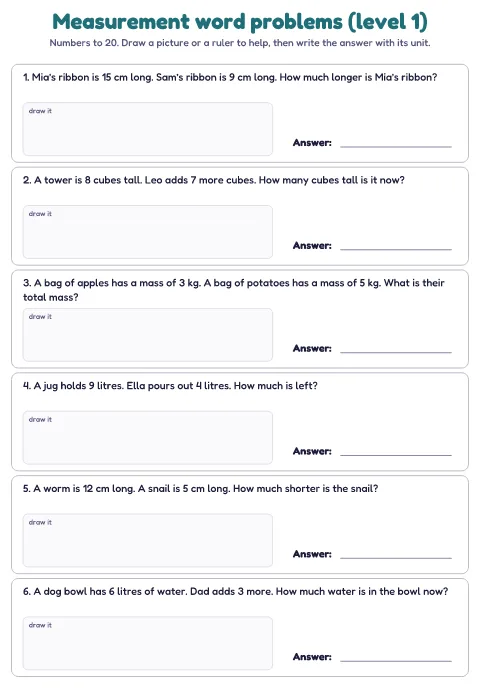
16. Measurement word problems
Six problems per level about ribbons, towers, apples, jugs, sunflowers and fish tanks, with a space to draw a picture, a bar or a number line. Level 1 stays within 20 and level 2 within 100. The answer pages give the number sentence as well as the answer with its unit. The US version uses inches, pounds and cups.
17. Class record and “I can measure” chart
A class grid with nine columns, from longer and shorter to comparing with symbols: write the date when a child does each one on their own. The second page is the child’s chart, with a star to colour for each step.
Teaching measurement in Year 1 and Year 2: an order that works
- Compare first. Two things side by side: which is longer, heavier, holds more? Lining up the ends matters more than any number. Use the anchor chart and word cards here.
- Order three. Once two can be compared, three can be put in order, and “the scarf is longer than the rope” questions show why: if A beats B and B beats C, A beats C.
- Same-size units, no gaps. Cubes, clips and cupfuls. Measure the same thing with two units and ask why the numbers differ: this is the idea behind every ruler.
- Standard units. Centimetres, then metres; kilograms and grams on scales; millilitres and litres in jugs. Estimate first, every time, with the benchmarks poster nearby.
- Read the scale. Work out what each small mark is worth before reading the arrow or the water. Then compare with <, > and = and solve word problems.
In England, the national curriculum asks Year 1 pupils to compare, describe and solve practical problems for lengths and heights, mass and weight, and capacity and volume (for example long/short, heavy/light, full/empty, half full and quarter), and to measure and begin to record them. In Year 2, pupils choose and use appropriate standard units to estimate and measure length and height (m/cm), mass (kg/g) and capacity (litres/ml) to the nearest appropriate unit, using rulers, scales and measuring vessels, and compare and order lengths, mass and volume or capacity, recording the results using >, < and = (mathematics programmes of study). In the US Common Core, grade 1 students order three objects by length and express a length as a whole number of same-size units laid end to end with no gaps or overlaps (1.MD.A.1 and 1.MD.A.2); grade 2 students measure with rulers and other tools, measure an object twice with different units, estimate lengths and work out how much longer one object is than another (2.MD.A.1 to 2.MD.A.4), and solve length word problems within 100 (2.MD.B.5). Common Core places liquid volume and mass in grade 3 (3.MD.A.2), so in the US the mass and capacity sheets are early enrichment rather than grade 1 and 2 standards. This kit supports that work alongside your school’s scheme; it does not replace it.
For grade 2 and 3 practice with a ruler, see the measuring in centimeters, nearest inch and nearest half inch worksheets, then area by counting squares and the rest of the measurement worksheets. Other teaching kits: telling time games and a teaching clock, 2D and 3D shapes and number bonds. By grade: kindergarten, first grade and second grade math worksheets, plus squared graph paper and more for teachers.
Questions
How do I print a ruler at the right size?
Open the PDF and print at 100% or “Actual size”. Turn off “Fit to page”, “Shrink to fit” and any scaling in the print dialog. Then measure the check square on the page with a ruler you trust: 5 cm (or 2 inches) on each side means every ruler on that page is correct. Both the A4 and the US Letter files are true size on their own paper.
What is non-standard measurement?
Measuring with any unit that is not centimetres, metres or inches: cubes, paper clips, hand spans, footsteps or cupfuls. It teaches the idea behind every ruler, that a length is a number of same-size units laid end to end with no gaps, before children meet standard units.
What is the difference between mass and weight?
Mass is how much stuff something is made of and is measured in grams and kilograms. Weight is how hard gravity pulls on it. On Earth the two go together, so in Year 1 and 2 the words are used side by side, and “heavier” and “lighter” describe both.
What is capacity?
Capacity is how much a container can hold, measured in millilitres and litres (or cups, quarts and gallons in the US). Volume is how much space something takes up, or how much is actually in the container: a jug with a capacity of 1 litre can hold 500 ml of water.
Do the worksheets have answers?
Yes. Every worksheet with answers has its answer pages at the end of the same PDF, drawn from the same numbers as the sheet. The recording sheets, the hunt, the posters and the rulers have no answers to give.
Are these free for my class?
Yes. Free for your own class, school and family, with no sign-up. Please don’t resell them or upload them to another site.