 Colouring Nest
2D and 3D shapes: anchor charts, nets and games
Free 2D and 3D shapes printables for teachers and parents of children in kindergarten to grade 2 and Reception to Year 2: 15 resources that sit around our shapes worksheets. A 2D shapes anchor chart and a 3D shapes anchor chart with faces, edges and vertices, word wall cards, a shape sort with a Venn diagram, “Is it a triangle?” and “Is it a rectangle?” sheets, drawing on dot paper, faces of 3D shapes, a curved-or-flat sort, nets of seven 3D shapes to cut and fold, “Which nets make a cube?”, guess my shape riddles, “I have, who has?”, shape bingo, a shape hunt and a class record. Every sheet with answers has an answer page, every file comes in A4 and US Letter, and the charts, nets and cards come in UK wording too (trapezium, cuboid).
Inside this set
- 15 printables
- A4 and US Letter PDFs
- Colour and ink-saver versions
- Free, no sign-up
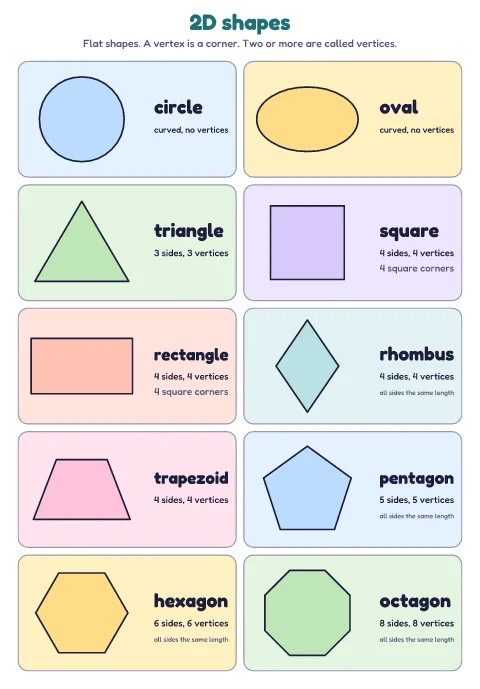 2D shapes anchor chart
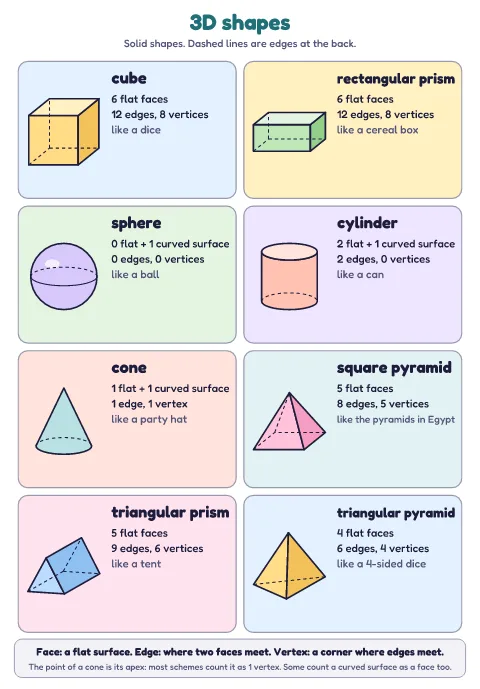 3D shapes anchor chart
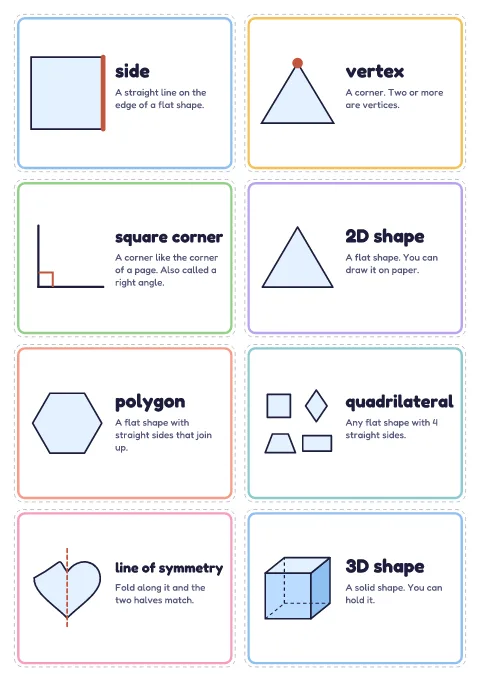 Shape word wall cards
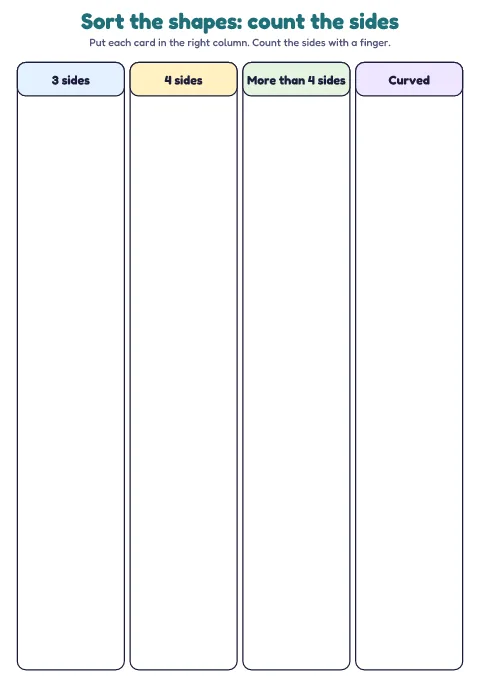 Shape sort with a Venn diagram
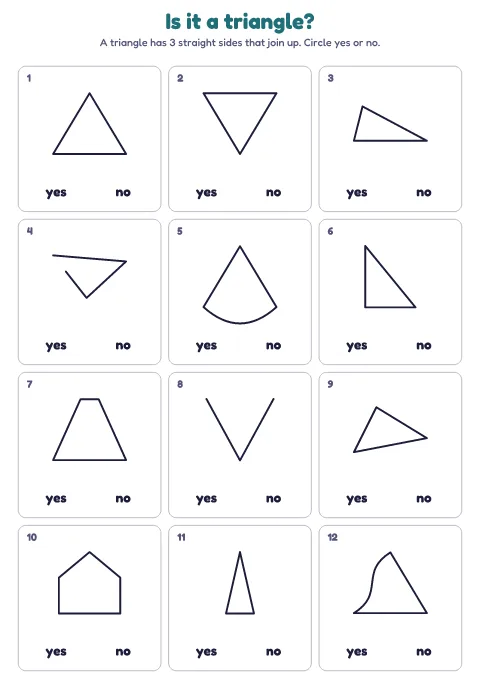 Is it a triangle? Is it a rectangle?
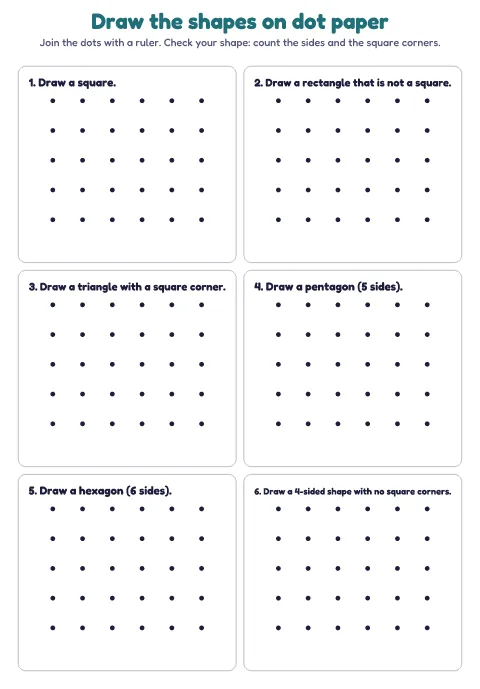 Draw shapes on dot paper
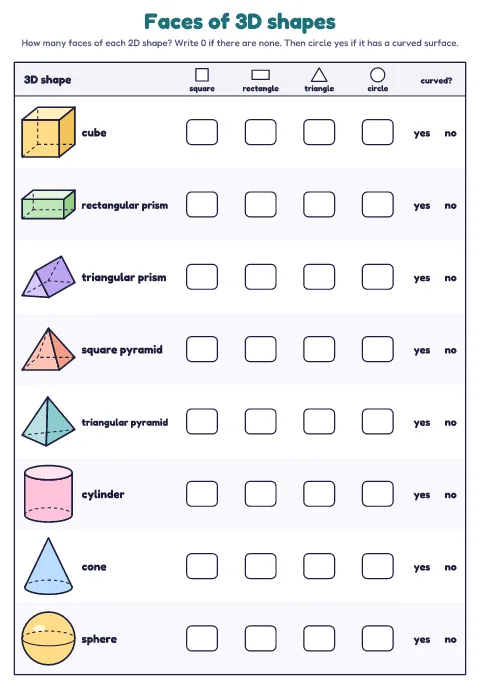 Faces of 3D shapes
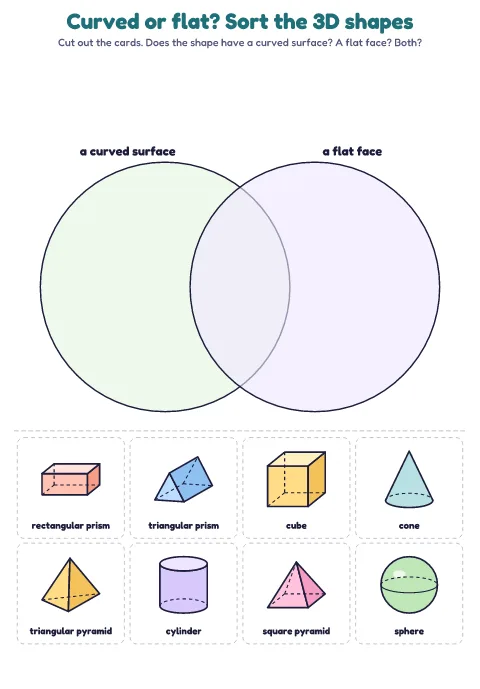 Curved or flat? 3D shape sort
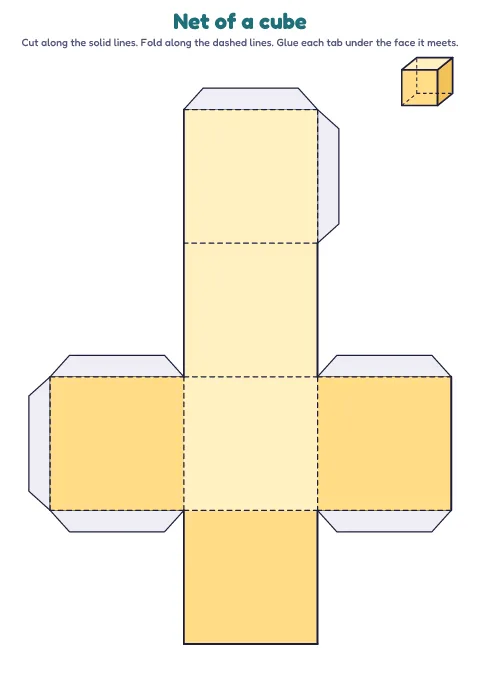 Nets of 3D shapes to cut and fold
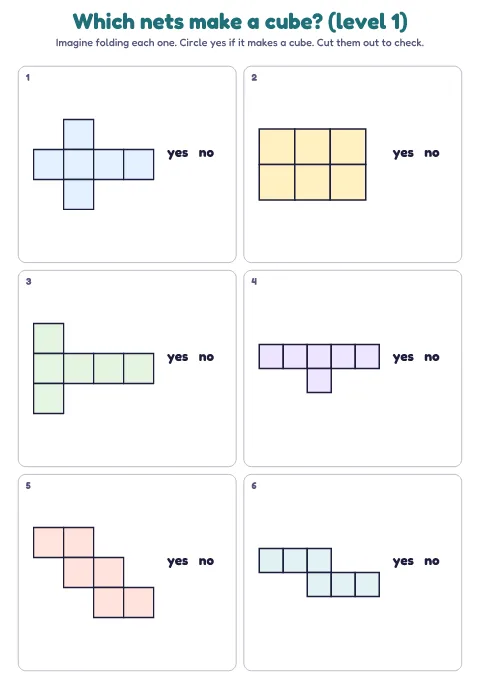 Which nets make a cube?
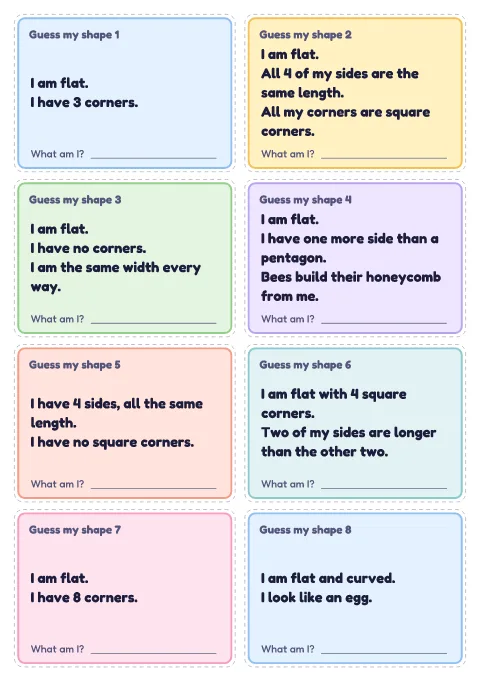 Guess my shape riddle cards
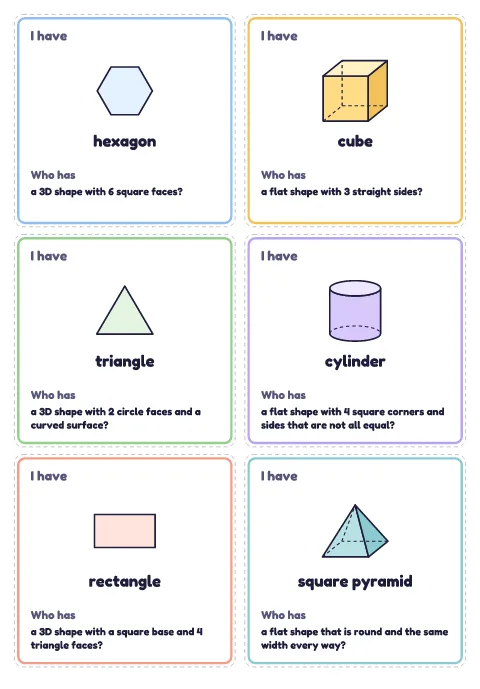 I have, who has? shapes loop
 Shape bingo
 Shape hunt
 Class record and “I know my shapes” chart
What makes a shape a shape
Ask a five-year-old to draw a triangle and you will nearly always get the same one: flat along the bottom, point at the top, all three sides the same length. Turn it upside down, or stretch it long and thin, and many children say it is not a triangle any more. The same thing happens with a square turned on its corner (“that’s a diamond”). What makes a triangle a triangle is three straight sides that join up, nothing else: not its size, not its colour, not which way it points.
So this kit keeps showing shapes the other way up, stretched, turned, and next to near-misses. The sort cards include a square on its corner and a rectangle on a slant. The “Is it a triangle?” sheet puts long, thin and upside-down triangles beside shapes that fail for one clear reason: a gap, a curved side, a fourth side. Every corner count on the answer pages is worked out from the shape that is drawn, and every face, edge and vertex count on the 3D charts comes from the same 3D model that draws the picture and unfolds the net, so the numbers and the pictures can’t disagree.
Anchor charts and word wall
1. 2D shapes anchor chart
Ten flat shapes, from circle to octagon, each with its name and how many sides and vertices it has. The square and rectangle are marked as having four square corners; the rhombus, pentagon, hexagon and octagon as having sides the same length. The UK version says trapezium instead of trapezoid. Print it on A4 or Letter for a desk, or enlarge it to A3 for the wall.
2D shapes chart PDF (A4)2D shapes chart PDF (US Letter)
2. 3D shapes anchor chart
Eight solid shapes: cube, rectangular prism (cuboid in the UK version), sphere, cylinder, cone, square pyramid, triangular prism and triangular pyramid. Each has its flat faces, curved surface, edges and vertices, and an everyday thing with that shape. Edges at the back are dashed so children can count every one. A note at the foot says how the cone’s point (its apex) is usually counted.
3D shapes chart PDF (A4)3D shapes chart PDF (US Letter)
3. Shape word wall cards
Sixteen cards, each with a small picture that points at the idea: side, vertex, square corner, 2D shape, polygon, quadrilateral, line of symmetry, 3D shape, face, edge, vertex on a solid, curved surface, prism, pyramid, net and apex. The meaning on each card is one short sentence a six-year-old can follow.
Advertisement
Sorting and spotting shapes
4. Shape sort with a Venn diagram
Eighteen cards to cut out, including a square turned on its corner, a kite, an L-shaped hexagon and a house-shaped pentagon. Level 1 sorts them by number of sides (3, 4, more than 4, curved). Level 2 is a Venn diagram: does it have 4 sides, does it have a square corner, both or neither? Both answer pages place every card.
5. Is it a triangle? Is it a rectangle?
Twelve figures on each page. Children circle yes or no; the answer pages say why in one line (“There is a gap: it is not closed.”, “One side is curved.”). The rectangle page includes a square, the shape children most often leave out: a square is a rectangle with four equal sides.
6. Draw shapes on dot paper
Six prompts with a dot grid for each: a square, a rectangle that is not a square, a triangle with a square corner, a pentagon, a hexagon and a four-sided shape with no square corners. The answer page shows one example of each and says that other answers can be right. A full page of plain dot paper comes with it.
3D shapes: faces, sorting and nets
7. Faces of 3D shapes
Eight solid shapes down the side and four flat shapes across the top. Children count how many square, rectangle, triangle and circle faces each solid has, then circle whether it has a curved surface. A triangular prism has 2 triangles and 3 rectangles; a square pyramid 1 square and 4 triangles.
Faces of 3D shapes PDF (A4)Faces of 3D shapes PDF (US Letter)
8. Curved or flat? 3D shape sort
A Venn diagram with two circles, a curved surface and a flat face, and eight cards to cut out. The sphere goes on its own, the cylinder and cone go in the middle, and the six shapes with only flat faces go on the right. Ask which ones roll and which ones stack before gluing.
9. Nets of 3D shapes to cut and fold
Seven nets, one per page and as big as the paper allows: cube, rectangular prism, triangular prism, square pyramid, triangular pyramid, cylinder and cone. Solid lines are for cutting, dashed lines for folding, and there is exactly one glue tab for each pair of edges that meet, so nothing is left loose or glued twice. Print on card for shapes that stand up.
Nets PDF (A4)Nets PDF (US Letter)
10. Which nets make a cube?
Level 1 has six arrangements of six squares, from the familiar cross to a 2 by 3 block that cannot fold into a cube. Level 2 has ten harder ones. There are only 11 different cube nets, and 10 of them appear across the two levels. Children circle yes or no, then cut them out to check: the answer pages were worked out by rolling a cube over each net.
Games
11. Guess my shape riddle cards
Sixteen riddles, eight flat and eight solid, each with two or three clues such as “I am 3D. I have 5 faces. I have 9 edges.” Every set of clues fits exactly one shape on the charts. Read one aloud and let children point at the chart, or hand them out for pairs to solve. Answers on the last page.
12. I have, who has? shapes loop
Eighteen cards, one for each shape on the two charts. Each card says “I have a hexagon” with a picture and asks for the next shape by its properties (“Who has a 3D shape with 6 square faces?”), and the last card leads back to the first. Each question fits only one card, so the loop never stalls.
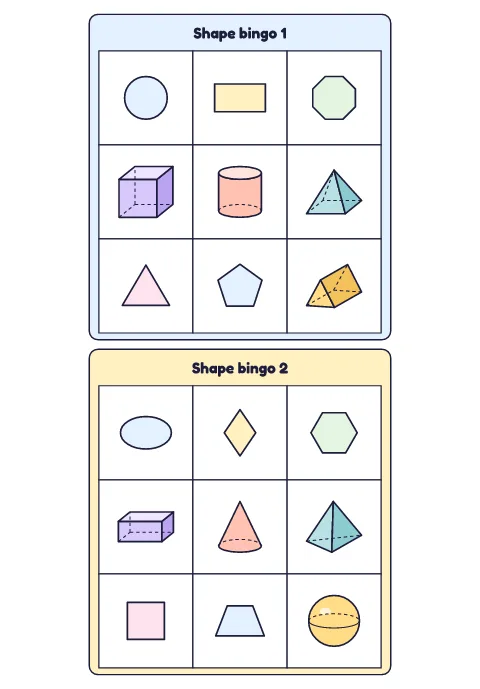
13. Shape bingo
Six different boards of nine shape pictures and eighteen caller cards. Call the name for younger children, or read the clue on the card (“a flat shape with 8 sides”) for older ones. Every shape on every board has a caller card.
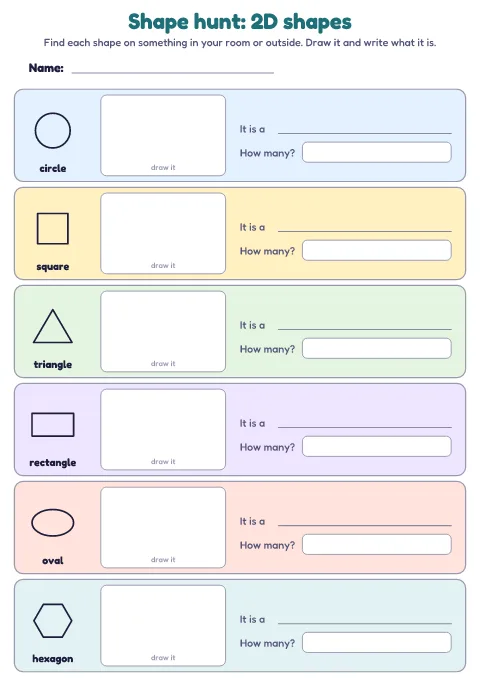
14. Shape hunt
Two record sheets, one for flat shapes and one for solid shapes. Children find each shape on something real, draw it, write what it is and count how many they found. Clocks, windows, tins and boxes are easy finds; a cone or a pyramid outdoors is the prize.
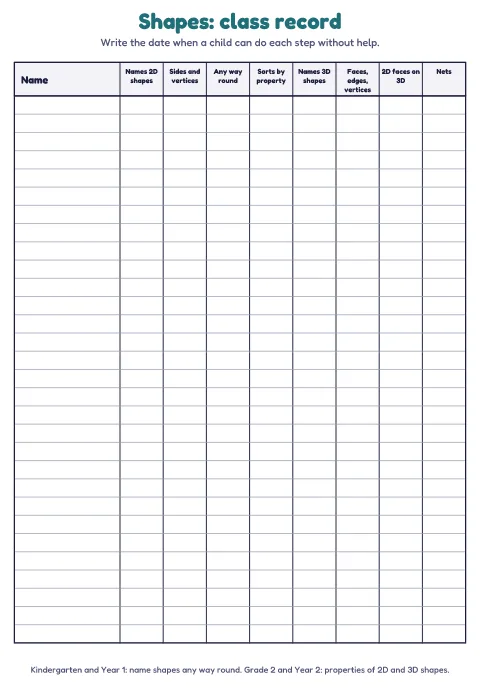
15. Class record and “I know my shapes” chart
A class grid with eight columns, from naming 2D shapes to folding nets: write the date when a child does each step without help. The second page is a child’s own chart with a star to colour for each step.
Teaching 2D and 3D shapes: an order that works
- Handle real things first. A tin, a ball, a box and a party hat on the table do more than any sheet. Name them, roll them, stack them.
- Name flat shapes any way round. Use the 2D chart, then the sort cards and “Is it a triangle?”. Turn every shape before asking its name.
- Count sides and vertices. Put a dot on each corner as you count, so none is counted twice. Then draw shapes from a description on dot paper.
- Name solid shapes and count their faces. Use the 3D chart and the faces sheet with real objects next to them: a cereal box beside the rectangular prism.
- Build them. Fold the nets, then try “Which nets make a cube?”. Games (bingo, riddles, the loop) give short, frequent practice.
In England, Year 1 pupils should be taught to recognise and name common 2-D and 3-D shapes, including rectangles (including squares), circles and triangles, and cuboids (including cubes), pyramids and spheres. In Year 2 they identify and describe the properties of 2-D shapes, including the number of sides and line symmetry in a vertical line; identify and describe the properties of 3-D shapes, including the number of edges, vertices and faces; identify 2-D shapes on the surface of 3-D shapes; and compare and sort common 2-D and 3-D shapes and everyday objects (national curriculum, mathematics programmes of study). In the US Common Core, kindergarten children name shapes whatever their orientation or size (K.G.A.2), first graders tell defining attributes, such as three straight sides, from ones that do not matter, such as colour or which way a shape is turned (1.G.A.1), and second graders recognise and draw shapes with given attributes (2.G.A.1). This kit supports that work alongside your school’s scheme; it does not replace it.
The worksheets with answer keys are in the shapes worksheets section: the 2D shapes coloring page, name the shapes, sides and corners, sort the shapes, the 3D shapes coloring page, 2D or 3D? and faces, edges and vertices. For younger children, the shape flash cards have the sides on the back, and the shape templates are big outlines to cut out. Next: symmetry worksheets (lines of symmetry, mirror pictures and rotational symmetry), fraction worksheets (equal parts of shapes), tangram puzzles, kindergarten, first grade and second grade math worksheets, and more for teachers.
Questions
How many faces, edges and vertices does a cube have?
A cube has 6 faces, 12 edges and 8 vertices, and so does a rectangular prism (cuboid). A triangular prism has 5 faces, 9 edges and 6 vertices; a square pyramid 5 faces, 8 edges and 5 vertices; a triangular pyramid 4 faces, 6 edges and 4 vertices.
Does a cylinder have faces, edges and vertices?
A cylinder has 2 flat circle faces and 1 curved surface, 2 curved edges and no vertices. Some schemes count the curved surface as a third face, so check which way your school says it. A cone has 1 flat face, 1 curved surface, 1 edge and 1 apex, which most schemes count as a vertex; a sphere has one curved surface and nothing else.
How many nets of a cube are there?
Eleven. Six arrangements of six squares fold into a cube in 11 different ways, not counting ones that are the same net turned over or round. The “Which nets make a cube?” sheets use ten of them, plus near-misses that do not fold.
Is a square a rectangle?
Yes. A rectangle is any four-sided shape with four square corners (right angles), and a square has those, with four equal sides as well. So every square is a rectangle, but not every rectangle is a square.
Is it a trapezoid or a trapezium?
The same shape has different names: in the US a four-sided shape with one pair of parallel sides is a trapezoid; in the UK, Australia and New Zealand it is a trapezium. The anchor charts and cards come in both wordings.
Are these free for my class?
Yes. Free for your own class, school and family, with no sign-up. Please don’t resell them or upload them to another site.