 Colouring Nest
Fact families worksheets: houses, triangles and word problems
A fact family is a group of three numbers that make four related facts. 3, 5 and 8 give 3 + 5 = 8, 5 + 3 = 8, 8 – 3 = 5 and 8 – 5 = 3; 3, 4 and 12 give 3 × 4 = 12, 4 × 3 = 12, 12 ÷ 3 = 4 and 12 ÷ 4 = 3. Below are 14 free fact families printables for grades 1 to 4 (Years 1 to 4): anchor charts, fact family houses, missing-number sheets, word problems and arrays, each in A4 and US Letter, colour and ink saver, with answer keys.
Inside this set
- 14 printables
- A4 and US Letter PDFs
- Colour and ink-saver versions
- Free, no sign-up
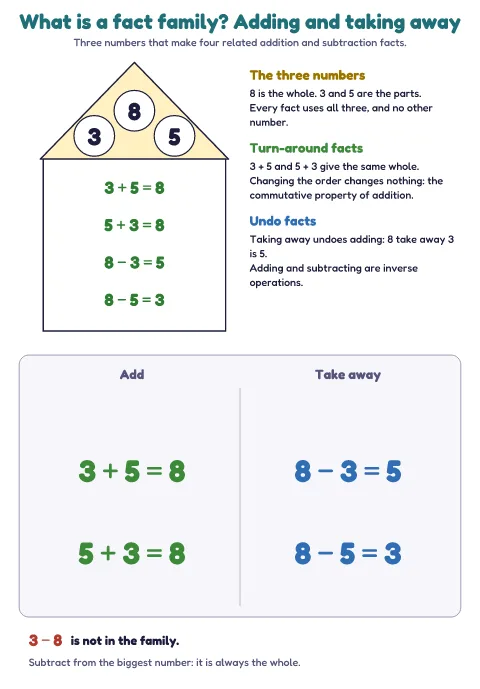 What is a fact family? Anchor charts
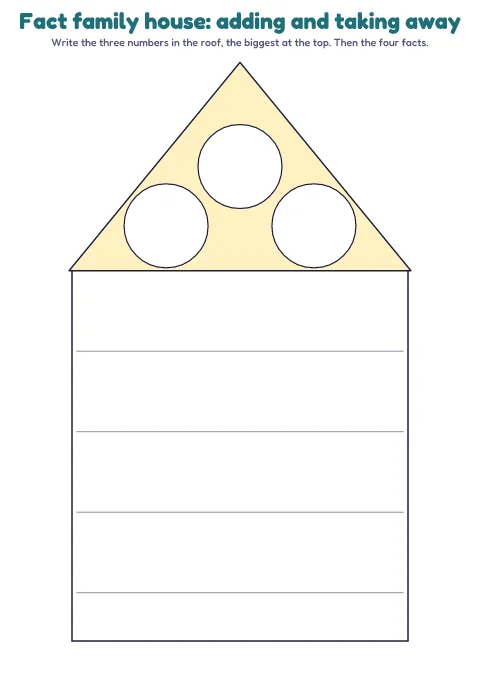 Blank fact family house templates
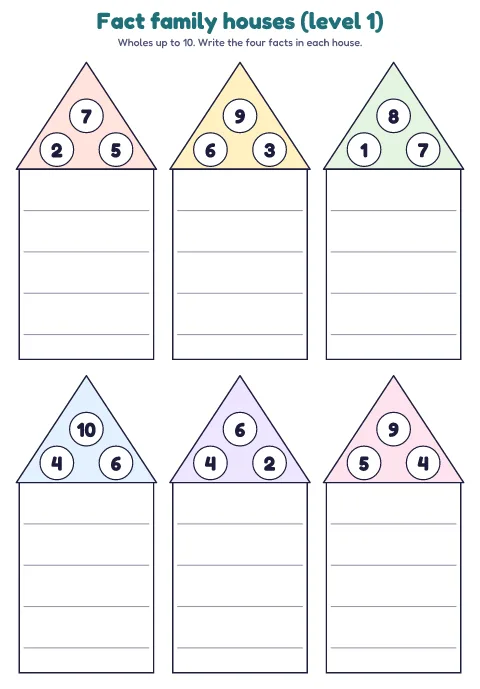 Fact family houses within 10 and 20
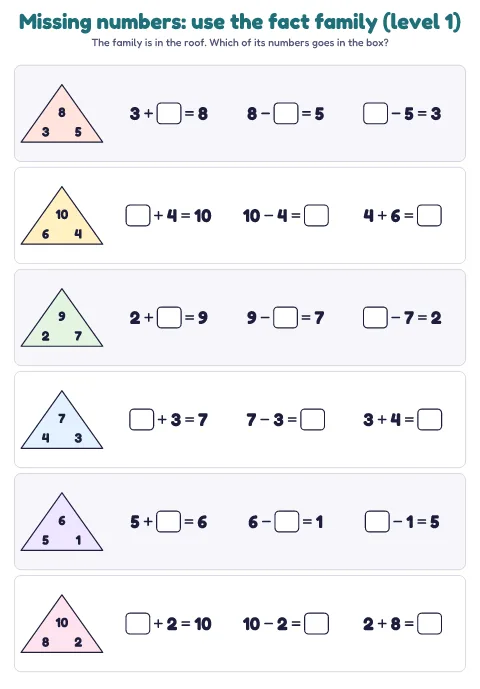 Missing numbers: use the fact family
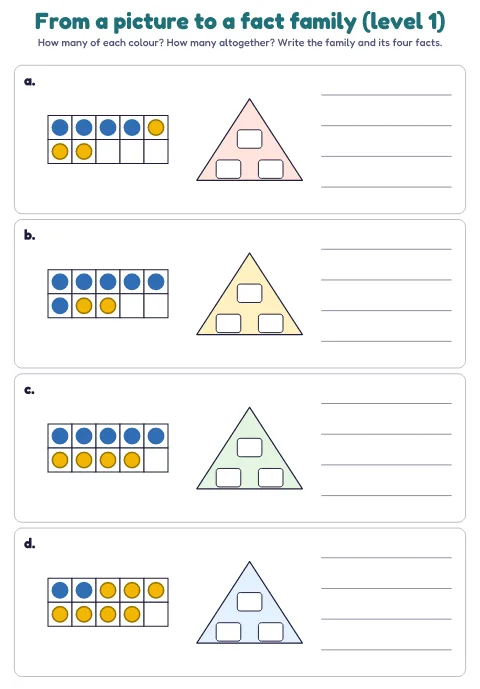 From a picture to a fact family
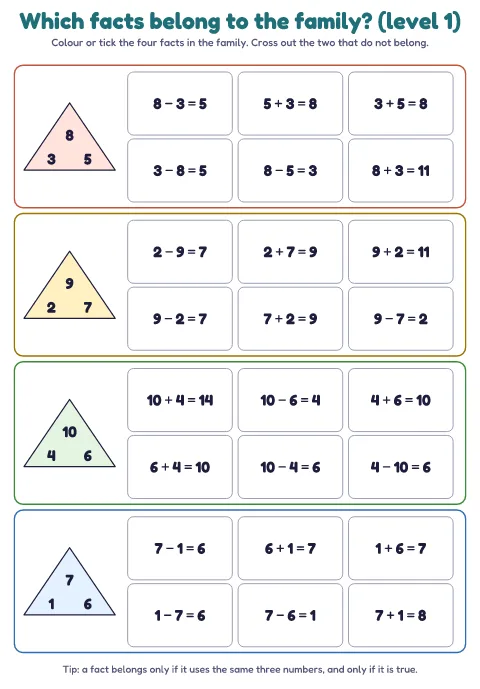 Which facts belong?
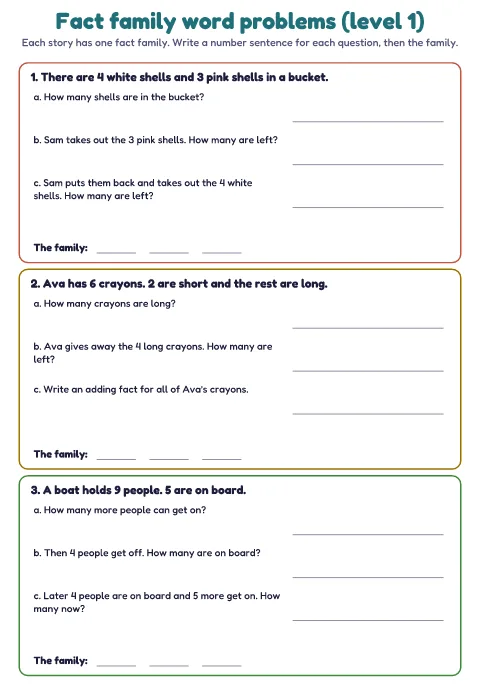 Fact family word problems
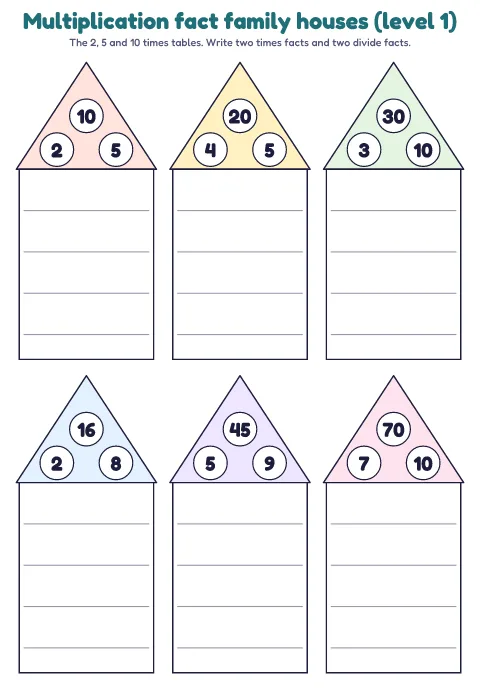 Multiplication and division fact family houses
 Multiplication fact triangles with a missing number
 Arrays and fact families
 Missing factors: use the fact family
 Multiplication and division fact family stories
 Families with only two facts
 Fact family sort cards
What is a fact family? The short answer
Fact families show that adding and taking away (or multiplying and dividing) are the same relationship read in different directions. Two ideas make every family work. The commutative property says the order of the parts doesn’t change the answer: 3 + 5 and 5 + 3 are both 8, and 3 × 4 and 4 × 3 are both 12. That gives the two “turn-around” facts. Inverse operations undo each other: subtraction undoes addition and division undoes multiplication, so if 3 + 5 = 8, then 8 – 5 takes you back to 3. That gives the other two facts. Subtraction and division are not commutative, which is why 3 – 8 and 3 ÷ 12 are never in the family: you always start from the biggest number.
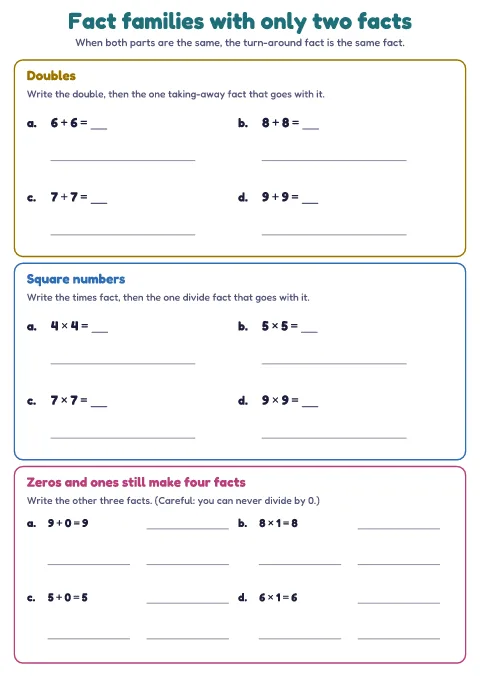
When both parts are the same (6 + 6 = 12, or 6 × 6 = 36), the family has only two facts, because the turn-around fact is the same fact. Updated 13 November 2026.
Start here: anchor charts and templates
1. What is a fact family? Anchor charts
Two posters, one for adding and taking away (3, 5 and 8) and one for times and divide (3, 4 and 12). Each shows the family in a house, labels the whole and the parts (or the product and the factors), names the turn-around facts and the undo facts, and ends with the mistake most children make: writing the subtraction or division backwards.
2. Blank fact family house templates
One big house for each sign pair, then four smaller houses to a page. Slip one into a plastic sleeve and use it with a dry-wipe pen for any family the class is working on, or for families children invent themselves.
Adding and taking away: grades 1 and 2
3. Fact family houses within 10 and 20
Six houses a page. Level 1 has wholes up to 10 and the whole roof filled in; children write the four facts on the floors. Level 2 uses wholes from 11 to 20 with one roof number left blank, so children work out the missing part or whole before they write. Answers on pages 3 and 4.
Fact family houses PDF (A4)Fact family houses PDF (US Letter)
4. Missing numbers: use the fact family
Eighteen sentences such as 3 + □ = 8, 8 – □ = 5 and □ – 5 = 3. On level 1 each row shows its family in a little roof, so the job is to choose which of the three numbers fits; level 2, within 20, takes the roof away. This is where knowing the family pays off: 13 – 8 is easy once you see 8 + 5 = 13.
5. From a picture to a fact family
Ten frames with blue and yellow counters (filled and open dots in the ink saver). Children count each colour and the total, write the three numbers in the roof and then the four facts. Level 2 spreads the counters over two ten frames for wholes past 10. A good first sheet for children who still need to see the parts.
6. Which facts belong?
Four families, six facts each: four belong, two are impostors. One impostor is the backwards subtraction (3 – 8 = 5, which is false); the other is a true fact that uses two of the numbers but belongs to a different family (8 + 3 = 11). Talking about why each one is out is worth more than writing ten more facts.
Which facts belong PDF (A4)Which facts belong PDF (US Letter)
7. Fact family word problems
Three short stories a page, each with three questions that all use the same three numbers, then a line for the family. Level 1 stays within 10; level 2 goes to 20 and asks children to check a taking-away answer with an adding fact. Answers on pages 3 and 4.
Advertisement
Multiplication and division: grades 3 and 4
8. Multiplication and division fact family houses
The same houses for times tables. Level 1 uses the 2, 5 and 10 tables with the roof filled in; level 2 uses the 3, 4, 6, 7, 8 and 9 tables with one number missing. Two times facts and two divide facts in every house, with answers.
Times and divide houses PDF (A4)Times and divide houses PDF (US Letter)
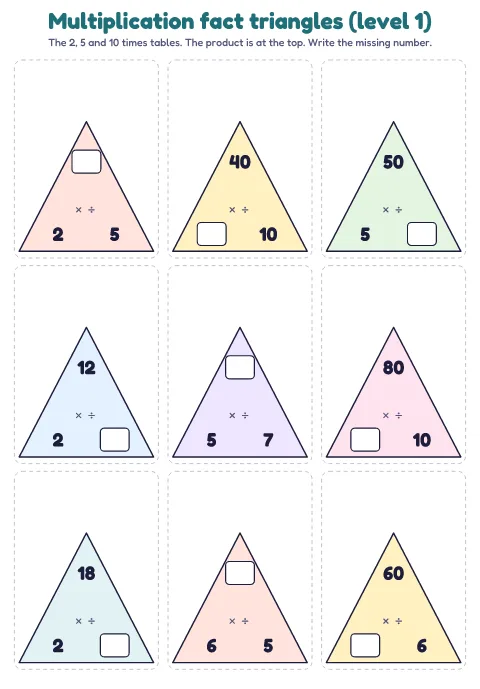
9. Multiplication fact triangles with a missing number
Nine triangles to a page with the product at the top and the factors at the bottom, one number replaced by a box. Cut them out for a partner game (one covers a corner, the other names it) or use them as a sheet. Level 1: 2, 5 and 10 tables; level 2: the harder tables. Our add and subtract fact triangles to 10, to 20 and blank are in the number bond games and posters kit.
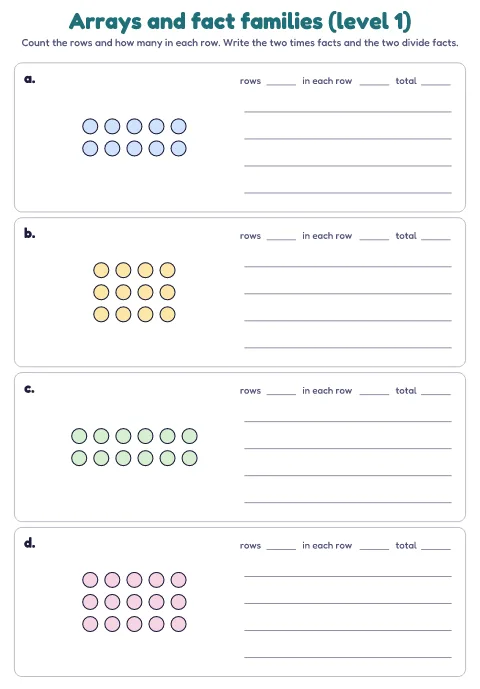
10. Arrays and fact families
Four dot arrays a page. Children read the rows and the number in each row, write the total, then the family: 3 rows of 5 and 5 rows of 3 are the same 15 dots turned round, and sharing the 15 dots into 3 rows or 5 rows gives the divide facts. Level 2 has bigger arrays, up to 6 rows of 7.
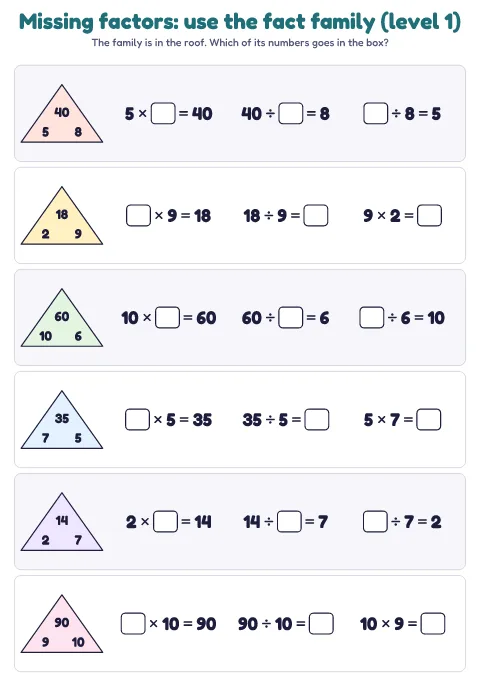
11. Missing factors: use the fact family
Sentences such as 5 × □ = 40, 40 ÷ □ = 8 and □ ÷ 8 = 5. Level 1 shows each family; level 2 doesn’t, and uses the tables children find hardest (6, 7, 8 and 9). Division as an unknown-factor problem is exactly what this sheet practises.
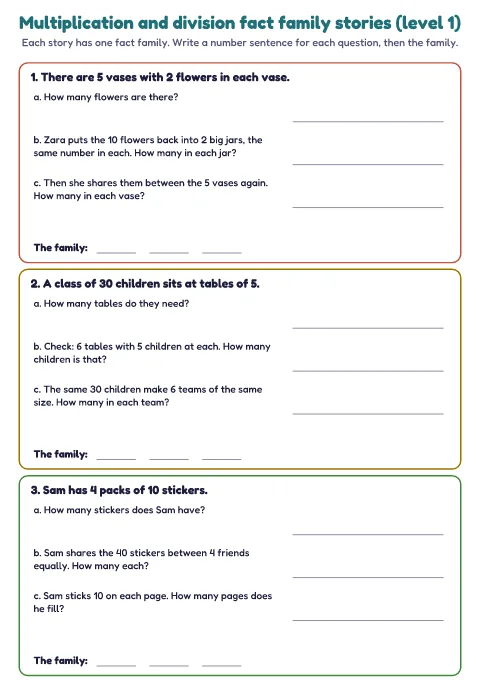
12. Multiplication and division fact family stories
Equal groups, rows and sharing: 6 rows of 8 chairs, 28 muffins in boxes of 4, carrots tied in bunches. Each story’s three questions use one family, so children see that “how many altogether?”, “how many in each?” and “how many groups?” are the same three numbers.
Times and divide stories PDF (A4)Times and divide stories PDF (US Letter)
Tricky families and a game
13. Families with only two facts
Doubles (7 + 7 = 14 and 14 – 7 = 7) and square numbers (5 × 5 = 25 and 25 ÷ 5 = 5) have only two facts. Families with 0 and 1 still have four: 9 + 0 = 9, 0 + 9 = 9, 9 – 0 = 9 and 9 – 9 = 0. The sheet makes children say why, which is the commutative property in plain words.
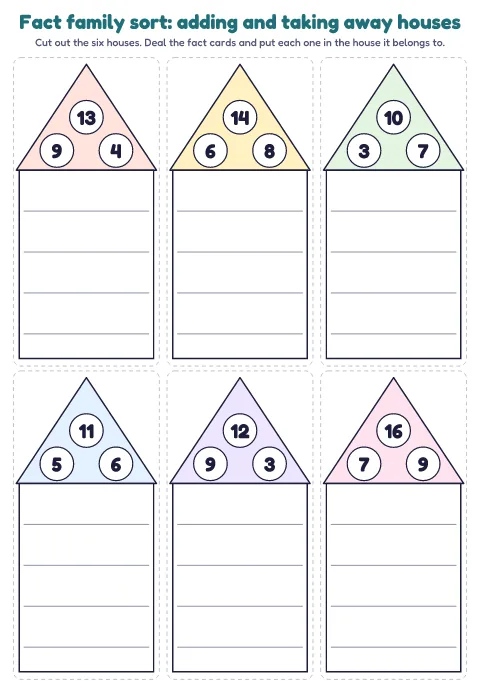
14. Fact family sort cards
Six houses and 24 fact cards for adding and taking away, six houses and 24 cards for times and divide. Deal the cards; each player places one in its house and reads it aloud. Nobody is out, and the game ends when every house holds its four facts. A key lists every family.
How to teach fact families
- Start with objects. Eight cubes in two colours, 3 and 5. Turn the stick round: still 8. Snap off the 5: 3 left. Every fact in the family is something you can do to the same cubes.
- Then the picture. The ten-frame sheet and the arrays sheet are the same step for adding and for times tables: see the parts, then write them.
- Name the two ideas. Turn-around facts (the commutative property) and undo facts (inverse operations). The anchor chart puts both on the wall.
- Use the family to find a missing number. This is the point of learning families: a child who knows 8 + 5 = 13 never needs to count back for 13 – 8, and a child who knows 6 × 8 = 48 can divide 48 by 6.
- Check for the backwards mistake. “Which facts belong?” catches children who write 5 – 8, and the two-fact families sheet catches those who think every family must have four.
Curriculum. In the US Common Core, these sheets support 1.OA.B.3 (apply properties of operations, such as the commutative property of addition, as strategies to add and subtract), 1.OA.B.4 (understand subtraction as an unknown-addend problem), 2.OA.B.2 (fluently add and subtract within 20 using mental strategies), 3.OA.B.5 (apply properties of operations, such as the commutative property of multiplication, as strategies to multiply and divide) and 3.OA.B.6 (understand division as an unknown-factor problem). In England’s national curriculum, they support Year 1 (represent and use number bonds and related subtraction facts within 20), Year 2 (show that addition of 2 numbers can be done in any order and subtraction of 1 number from another cannot, recognise and use the inverse relationship between addition and subtraction, and show that multiplication can be done in any order and division cannot) and Year 3 (recall and use multiplication and division facts for the 3, 4 and 8 multiplication tables). Wording checked against the Common Core site and GOV.UK on 13 November 2026. The printables support that teaching; they don’t replace your school’s scheme.
More practice: the fact families within 20 worksheet and the number bonds fact families worksheet, number bonds worksheets, the number bond games and posters, addition and subtraction worksheets, multiplication worksheets, division worksheets, times tables worksheets, the 1–12 multiplication chart and everything else for teachers.
Questions
What is a fact family in math?
Three numbers that make four related facts. For addition and subtraction: 3 + 5 = 8, 5 + 3 = 8, 8 – 3 = 5 and 8 – 5 = 3. For multiplication and division: 3 × 4 = 12, 4 × 3 = 12, 12 ÷ 3 = 4 and 12 ÷ 4 = 3.
How do fact families relate to the commutative property?
The two adding (or multiplying) facts in a family are the same parts in the other order. The commutative property says that order doesn’t change the answer, so 3 + 5 and 5 + 3 are both 8.
What do inverse operations have to do with fact families?
Subtraction undoes addition and division undoes multiplication. Once you know 3 + 5 = 8, taking 5 away from 8 takes you back to 3, so the two taking-away facts come for free.
Why do some fact families have only two facts?
When both parts are the same, as in 6 + 6 = 12 or 6 × 6 = 36, turning the parts round gives the same fact again, so there is one adding fact and one taking-away fact.
What is a fact family house?
A drawing of a house with the three numbers in the roof (the biggest at the top) and four floors where children write the four facts. It is the same idea as a fact triangle, with room to write.
What grade are fact families taught in?
Addition and subtraction families in grades 1 and 2 (Years 1 and 2), multiplication and division families in grade 3 (Year 3 in England, with the 2, 5 and 10 tables in Year 2).
Are these free for my class?
Yes. Free for your own class, school and family, with no sign-up. Please don’t resell them or upload them to another site.