 Colouring Nest
Four line writing: capital and small letters in four lines
Four-line writing is English handwriting on four ruled lines: a red top line, two blue lines and a red bottom line, as in the four-line notebooks used in Indian schools from LKG and UKG to Class 3, and in many schools across Asia and the Middle East. Below are 18 free printables for parents and teachers: capital and small letters in four lines in print and cursive, letters by family, words, sentences and numbers, blank four-line notebook paper in four line heights, a guide, a mistakes checklist and a progress tracker. Every sheet comes as an A4 and a US Letter PDF; the sheets with answers have an answer key.
Inside this set
- 18 printables
- A4 and US Letter PDFs
- Free, no sign-up
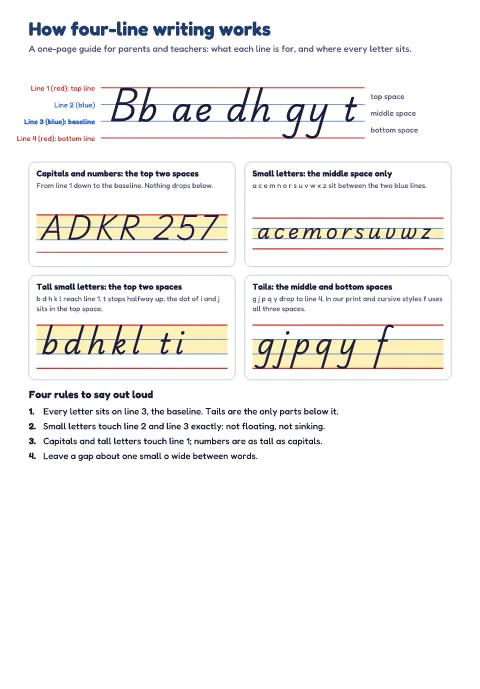 How four-line writing works
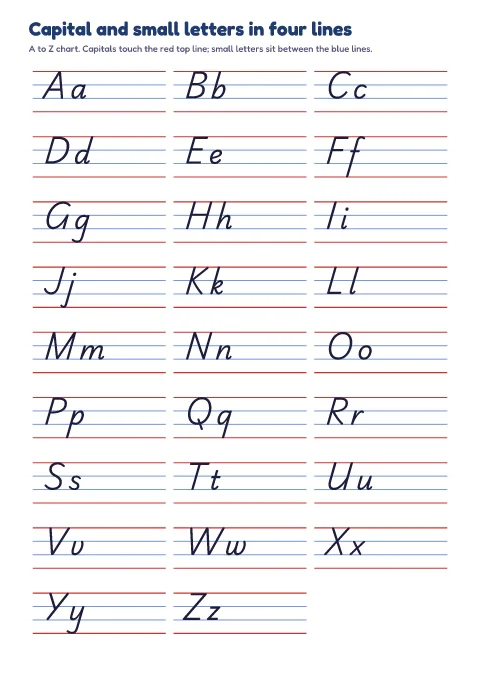 Capital and small letters A to Z chart
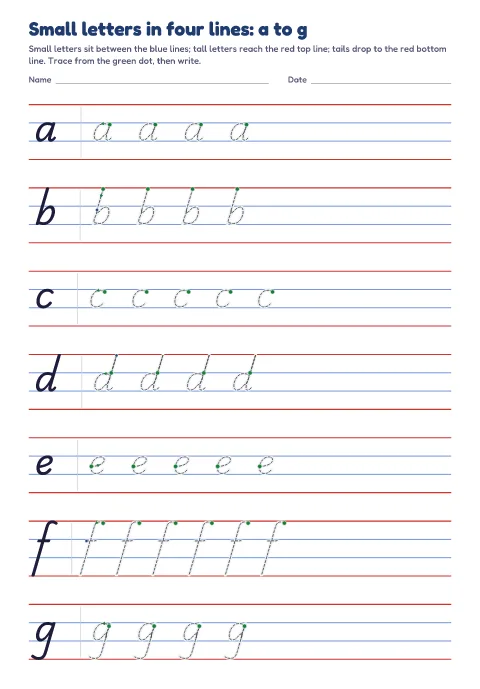 Small letters in four lines (a to z)
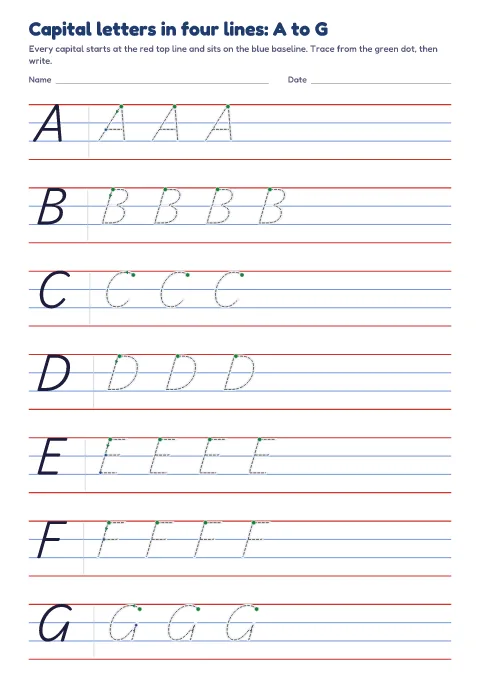 Capital letters in four lines (A to Z)
 Cursive small letters in four lines
 Cursive capital letters in four lines
 Letters by family
 Missing letters and abcd in four lines
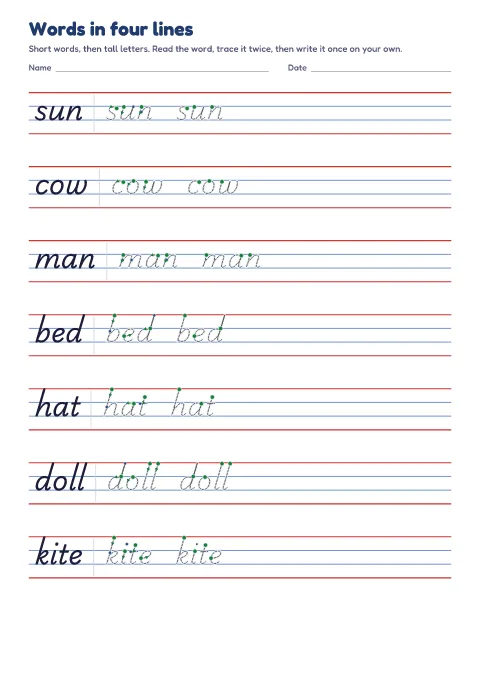 Words in four lines
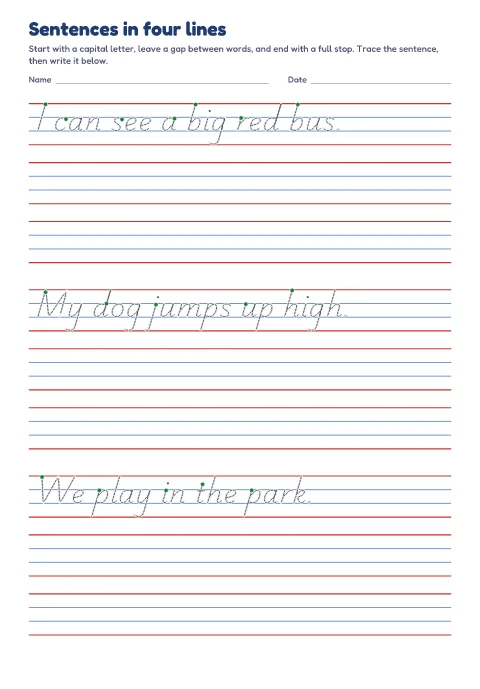 Sentences in four lines
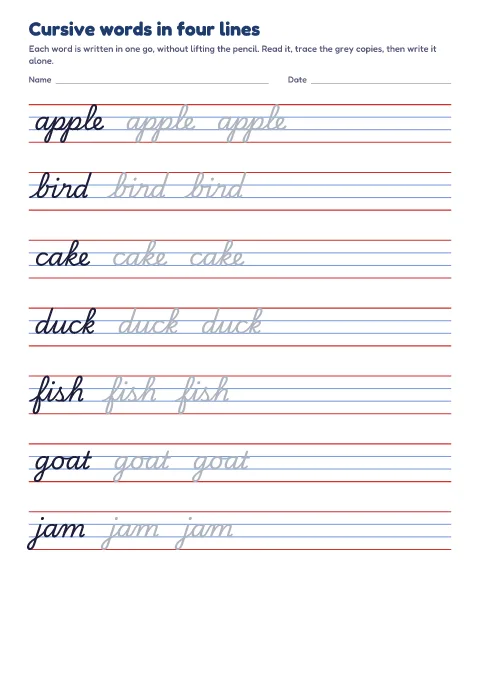 Cursive words in four lines
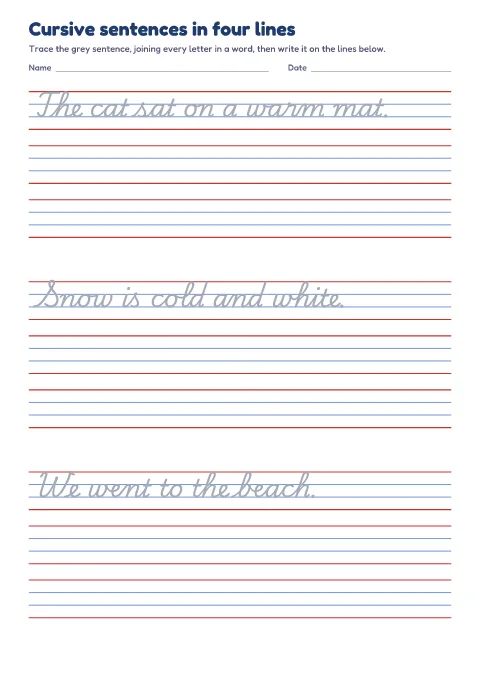 Cursive sentences in four lines
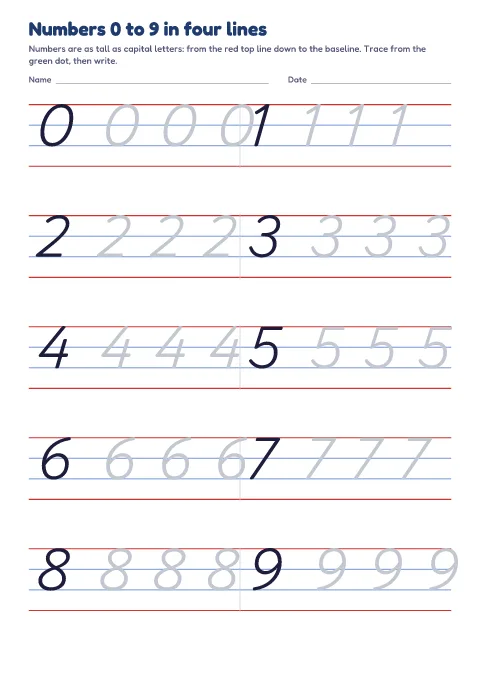 Numbers in four lines
 Four-line notebook paper with a margin
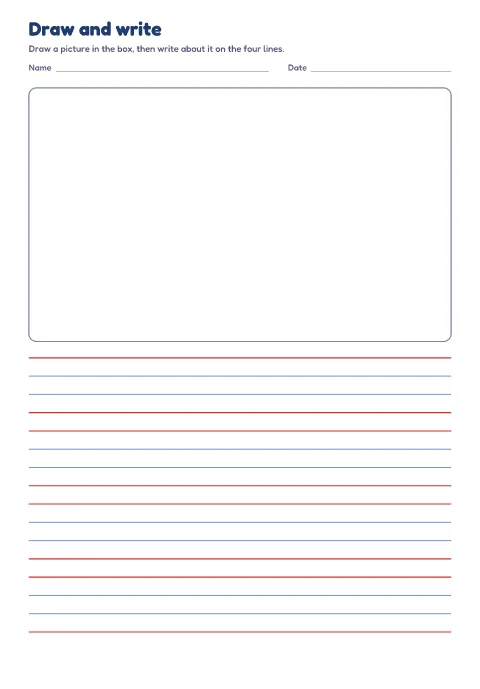 Draw and write
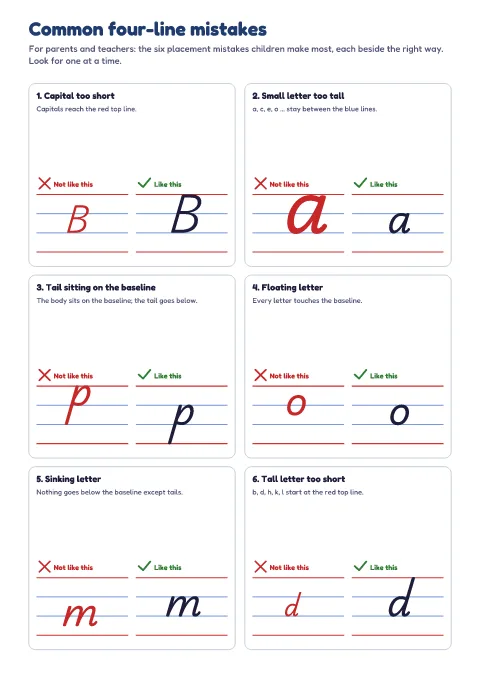 Common four-line mistakes and a checklist
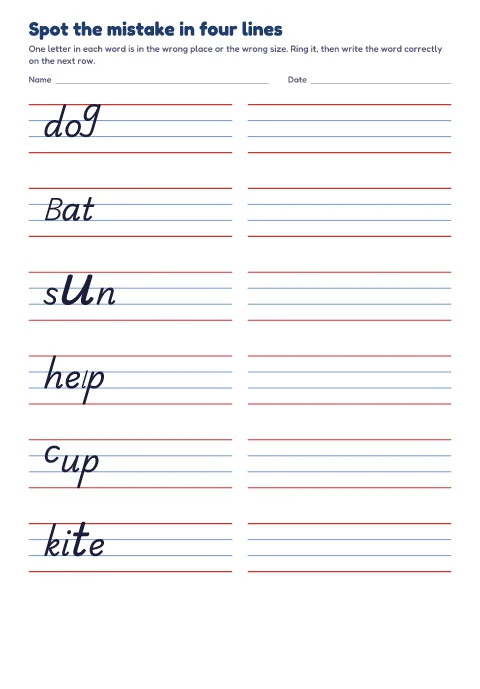 Spot the mistake
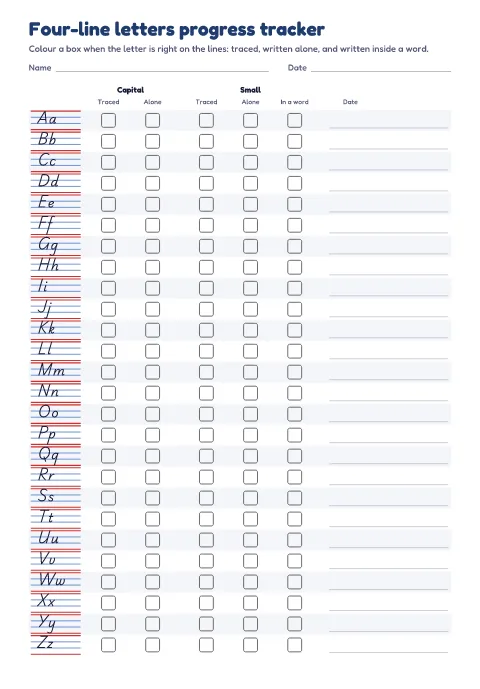 Progress tracker A to Z
How to write capital and small letters in four lines
The four lines make three spaces. Capital letters and numbers fill the top two spaces, from the red top line down to the third line (the baseline). Small letters such as a, c, e, m, n, o, r, s, u, v, w, x and z sit in the middle space, between the two blue lines. The tall small letters b, d, h, k and l reach up to the red top line, t stops halfway, and the tails of g, j, p, q and y drop to the red bottom line. Every letter, capital or small, sits on the baseline; only tails go below it. Two letters differ between copybooks: in our print and cursive styles f uses all three spaces, and some schools teach print f without a tail. Updated 13 November 2026.
Start here: the guide and the chart
1. How four-line writing works
Page 1 is the whole system on one sheet: the four lines named, the three spaces, and a box for each letter family with the spaces it uses shaded. Page 2 is for the adult: the order to teach it in, which line height suits which class, where schools differ (print f, the height of t, cursive capitals with loops) and how to keep practice short.
2. Capital and small letters A to Z chart
Aa to Zz on four lines, three columns to a page: one page in upright-sloped print and one in cursive. Pin it above the desk or slip it into the front of the notebook so the child can check where a letter sits without asking.
Capital and small letters: trace, then write
3. Small letters in four lines (a to z)
Seven letters a page, 4 pages. Each row has the letter in solid black, trace copies that start on a green dot (the first copy shows the arrow and numbered strokes), then a stretch of empty row to write the letter alone. The 7 mm spaces suit UKG and Class 1.
4. Capital letters in four lines (A to Z)
The same layout for capitals, which all start on the red top line and stop on the baseline. Q is the only capital whose tail dips a little below. Start here with younger children: capitals are the easiest to place.
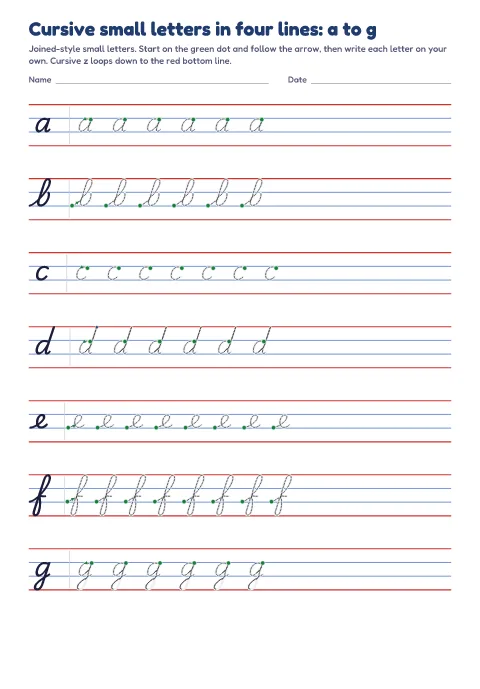
5. Cursive small letters in four lines
Joined-style small letters with their lead-in and exit strokes, on 6 mm spaces. The green dot shows where the pencil goes down; in cursive that is often on the baseline, not at the top of the letter.
Cursive small letters PDF (A4)Cursive small letters PDF (US Letter)
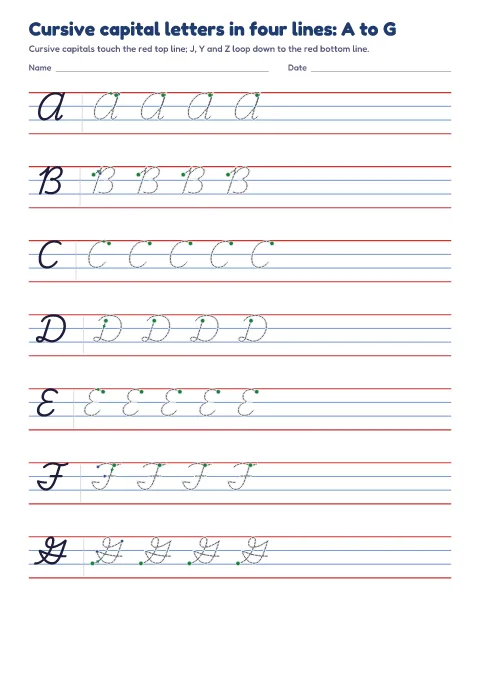
6. Cursive capital letters in four lines
Cursive capitals A to Z. They touch the red top line like print capitals, and J, Y and Z loop down to the red bottom line. Use them once the small letters join comfortably.
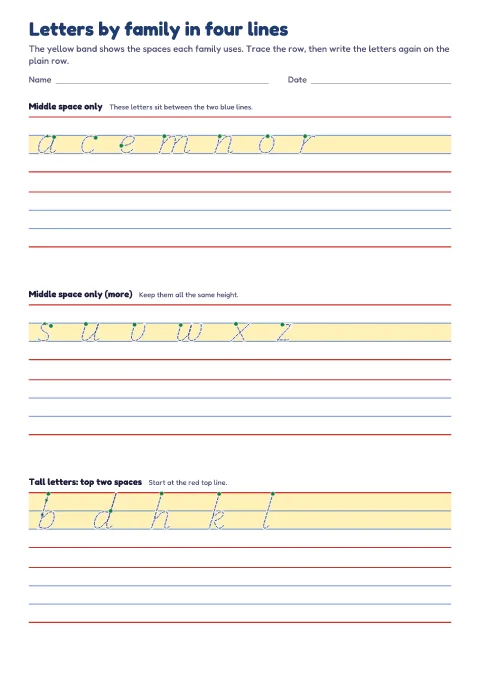
7. Letters by family
The fastest way to fix placement: practise letters that share the same spaces together. A yellow band shades the spaces each family uses: middle-space letters, tall letters, t and i, tails, f, then capitals and numbers. A plain row below each family is for writing them again without the band.
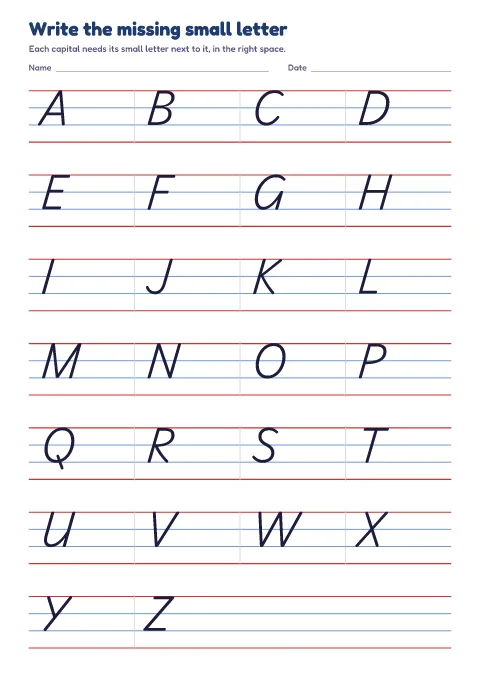
8. Missing letters and abcd in four lines
Three sheets and their answers: write the small letter after each capital, write the capital before each small letter, and fill the gaps in the alphabet (a b _ d). Each answer has to go in the right space, which is the point of the sheet.
Advertisement
Words, sentences and numbers
9. Words in four lines
Fourteen words in order of difficulty: middle-space words (sun, cow, man), words with tall letters (bed, hat, doll, kite), words with tails (pig, jug, yes, egg), then happy, fish and Monday with a capital. Read, trace twice, write once.
10. Sentences in four lines
Six short sentences to trace, each with an empty row below to copy it: a capital at the start, finger spaces, a full stop at the end, and between them every tail letter (g, j, p, q, y) and the f.
11. Cursive words in four lines
Fourteen joined words, from apple and bird to queen, zebra and puppy, in one solid copy and grey copies to trace. The joins are the font’s own, so children see real joined writing, not letters set side by side.
12. Cursive sentences in four lines
Six joined sentences in grey to trace, each with an empty row to write it again. Good for Class 3 and up, on 5.5 mm spaces.
13. Numbers in four lines
The digits 0 to 9 to trace (numbers are as tall as capitals, top two spaces), then a counting sheet with missing numbers to 49 and its answers. Two-digit numbers practise keeping both digits the same height.
Blank four-line notebook paper
14. Four-line notebook paper with a margin
Four pages, one per line height: 10 mm, 8 mm, 6 mm and 5 mm between lines, measured on the printed page in both A4 and US Letter, with a red margin and a name line. Print at 100% (actual size). Our single four-line sheets in 8, 6 and 4 mm have no margin.
Four-line notebook PDF (A4)Four-line notebook PDF (US Letter)
15. Draw and write
A big picture box above four-line rows, in 8 mm and 6 mm. For news, journals, “my weekend” and science observations: draw first, then write two or three sentences.
Check and track
16. Common four-line mistakes and a checklist
For the adult: the six placement mistakes children make most (short capitals, tall small letters, tails sitting on the baseline, floating and sinking letters, short tall letters), each beside the right way. For the child: a nine-point checklist with a tick box for each school day.
17. Spot the mistake
Six words, each with one letter in the wrong space or the wrong size. Children ring it and write the word correctly next to it. Spotting the mistake in someone else’s writing makes it easier to see in your own. Answers on page 2.
18. Progress tracker A to Z
Aa to Zz with boxes to colour when a letter is right on the lines: capital traced and written alone, small letter traced, written alone and written inside a word, plus a date. One sheet per child for the term.
How to teach four-line writing
- Name the lines. Line 1 is the red top line, lines 2 and 3 are blue, line 3 is the baseline where every letter sits, line 4 is the red bottom line. Some teachers call the spaces sky, grass and ground; use whatever your school uses.
- Capitals first. They all use the top two spaces, so a child only has to learn one height. Then numbers, which are the same height.
- Small letters by family, not A to Z. Middle-space letters first (c, o, a, d, g start the same way), then tall letters, then tails. The letters-by-family sheet shades the spaces.
- Words and sentences early. Placement goes wrong when letters meet other letters, so move to short words as soon as single letters sit well.
- Check one thing at a time. Use the mistakes sheet to pick the one mistake your child makes most, and look only for that this week.
Which line height? 10 mm for nursery and LKG, 8 mm for UKG and Class 1, 6 mm for Class 1 and 2 (closest to most printed four-line notebooks), 5 mm for Class 3 and up and for cursive. Move down a size when the letters fit comfortably.
More handwriting: the kids’ capital and small letters in four lines and cursive capital and small letters in four lines sheets, handwriting paper in every size, cursive worksheets, letter and number tracing, handwriting alphabet charts and the teacher resources.
Questions
How do you write capital and small letters in four lines?
Capitals use the top two spaces, from the red top line to the baseline (line 3). Small letters like a, c, e and o sit between the two blue lines; b, d, h, k and l reach up to the top line; the tails of g, j, p, q and y drop to the red bottom line.
Which small letters touch the top line in four lines?
b, d, h, k and l touch the red top line, and f in most styles. t goes about halfway into the top space, and the dots of i and j sit in the top space.
Which letters go below the baseline in four-line writing?
The small letters with tails: g, j, p, q and y, and f in our print and cursive styles. Capitals do not go below the baseline, except the small tail of Q. In cursive, capital J, Y and Z and small z also loop down to the bottom line.
Where do numbers go in four lines?
Numbers are as tall as capitals: from the red top line down to the baseline, in the top two spaces.
What size is a four-line notebook?
Most printed four-line notebooks have about 5 to 6 mm between lines. Younger children start with 8 or 10 mm; this kit has blank paper in 10, 8, 6 and 5 mm.
Why are the lines red and blue?
The red lines mark the top and bottom limits of the writing; the blue lines mark the middle space where small letters sit. On a black-and-white printer our red lines print darker and thicker than the blue ones, so the rows still read.
Are these free for my class?
Yes. Free for your own class, school, tuition centre and family, with no sign-up. Please don’t resell them or upload them to another site.