 Colouring Nest
EYLF learning outcomes: free printable posters, cards and templates
Four free printables for Australian early childhood educators, made around the five learning outcomes of the EYLF V2.0: a wall poster, five outcome cards for your program display, a learning story template and an observation and planning sheet. Each is an A4 PDF and a US Letter PDF, prints clearly in black and white, and needs no account.
Inside this set
- 4 printables
- A4 and US Letter PDFs
- Free, no sign-up
About this resource
Ages 1–5, prep, what you need and how to use it
- Ages
- 1 to 5 years (toddlers, preschool, school start)
- Prep
- Print and go: a few minutes.
- You’ll need
- Printer and paper (card for the poster and outcome cards)
- A pen for the templates
- Supports
- EYLF (Australia)
How to use it in the room
- Put the poster and outcome cards up for families and visitors.
- Write a learning story or observation, then link an outcome only where the learning really shows it.
- Use the planning sheet’s “Reflect” box to note what you will change.
Show resources for
Remembered on this device only. It sets A4 or US Letter as the first download.
The five EYLF learning outcomes
Belonging, Being and Becoming: The Early Years Learning Framework for Australia (V2.0, 2022) sets out five learning outcomes for children from birth to five and through the transition to school:
- Outcome 1: Children have a strong sense of identity.
- Outcome 2: Children are connected with and contribute to their world.
- Outcome 3: Children have a strong sense of wellbeing.
- Outcome 4: Children are confident and involved learners.
- Outcome 5: Children are effective communicators.
Each outcome has key components in the framework, with examples of what educators might see and do. We print the five titles exactly and write everything else in our own words, so the poster and cards stay short enough to read across a room. Read the components in the EYLF V2.0 document (ACECQA).
1. EYLF learning outcomes poster
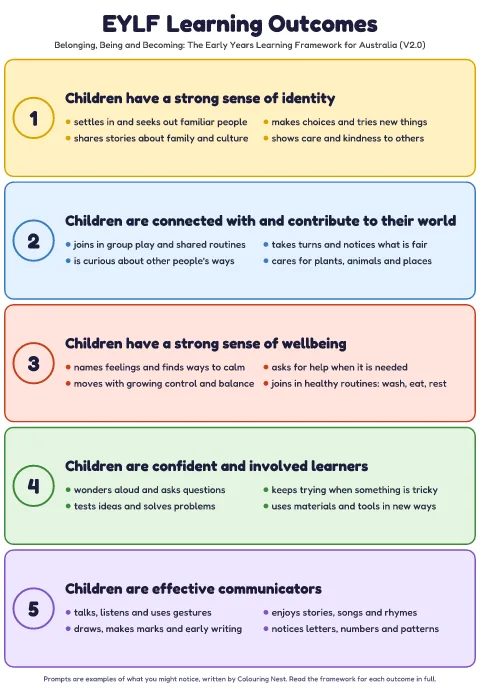
All five outcomes on one page, each in its own colour band with a number you can see from across the room, and four short prompts of what you might notice when a child’s learning connects with that outcome (for outcome 3: naming feelings and finding ways to calm, asking for help, moving with growing control, joining in healthy routines). Put it near your planning wall or in the parent area so families can see what the program is working towards.
2. Outcome cards for your program display
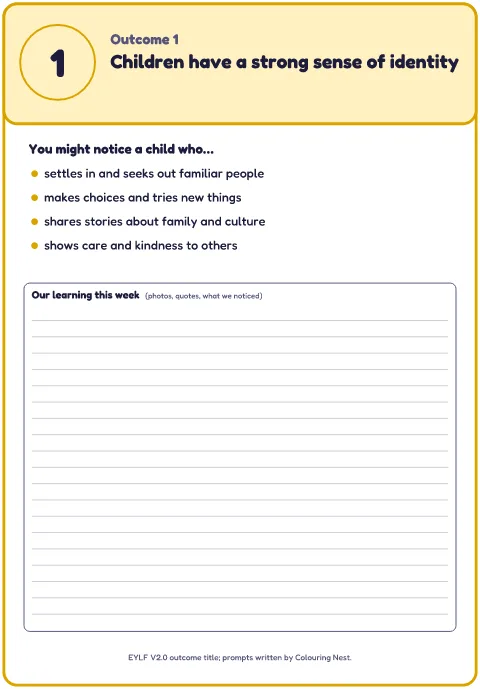
One outcome per page: the number and title large at the top, “You might notice a child who…” with four prompts, and a ruled box headed “Our learning this week” for photos, quotes and what you noticed. Laminate the cards and write on them with a whiteboard marker, or print a fresh set each week and file the old ones with your program.
Advertisement
3. Learning story template
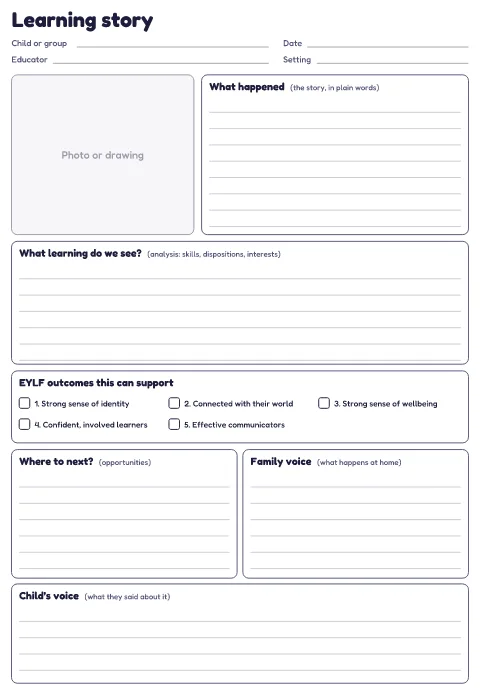
A one-page learning story: who, when and where; a box for a photo or the child’s drawing; “What happened” for the story itself; “What learning do we see?” for your analysis; tick boxes for the EYLF outcomes the story can support; “Where to next?”; and space for the family’s voice and the child’s own words. Write in the first person to the child if that is your service’s style; the boxes work either way.
4. Observation and planning sheet
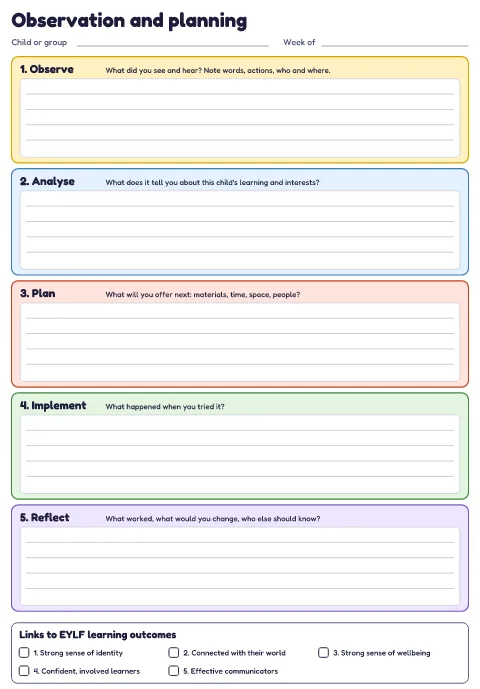
Five coloured steps down the page (observe, analyse, plan, implement, reflect), each with a one-line question and lines to write on, then tick boxes for the outcomes the plan links to. It follows the cycle many services use for documentation; adapt the step names to your own planning cycle.
Using them well
- Link an outcome only where the learning really shows it. A story that supports one outcome clearly is more useful than five ticks.
- Keep the child’s and family’s voice on the page: a direct quote says more than a summary.
- For NQS Quality Area 1, the point is a program that grows from what you observe. Use the planning sheet’s “Reflect” box to note what you will change.
- These are not assessments and make no claim beyond supporting your documentation. For First Nations perspectives, work with your local community; we do not make language or art resources for that (see the Australia page).
More for Australian services: emotion cards, visual schedule cards, state handwriting charts, all about me and the 2027 term dates.
For a whole service
Every template here is free for your own service. The yearly School membership covers one school or one early learning centre at one address (any number of staff) for every printable pack in our shop.
Related sets
 Doctor’s role play: check-up form, eye chart, signsDisplays and charts · ages 2–6
 Te Whāriki learning story templatesTemplates · ages 1–5
 EYFS observation templates and ELG posterTemplates · ages 1–5
 Pepeha template and mihi promptsTemplates · ages 3–6
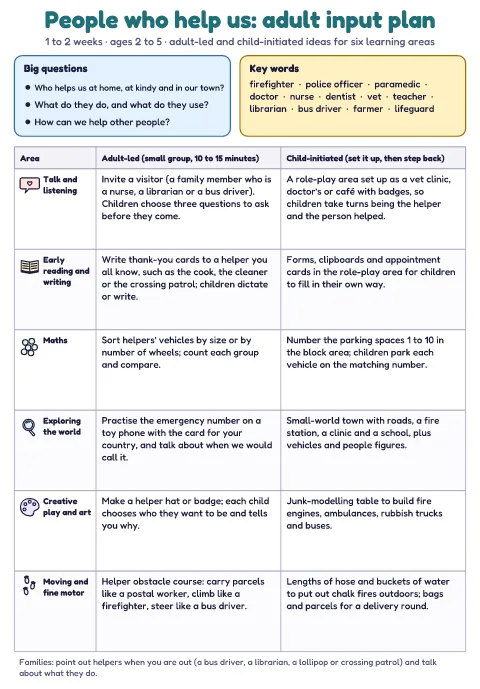 People who help us topic pack and emergency number cardsTemplates · ages 2–5
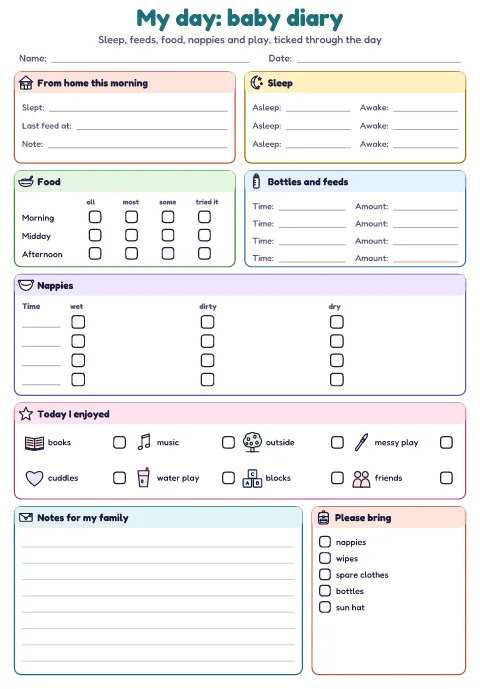 Daily care diary for babies and toddlers, family sheetsTemplates · ages 0–3
Questions
What are the 5 learning outcomes of the EYLF?
In V2.0 (2022) they are: 1. Children have a strong sense of identity; 2. Children are connected with and contribute to their world; 3. Children have a strong sense of wellbeing; 4. Children are confident and involved learners; 5. Children are effective communicators.
How many EYLF outcomes are there?
Five learning outcomes, alongside the vision, eight principles and seven practices of the framework. Each outcome has its own set of key components in the framework document.
What is new in EYLF V2.0?
V2.0 (2022) made Aboriginal and Torres Strait Islander perspectives a principle of its own, and renamed the practices cultural responsiveness and play-based learning and intentionality. It applies from birth to five and through the transition to school.
Can I write my own examples on the cards?
Yes: the prompts are examples written by us, and each card has a ruled box for what your group actually did this week. Many services put one card up per outcome and change the box weekly.
Are the templates free for my service?
Yes. Print as many as you need for your own service and families. Please don’t resell them or upload them to another site.
Sources
- EYLF V2.0 (ACECQA, 2022) (outcome titles, principles and practices; read 2026-11-11)
Learn more
- What is a learning story? How to write one, with an exampleWhere learning stories come from, notice-recognise-respond, a written example, how they fit Te Whāriki, the EYLF and the EYFS, and family voice.