 Colouring Nest
Fine motor activities and printables for preschool
A practical guide to fine motor skills for early childhood educators and parents of children aged 2 to 6, with free printables to go with it: cutting practice in five levels, tracing lines and pre-writing patterns, playdough mats, and a poster of 24 everyday ideas for your room. Every sheet is a PDF in A4 and US Letter, drawn in thin black lines on pale grey so it uses little ink.
About this resource
Ages 2–6, prep, what you need and how to use it
- Ages
- 2 to 6 years (toddlers, preschool, school start)
- Included
- A4 and US Letter PDFs · Free, no sign-up
- Prep
- Print the poster: a couple of minutes.
- You’ll need
- Printer and paper or card for the poster
- Everyday things from the poster: pegs, tongs, playdough, scissors
- Supports
- EYFS (England), EYLF (Australia), Te Whāriki (NZ), ELOF (US)
How to use it in the room
- Read the guide for a sensible order of skills.
- Put the ideas poster up and pick one or two ideas a day.
- Go back a step when a child finds something hard.
Show resources for
Remembered on this device only. It sets A4 or US Letter as the first download.
Start here: cutting practice worksheets (snips to shapes), tracing lines (nine pre-writing patterns, big and smaller) and playdough mats (faces, ladybird, cake, numbers 1 to 10).
What fine motor skills are, and why they matter before writing
Fine motor skills are the small, controlled movements of the hands and fingers: picking up a raisin, turning a page, pulling a zip, snipping with scissors, holding a crayon. They grow out of big movements first. A child who climbs, hangs from a bar, crawls through a tunnel and carries a bucket of sand is building the shoulder and wrist strength that steady hands need. That is why a good fine motor plan for a nursery, kindy or preschool room has as much digging, pouring and squeezing in it as worksheets.
Writing comes last. Before a child can form letters comfortably they need a hand that can hold a tool with the fingers rather than the fist, a wrist that stays steady while the fingers move, and the eyes and hand working together along a line. The printables here practise exactly those things in short, satisfying bursts: a page of snips takes two minutes and ends with a pile of paper confetti.
Supports:
- EYFS England
- Physical development
- EYLF Australia
- Outcome 3: Children have a strong sense of wellbeing
- Te Whāriki NZ
- Exploration | Mana aotūroa
- Wellbeing | Mana atua
- ELOF US
- Perceptual, Motor, and Physical Development
In England, the early learning goal for fine motor skills sits in physical development; in New Zealand, Australia and the US the same skills sit in wellbeing, exploration and physical development. The early learning hub shows how each country names them.
A sensible order (and when to go back a step)
- Strength and play first: dough, pegs, tongs, sponges, tearing paper. These build the muscles of the hand and the arches of the palm.
- Snipping: one cut across a strip of card. Children learn to open and close scissors with the thumb on top before they move the scissors forward.
- Cutting along a line: wide straight lines, then thinner ones, then zigzags, waves, curves and finally shapes. Our cutting pages follow that order in five levels.
- Pre-writing patterns: lines down and across, circles, crosses, slopes, zigzags, waves, loops, then squares and triangles: a common teaching order for the strokes that letters are made of.
- Letters and numbers: once the patterns are easy, move on to letter and number tracing and handwriting styles for your country.
Go back a step whenever a child is frustrated, gripping hard or pressing so firmly that the paper tears. Short and fun beats long and accurate: stop while they still want one more go.
Room poster: 24 everyday fine motor ideas
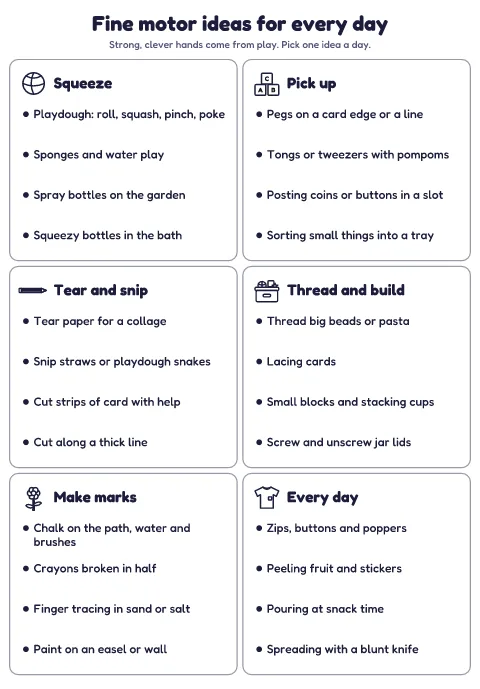
Six boxes (squeeze, pick up, tear and snip, thread and build, make marks, every day), each with four ideas that need nothing more than what a room or a kitchen already has. Pin it by the craft trolley or send it home in a newsletter so families can join in without buying anything.
Advertisement
Pencils, crayons and scissors for small hands
- Short tools are easier. Break crayons in half and use short, chunky pencils: a short tool nudges the fingers into a pinch rather than a fist.
- Thumb on top. For scissors, say “thumb in the top hole, thumb up to the sky”, and hold the paper with the other hand. Turn the paper, not the scissors, on curves.
- Work on a slope. A sheet taped to an easel or a wall, or a ring binder turned sideways as a slope, brings the wrist into a good position for drawing.
- Left-handed children need left-handed scissors (the blades are the other way round, so they can see the line). Our sheets put the scissors on the left; left-handers can turn the page upside down for straight lines.
- Safety: round-ended children’s scissors, a grown-up nearby, and a rule that scissors stay at the table.
Making it easier or harder
Easier: print on thin card so the paper does not flop, cut the page into strips first, use the big lines, and let a child cut off one picture at a time. Harder: the smaller lines, a timer-free “how slowly can you go?” challenge, cutting out the shapes and gluing them into a picture, or tracing with a felt pen and then going over it in a different colour. Laminate the tracing pages and playdough mats and they last the whole year with whiteboard pens and dough.
If a child still finds these movements very hard after lots of play, or avoids drawing altogether, talk to the child’s family and your local health visitor, doctor or an occupational therapist. These sheets are practice for fun, not an assessment or a therapy programme.
More fine motor printables: cutting practice in five levels, tracing lines and pre-writing patterns, playdough mats, letter and number tracing, dot to dot, handwriting paper, and the fine motor guide.
Related sets
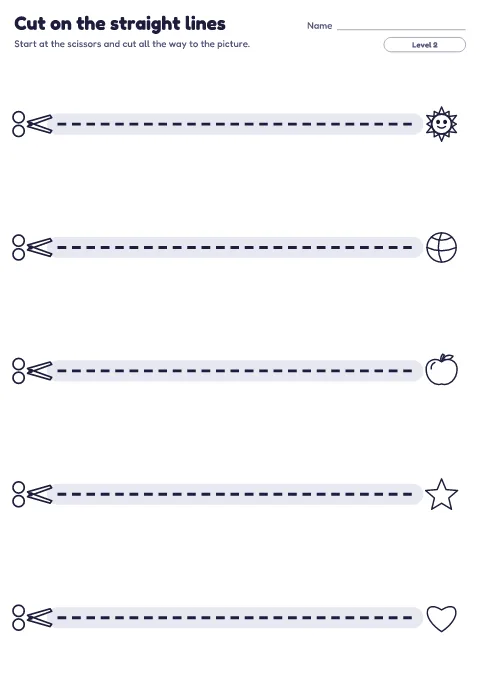 Cutting practice worksheets (5 levels)Worksheets · ages 3–6
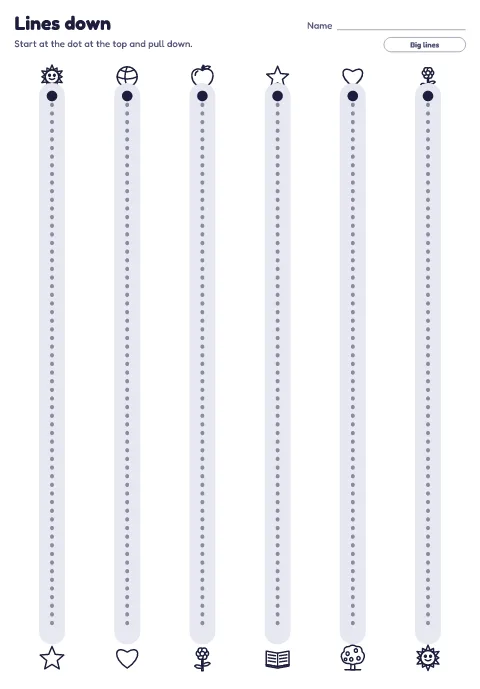 Tracing lines and pre-writing patternsWorksheets · ages 3–6
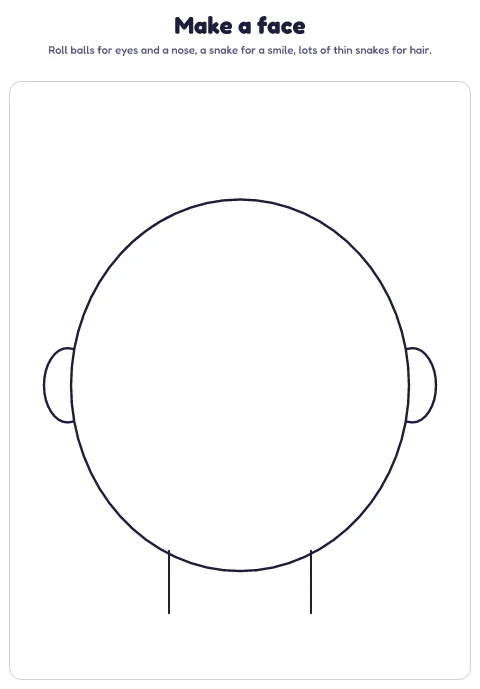 Playdough mats: pictures and numbers 1–10Displays and charts · ages 2–6
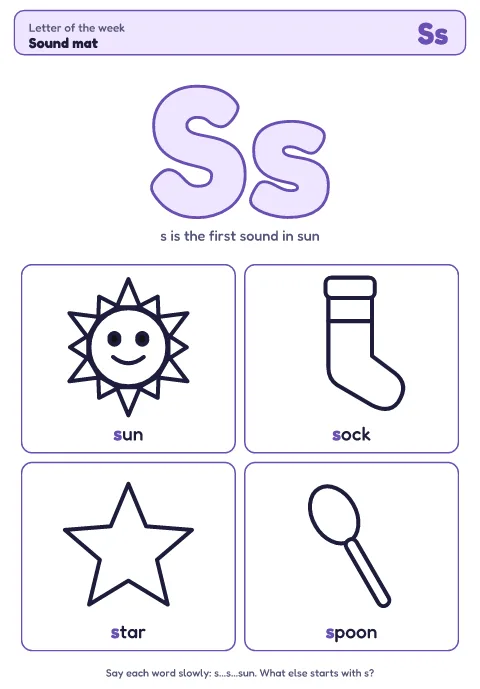 Letter of the week packs A to Z with letter formationWorksheets · ages 3–6
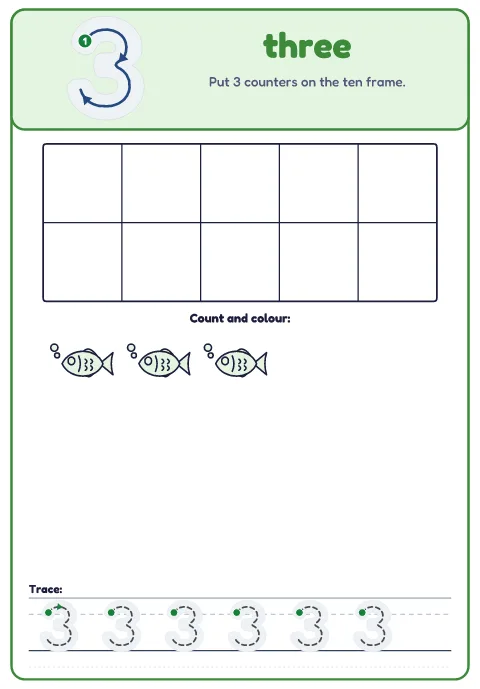 Counting mats 1 to 20 and number formation rhymesWorksheets · ages 3–6
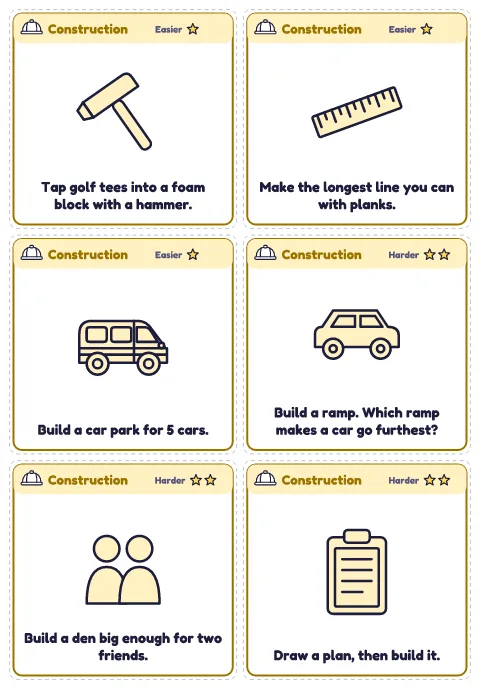 Continuous provision challenge cards for 10 play areasCards · ages 3–5
Questions
What are fine motor skills?
The small movements of the hands and fingers, working with the eyes: picking up small things, using scissors, holding a crayon, doing up buttons. They grow from big movements and plenty of play.
What fine motor activities suit 2 and 3 year olds?
Squashing and rolling playdough, posting things through a slot, tearing paper, big pegs and chunky crayons. Most two-year-olds are not ready for scissors along a line; snipping with help comes at about three for many children.
How do fine motor skills link to the EYFS?
In the EYFS, fine motor skills are part of physical development, a prime area, and there is an early learning goal for them at the end of Reception. These printables support that area; they are not an assessment.
Are the printables free for my setting?
Yes, for your own setting, class or family. Please do not resell them or upload them to another site.