 Colouring Nest
Continuous provision challenge cards
Free continuous provision challenge cards for nursery, preschool, kindy and Reception: sixty cards for ten play areas (blocks, sand, water, playdough, mark-making, reading corner, small world, outdoor, construction and art). Each area has three easier and three harder challenges with a picture, so children can choose one without an adult reading it, and the back of every card gives the adult three open questions and what to look for. A blank set and a weekly planner are included. A4 and US Letter PDFs, colour and ink saver.
Inside this set
- 12 printables
- A4 and US Letter PDFs
- Colour and ink-saver versions
- Free, no sign-up
About this resource
Ages 3–5, what you need and how to use it
- Ages
- 3 to 5 years (preschool, school start)
- You’ll need
- Printer and thin card
- Scissors or a guillotine
- Laminator (optional)
- Supports
- Te Whāriki (NZ), EYLF (Australia), EYFS (England), ELOF (US)
How to use it in the room
- Print at 100% on card.
- Cut the cards apart and laminate them if they will be used often.
- Start with a few cards and add more as children get to know them.
Show resources for
Remembered on this device only. It sets A4 or US Letter as the first download.
What continuous provision challenge cards are for
Continuous provision is the set of areas and resources that are out every day, so children can return to them, choose what to do and get better at it over weeks. A challenge card is a small nudge inside one of those areas: an idea a child can take up or ignore. It never replaces free play. The best challenges are open (there is more than one way to do them), short enough to remember, and linked to what the area already offers.
Our cards come in two levels. The easier cards (one star) ask for one thing a child can do alone, such as “Roll a long snake”. The harder cards (two stars) add a goal, a test or a plan, such as “Build a ramp. Which ramp makes a car go furthest?” Put out one or two cards per area, not all six, and swap them when children lose interest or show they are ready for more.
Printing double-sided
Each PDF has the card fronts on one page and the backs on the next. The backs are placed in mirror order, so if you print double-sided and flip on the long edge, every question lines up behind its own challenge. No duplex printer? Print both pages, cut out the cards and glue them back to back, or keep the backs on a clipboard for staff.
Supports: Exploration | Mana aotūroa, Communication | Mana reo, Wellbeing | Mana atua (Te Whāriki) · Outcome 2, Outcome 4, Outcome 5, Outcome 3 (EYLF) · Understanding the world, Mathematics, Communication and language, Literacy, Physical development (EYFS) · Cognition, Language and Literacy, Perceptual, Motor, and Physical Development (ELOF).
1. Blocks challenge cards
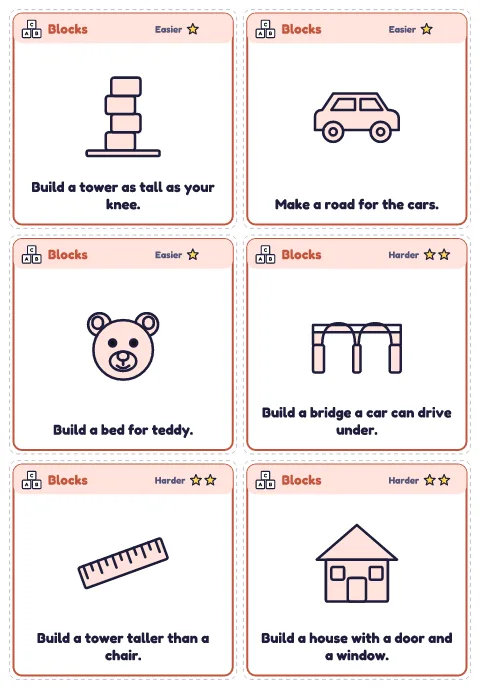
Six cards for blocks (stacking, balancing, measuring and planning): “Build a tower as tall as your knee”, “Make a road for the cars”, “Build a bed for teddy” are the easier ones; the harder three ask for more, such as “Build a bridge a car can drive under”. On the back: three questions to ask and what to look for.
2. Sand challenge cards
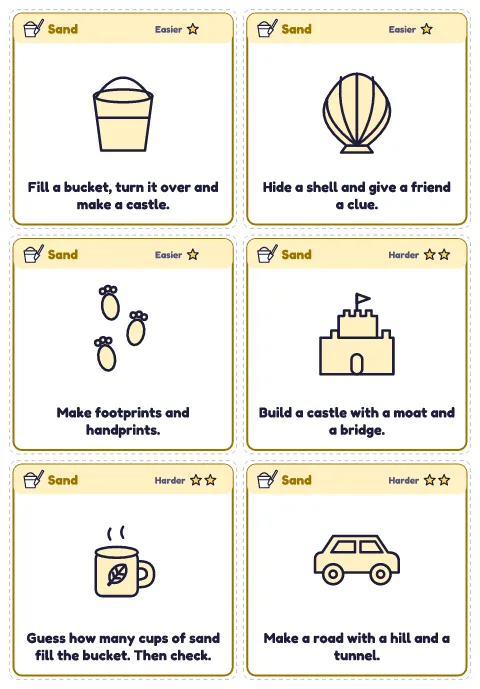
Six cards for sand (filling, emptying, digging and shaping): “Fill a bucket, turn it over and make a castle”, “Hide a shell and give a friend a clue”, “Make footprints and handprints” are the easier ones; the harder three ask for more, such as “Build a castle with a moat and a bridge”. On the back: three questions to ask and what to look for.
3. Water challenge cards
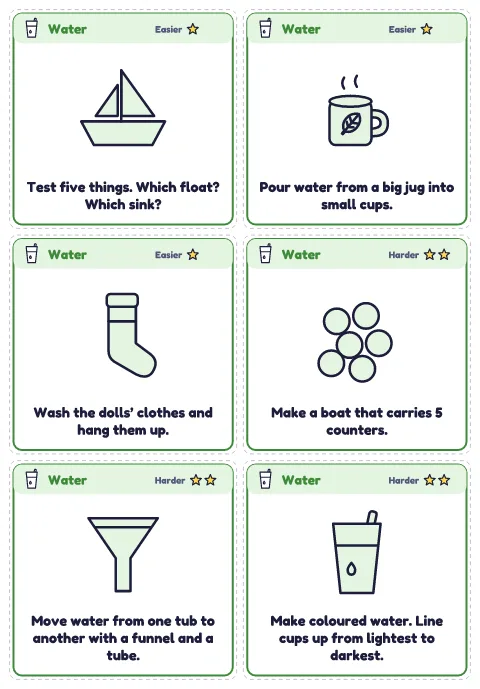
Six cards for water (pouring, floating, sinking and moving water): “Test five things. Which float? Which sink?”, “Pour water from a big jug into small cups”, “Wash the dolls’ clothes and hang them up” are the easier ones; the harder three ask for more, such as “Make a boat that carries 5 counters”. On the back: three questions to ask and what to look for.
4. Playdough challenge cards
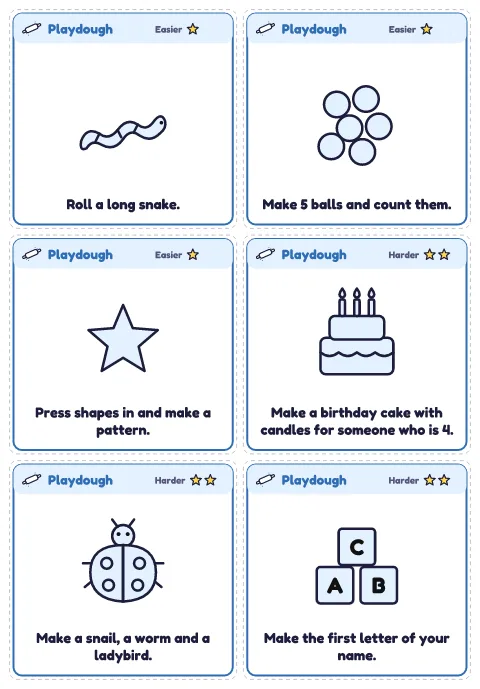
Six cards for playdough (squashing, rolling, cutting and making): “Roll a long snake”, “Make 5 balls and count them”, “Press shapes in and make a pattern” are the easier ones; the harder three ask for more, such as “Make a birthday cake with candles for someone who is 4”. On the back: three questions to ask and what to look for.
5. Mark-making challenge cards
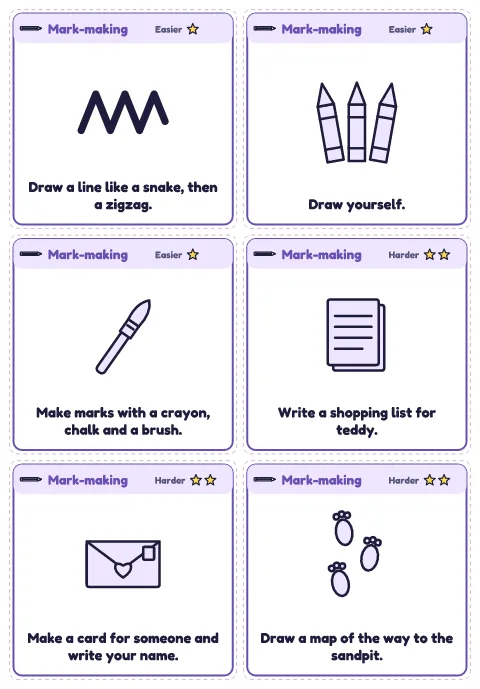
Six cards for mark-making (drawing, writing and making marks with purpose): “Draw a line like a snake, then a zigzag”, “Draw yourself”, “Make marks with a crayon, chalk and a brush” are the easier ones; the harder three ask for more, such as “Write a shopping list for teddy”. On the back: three questions to ask and what to look for.
Advertisement
6. Reading corner challenge cards
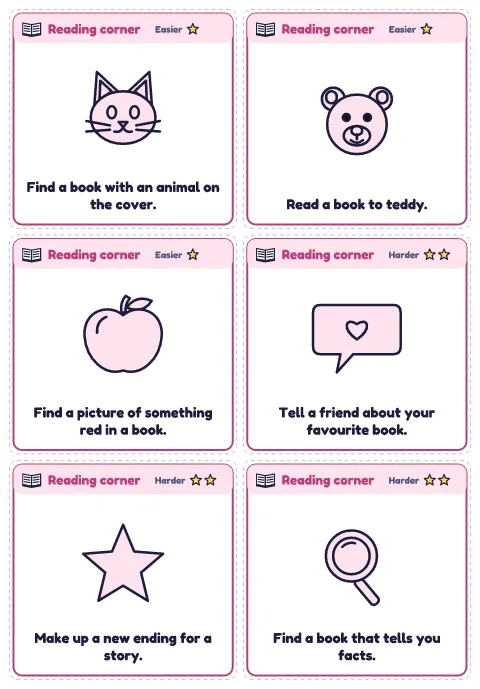
Six cards for reading corner (sharing, retelling and choosing books): “Find a book with an animal on the cover”, “Read a book to teddy”, “Find a picture of something red in a book” are the easier ones; the harder three ask for more, such as “Tell a friend about your favourite book”. On the back: three questions to ask and what to look for.
Reading corner cards PDF (A4)Reading corner cards PDF (US Letter)
7. Small world challenge cards
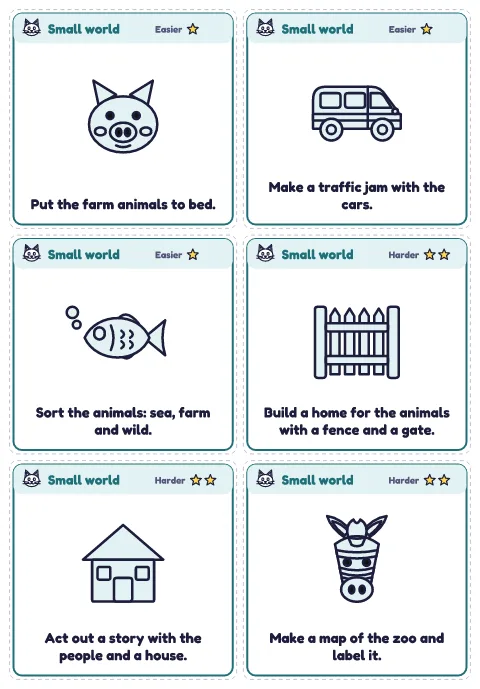
Six cards for small world (pretending, storytelling and arranging small toys): “Put the farm animals to bed”, “Make a traffic jam with the cars”, “Sort the animals: sea, farm and wild” are the easier ones; the harder three ask for more, such as “Build a home for the animals with a fence and a gate”. On the back: three questions to ask and what to look for.
8. Outdoor challenge cards
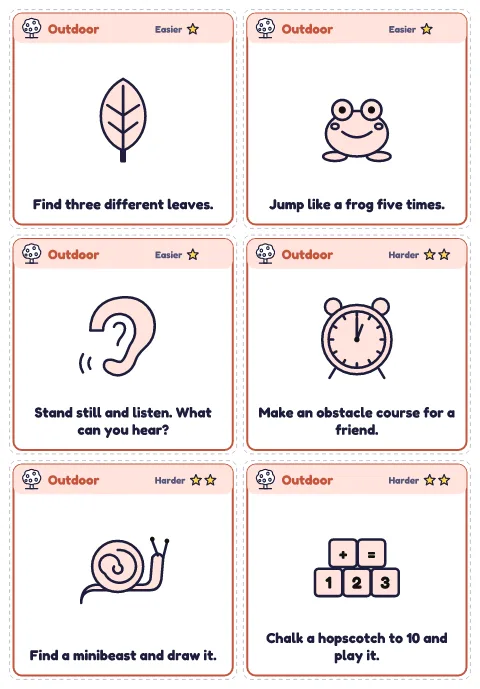
Six cards for outdoor (moving, exploring nature and playing big): “Find three different leaves”, “Jump like a frog five times”, “Stand still and listen. What can you hear?” are the easier ones; the harder three ask for more, such as “Make an obstacle course for a friend”. On the back: three questions to ask and what to look for.
9. Construction challenge cards
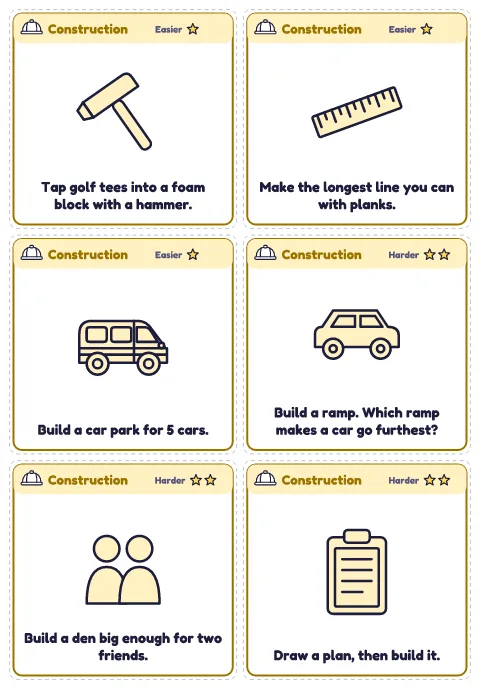
Six cards for construction (building big, using tools and testing designs): “Tap golf tees into a foam block with a hammer”, “Make the longest line you can with planks”, “Build a car park for 5 cars” are the easier ones; the harder three ask for more, such as “Build a ramp. Which ramp makes a car go furthest?”. On the back: three questions to ask and what to look for.
Construction cards PDF (A4)Construction cards PDF (US Letter)
10. Art challenge cards
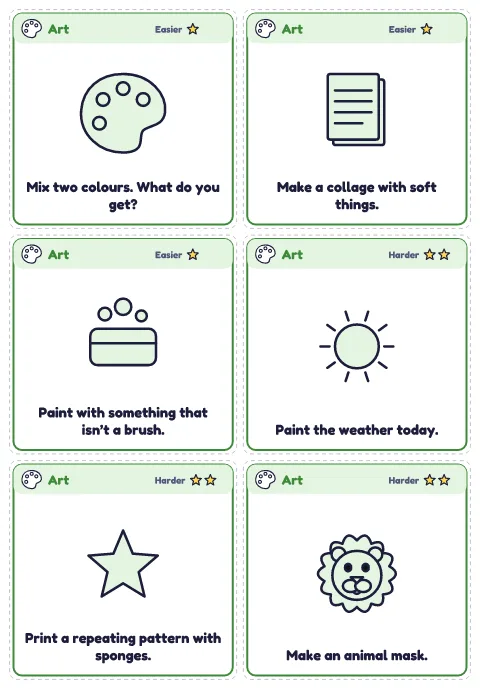
Six cards for art (mixing, printing, collage and making): “Mix two colours. What do you get?”, “Make a collage with soft things”, “Paint with something that isn’t a brush” are the easier ones; the harder three ask for more, such as “Paint the weather today”. On the back: three questions to ask and what to look for.
11. Blank challenge cards
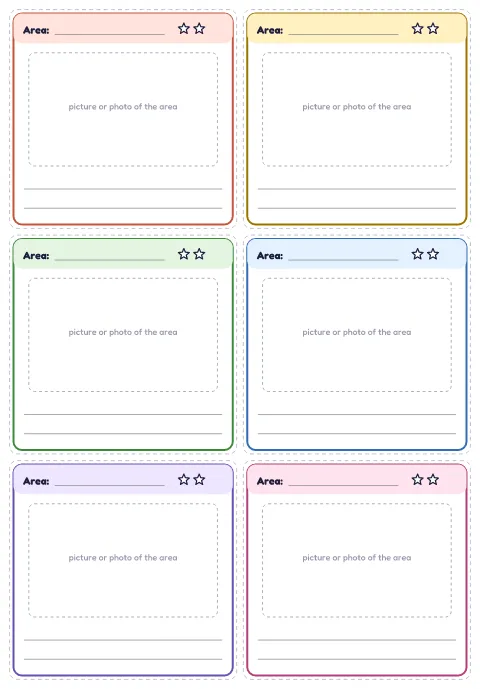
Six blank fronts with a space for the area, a picture or a photo of your own room and two lines for the challenge, plus matching backs with lines for questions and “look for”. Write cards for the areas we have not covered, such as a mud kitchen, a sensory tray or a woodwork bench.
12. Continuous provision planner
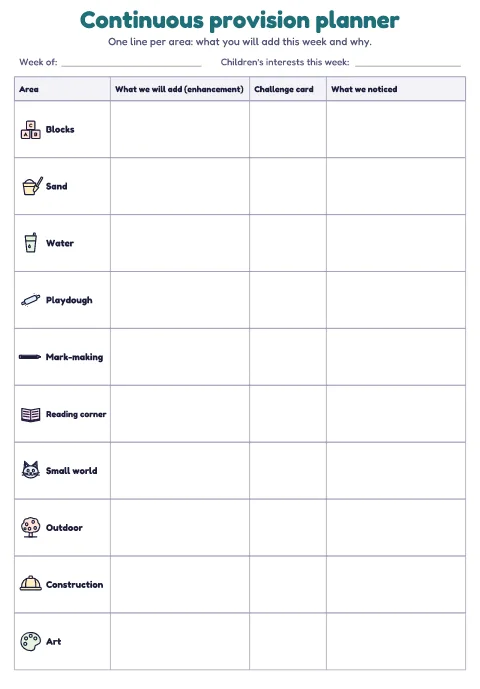
One page for the week: a row for each of the ten areas with space for the enhancement you will add, the challenge card you will put out and what you noticed. Use it at a team meeting, then pin it up for relief staff.
Tips from the floor
- Read it together the first time. Show the card at group time, read it aloud and point to the picture. After that, most children use the picture to remember.
- Follow interests. If the group is mad about dinosaurs, a dinosaur in the sand with the “hide a treasure” card beats a new card nobody asked for.
- Questions, not quizzes. The questions on the back are there to start a conversation. Ask one, listen, and follow what the child says.
- Let children write their own. Older preschoolers love inventing a challenge for a friend on a blank card.
- Keep them clean. Laminate cards for sand, water and outdoors, and store each area’s set in a sleeve at the area.
Pair the cards with area signs and tray labels, the playdough mats, the counting mats and the role-play packs for the home corner: café, shop, vet and doctor’s.
Related sets
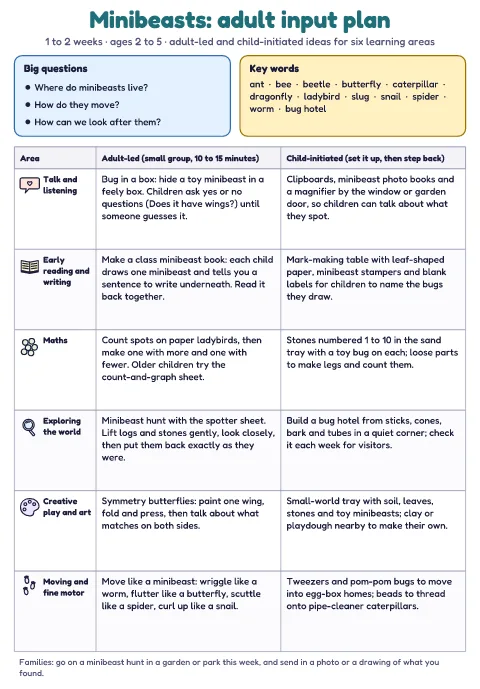 Minibeasts topic pack: adult input plan, word cards, sheetsTemplates · ages 2–5
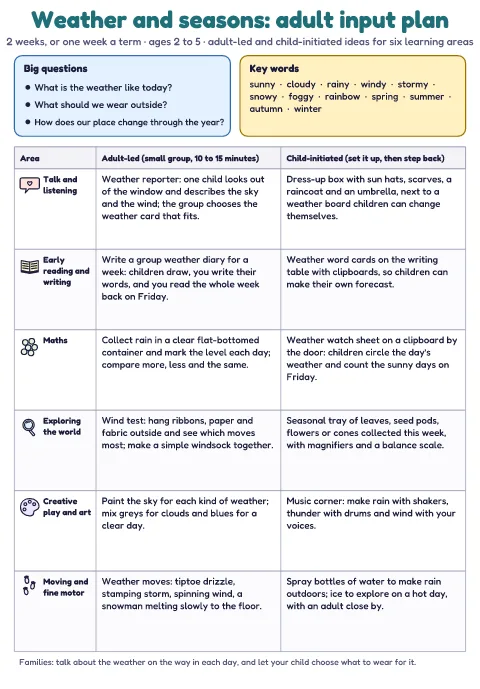 Weather and seasons topic pack (both hemispheres)Templates · ages 2–5
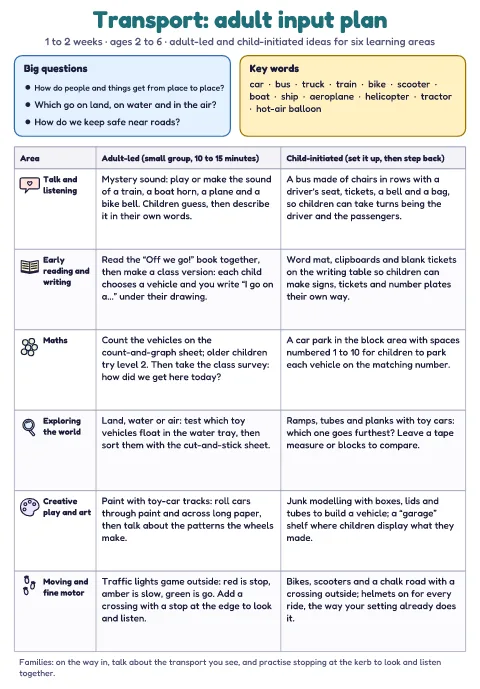 Transport topic pack: plan, word cards, road safety, sortsTemplates · ages 2–6
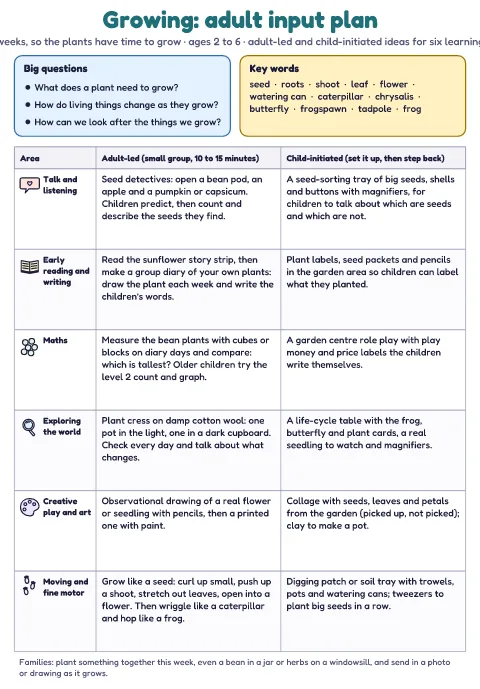 Growing topic pack: plant, butterfly and frog life cyclesTemplates · ages 2–6
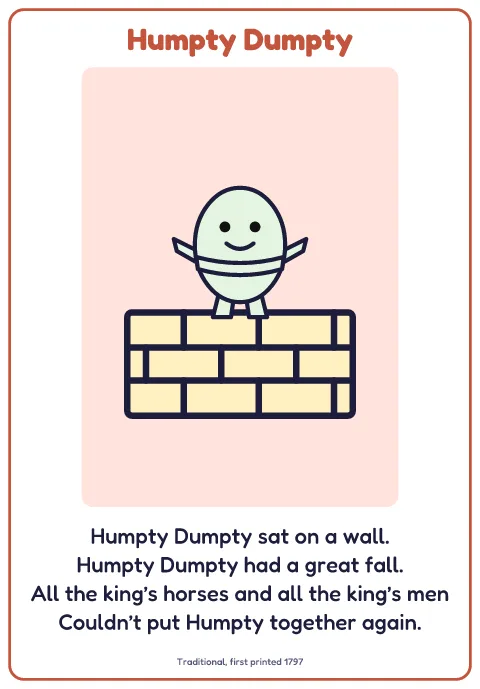 Nursery rhymes: posters, sequencing, actions, rhyming and countingCards · ages 1–6
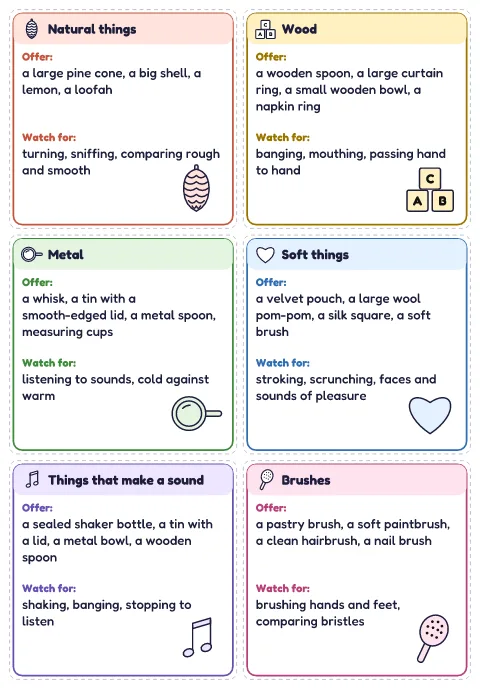 Treasure basket and heuristic play idea cardsCards · ages 0–2
Questions
What is continuous provision in early years?
The play areas and resources that are available every day, such as blocks, sand, water, books and art, set out so children can choose and return to them. Adults add enhancements and challenges to extend the play.
How do I use challenge cards without taking over the play?
Put one or two cards in an area as an invitation. Children can choose them or not. Use the questions on the back to talk with children who take a card up, rather than to test them.
How are the cards differentiated?
Each area has three easier cards with one star (one simple action) and three harder cards with two stars (a goal, a test or a plan). Use the blank cards to make a card easier or harder for a particular child.
Are these free?
Yes. Free for your own centre, kindergarten, school, class and family, with no sign-up. Please don’t resell them or upload them to another site.