 Colouring Nest
Te Whāriki learning story templates and strands poster
Not yet reviewed by a fluent speaker. The strand names and Māori words are checked on Te Aka Māori Dictionary and Ministry of Education documents, with their macrons. Corrections welcome.
Four free printables for kaiako in New Zealand early learning services: a strands poster for the wall, a learning story template with strand tick boxes, a whānau voice sheet to send home, and a planning sheet organised by strand. Each is an A4 PDF (US Letter too), clear in black and white.
Inside this set
- 4 printables
- A4 and US Letter PDFs
- Free, no sign-up
About this resource
Ages 1–5, prep, what you need and how to use it
- Ages
- 1 to 5 years (toddlers, preschool, school start)
- Prep
- Print and go: a few minutes.
- You’ll need
- Printer and paper
- A pen, and photos if you add them
- Supports
- Te Whāriki (NZ)
How to use it in the room
- Put the strands poster up where whānau can see it.
- Write a learning story and tick the strands it shows.
- Send the whānau voice sheet home and add what comes back to the child’s story.
- Plan next steps by strand on the planning sheet.
Show resources for
Remembered on this device only. It sets A4 or US Letter as the first download.
The five strands
Te Whāriki has five strands, each with goals and learning outcomes. The names below are exactly as the Ministry of Education prints them in Part A of the curriculum framework; the one-line summaries are ours.
- Wellbeing | Mana atua: Health, safety and feeling cared for; learning to manage feelings.
- Belonging | Mana whenua: Knowing they have a place here, with familiar routines and links to home.
- Contribution | Mana tangata: Fair turns for everyone, playing alongside others, ideas that count.
- Communication | Mana reo: Talk, gesture, stories, symbols, art, music and movement.
- Exploration | Mana aotūroa: Play, moving with confidence, wondering and making sense of the world.
1. Strands poster
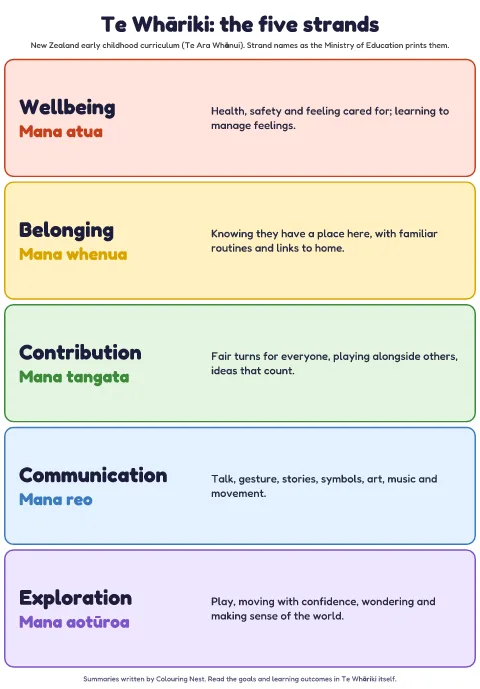
Five colour bands, one per strand, with the English and Māori names large enough to read across the room and our one-line summary beside each. Put it on your planning wall or the whānau noticeboard so families can see how you think about learning.
2. Learning story template
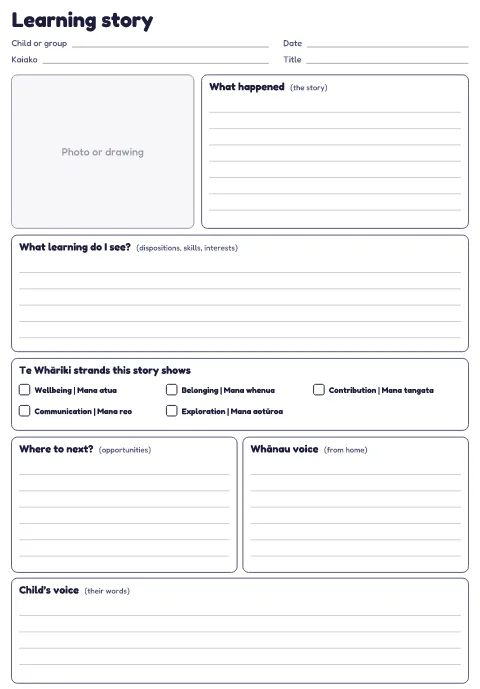
Child, date, kaiako and a title; a photo box; “What happened”; “What learning do I see?”; tick boxes for the strands the story shows; “Where to next?”; and space for whānau voice and the child’s own words. The layout follows the shape most services use (notice, recognise, respond), with room to write in the first person to the child.
Advertisement
3. Whānau voice sheet
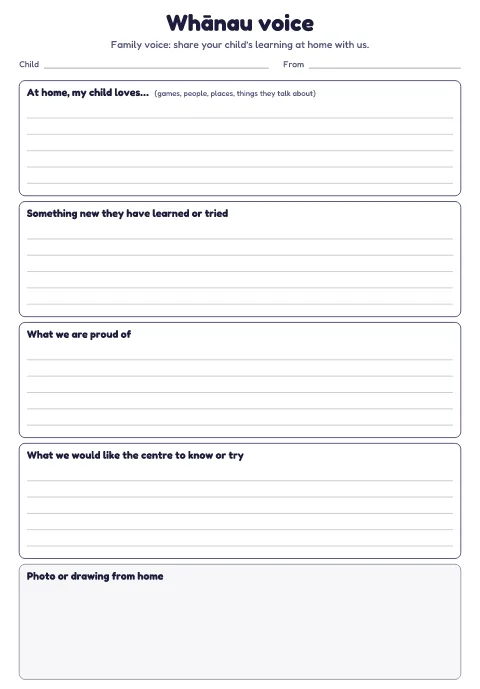
Four short prompts for families (what their child loves at home, something new they have tried, what they are proud of, what they would like the centre to know) and a space for a photo or drawing. Send it home with a learning story, or keep a few by the door at pick-up.
4. Planning sheet by strand
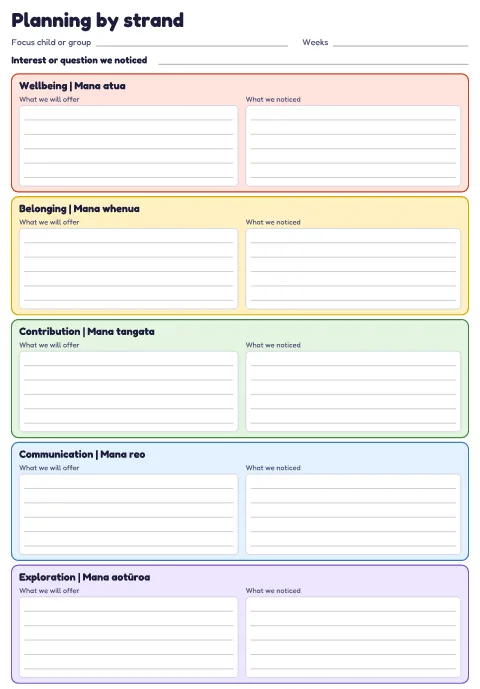
Start from an interest or question you noticed, then plan across the five strands: one row each, split into “What we will offer” and “What we noticed”. It keeps a plan from leaning on one strand and gives you notes for the next learning story.
A note on te reo Māori
The strand names and the few Māori words on these pages are checked against Te Aka Māori Dictionary and the Ministry of Education’s own documents, with their macrons. A fluent speaker and a Māori early childhood kaiako have not yet reviewed them; if you spot something we should change, please tell us. We do not publish karakia, waiata, anyone’s pepeha or Māori pattern art; our te reo Māori printables include a pepeha template with the structure only. More for NZ services is on the New Zealand early learning page; Australian services will find an EYLF version of the learning story on the EYLF outcomes page.
Related sets
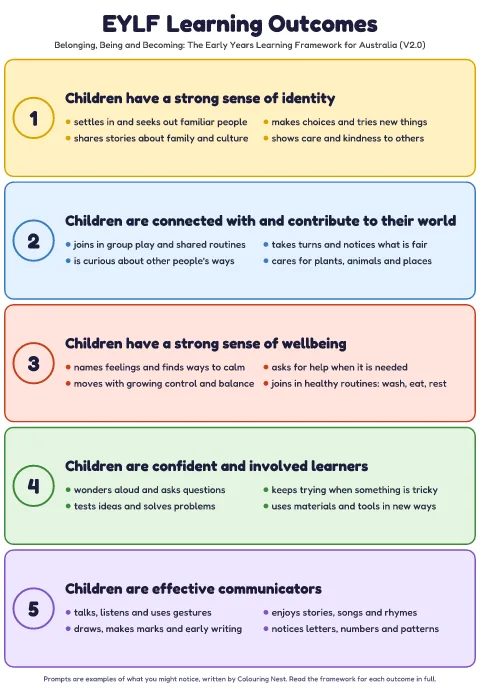 EYLF outcomes poster, cards and templatesTemplates · ages 1–5
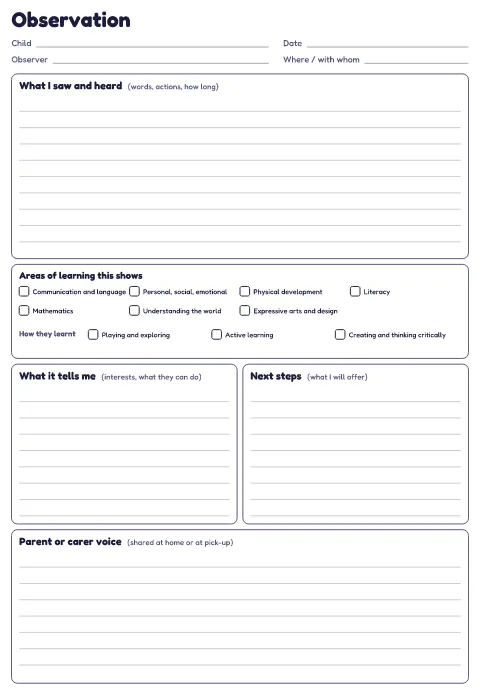 EYFS observation templates and ELG posterTemplates · ages 1–5
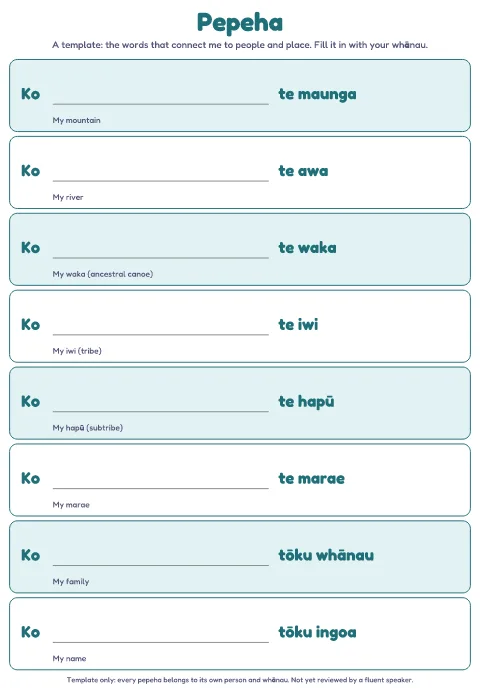 Pepeha template and mihi promptsTemplates · ages 3–6
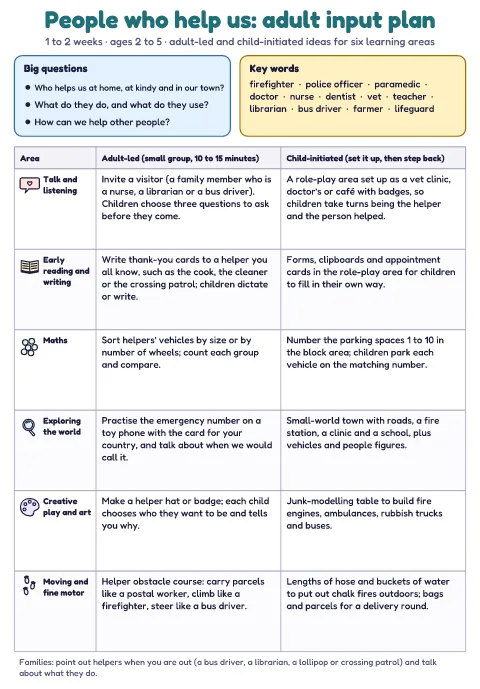 People who help us topic pack and emergency number cardsTemplates · ages 2–5
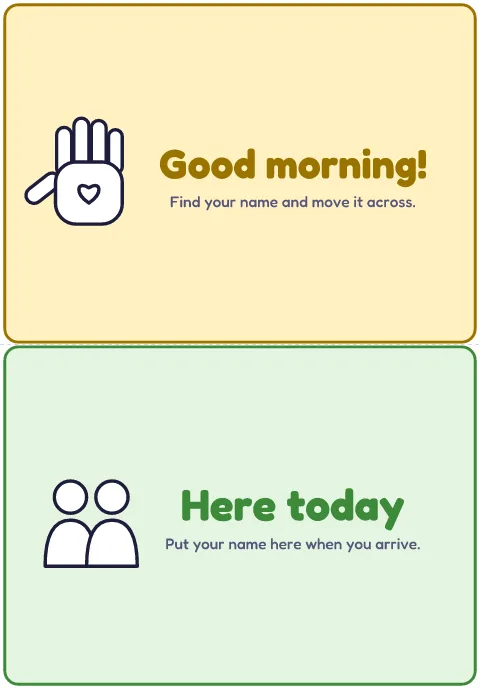 Self-registration, welcome banner and birthday chartDisplays and charts · ages 2–6
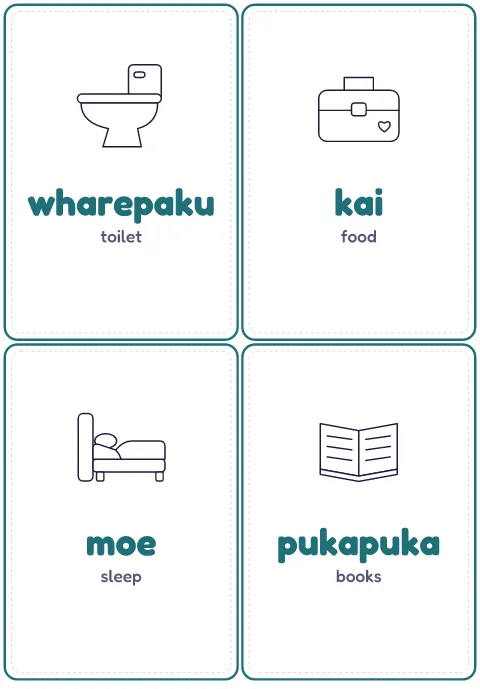 Te reo Māori room labels, greetings, shapes, feelingsDisplays and charts · ages 1–6
Questions
What are the five strands of Te Whāriki?
Wellbeing | Mana atua, Belonging | Mana whenua, Contribution | Mana tangata, Communication | Mana reo and Exploration | Mana aotūroa. Each strand has goals and learning outcomes in the curriculum.
What is a learning story?
A short written story of something a child did, told so that the learning shows, usually with a photo, what the kaiako noticed, where the learning could go next, and the voice of the child and their whānau. It is one of the ways New Zealand services document learning.
Do I have to tick a strand on every story?
No. Tick a strand only where the story really shows it; one clear link is worth more than five ticks.
Do you have a pepeha template?
Yes, on our te reo Māori pages: the structure only, with blanks for each whānau to fill in, a “my place” version for any family, and mihi prompts. A pepeha carries a person’s ancestry and connections to place, which belong to each whānau, so we never give an example to copy.
Are these free for my centre?
Yes, for your own service and whānau. Please don’t resell them or upload them to another site.
Sources
Learn more
- What is a learning story? How to write one, with an exampleWhere learning stories come from, notice-recognise-respond, a written example, how they fit Te Whāriki, the EYLF and the EYFS, and family voice.