 Colouring Nest
Telling time games, a teaching clock and posters
Free telling time games, a teaching clock to cut out, posters and activities for Year 1 to Year 3 and grades 1 to 3: 15 printables that sit around our telling time worksheets and clock faces. A big teaching clock with split-pin steps and a class set, a “how to read a clock” anchor chart, a poster that shows the hour hand moving, a chart of UK and US ways to say each time, word wall cards, count in fives, read-and-draw sheets at four levels, “right or wrong?” clocks, matching cards, “I have, who has?”, clock bingo, a daily routine to put in order, elapsed time word problems and “What’s the time, Mr Wolf?”. Every sheet with answers has an answer page, and the word sheets come in UK and US wording.
Inside this set
- 15 printables
- A4 and US Letter PDFs
- Colour and ink-saver versions
- Free, no sign-up
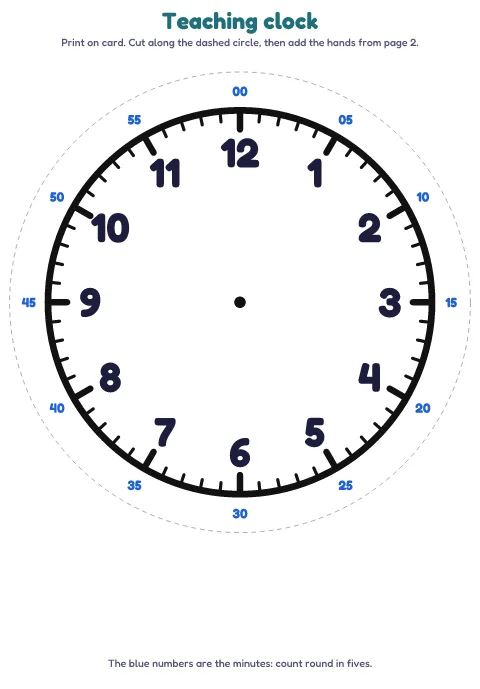 Teaching clock to cut out
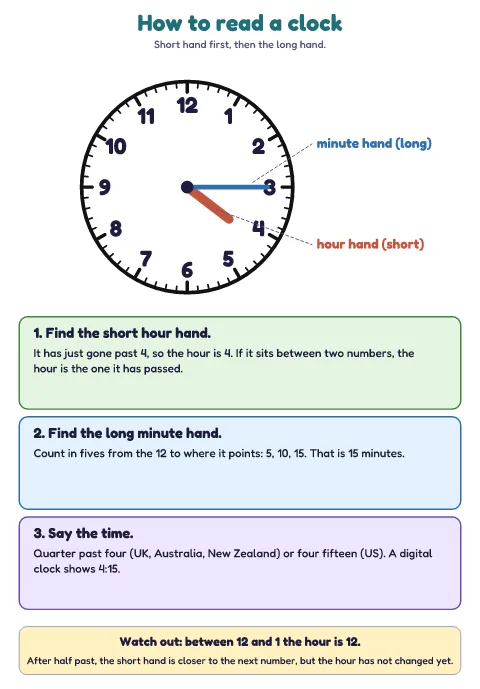 How to read a clock anchor chart
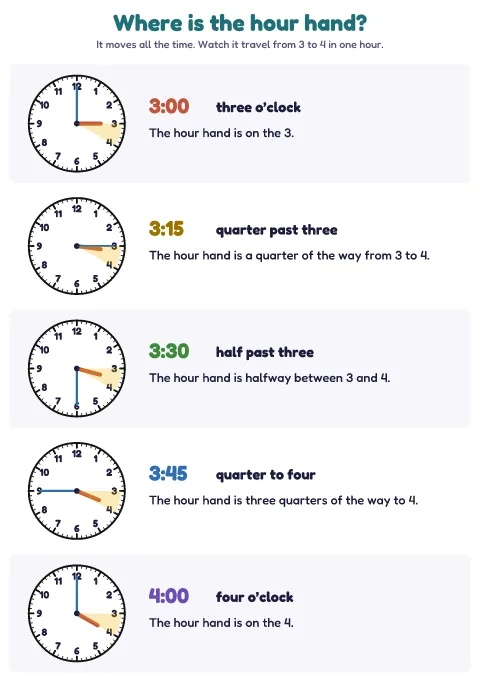 Where is the hour hand? poster
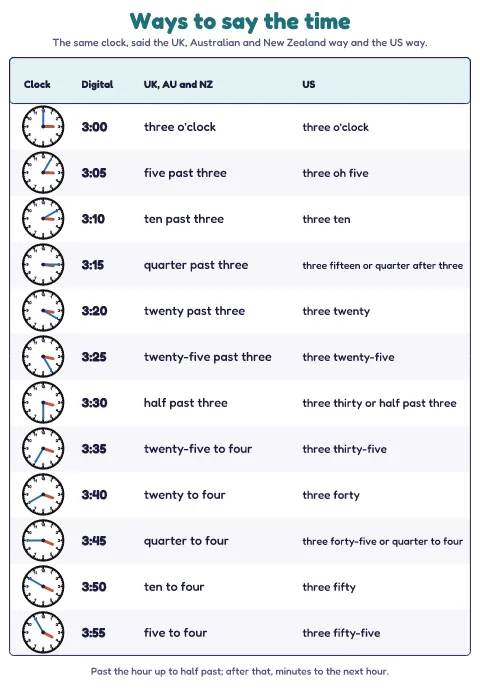 Ways to say the time chart
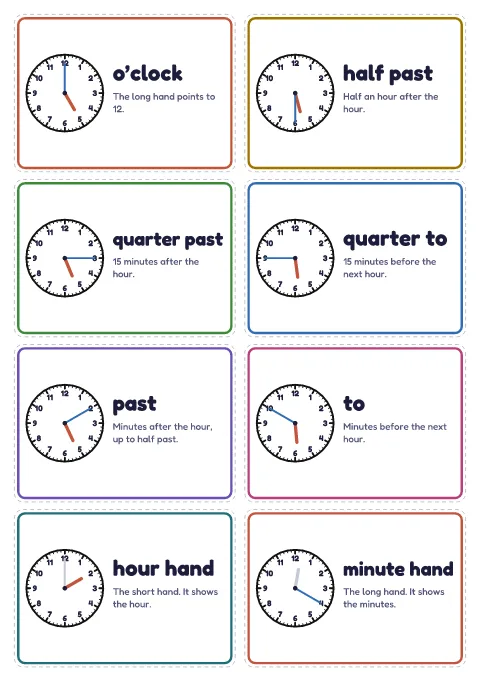 Time word wall cards
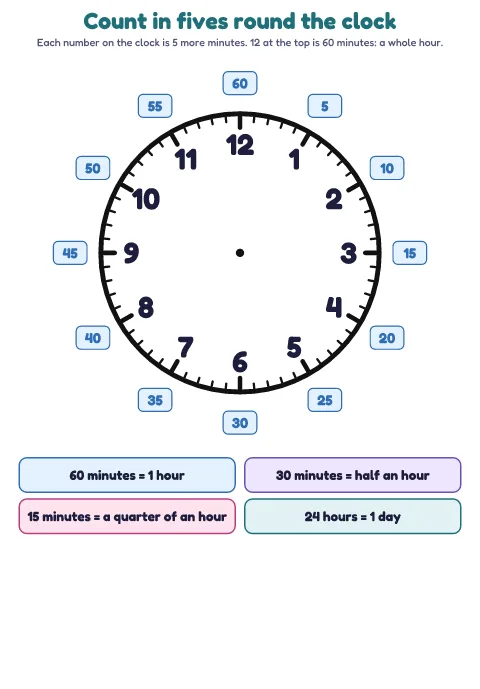 Count in fives round the clock
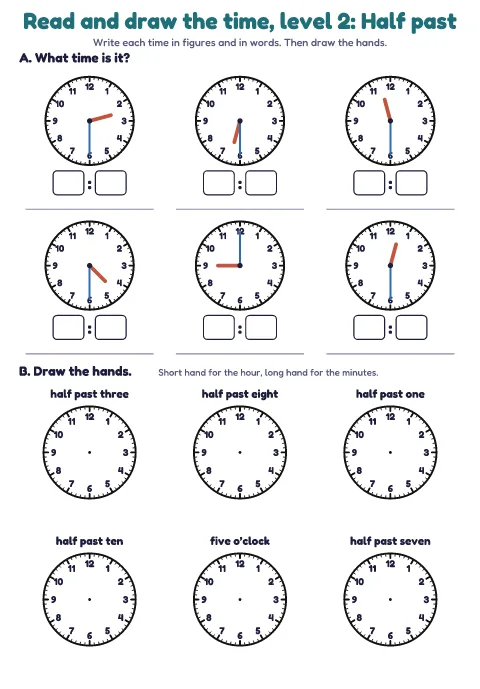 Read and draw the time: four levels
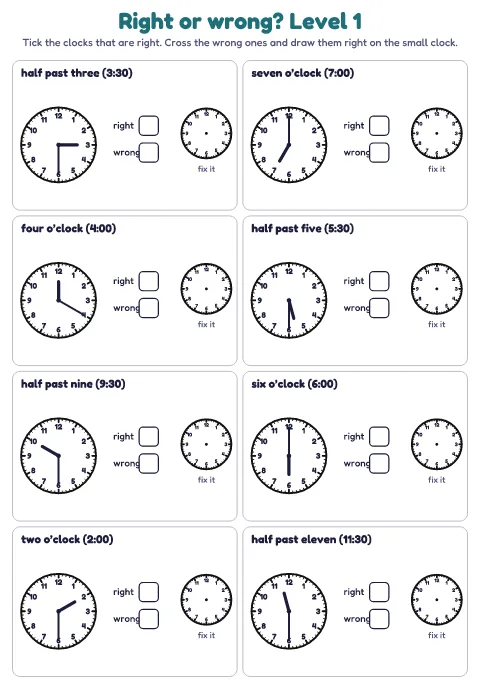 Right or wrong?
 Analogue, digital and words matching cards
 I have, who has? time loops
 Clock bingo
 What’s the time, Mr Wolf? cards
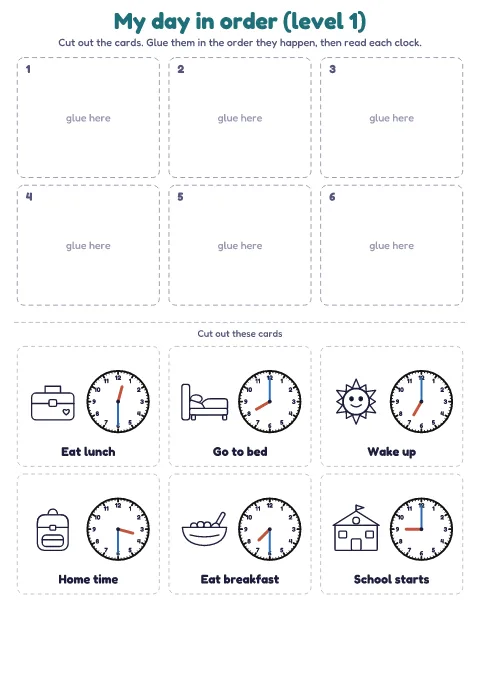 My day in order
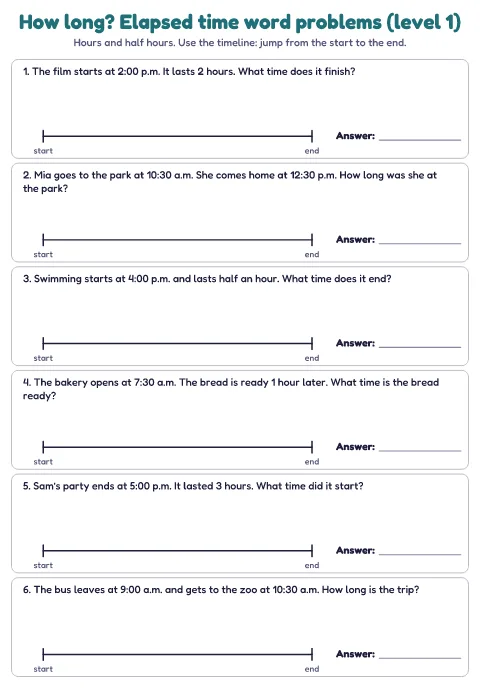 Elapsed time word problems
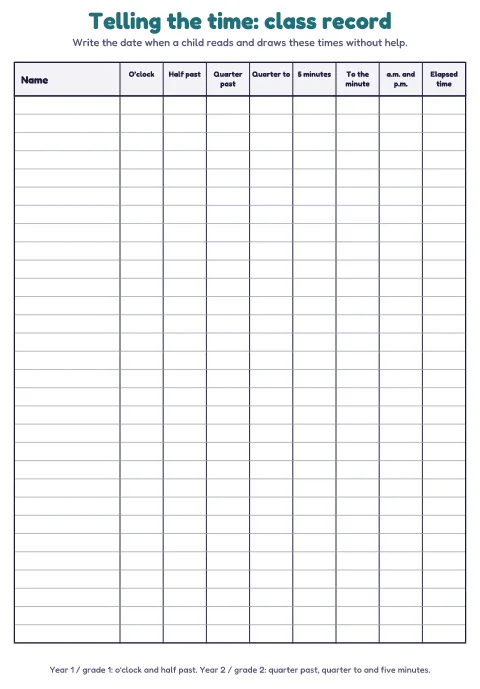 Class record and “I can tell the time” chart
The idea behind the kit: watch the hour hand
Most children can say “half past” long before they can read it from a clock, because the minute hand is easy: it points at 6. The hour hand is where they slip. At half past three it sits halfway between 3 and 4, and a child who reads “the short hand points at 4” says four thirty. Many free clock pictures make this worse by parking the hour hand on the number. Every clock in this kit is drawn by our own clock engine at the true angle (at 3:45 the short hand is three quarters of the way to 4), and the hour hand poster and the “right or wrong?” sheets are built around exactly this mistake.
The teaching clocks use a red hour hand and a blue minute hand, as classroom demonstration clocks often do. On a black-and-white printer the difference still shows, because the hour hand is shorter and thicker.
Clocks and posters for the wall
1. Teaching clock to cut out
A clock face about as wide as the page, with the minutes 00 to 55 printed in blue round the rim, a page of hands with six steps for putting it together with a paper fastener (split pin or brad), and a page of four small clocks with their hands so every child can have one. Card from a cereal box works if you have no card stock. Turn the long hand once round and the short hand moves on one number: show that before anything else.
2. How to read a clock anchor chart
Quarter past four, read in three steps: find the short hour hand and the number it has passed, count the long hand in fives from 12, then say the time. The time is given both ways, quarter past four and four fifteen, with a reminder for the awkward case: between 12 and 1 the hour is still 12.
3. Where is the hour hand? poster
Five clocks, 3:00, 3:15, 3:30, 3:45 and 4:00, with the space between 3 and 4 shaded so the short hand can be seen creeping across it. Each row says where the hand is in plain words (“halfway between 3 and 4”). Put it next to the clock on the classroom wall.
4. Ways to say the time chart
Every five minutes from 3:00 to 3:55, with a small clock, the digital time, the words used in the UK, Australia and New Zealand (twenty-five to four) and the words used in the US (three thirty-five). Useful in any class with children who moved countries, and for parents who learned the other way.
5. Time word wall cards
Sixteen cards: o’clock, half past, quarter past, quarter to, past, to, hour hand, minute hand, analogue clock, digital clock, clockwise, minute, hour, a.m., p.m. and day, each with a picture and a one-line meaning. The US set says analog, quarter after and after, and noon instead of midday.
6. Count in fives round the clock
A poster with the minutes in a box beside each number (5 at the 1, 60 at the 12) and four facts: 60 minutes in an hour, 30 in half an hour, 15 in a quarter of an hour and 24 hours in a day. Then a sheet with empty boxes to fill and six questions about where the long hand points, with answers.
Advertisement
Practice sheets with answer pages
7. Read and draw the time: four levels
One page per level: o’clock, half past, quarter past and quarter to, then five minutes. The top half has six clocks to read and write in numbers and words; the bottom half has six times to draw. Pages 5 to 8 are the answers. The US version labels the half past page “:30 (thirty)” and writes the times as children there say them, such as 8:30, eight thirty.
8. Right or wrong?
Eight labelled clocks per page, four drawn right and four with a real mistake: the hour hand left on the number at half past, the hands swapped, the long hand on 2 for “ten past” read as 10. Children tick or cross each one and draw the wrong ones correctly on a small clock. The answer pages say what went wrong in one line, which is the bit worth reading aloud.
Games and cards
On screen too: the free online telling time game has the same five levels, from o’clock to the minute, in UK or US wording. Children drag the hands to show a time (the hour hand moves as the minute hand turns, like a geared teaching clock) or read a clock and pick or type the answer. Press “Big screen” to use it on the classroom board.
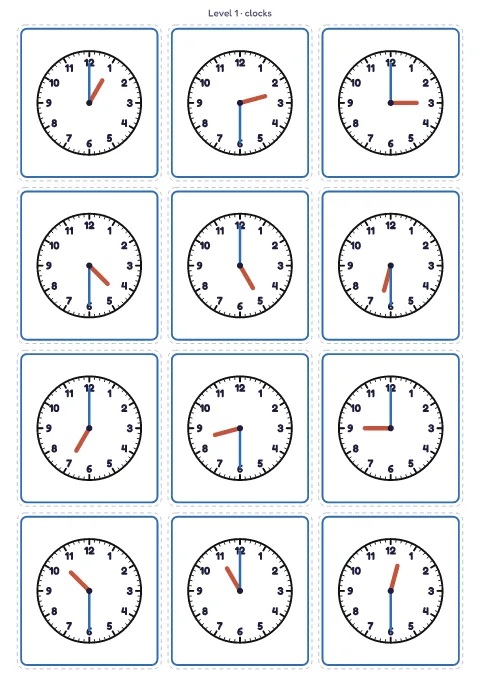
9. Analogue, digital and words matching cards
Three cards for each time, a clock, a digital display and the time in words, at two levels (o’clock and half past, then quarter hours and five minutes): 72 cards in all. Play snap with two sets, memory with all three, or hand out one card each and ask children to find their group. The US version swaps the word cards only.
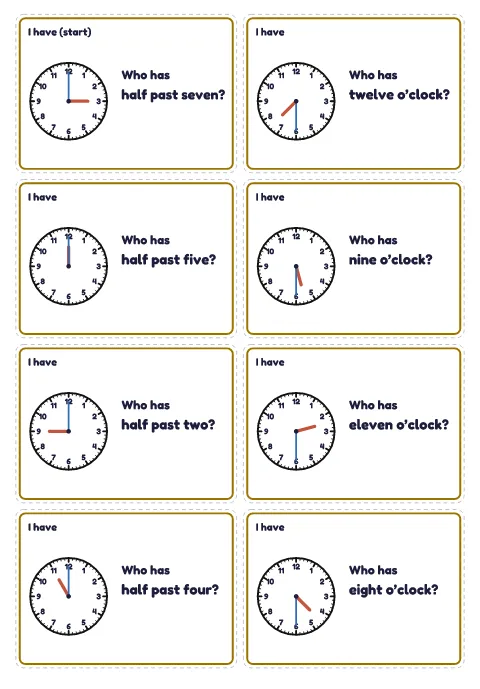
10. I have, who has? time loops
Two loops of 24 cards: every o’clock and half past time, then a loop of quarter hours and five-minute times. Each card shows a clock and asks for the next time, and the last card leads back to the first, so the whole class finishes together. Time the loop and try to beat the class’s own record, not each other.
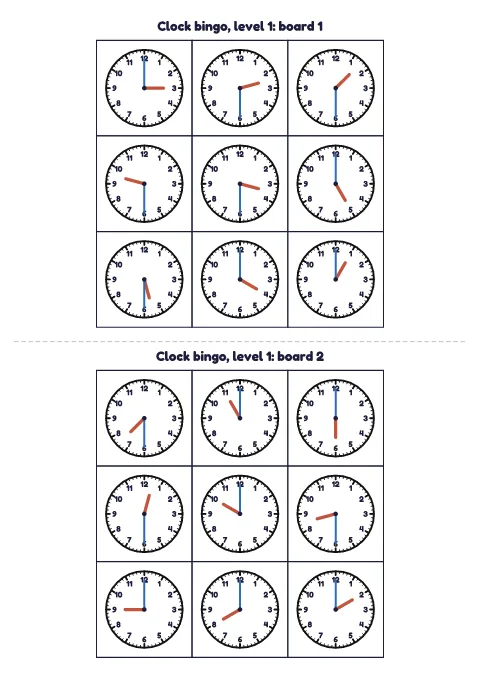
11. Clock bingo
Six different boards per level (12 in all), each nine clocks, and 24 caller cards with the time in words, in figures and in US words underneath. Players cover the clock that shows the time called. Everyone keeps playing to a full board, so nobody sits out after the first winner.
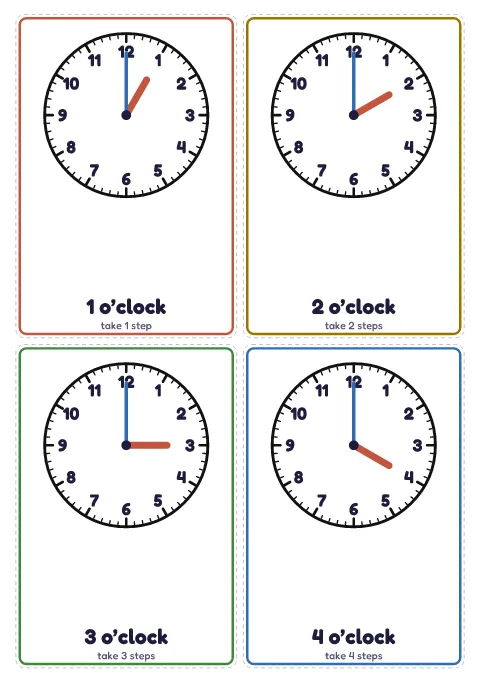
12. What’s the time, Mr Wolf? cards
The playground game with a maths job: the wolf holds up a card from 1 o’clock to 12 o’clock, everyone reads it and takes that many steps, until the “Dinner time!” card sends them running. Big clocks you can read from across a playground, and a rules card for whoever has not played it before.
Time in the day and elapsed time
13. My day in order
Level 1: six picture cards with clocks, from waking up at 7 o’clock to bed at 8, to cut out and glue in order. Level 2: the cards show digital times such as 7:40, and children glue them in order, draw the hands and circle a.m. or p.m. The cut-out cards are mixed up so none starts in its own place. Answers on pages 3 and 4.
14. Elapsed time word problems
A timeline mat with a worked example (3:35 p.m. to 5:20 p.m. is 25 minutes, 1 hour and 20 minutes), then six word problems at each level: hours and half hours for grade 2, five-minute times that cross the hour for grade 3, asking for the end time, the start time or how long. The answer pages draw the jumps on each timeline.
15. Class record and “I can tell the time” chart
A class grid with eight columns from o’clock to elapsed time: write the date when a child reads and draws those times without help. The second page is a child’s own chart with a star to colour for each step.
Teaching the time: an order that works
- Hours first, with the clock in their hands. Give out the small clocks and say a time; children show it. Keep the minute hand on 12 and only move the short hand.
- Half past. Turn the long hand half way round and watch the short hand move half way to the next number. The hour hand poster is for this lesson.
- Quarter past and quarter to. Fold a paper circle into quarters. In the US, children will hear “quarter after” and see 3:15; say both.
- Five minutes. Count round in fives, then read any time. Bingo, the matching cards and the loop cards make the repetition short and often.
- Time in the day. Put the day in order, add a.m. and p.m., then work out how long things take with the timeline.
In England, Year 1 pupils are taught to tell the time to the hour and half past the hour and draw the hands on a clock face to show these times; in Year 2, to tell and write the time to five minutes, including quarter past/to the hour, and to know the number of minutes in an hour and the number of hours in a day (national curriculum, mathematics programmes of study). In the US Common Core, grade 1 students tell and write time in hours and half-hours using analog and digital clocks (1.MD.B.3), and grade 2 students tell and write time to the nearest five minutes, using a.m. and p.m. (2.MD.C.7). This kit supports that work alongside your school’s scheme; it does not replace it.
The worksheets with answer keys are in the telling time section: write the time to the hour, draw the hands at half past, quarter past and quarter to, five minutes, a blank clock face and the past and to chart. Next: the a.m. and p.m. worksheet, first grade, second grade and third grade math worksheets, the classroom timer and more for teachers.
Questions
What is a Judy clock?
A brand of geared teaching clock, where turning the minute hand moves the hour hand with it. Our printable teaching clock is not geared, so move the short hand on by hand as the long hand goes round: that is a good thing to talk about.
How do I make a paper clock with a split pin?
Print the face and hands on card, cut them out, make a hole in the middle of each with a sharp pencil pushed into modelling clay, stack the face, the hour hand and the minute hand, and push a paper fastener (split pin or brad) through from the front. Open the legs flat on the back.
Why is the hour hand between two numbers?
Because it moves all the time. In one hour it travels from one number to the next, so at half past three it is halfway from 3 to 4, and at quarter to four it is three quarters of the way there.
Is “quarter past” the same as “quarter after”?
Yes. Both mean 15 minutes after the hour (3:15). Quarter past is said in the UK, Australia and New Zealand; quarter after, or three fifteen, in the US.
Are these free for my class?
Yes. Free for your own class, school and family, with no sign-up. Please don’t resell them or upload them to another site.