 Colouring Nest
Easter worksheets and activities for kids: free printables for Easter 2027
Free Easter worksheets and activities for kids, for the classroom and the kitchen table in the run-up to Easter 2027: counting, adding and taking away with eggs, egg carton maths, a colour by number at three levels, measuring carrots at true size, patterns and an egg hunt bar graph, all with answer keys; a reading text at two levels, a word search, a crossword and writing prompts; an ESL vocabulary set and prepositions; egg hunt clue cards for indoors, outdoors and for children who can’t read yet; and early-years tracing and egg-halves matching. Seventeen resources from preschool to grade 3. Every one downloads as a PDF sized for A4 or US Letter paper, in full colour or a low-ink black-and-white version, with nothing to sign up for.
Inside this set
- 17 printables
- A4 and US Letter PDFs
- Colour and ink-saver versions
- Free, no sign-up
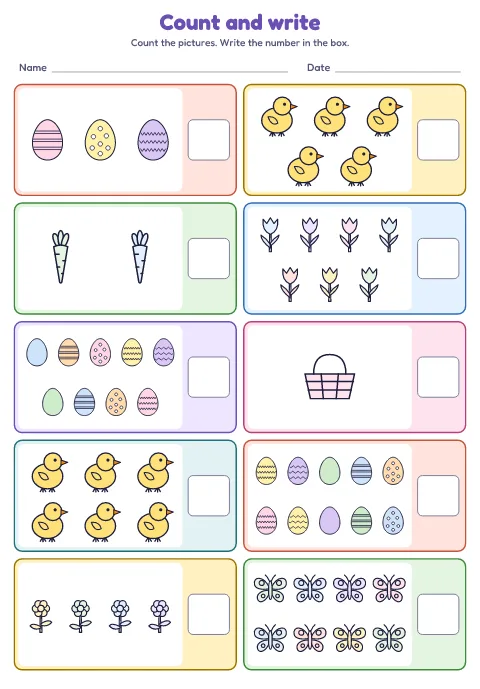 Easter counting to 10
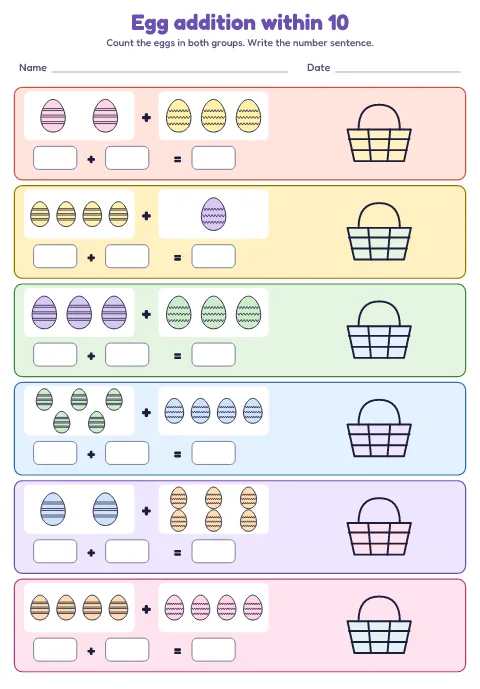 Egg addition within 10 and 20
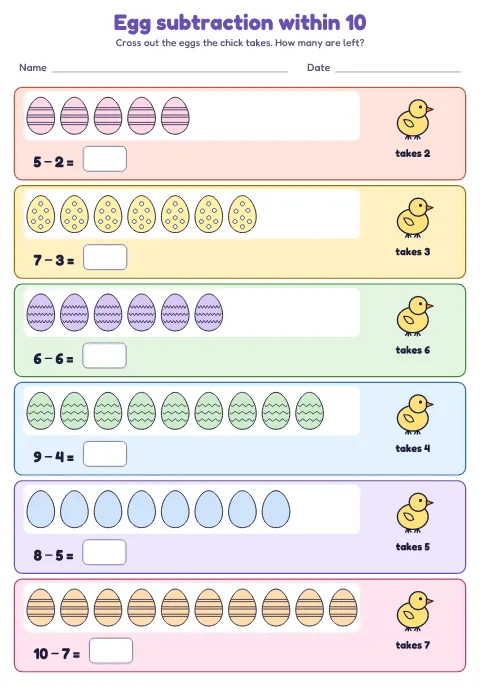 Egg subtraction within 10 and 20
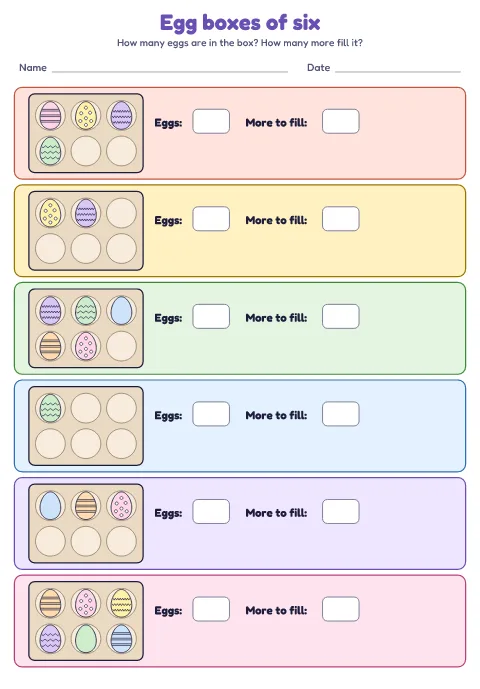 Egg carton maths: boxes of six and a dozen
 Easter egg colour by number maths at three levels
 Measuring carrots: cubes, centimetres and inches
 Easter patterns: pictures and numbers
 Egg hunt tally chart and bar graph
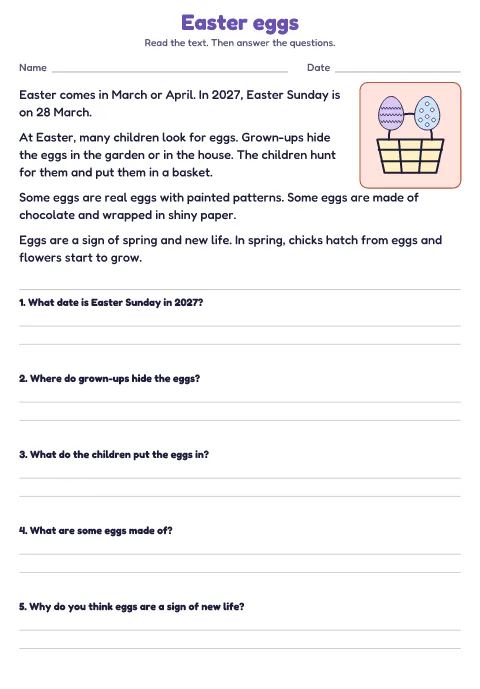 Easter reading comprehension at two levels
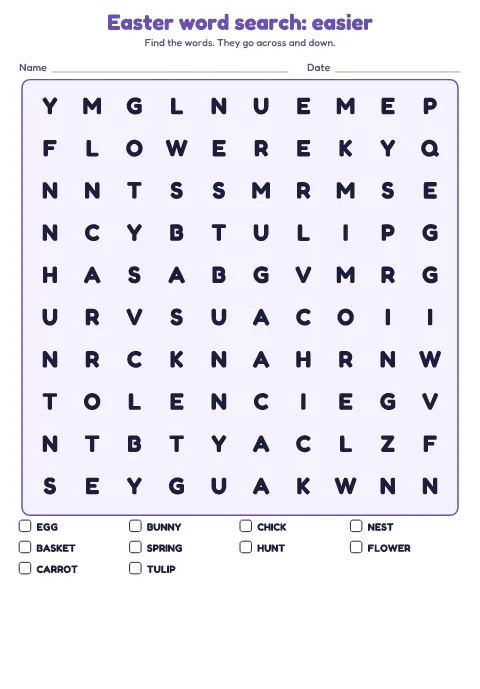 Easter word search: easier and harder
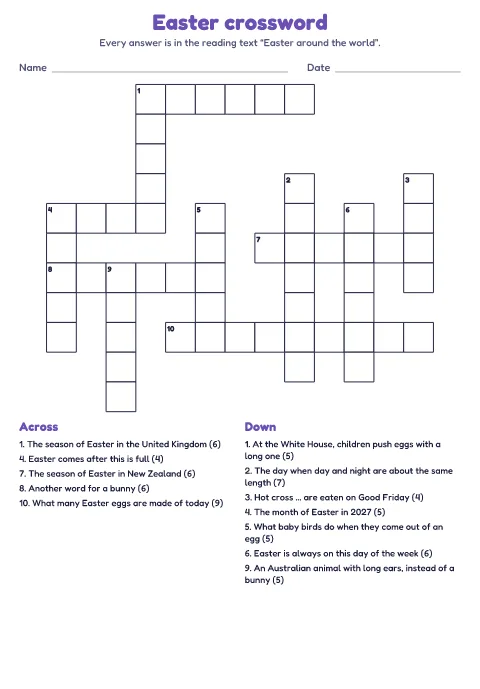 Easter crossword
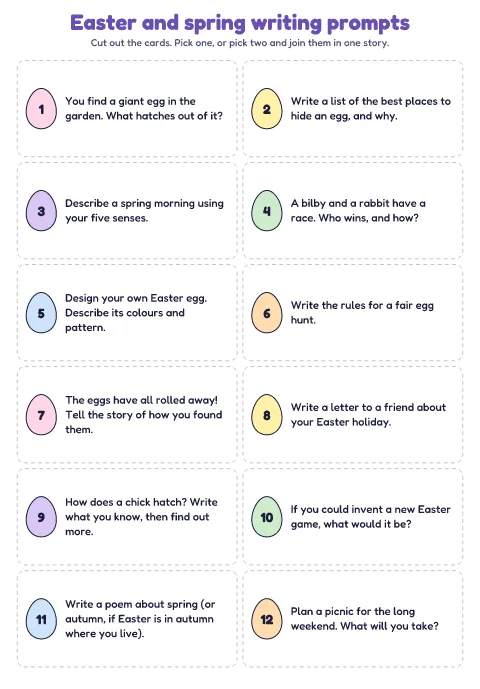 Easter writing prompts and frames
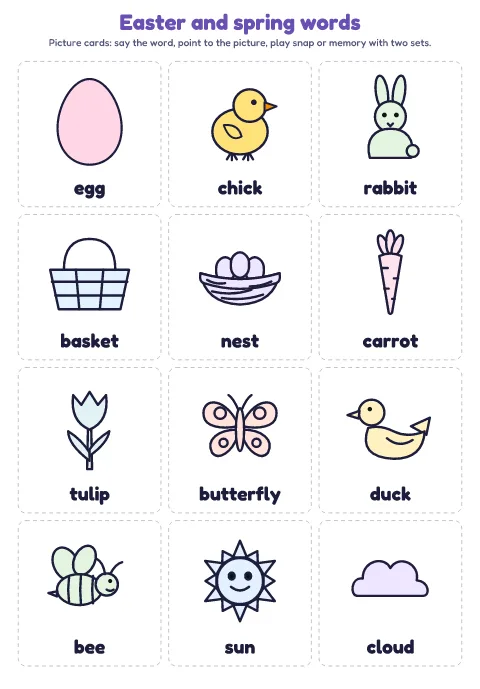 Easter ESL vocabulary set
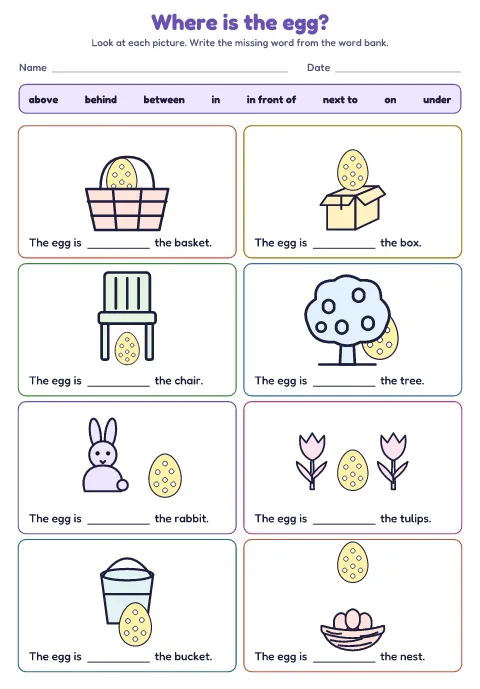 Where is the egg? Prepositions
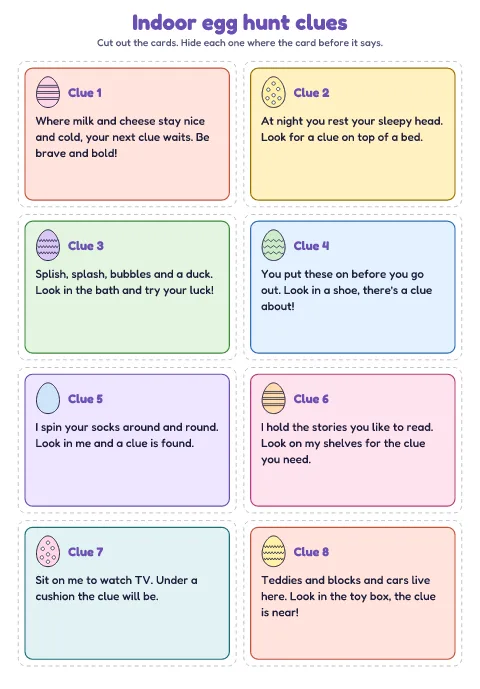 Easter egg hunt clue cards
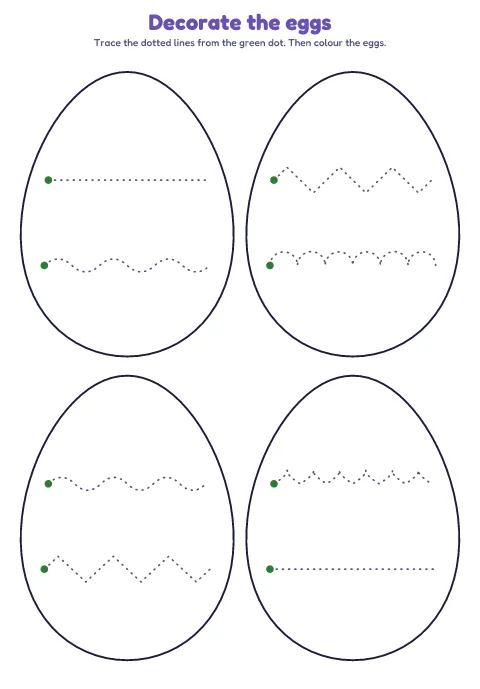 Early years tracing: decorate the eggs
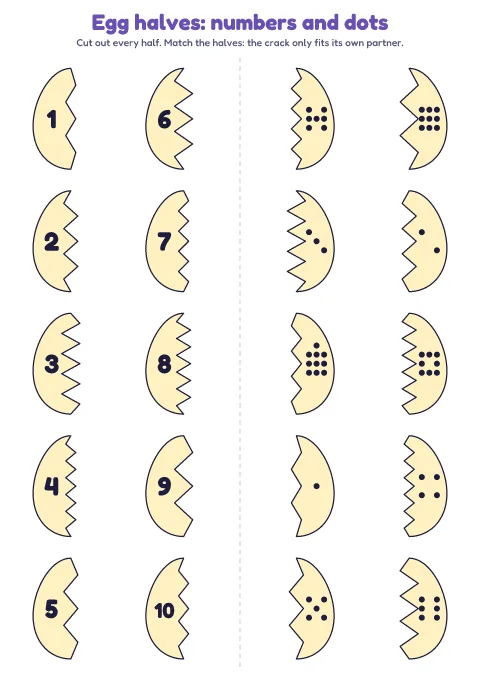 Egg halves matching: numbers and letters
When is Easter 2027?
Easter Sunday 2027 is Sunday 28 March 2027, one of the earliest Easters of the decade, so the Easter week of school falls in March. Good Friday is 26 March and Easter Monday is 29 March; both are public holidays in the UK and New Zealand. Easter moves every year: it is the first Sunday after the full Moon that falls on or after the spring equinox, so it is always between 22 March and 25 April. In the northern hemisphere Easter comes in spring; in Australia and New Zealand it comes in autumn.
We checked the date with Royal Museums Greenwich, the UK government’s bank holiday list and Employment New Zealand, and a test re-works it from the date rule every time the site is built. Updated 17 November 2026.
Which sheets for which class
| Children | Good first picks |
|---|---|
| Under-fives at home or nursery (2 to 4) | Decorate the eggs (tracing), spring paths, count and colour eggs, the picture clue cards for an egg hunt |
| Pre-K, kindergarten, EYFS Reception, NZ new entrants (4 to 6) | Counting eggs to ten, egg halves matching, picture patterns, egg addition and subtraction within 10, egg boxes of six, measuring in cubes, colour by number level A |
| First and second grade, Years 1 to 3 (5 to 8) | The “Easter eggs” reading text, sums and take-aways up to 20, egg boxes of twelve, the egg hunt tally and bar graph, measuring in centimetres or inches, number patterns, the easier word search, colour by number level B |
| Second and third grade, Years 3 and 4 (7 to 9) | “Easter around the world” and its questions, the crossword, the harder word search, the times-tables colour by number, measuring to the half inch, writing prompts and the instructions frame |
| English learners (any age) | Picture word cards, match the words, fill the gaps, and “Where is the egg?” prepositions |
Maths
1. Easter counting to 10
How many chicks? How many tulips? Each of the ten panels holds between one and ten things (striped and spotty eggs, chicks, carrots, tulips, one basket, butterflies) and a square for the numeral. On the second sheet children read a numeral and shade that many eggs out of a row of ten, which is also a quiet look at how far each number is from ten. The third sheet has the totals for marking. Pictures are large with space between them, so small fingers can touch each one as they count.
2. Egg addition within 10 and 20
Sheet one puts two little groups of eggs side by side with a basket to collect them: children count each group, then fill in the three boxes of the sentence, so “3 eggs and 3 eggs” becomes 3 + 3 = 6 (all totals stay at ten or below). Sheet two moves to bridging ten, with a dozen sums such as 8 + 5 and 9 + 7, a number line from 0 to 20 for counting on, and three short stories to solve: Mia’s egg hunt, chicks on a farm and painting eggs over a weekend. Both answer sheets follow. To build the facts underneath, try number bonds or fact families.
3. Egg subtraction within 10 and 20
Page 1 is take-away you can see: a hungry chick takes some eggs, children cross them out and write how many are left, with the minus sign printed clearly. Page 2 is twelve facts within 20 with a number line for counting back and three word problems. The answer pages show the crossed-out eggs, so children can check how they got there.
4. Egg carton maths: boxes of six and a dozen
Real egg boxes make number facts easy to see. Level 1 has six boxes of six: how many eggs, and how many more fill the box (the facts that make 6). Level 2 has six boxes of twelve, written as a number sentence: 9 + 3 = 12, and so on, including a full box and a half-full one. Two rows of six also show doubles: 6 + 6 = 12.
5. Easter egg colour by number maths at three levels
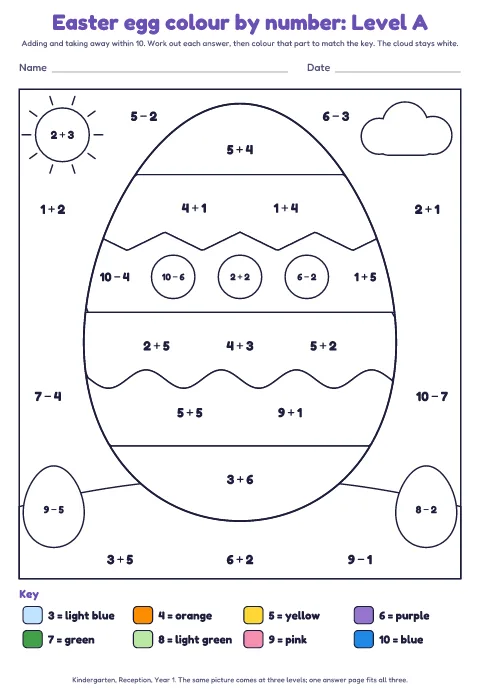
A giant striped egg fills the page: six bands (one with a zigzag edge, one wavy), three round spots, a smaller egg on each side, grass, sky and a sun. Each part shows a sum; solving it tells the child which crayon to pick from the key. Three versions share one picture, so a mixed class can work on it together: A uses sums and take-aways up to 10, B goes up to 20, and C uses multiplication and division facts from the 2, 3, 4, 5 and 10 tables. There are 26 sums per sheet and a colour never gets the same sum twice, so copying a neighbour’s answer for one stripe does not help with the next. The last page is the coloured-in egg with the numbers for A, B and C beside each colour, one key for all three. A test checks every sum and that each one is printed inside the shape it colours. For more hidden-picture maths, see the math mystery pictures.
6. Measuring carrots: cubes, centimetres and inches
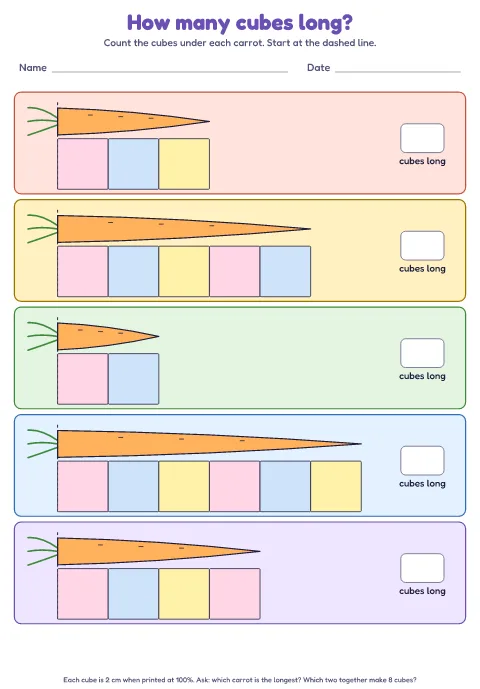
Page 1 is non-standard measuring: count the cubes under each carrot, starting at the dashed line. Page 2 is whole centimetres (4 to 15 cm) and page 3 is inches, with two lengths to the half inch for grade 3. The carrots are drawn at true size, so a real ruler gives the right answer when the page is printed at 100%, and each page has a cut-out ruler for children who don’t have one. Pages 4 to 6 are the answers. For length, mass and capacity, see the measurement kit and printable ruler.
7. Easter patterns: pictures and numbers
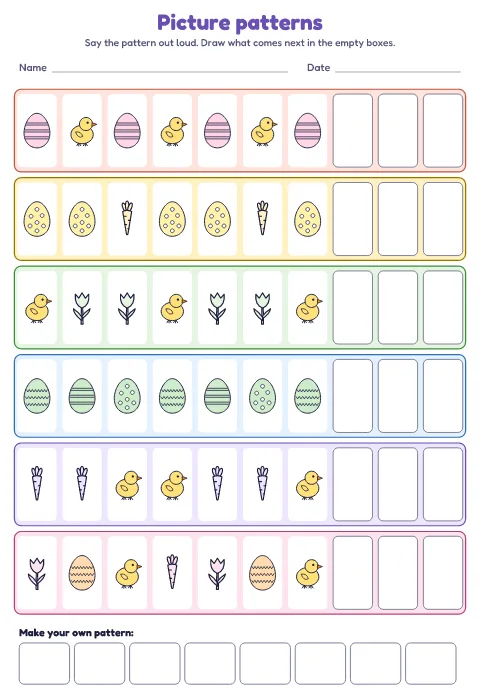
The first sheet has six rows to continue, from a simple two-part repeat (striped egg, chick) up to four-part ones, using eggs with stripes, spots and zigzags alongside chicks, carrots and tulips; an empty strip at the foot invites children to invent one. Because each picture has its own outline and markings, a black-and-white print is just as easy to read. The second sheet swaps pictures for numbers written on eggs: two, five, ten, three and four steps forward and two steps back from twenty. Children fill the empty eggs and write the rule in words.
8. Egg hunt tally chart and bar graph
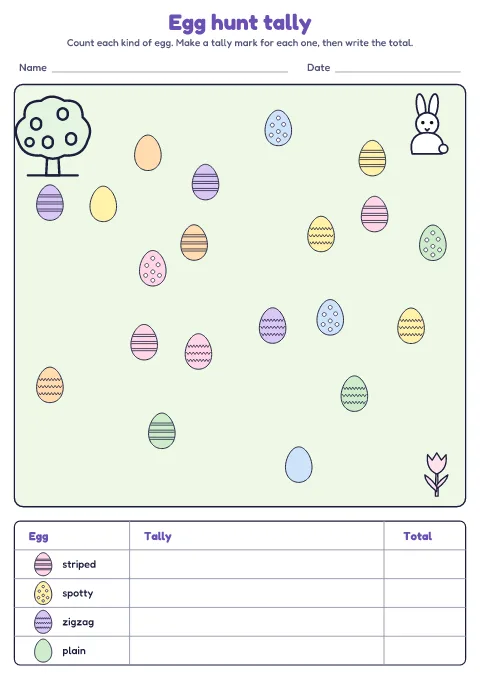
Twenty eggs are hidden in a garden picture: striped, spotty, zigzag and plain. Children count each kind, make tally marks in fives and write the totals, then colour a bar graph and answer four questions (most, fewest, how many more, how many altogether). Every kind has a different total, so every question has one answer. The eggs are told apart by their pattern, not their colour, so it works in black and white.
Advertisement
Reading and writing
9. Easter reading comprehension at two levels
Two non-fiction passages we wrote ourselves. “Easter eggs” (first and second grade) is four very short paragraphs on one page, covering when Easter is, egg hunts, painted and chocolate eggs and why eggs go with spring, followed by five questions with lines to write on. “Easter around the world” (second to fourth grade) runs a full page under five headings: why the date changes, eggs as a sign of new life, egg rolling at the White House and on English hills, Australia’s Easter Bilby, and why New Zealand has an autumn Easter. Its eight questions ask children to retrieve facts, work out a word’s meaning, explain why and use the headings to navigate. The marking page gives model answers for both, and the facts are traceable to the sources at the foot of this page.
10. Easter word search: easier and harder
Two grids of different difficulty. The 10 × 10 one hides ten short spring and Easter words, all reading left to right or top to bottom, so beginners only scan in two directions. The bigger grid hides fourteen longer words, among them chocolate, daffodil, blossom, bilby and feather, and adds diagonals. Our test confirms that no word can be found twice, and the marking sheets highlight each one.
11. Easter crossword
Twelve clues, each answered somewhere in “Easter around the world”, so children who read carefully can complete it: Sunday, March, equinox, moon, hatch, chocolate, spoon, bilby, rabbit, autumn, spring and buns. Each clue shows how many letters to write. A script builds the grid and checks that every letter where words cross is the same both ways, and the second page shows the solution.
12. Easter writing prompts and frames
Page 1 is twelve prompt cards to cut out, from “You find a giant egg in the garden. What hatches out of it?” to writing the rules for a fair egg hunt and a poem about spring, or autumn if that is your Easter. Page 2 is a story frame, “The great egg hunt”, with a planning box and four sentence starters (ages 5 to 8). Page 3 is instruction writing, “How to plan an egg hunt”, with a “you will need” list and steps that start with First, Next, Then and Finally (ages 7 to 10).
English learners
13. Easter ESL vocabulary set
Twelve picture word cards for beginners (A1 to A2): egg, chick, rabbit, basket, nest, carrot, tulip, butterfly, duck, bee, sun and cloud. Print two sets for snap or a memory game. Page 2 is match the picture to the word and write the words; page 3 is eight gap-fill sentences with a word bank, such as “The rabbit eats an orange ___.”. Answers on pages 4 and 5.
14. Where is the egg? Prepositions
Hiding eggs is the perfect way to teach prepositions. Eight pictures show the egg in the basket, on the box, under the chair, behind the tree, next to the rabbit, between the tulips, in front of the bucket and above the nest; children write the missing word from the word bank. Page 2 asks them to draw an egg under the hat, on the table, next to the duck and in the bucket. Then hide a real egg and ask, “Where is the egg?”.
Egg hunt and early years
15. Easter egg hunt clue cards
Sixteen short rhyming clues of our own: eight for indoors (the fridge, a bed, the bath, a shoe, the washing machine, the bookshelf, the sofa, the toy box) and eight for outdoors (the letterbox, a plant pot, a tree, the swing, the hose, a bike, the doormat, the sandpit). The clue on each card leads to where the next card is hidden, and the card never names its own hiding place. Picture clues show a bed, a chair, a table and more for children who can’t read yet, and eight blank cards are for your own riddles. The last page is a planner for grown-ups with ideas for each age and a safety list: keep away from roads, water and anything hot, check for allergies, and use big eggs for toddlers.
16. Early years tracing: decorate the eggs
Pre-writing practice with a purpose. The first sheet is four large blank eggs, each crossed by two dotted lines (straight, wavy, zigzag, bumpy arches or loops) that begin at a green dot; once traced, they become the egg’s decoration, ready for colouring. The second sheet has five dotted trails that take a rabbit to a carrot, a chick to its nest, a bee to a tulip, a butterfly to a flower and an egg to the basket. More hand-strength ideas are on our fine motor page.
17. Egg halves matching: numbers and letters
Cut out twenty egg halves and put each egg back together. On page 1 a numeral 1 to 10 matches its number of dots; on page 2 a capital letter matches its lower case letter (A, B, D, E, G, H, M, Q, R and T, the pairs that look least alike). Every egg has its own crack, so only the right half fits: the puzzle checks itself. Pages 3 and 4 show the finished eggs.
How we made these worksheets
These are Easter worksheets for every classroom. Easter is a Christian festival, and many schools teach its story in religious education; these sheets don’t retell it. They are about what children of any background see at Easter: eggs, chicks and spring flowers (or autumn leaves in the south), egg hunts, egg rolling, the Easter Bilby and the long weekend. No crosses, churches or Bible scenes, and no cartoon Easter Bunny selling chocolate. Every picture is our own, the maths answers are worked out by code, and the reading text names its sources. If you teach a religious education unit, the reading and writing pages sit happily beside it.
Sources: Royal Museums Greenwich: When is Easter? (the date rule; 28 March 2027); GOV.UK: UK bank holidays (Good Friday 26 March and Easter Monday 29 March 2027); Employment New Zealand: public holidays and anniversary dates; Wikipedia: Easter egg; Wikipedia: Egg rolling (the White House Easter Egg Roll since 1878); Wikipedia: Easter Bilby; Wikipedia: Hot cross bun.
More for Easter: the Easter colouring pages with eggs, bunnies and Easter cards, the Easter egg template and bunny template for crafts, and the spring colouring pages. Ten days before Easter 2027 is St Patrick’s Day, with its own St Patrick’s Day activities, and our teachers’ hub lists every worksheet by subject and age.
Questions
When is Easter 2027?
Easter Sunday is 28 March 2027. Good Friday is 26 March and Easter Monday is 29 March 2027. Easter is the first Sunday after the full Moon on or after the spring equinox, so it moves between 22 March and 25 April.
Are these Easter worksheets religious?
No. They are about eggs, spring, egg hunts and how people celebrate Easter around the world, so they suit any school. The reading text says that Easter is a Christian festival and leaves the religious story to religious education lessons.
What Easter activities suit preschoolers?
Start with the egg tracing sheet and spring paths, then counting and shading eggs, the egg halves puzzle and an egg hunt using the picture clue cards. None of them needs reading.
Are there answer keys?
Yes, at the back of each PDF: every maths level, the coloured-in egg with the numbers for A, B and C, the carrot lengths, the tally and graph, both reading texts, both word searches, the crossword, the ESL sheets and the finished egg halves.
Do you have Easter egg hunt clues for kids who can’t read?
Yes. Next to the indoor and outdoor rhyming clues there are eight picture clues (a bed, a chair, a table, books, shoes, a door, the bath and the toy box) and eight blank cards, with a planner and safety list for grown-ups.
Are these Easter worksheets free?
Yes, for use with your own pupils, at school or at home, and you never need an account. We ask only that you link to this page instead of selling the sheets or re-hosting the PDFs elsewhere.