 Colouring Nest
Days of the week and months in te reo Māori
Not yet reviewed by a fluent speaker. Every Māori word is checked on Te Aka Māori Dictionary and a second source, with its macrons. Corrections welcome.
Free posters of the days of the week and the months of the year in te reo Māori with English, and seven day cards for calendar time. Both sets of names that New Zealand uses are shown: the names Te Taura Whiri i te Reo Māori created, and the borrowings from English. A4 PDFs (US Letter too).
Inside this set
- 3 printables
- A4 and US Letter PDFs
- Free, no sign-up
About this resource
Ages 3–6, prep, what you need and how to use it
- Ages
- 3 to 6 years (preschool, school start)
- Prep
- About 15 minutes to print and cut the day cards.
- You’ll need
- Printer and paper or thin card
- Scissors
- Laminator (optional)
- Supports
- Te Whāriki (NZ), EYLF (Australia), EYFS (England), ELOF (US)
How to use it in the room
- Choose which set of day names your service uses; the page shows both.
- Use a day card each morning at calendar time.
- Put the months poster up and find each child’s birthday month.
Show resources for
Remembered on this device only. It sets A4 or US Letter as the first download.
Days of the week: two sets of names
| English | Te Taura Whiri names | From English |
|---|---|---|
| Monday | Rāhina | Mane |
| Tuesday | Rātū | Tūrei |
| Wednesday | Rāapa | Wenerei |
| Thursday | Rāpare | Tāite |
| Friday | Rāmere | Paraire |
| Saturday | Rāhoroi | Hātarei |
| Sunday | Rātapu | Rātapu |
The names from Rāhina to Rāhoroi were created by Te Taura Whiri i te Reo Māori, the Māori Language Commission: each begins with rā, day. The borrowings (Mane, Tūrei and so on) came from English much earlier and are still widely used, especially by older speakers. Rātapu is Sunday in both. For Saturday, Te Taura Whiri lists the borrowing both with and without the macron; we print Hātarei, as Te Aka does. Pick one set for your room and use it every day; the cards show the other set small underneath.
1. Days of the week poster
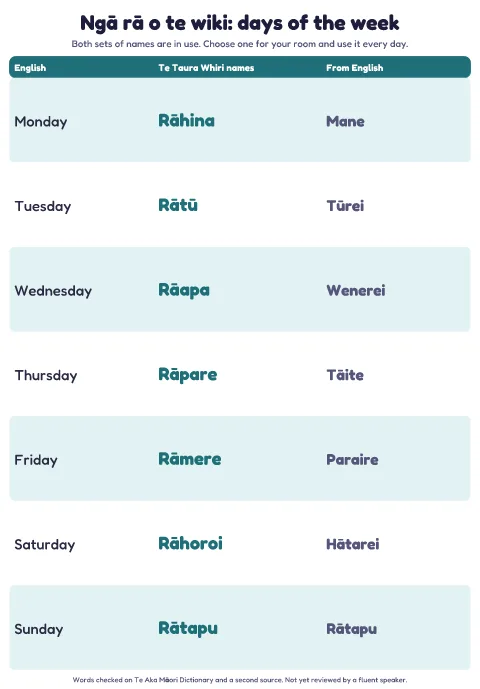
Seven rows with the English, the Te Taura Whiri name large in the middle and the borrowing beside it. A good companion to the weather and date board.
2. Day cards for calendar time
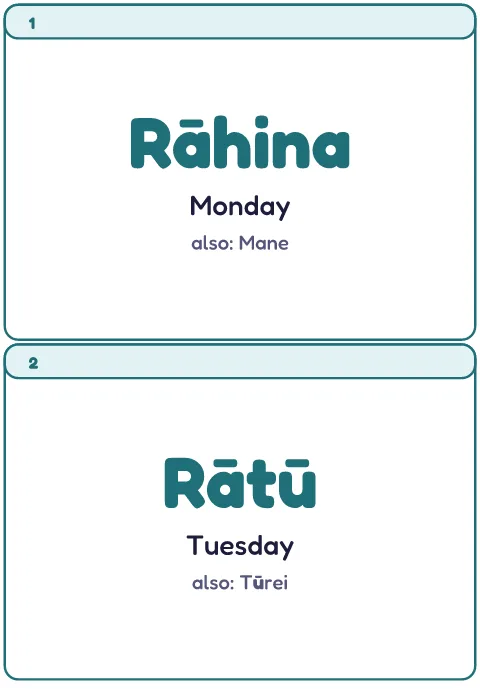
One card per day, two to a page: the Te Taura Whiri name large, the English under it and the borrowing small (“also: Mane”). Change the card each morning at mat time and ask “What day is it today?”.
Advertisement
Months of the year
| English | Maramataka names | From English |
|---|---|---|
| January | Kohitātea | Hānuere |
| February | Huitanguru | Pēpuere |
| March | Poutūterangi | Māehe |
| April | Paengawhāwhā | Āperira |
| May | Haratua | Mei |
| June | Pipiri | Hune |
| July | Hōngongoi | Hūrae |
| August | Hereturikōkā | Ākuhata |
| September | Mahuru | Hepetema |
| October | Whiringa-ā-nuku | Oketopa |
| November | Whiringa-ā-rangi | Noema |
| December | Hakihea | Tīhema |
The maramataka names come from the Māori lunar calendar. Te Aka describes most of them as lunar months “approximately equivalent” to the English month, and the year traditionally starts in Pipiri (around June), near Matariki. Iwi calendars differ in names and order, so if your local iwi uses other names, use theirs. We spell the names as Te Taura Whiri’s orthography guidelines do: Poutūterangi, Paengawhāwhā and Hereturikōkā as single words (Te Aka writes them with hyphens), and Whiringa-ā-nuku and Whiringa-ā-rangi with hyphens.
3. Months poster
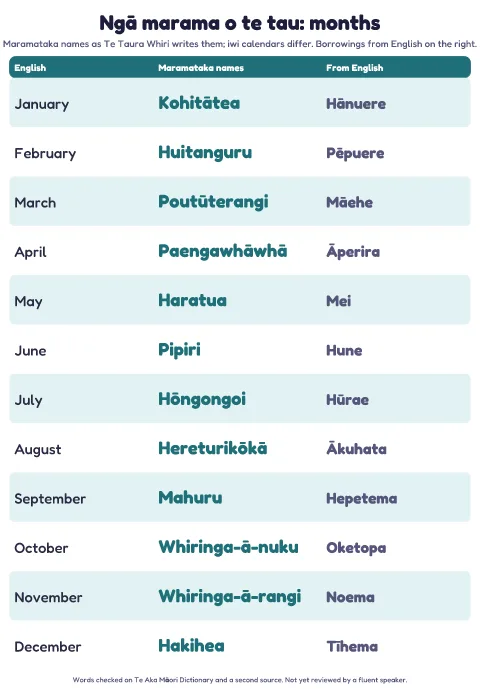
Twelve rows: English, the maramataka name and the borrowing. Pin it beside your birthday chart or term planner; the 2027 NZ calendar has the term dates.
Supports:
- Te Whāriki NZ
- Communication | Mana reo
- Belonging | Mana whenua
- Wellbeing | Mana atua
- EYLF Australia
- Outcome 5: Children are effective communicators
- Outcome 1: Children have a strong sense of identity
- Outcome 3: Children have a strong sense of wellbeing
- EYFS England
- Communication and language
- Literacy
- Personal, social and emotional development
- ELOF US
- Language and Literacy
- Social and Emotional Development
- Approaches to Learning
More te reo Māori for early learning: room labels, greetings, shapes and feelings, numbers 1 to 10, the alphabet, pepeha template and mihi prompts, classroom displays: signs, weather, seasons, birthdays, colours chart. For kaiako, the New Zealand early learning page and the Te Whāriki learning story templates.
Not yet reviewed by a fluent speaker. Every word here is checked against Te Aka Māori Dictionary and a second source (Te Taura Whiri i te Reo Māori’s He Pātaka Kupu or its orthography guidelines), with its macrons. No fluent speaker or Māori early childhood kaiako has read this page yet. If something should change, please tell us and we will fix it.
Related sets
 Te reo Māori classroom displays: signs, weather, seasons, birthdaysDisplays and charts · ages 1–6
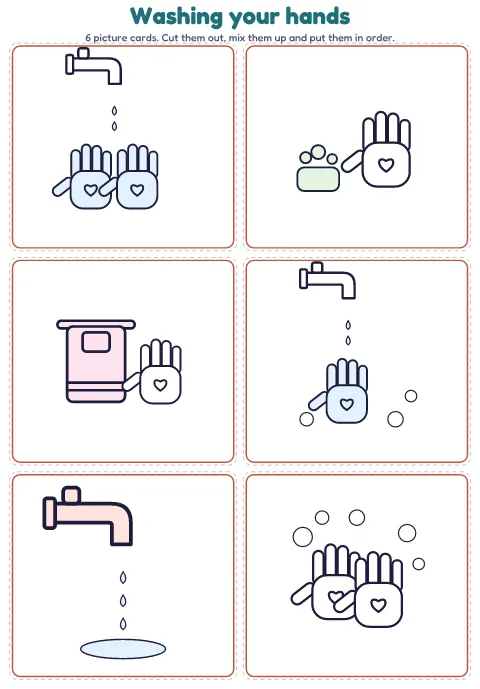 Sequencing cards: 3, 4 and 6 step picture storiesCards · ages 3–6
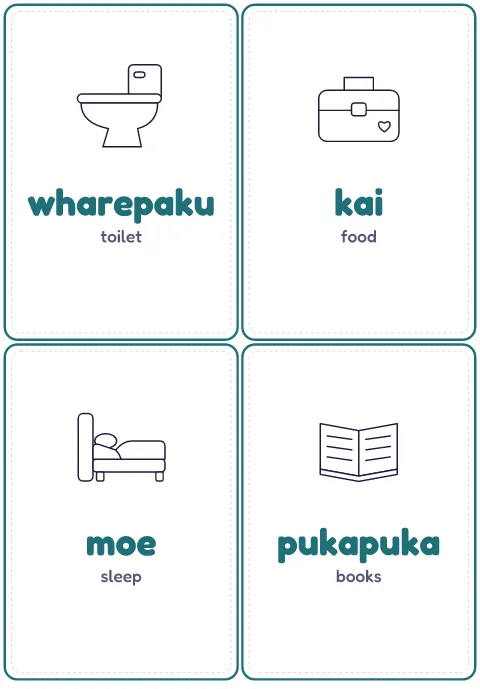 Te reo Māori room labels, greetings, shapes, feelingsDisplays and charts · ages 1–6
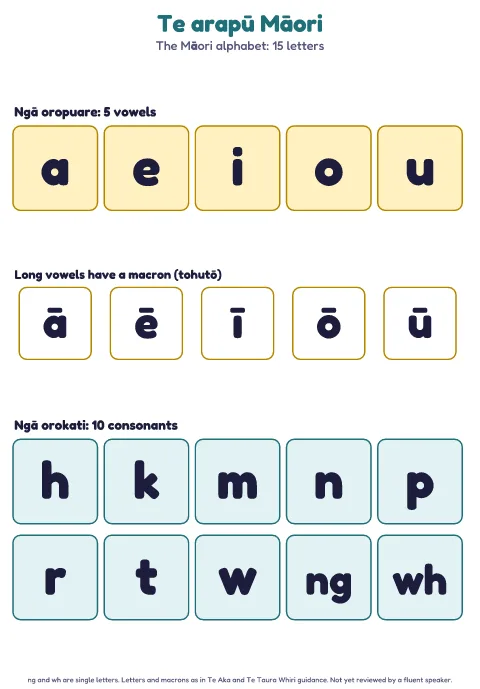 Māori alphabet poster and letter cardsDisplays and charts · ages 3–6
 Classroom labels with pictures: area signs, trays, name tagsDisplays and charts · ages 1–6
 Café role play: menu, order pad, signs, badgesDisplays and charts · ages 2–6
Questions
What are the days of the week in te reo Māori?
Te Taura Whiri’s names: Rāhina, Rātū, Rāapa, Rāpare, Rāmere, Rāhoroi, Rātapu. The borrowings from English: Mane, Tūrei, Wenerei, Tāite, Paraire, Hātarei, Rātapu.
Mane or Rāhina: which should we use?
Both are correct and in use. Choose one set for your room, use it every day, and let children hear the other set too.
What is January in te reo Māori?
Kohitātea (maramataka name) or Hānuere (borrowing). Iwi calendars may use other names.
Are the posters free?
Yes, for your own service, class and whānau. Please don’t resell them or upload them elsewhere.
Sources
- Te Aka Māori Dictionary (meanings and macrons; each word’s entry read 2026-11-11)
- He Pātaka Kupu, Te Taura Whiri i te Reo Māori (spelling of each word)
- Te Taura Whiri i te Reo Māori’s orthography guidelines (letters, macrons, and appendix 4: days and months)