 Colouring Nest
Pepeha template for kids and mihi prompts
Not yet reviewed by a fluent speaker. Every Māori word is checked on Te Aka Māori Dictionary and a second source, with its macrons. Corrections welcome.
A free pepeha template for tamariki and whānau that gives the structure only, a “my place” version that any child or family can use, and mihi prompts for introducing yourself. A4 PDFs (US Letter too). Every pepeha belongs to its own person and whānau: these sheets are for families to fill in together, at home or with your service.
Inside this set
- 3 printables
- A4 and US Letter PDFs
- Free, no sign-up
About this resource
Ages 3–6, prep, what you need and how to use it
- Ages
- 3 to 6 years (preschool, school start)
- Prep
- Print and go: a few minutes.
- You’ll need
- Printer and paper
- Pens or pencils
- Supports
- Te Whāriki (NZ), EYLF (Australia), EYFS (England), ELOF (US)
How to use it in the room
- Send the sheet home for whānau to fill in together with their child.
- Use the “my place” version for any child or family.
- Use the mihi prompts when children introduce themselves.
Show resources for
Remembered on this device only. It sets A4 or US Letter as the first download.
What a pepeha is
Te Aka describes a pepeha as a tribal saying, a set form of words. In everyday use it is how a person introduces themselves through the places and people they come from: a maunga (mountain), an awa (river), the waka (ancestral canoe), the iwi (tribe) and hapū (subtribe), the marae, the whānau, and then the person’s name. Each line usually starts with Ko, which introduces the name that follows.
Because a pepeha is someone’s ancestry and connection to land, nobody should be given one to copy, and a centre should not invent one for a child. That is why our template has blanks and prompts only. Many Māori families will already know theirs; others are still finding it out, and that is fine too.
Children who are not Māori
Children and families who are not Māori should not claim a waka, iwi, hapū or marae. The second sheet, “My place: where I come from”, asks about a place outside that is special to them, a river or the sea, how their family came to live here, their family, their centre and their name, with an optional line in te reo Māori: Nō ___ ahau (I am from ___). Ask your local iwi or a Māori kaiako how they would like families who are not Māori to introduce themselves in your area.
1. Pepeha template (structure only)
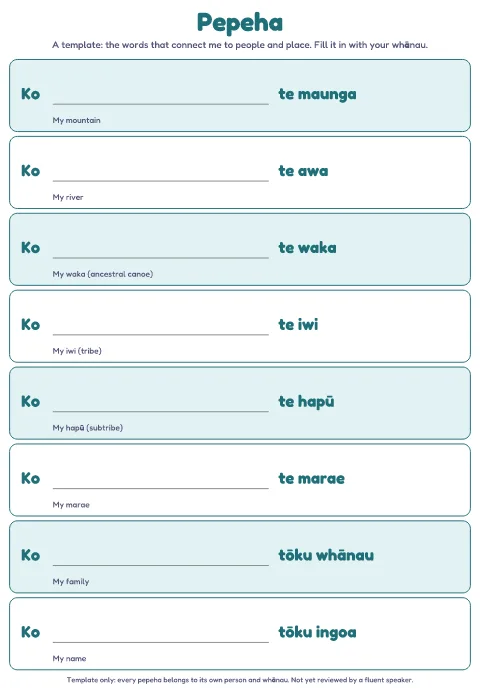
Eight lines, each starting Ko with a blank to fill in: te maunga, te awa, te waka, te iwi, te hapū, te marae, tōku whānau, tōku ingoa, with the English under each line. Leave lines blank that a family does not use; it is theirs to fill, not a test.
2. My place: where I come from
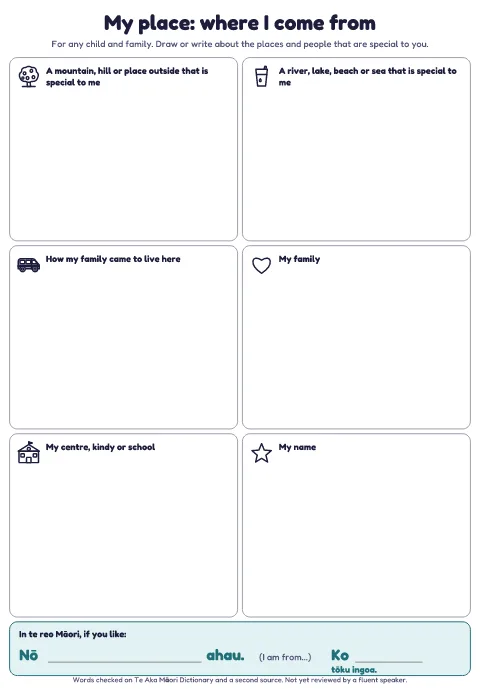
Six boxes to draw or write in with a grown-up, and the optional te reo line at the bottom. Works for every child in the room, which makes it a good whole-group activity alongside Māori children’s pepeha.
Advertisement
3. Mihi prompts
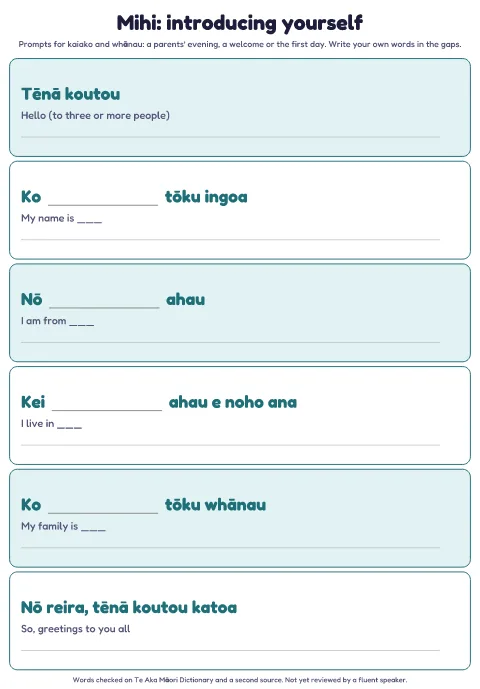
Six lines for introducing yourself to a group, with blanks for your own words and the English: Tēnā koutou; Ko … tōku ingoa; Nō … ahau; Kei … ahau e noho ana; Ko … tōku whānau; Nō reira, tēnā koutou katoa. For new kaiako, parent evenings or the start of the year. A mihi at a formal occasion follows local custom: ask your local iwi.
Words on these sheets
- pepeha: tribal saying, set form of words of identity
- mihi: greet, acknowledge
- maunga: mountain
- awa: river
- waka: canoe (ancestral canoe)
- iwi: tribe, people
- hapū: subtribe, kinship group
- marae: courtyard, meeting place in front of the meeting house
- ingoa: name
- Ko: particle introducing a name or topic
- te: the
- tōku: my
- ahau: I, me
- Nō: from, belonging to
- Kei: at, in (now)
- e: particle (with ana: continuing action)
- noho: live, stay
- ana: particle (continuing action)
- reira: there, that (place or circumstance)
- katoa: all
- whānau: family
Supports:
- Te Whāriki NZ
- Belonging | Mana whenua
- Contribution | Mana tangata
- Communication | Mana reo
- EYLF Australia
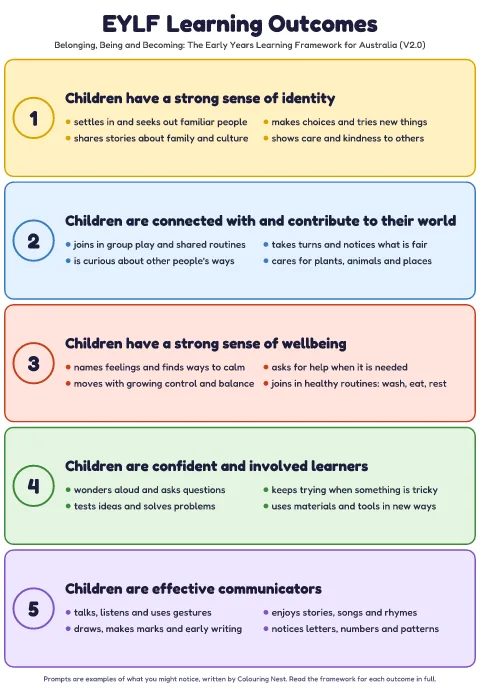
- Outcome 1: Children have a strong sense of identity
- Outcome 2: Children are connected with and contribute to their world
- Outcome 5: Children are effective communicators
- EYFS England
- Personal, social and emotional development
- Communication and language
- Literacy
- ELOF US
- Social and Emotional Development
- Language and Literacy
More te reo Māori for early learning: room labels, greetings, shapes and feelings, numbers 1 to 10, days and months, the alphabet, classroom displays: signs, weather, seasons, birthdays, colours chart. For kaiako, the New Zealand early learning page and the Te Whāriki learning story templates.
Not yet reviewed by a fluent speaker. Every word here is checked against Te Aka Māori Dictionary and a second source (Te Taura Whiri i te Reo Māori’s He Pātaka Kupu or its orthography guidelines), with its macrons. No fluent speaker or Māori early childhood kaiako has read this page yet. If something should change, please tell us and we will fix it.
Related sets
 EYLF outcomes poster, cards and templatesTemplates · ages 1–5
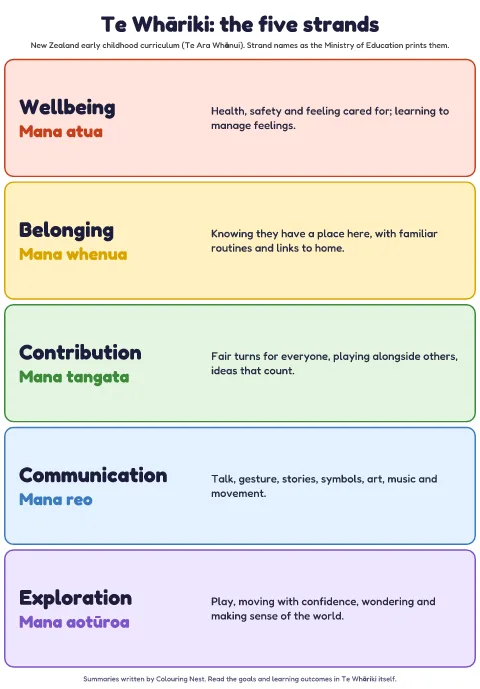 Te Whāriki learning story templatesTemplates · ages 1–5
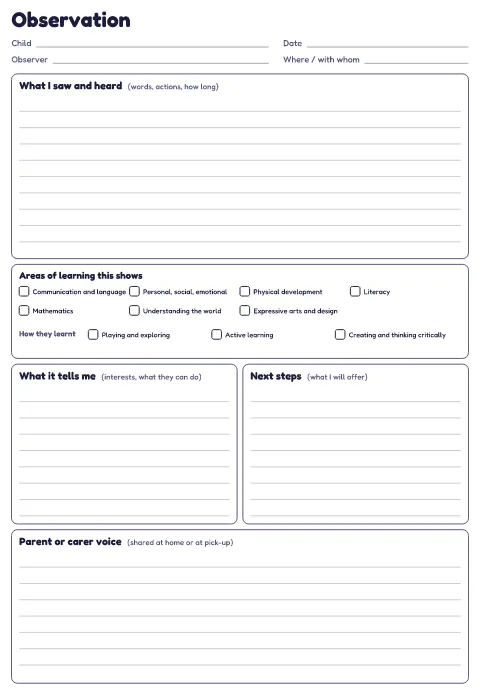 EYFS observation templates and ELG posterTemplates · ages 1–5
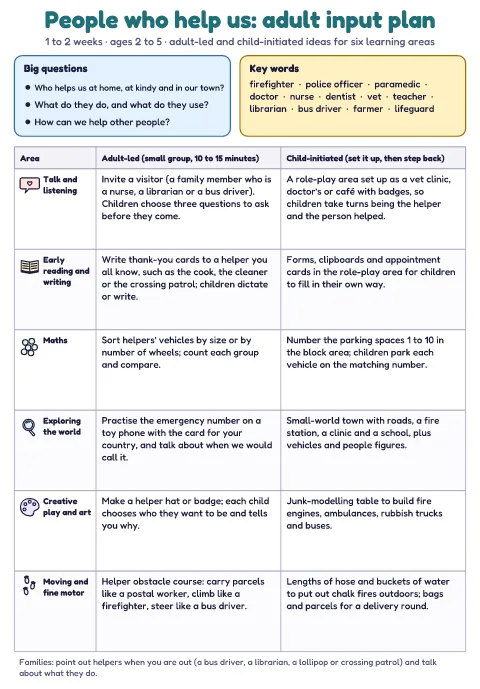 People who help us topic pack and emergency number cardsTemplates · ages 2–5
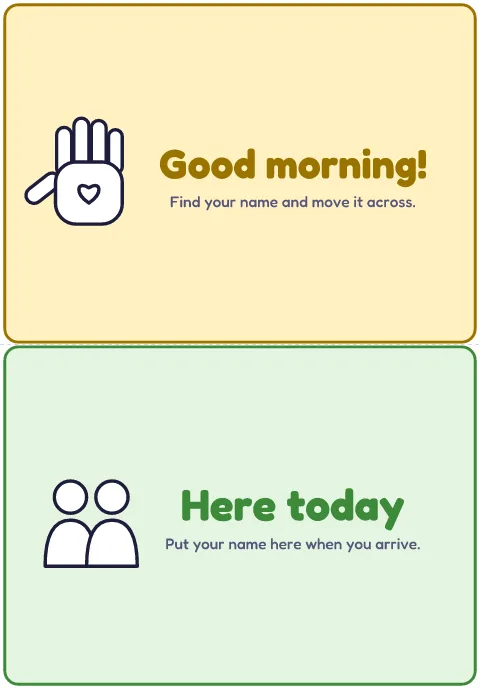 Self-registration, welcome banner and birthday chartDisplays and charts · ages 2–6
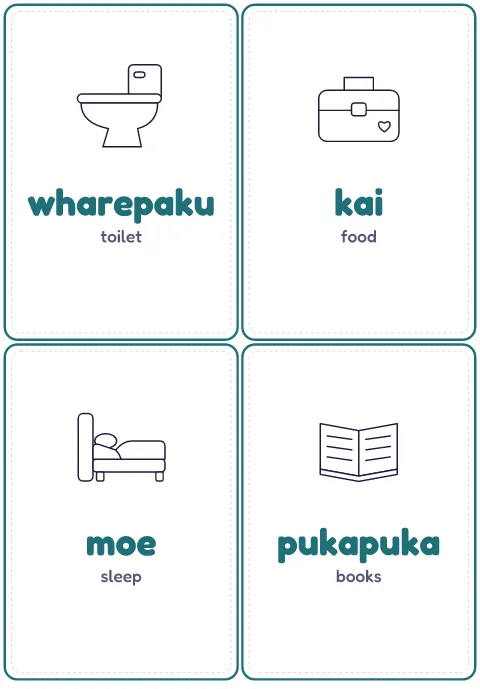 Te reo Māori room labels, greetings, shapes, feelingsDisplays and charts · ages 1–6
Questions
Can a child who is not Māori have a pepeha?
Children who are not Māori should not claim a waka, iwi, hapū or marae. Our “My place” sheet lets every child share the places and people that matter to them; ask your local iwi how they would like families who are not Māori to introduce themselves.
What goes in a pepeha?
Usually a maunga, awa, waka, iwi, hapū, marae, whānau and your name. Each person’s is their own.
Why is there no example pepeha?
A pepeha belongs to a person and their whānau, so we only give the structure. Families fill in their own.
Are the templates free?
Yes, for your own service, class and whānau. Please don’t resell them or upload them elsewhere.
Sources
- Te Aka Māori Dictionary (meanings and macrons; each word’s entry read 2026-11-11)
- He Pātaka Kupu, Te Taura Whiri i te Reo Māori (spelling of each word)
- Te Taura Whiri i te Reo Māori’s orthography guidelines (letters, macrons, and appendix 4: days and months)