 Colouring Nest
Nursery rhymes printables and activities
A free nursery rhymes kit for babies, toddlers, preschool, kindy, nursery and Reception, built round twelve traditional rhymes: Humpty Dumpty, Twinkle, Twinkle, Little Star, Hey Diddle Diddle, Jack and Jill, Incy Wincy (or Itsy Bitsy) Spider, Baa, Baa, Black Sheep, Hickory Dickory Dock, Little Miss Muffet, Row, Row, Row Your Boat, Hot Cross Buns, One, Two, Buckle My Shoe and Mary Had a Little Lamb. Fourteen printables: posters, choice cards and a choosing board, sequencing cards at three levels, finger-play action cards, stick-puppet props, finish-the-rhyme sheets, rhyming pairs, a counting set, a make-a-clock with o’clock sheets, a chart and class record, rhyme bag cards, an adult input plan, observation prompts and large-print song sheets. Every task with a right answer has its answer page, and each printable comes as an A4 and a US Letter PDF in colour and in an ink-saving black-and-white version.
Inside this set
- 14 printables
- A4 and US Letter PDFs
- Colour and ink-saver versions
- Free, no sign-up
About this resource
Ages 1–6, prep, what you need and how to use it
- Ages
- 1 to 6 years (toddlers, preschool, school start)
- Prep
- Five minutes to print the posters, plan and sheets; twenty minutes to cut and laminate the choice cards, sequencing cards, rhyming pairs and props.
- You’ll need
- Printer, paper and thin card
- Scissors, glue, crayons and lolly sticks for the props
- A split pin for the clock
- Cloth bags or boxes and a few real objects for rhyme bags
- Supports
- Te Whāriki (NZ), EYLF (Australia), EYFS (England), ELOF (US)
How to use it in the room
- Sing a few rhymes often, with actions, before using any sheet.
- Put the posters up at child height and the choice cards in a basket for children to choose a rhyme.
- Fill one rhyme bag a week from the bag cards, and use the sequencing, rhyming and counting sheets with children who are ready.
Show resources for
Remembered on this device only. It sets A4 or US Letter as the first download.
How to use nursery rhymes in your setting
Most children arrive knowing a few rhymes already, from a parent, a grandparent, a car journey or a bath time, and that is the place to start. Ask families which ones they sing at home, in any language, and add them to your circle time. The twelve rhymes in this kit are the ones most often sung in English-speaking homes and early years settings in New Zealand, Australia, the UK and the US, so most children will recognise at least one.
Rhymes do a lot of quiet work. Singing the same words with a steady beat helps children hear that words are made of sounds, notice when two words end the same way, and remember a sequence of events. Counting rhymes such as One, two, buckle my shoe practise number names in order, and finger plays build the hand control children need later for drawing and writing. None of that needs a worksheet: it happens when the rhyme is sung often, slowly and with actions. The printables are there to give the rhymes a second life on the wall, in the book corner, at the maths table and in the home corner.
How the printables fit together
Put the posters up at child height and the choice cards in a basket, so children can choose and “read” a rhyme they know by heart. Use the rhyme bag cards to fill a cloth bag or a shoebox for each rhyme with real objects; pulling out a toy spider or a plastic egg is often all it takes to start a song. The stick-puppet props and the action cards turn a rhyme into something children perform for each other. After that, for children who are ready, the sequencing cards, the finish-the-rhyme sheets, the rhyming pairs and the counting and clock sheets each take one rhyme a little further, with an answer page for every task that has a right answer.
Levels, so every child can join in
The sequencing cards go from three pictures (Humpty Dumpty and Hickory dickory dock) to four (Jack and Jill) and five (Incy Wincy). Finish the rhyme has a picture level, where children circle one of three pictures, and a writing level with a word box. The counting sheets go to five and then to ten, and the clock sheets move from reading the short hand to drawing it. Start with the easier version even with older children; it is quicker to move up than to rebuild confidence.
Which words, and where they come from
Every rhyme here is traditional and in the public domain: the oldest, Baa, baa, black sheep and Hickory dickory dock, were printed in London in 1744, and the newest, the spider rhyme, in 1910. Twinkle, twinkle, little star was written by Jane Taylor (1806) and Mary had a little lamb by Sarah Josepha Hale (1830). We checked the wording of each one against a published source and use the version most settings sing today. Rhymes change from place to place, so if your families sing a different line, sing theirs. The spider rhyme is the one that changes most: Incy Wincy Spider in the UK, New Zealand and Australia, The Itsy Bitsy Spider in the US. The posters, choosing board, sequencing cards, chart, bag cards and large-print sheets come in both versions.
We left out rhymes with frightening or unkind lines, and modern songs that are still under copyright. The pictures are our own drawings, made for this kit.
For grandparents and care homes
The large-print song sheets are set in big, clear type, black on white, two rhymes to a page. They are for grandparents singing with a grandchild, for intergenerational sessions where an early years group visits a care home, and for singalongs where older adults lead the words they learned as children. They are also handy for any adult who would like the words in front of them.
Supports:
- Te Whāriki NZ
- Communication | Mana reo
- Exploration | Mana aotūroa
- Wellbeing | Mana atua
- EYLF Australia
- Outcome 5: Children are effective communicators
- Outcome 4: Children are confident and involved learners
- Outcome 3: Children have a strong sense of wellbeing
- EYFS England
- Communication and language
- Literacy
- Mathematics
- Expressive arts and design
- Physical development
- ELOF US
- Language and Literacy
- Cognition
- Approaches to Learning
- Perceptual, Motor, and Physical Development
1. Rhyme posters
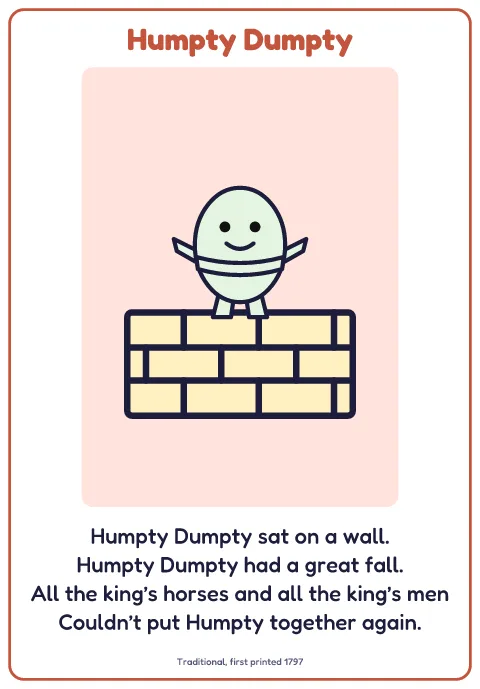
Twelve posters, one rhyme on each: a big title, our own picture and the words in large print, with the year it was first printed. Choose the version with Incy Wincy (New Zealand, Australia and the UK) or the US version with The Itsy Bitsy Spider.
Rhyme posters PDF, NZ, AU and UK words (A4)Rhyme posters PDF, NZ, AU and UK words (US Letter)
Ink saver (A4)Ink saver (US Letter)
US words (Itsy Bitsy) (A4)US words (Itsy Bitsy) (US Letter)
US words (Itsy Bitsy) ink saver (A4)US words (Itsy Bitsy) ink saver (US Letter)
2. Choice cards and choosing board
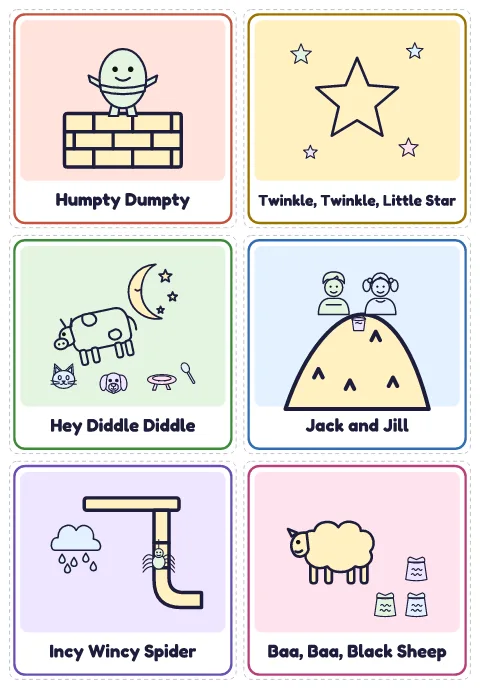
Big picture cards with the rhyme title, six to a page, and a one-page choosing board with all twelve. Children point, or clip a peg on the rhyme they want to sing next.
Choice cards and choosing board PDF, NZ, AU and UK words (A4)Choice cards and choosing board PDF, NZ, AU and UK words (US Letter)
Ink saver (A4)Ink saver (US Letter)
US words (Itsy Bitsy) (A4)US words (Itsy Bitsy) (US Letter)
US words (Itsy Bitsy) ink saver (A4)US words (Itsy Bitsy) ink saver (US Letter)
3. Sequencing cards
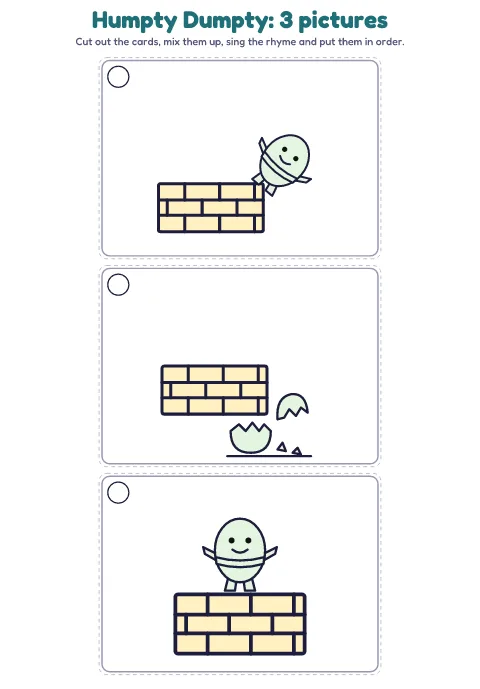
Four rhymes told in pictures to cut out and put in order: Humpty Dumpty and Hickory dickory dock in three steps, Jack and Jill in four and Incy Wincy in five. Each set has an answer page with the words beside each picture.
Sequencing cards PDF, NZ, AU and UK words (A4)Sequencing cards PDF, NZ, AU and UK words (US Letter)
Ink saver (A4)Ink saver (US Letter)
US words (Itsy Bitsy) (A4)US words (Itsy Bitsy) (US Letter)
US words (Itsy Bitsy) ink saver (A4)US words (Itsy Bitsy) ink saver (US Letter)
4. Finger-play action cards
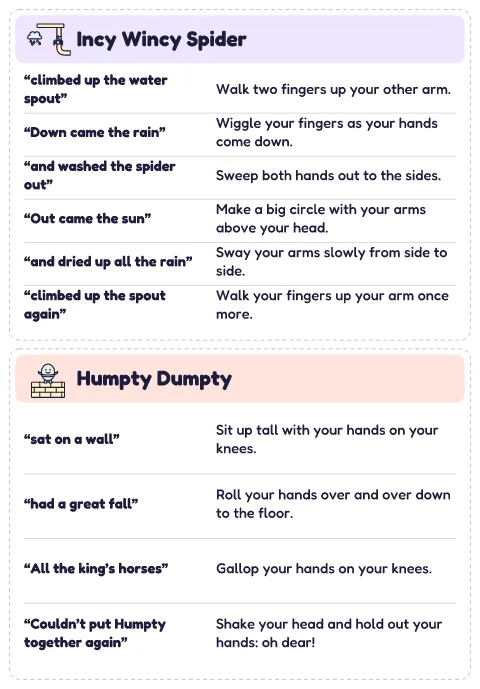
Six cards with each line of a finger-play rhyme and a simple action to match: Incy Wincy, Humpty Dumpty, Twinkle, Twinkle, Row, row, row your boat, Hickory dickory dock and Jack and Jill.
Finger-play action cards PDF (A4)Finger-play action cards PDF (US Letter)
Advertisement
5. Stick-puppet props
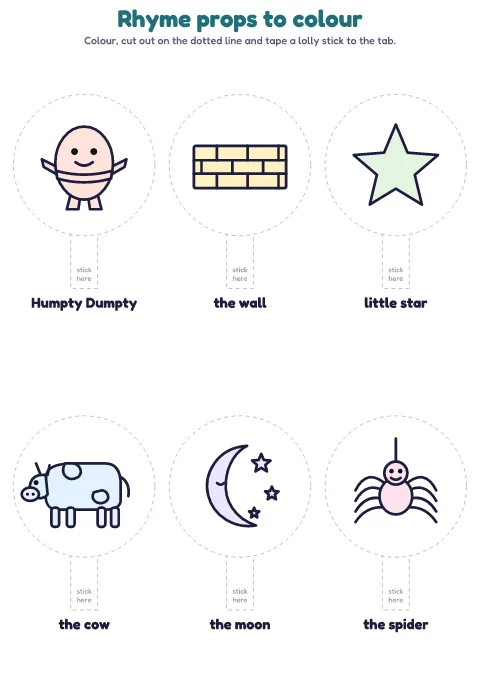
Twelve props in circles to colour, cut out and tape to a lolly stick, from Humpty Dumpty and his wall to the cow, the moon, the mouse, the clock and the big fat hen.
Stick-puppet props PDF (A4)Stick-puppet props PDF (US Letter)
6. Finish the rhyme
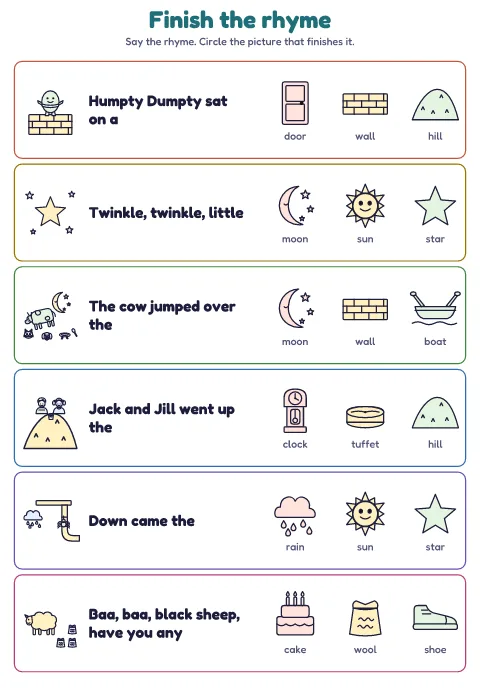
Twelve lines with the last word missing, one from each rhyme. Level 1: circle the right picture from three. Level 2: write the word from the word box. Answer pages follow each sheet.
7. Rhyming pairs
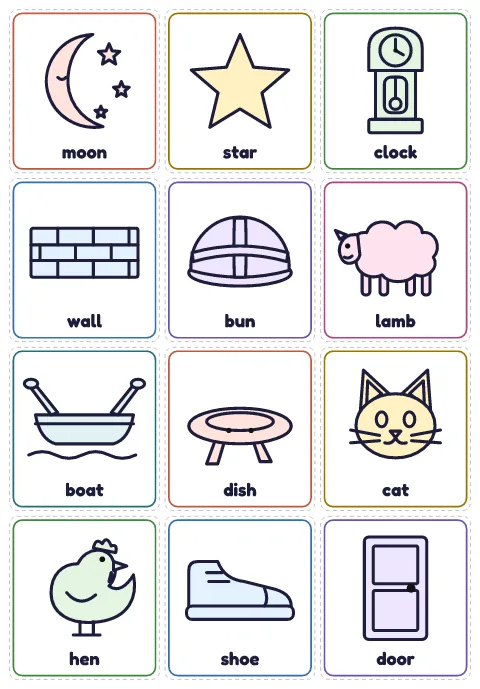
Twelve pairs of rhyming words taken from the rhymes (moon and spoon, star and car, clock and sock, hen and ten), as 24 picture cards for pairs and snap and two draw-a-line sheets with answers. Every pair rhymes whichever accent you speak.
8. One, two, buckle my shoe counting
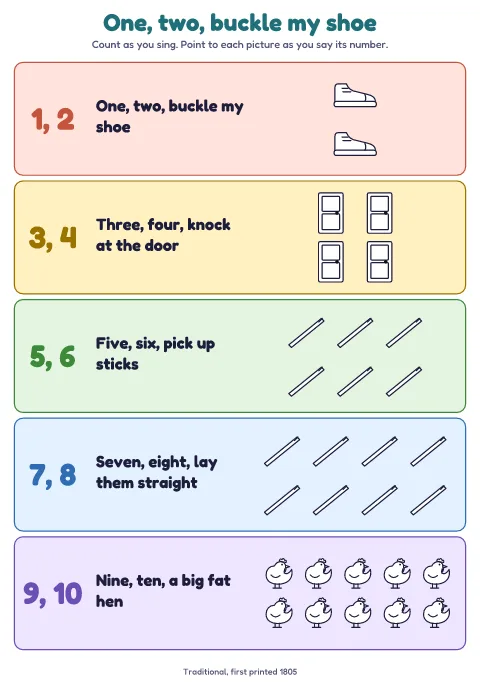
A poster that sets out One, two, buckle my shoe in number pairs with that many pictures, then count-and-write sheets to five and to ten, each with an answer page.
One, two, buckle my shoe counting PDF (A4)One, two, buckle my shoe counting PDF (US Letter)
9. Hickory dickory dock clock
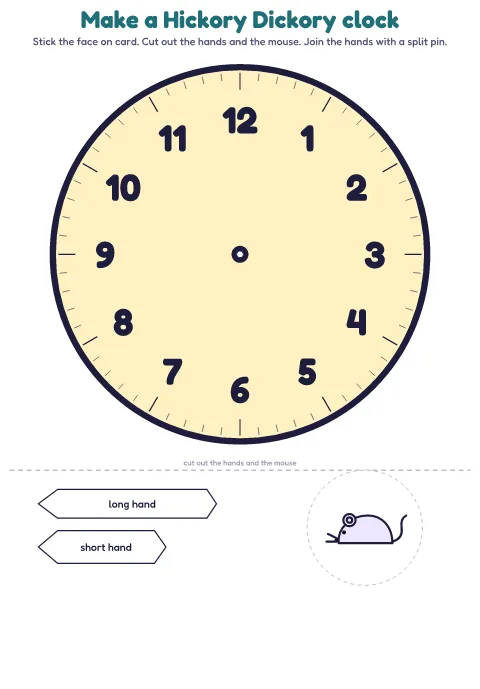
A large clock face with hands and a mouse to cut out, then “the clock struck…” sheets: level 1 reads the short hand, level 2 draws it. Answer pages show every clock.
Hickory dickory dock clock PDF (A4)Hickory dickory dock clock PDF (US Letter)
10. Rhymes I can sing chart
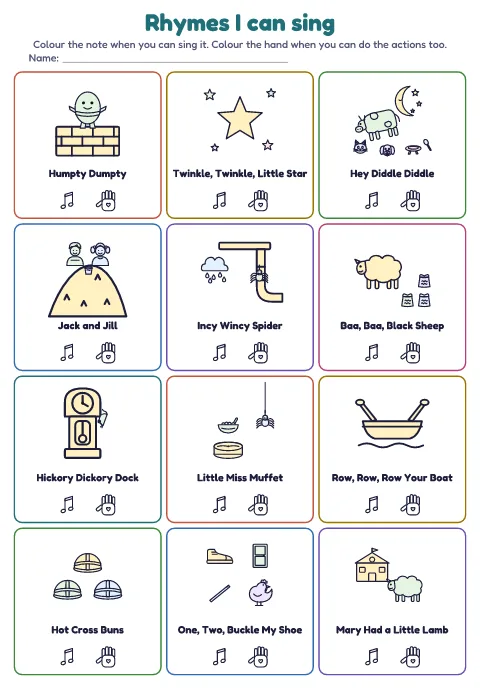
A chart for each child with a note to colour when they can sing a rhyme and a hand for the actions, and a class record with a column for each rhyme.
Rhymes I can sing chart PDF, NZ, AU and UK words (A4)Rhymes I can sing chart PDF, NZ, AU and UK words (US Letter)
Ink saver (A4)Ink saver (US Letter)
US words (Itsy Bitsy) (A4)US words (Itsy Bitsy) (US Letter)
US words (Itsy Bitsy) ink saver (A4)US words (Itsy Bitsy) ink saver (US Letter)
Advertisement
11. Rhyme bag cards
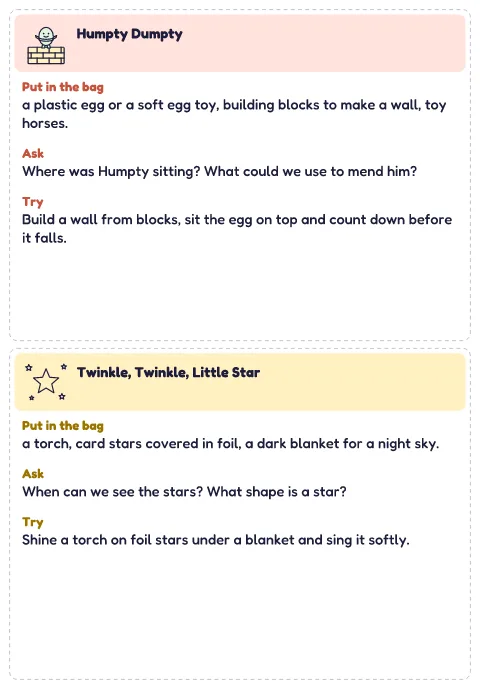
A card for each rhyme to keep in its rhyme bag or basket: what to put in, two questions to ask and one thing to try. Two cards to a page, so the words are big enough to read from the bag.
Rhyme bag cards PDF, NZ, AU and UK words (A4)Rhyme bag cards PDF, NZ, AU and UK words (US Letter)
Ink saver (A4)Ink saver (US Letter)
US words (Itsy Bitsy) (A4)US words (Itsy Bitsy) (US Letter)
US words (Itsy Bitsy) ink saver (A4)US words (Itsy Bitsy) ink saver (US Letter)
12. Adult input plan
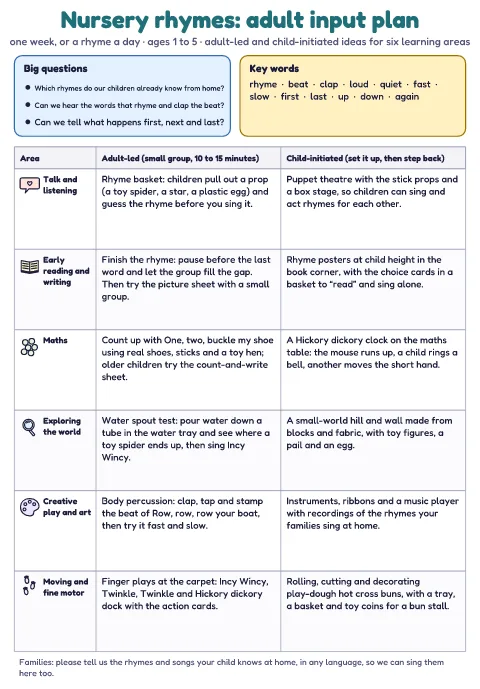
One page for the team: three big questions, twelve key words and an adult-led and a child-initiated idea for six learning areas, with a line asking families for the rhymes they sing at home.
13. Observation prompts
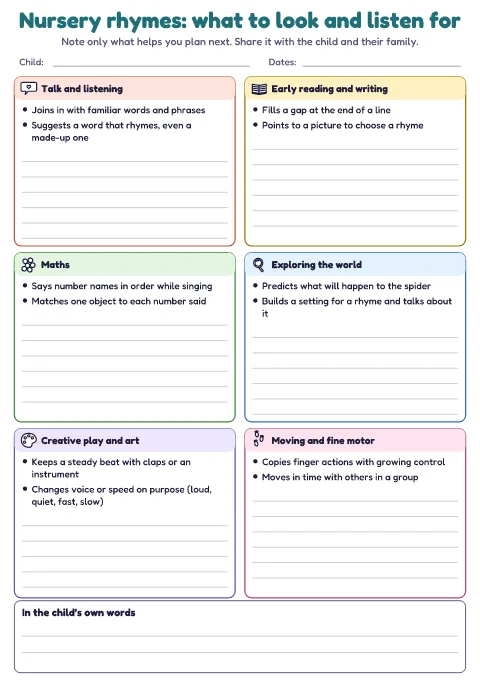
Two things to look and listen for in each learning area while you sing, with lines for notes and a box for the child’s own words.
Observation prompts PDF (A4)Observation prompts PDF (US Letter)
14. Large-print song sheets
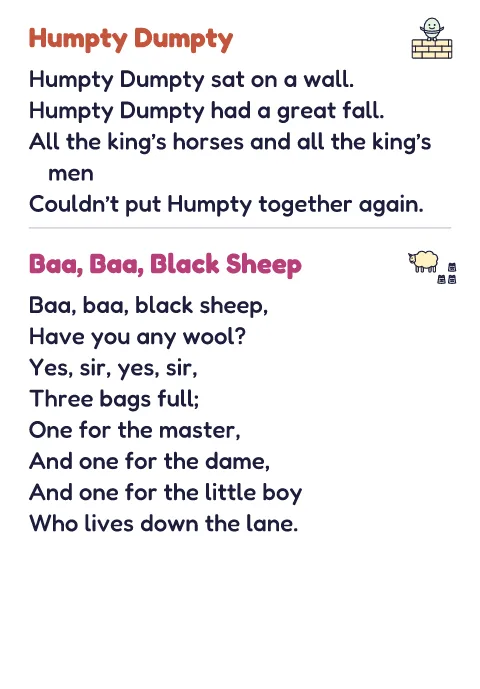
All twelve rhymes in large, clear type, two to a page, for grandparents, intergenerational visits and care-home singalongs.
Large-print song sheets PDF, NZ, AU and UK words (A4)Large-print song sheets PDF, NZ, AU and UK words (US Letter)
Ink saver (A4)Ink saver (US Letter)
US words (Itsy Bitsy) (A4)US words (Itsy Bitsy) (US Letter)
US words (Itsy Bitsy) ink saver (A4)US words (Itsy Bitsy) ink saver (US Letter)
The twelve rhymes
- Humpty Dumpty. Traditional, first printed 1797. In the kit: poster, choice card, bag card, large-print sheet, sequencing cards, action card.
- Twinkle, Twinkle, Little Star. Jane Taylor, first printed 1806. In the kit: poster, choice card, bag card, large-print sheet, action card.
- Hey Diddle Diddle. Traditional, first printed about 1765. In the kit: poster, choice card, bag card, large-print sheet.
- Jack and Jill. Traditional, first printed about 1765. In the kit: poster, choice card, bag card, large-print sheet, sequencing cards, action card.
- Incy Wincy Spider (US: The Itsy Bitsy Spider). Traditional, first printed 1910. In the kit: poster, choice card, bag card, large-print sheet, sequencing cards, action card.
- Baa, Baa, Black Sheep. Traditional, first printed 1744. In the kit: poster, choice card, bag card, large-print sheet.
- Hickory Dickory Dock. Traditional, first printed 1744. In the kit: poster, choice card, bag card, large-print sheet, sequencing cards, action card, clock.
- Little Miss Muffet. Traditional, first printed 1805. In the kit: poster, choice card, bag card, large-print sheet.
- Row, Row, Row Your Boat. Traditional, first printed 1852. In the kit: poster, choice card, bag card, large-print sheet, action card.
- Hot Cross Buns. Traditional, first printed 1767. In the kit: poster, choice card, bag card, large-print sheet.
- One, Two, Buckle My Shoe. Traditional, first printed 1805. In the kit: poster, choice card, bag card, large-print sheet, counting set.
- Mary Had a Little Lamb. Sarah Josepha Hale, first printed 1830. In the kit: poster, choice card, bag card, large-print sheet.
Tips
- Sing first, print second. A rhyme needs to be sung many times before a sequencing card or a missing word means anything to a child.
- Slow down and pause. Stop before the last word of a line and let the children fill it. It is the simplest rhyming activity there is.
- Keep a rhyme bag. Real objects in a bag (an egg, a star, a toy spider) work for babies and toddlers long before pictures do.
- Ask families. Collect the rhymes and lullabies children hear at home in every language spoken in your group, and sing those too.
- Count with your body. Clap the beat, hold up fingers for One, two, buckle my shoe and ring a real bell for the clock struck one.
More for the room: phase 1 phonics listening games, sequencing cards, counting mats and number rhymes, fine motor activities, topic packs for transport and growing, and early learning by country.
Related sets
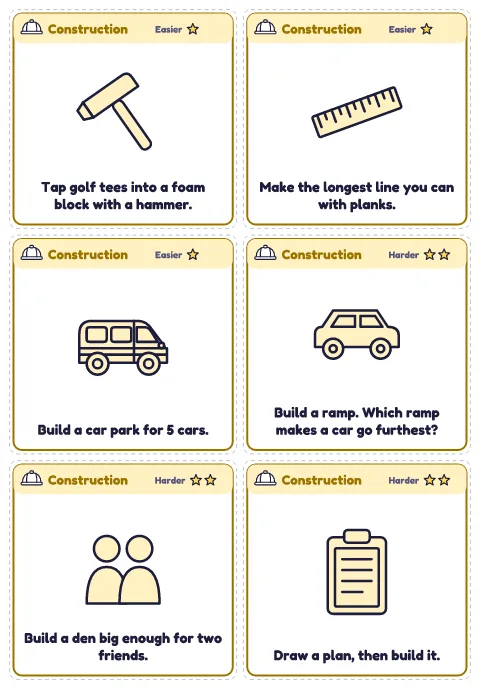 Continuous provision challenge cards for 10 play areasCards · ages 3–5
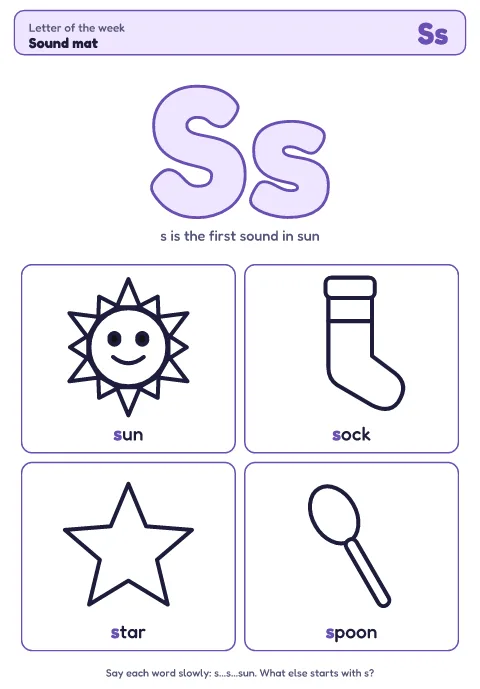 Letter of the week packs A to Z with letter formationWorksheets · ages 3–6
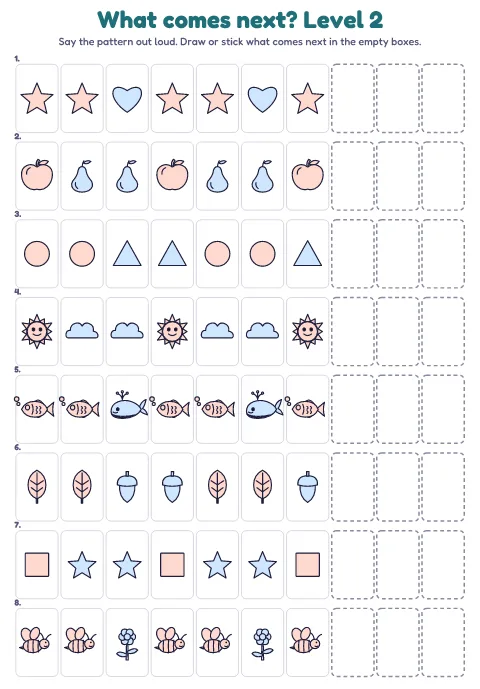 Pattern cards: AB, ABB and ABC strips, cube cardsCards · ages 3–6
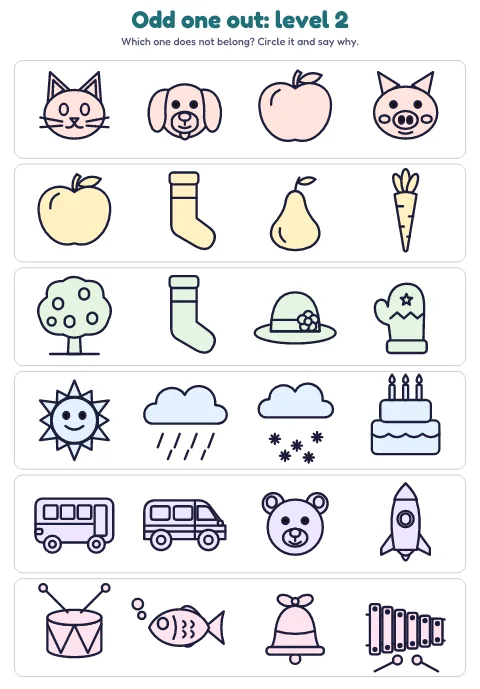 Sorting mats, matching pairs, shadow matching, odd one outCards · ages 2–5
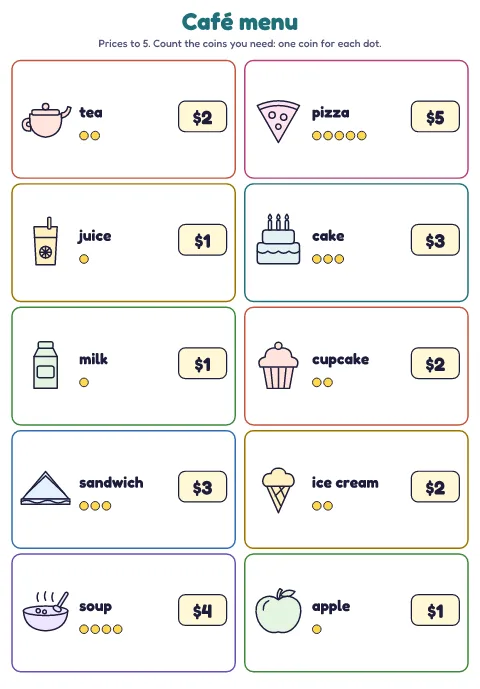 Café role play: menu, order pad, signs, badgesDisplays and charts · ages 2–6
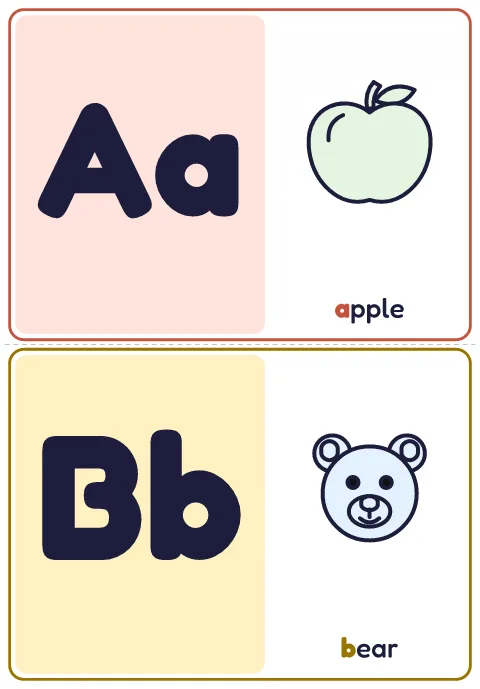 Alphabet frieze (8 handwriting styles) and number frieze 0–20Displays and charts · ages 3–6
Questions
What are the most popular nursery rhymes?
In English-speaking settings the rhymes sung most are Twinkle, Twinkle, Little Star, Humpty Dumpty, Baa, Baa, Black Sheep, Incy Wincy (Itsy Bitsy) Spider, Row, Row, Row Your Boat, Hickory Dickory Dock, Jack and Jill, Hey Diddle Diddle, Little Miss Muffet, Mary Had a Little Lamb, Hot Cross Buns and One, Two, Buckle My Shoe. All twelve are in this kit.
Why are nursery rhymes good for young children?
Singing rhymes often helps children hear the sounds in words and notice words that rhyme, remember a sequence, practise counting and new words, and build hand control through finger plays. Above all they are a shared, playful way to use language together.
Is it Incy Wincy or Itsy Bitsy Spider?
It is the same rhyme. Incy Wincy Spider is the usual name in the UK, New Zealand and Australia, and The Itsy Bitsy Spider in the US. The posters and sheets that show the rhyme come in both versions.
Are nursery rhymes copyright free?
Traditional nursery rhymes that were first printed long ago, like the twelve here (printed between 1744 and 1910), are in the public domain. Many modern children’s songs are not, so check before you copy the words of a newer song.
How do you teach nursery rhymes in early years?
Sing a small number of rhymes often, with actions and props, and come back to them for weeks. Add one new rhyme at a time, pause for children to fill in words, and then use posters, sequencing cards and counting activities to take a well-known rhyme further.
Are these free?
Yes. Free for your own centre, kindergarten, school, class and family, with no sign-up. Please don’t resell them or upload them to another site.