 Colouring Nest
Transport topic pack with an adult input plan
A free transport topic pack for nursery, preschool, kindy and Reception: a one-page adult input plan with an adult-led and a child-initiated idea for six learning areas, twelve vocabulary cards and a twenty-word mat (New Zealand and Australian, UK and US words), a count-and-graph sheet at two levels, a land, water or air cut-and-stick sort, a “how did we get here today?” class pictograph, bus-trip sequencing cards at four and six steps, a road safety poster, tracing paths, an “Off we go!” reader to cut and staple, a garage and car wash role-play set-up with signs, and an observation prompt sheet. Answer pages are included. A4 and US Letter PDFs, colour and ink saver.
Inside this set
- 12 printables
- A4 and US Letter PDFs
- Colour and ink-saver versions
- Free, no sign-up
 Transport adult input plan
 Transport vocabulary cards
 Transport word mat
 Count the vehicles and graph them
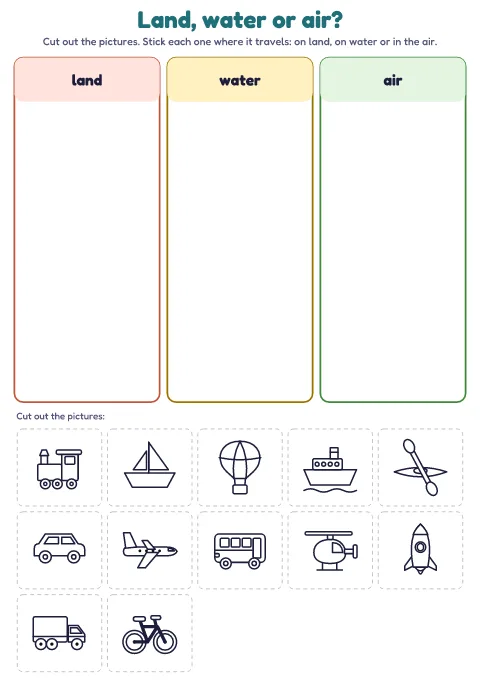 Land, water or air? Cut-and-stick sort with answers
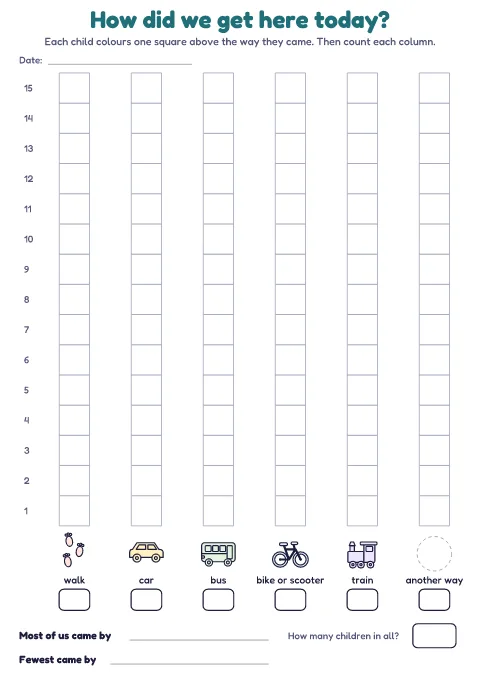 How did we get here today? Class pictograph
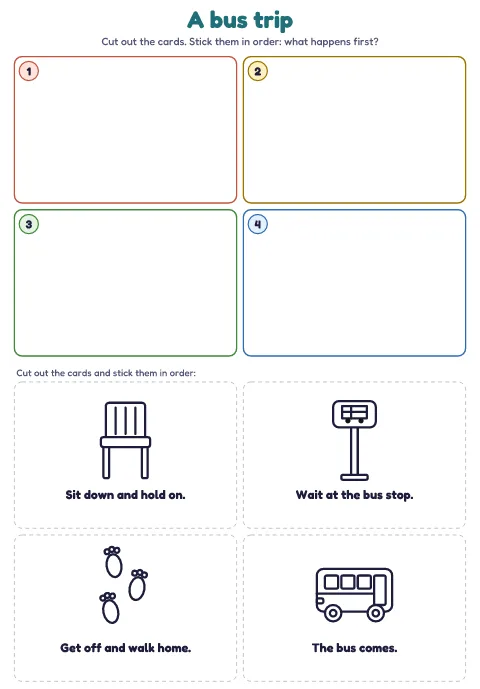 A bus trip
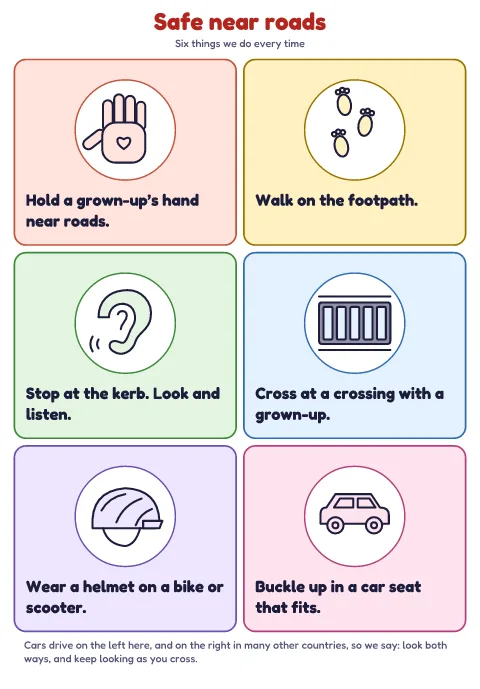 Safe near roads
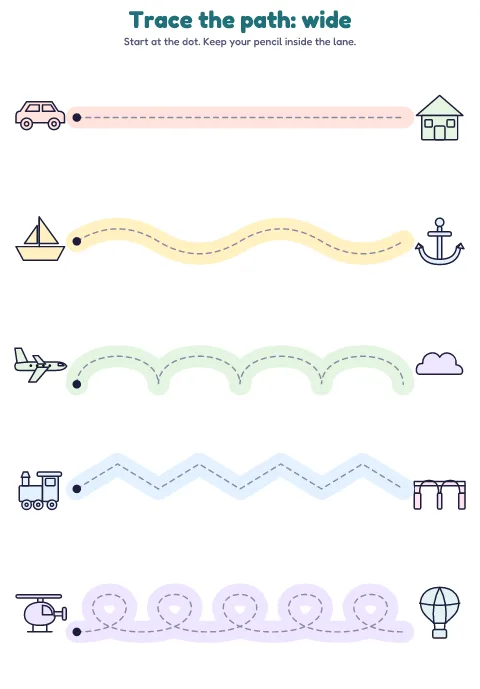 Transport tracing paths
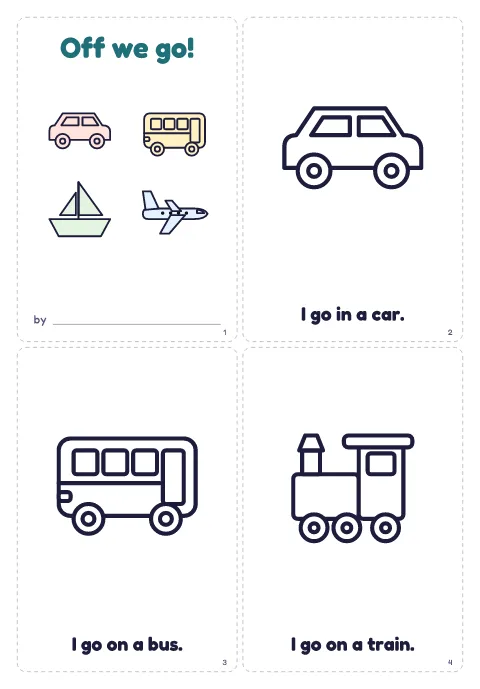 Off we go! A little transport reader to cut and staple
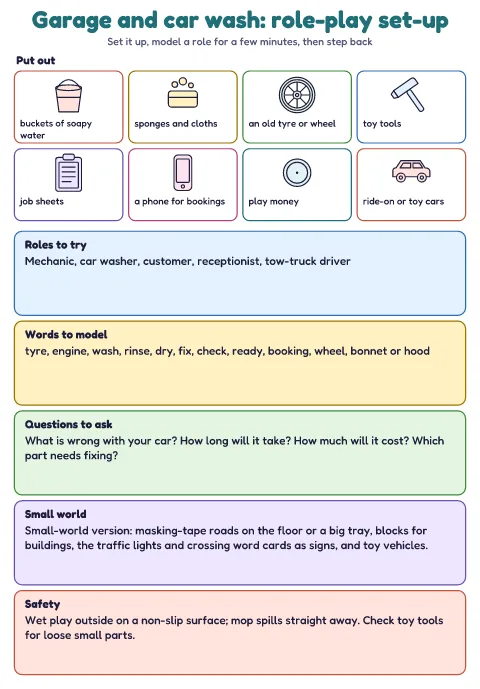 Garage and car wash role play
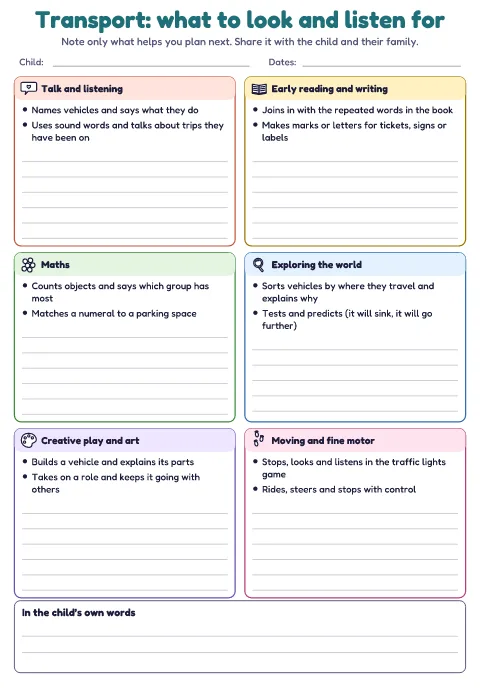 Transport observation prompts
About this resource
Ages 2–6, prep, what you need and how to use it
- Ages
- 2 to 6 years (toddlers, preschool, school start)
- Prep
- Five minutes to print the plan, poster and sheets; fifteen minutes to cut and laminate the word cards, sequencing cards and role-play signs.
- You’ll need
- Printer, paper and thin card
- Scissors, glue, crayons and a stapler for the reader
- Toy vehicles and a water tray for the float test
- Chalk for a crossing outside (optional)
- Supports
- Te Whāriki (NZ), EYLF (Australia), EYFS (England), ELOF (US)
How to use it in the room
- Start with the class pictograph: how did we get here today?
- Pin up the adult input plan and leave the child-initiated set-ups out for the whole topic.
- Practise the road safety habits outside with the traffic lights game before talking about real roads.
Show resources for
Remembered on this device only. It sets A4 or US Letter as the first download.
How to use this transport plan
Transport is a topic children walk into the room already knowing: they arrived by car, bus, bike, buggy or on foot, and many can name more vehicles than adults expect. Start there. On the first morning, ask how everyone got in today and fill in the class pictograph together, so the topic begins with real data the children made themselves. Then let their interests steer the next week: a group obsessed with diggers, a child whose family drives a truck, or a train trip someone took at the weekend is worth more than any plan.
The plan pairs one short adult-led activity with one child-initiated set-up in each of six learning areas. Lead the adult-led ideas with a small group for ten to fifteen minutes, modelling words such as wheels, engine, passenger and journey. Leave the set-ups out for the whole topic so children can return to them. A garage, a bus made of chairs or a floor of masking-tape roads will be played with differently on day eight than on day one, and that change is what you are watching for.
Road safety, as habits
The road safety poster shows six habits rather than a sequence: hold a grown-up’s hand, walk on the footpath, stop at the kerb to look and listen, cross at a crossing with an adult, wear a helmet on wheels and buckle up in a car seat that fits. Young children cannot judge the speed of traffic, so every habit includes an adult. Practise them outside with the traffic lights game and a chalk crossing before you talk about real roads. Traffic drives on the left in New Zealand, Australia and the UK and on the right in the US, so the poster teaches “look both ways” rather than which side to check first, and it comes in three versions: footpath (New Zealand and Australia), pavement (UK) and sidewalk and curb (US).
Words that change by country
The word cards and word mat come in three versions because transport words travel badly: a truck in Auckland, Sydney or Chicago is a lorry in Leeds, an aeroplane is an airplane in the US, and a fire engine becomes a fire truck. Print the version your children hear at home, and if your group mixes countries, put both words on the wall and talk about them.
Supports:
- Te Whāriki NZ
- Exploration | Mana aotūroa
- Communication | Mana reo
- Wellbeing | Mana atua
- EYLF Australia
- Outcome 2: Children are connected with and contribute to their world
- Outcome 4: Children are confident and involved learners
- Outcome 5: Children are effective communicators
- Outcome 3: Children have a strong sense of wellbeing
- Outcome 1: Children have a strong sense of identity
- EYFS England
- Understanding the world
- Communication and language
- Literacy
- Mathematics
- Personal, social and emotional development
- Physical development
- ELOF US
- Cognition
- Language and Literacy
- Social and Emotional Development
- Perceptual, Motor, and Physical Development
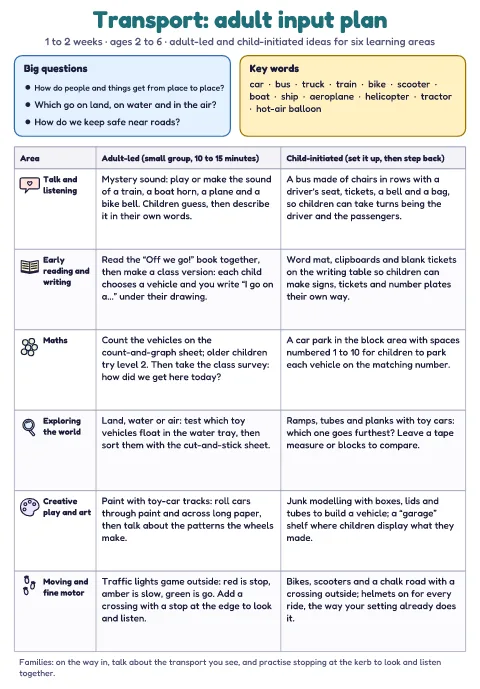
1. Transport adult input plan
One page for the team: three big questions, twelve key words and, for each of six learning areas, a short adult-led activity and a child-initiated set-up, with a line for families.
Transport adult input plan PDF (A4)Transport adult input plan PDF (US Letter)
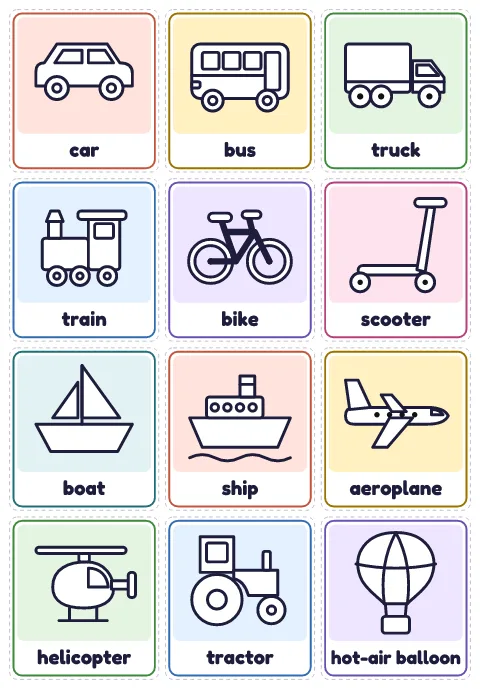
2. Transport vocabulary cards
Twelve big picture cards for the writing table, a word wall or a game of pairs. Choose New Zealand and Australian words (truck, aeroplane), UK words (lorry) or US words (airplane).
Transport vocabulary cards PDF, NZ and AU words (truck, aeroplane) (A4)Transport vocabulary cards PDF, NZ and AU words (truck, aeroplane) (US Letter)
Ink saver (A4)Ink saver (US Letter)
UK words (lorry) (A4)UK words (lorry) (US Letter)
UK words (lorry) ink saver (A4)UK words (lorry) ink saver (US Letter)
US words (airplane) (A4)US words (airplane) (US Letter)
US words (airplane) ink saver (A4)US words (airplane) ink saver (US Letter)
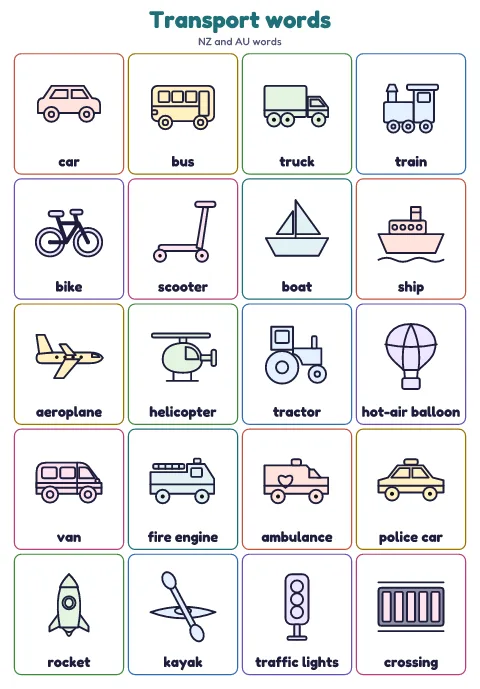
3. Transport word mat
Twenty transport words with pictures on one sheet, adding a fire engine, an ambulance, a kayak, traffic lights and a crossing to the twelve on the cards. Laminate it for the mark-making table.
Transport word mat PDF, NZ and AU words (A4)Transport word mat PDF, NZ and AU words (US Letter)
Ink saver (A4)Ink saver (US Letter)
UK words (A4)UK words (US Letter)
UK words ink saver (A4)UK words ink saver (US Letter)
US words (fire truck, crosswalk) (A4)US words (fire truck, crosswalk) (US Letter)
US words (fire truck, crosswalk) ink saver (A4)US words (fire truck, crosswalk) ink saver (US Letter)
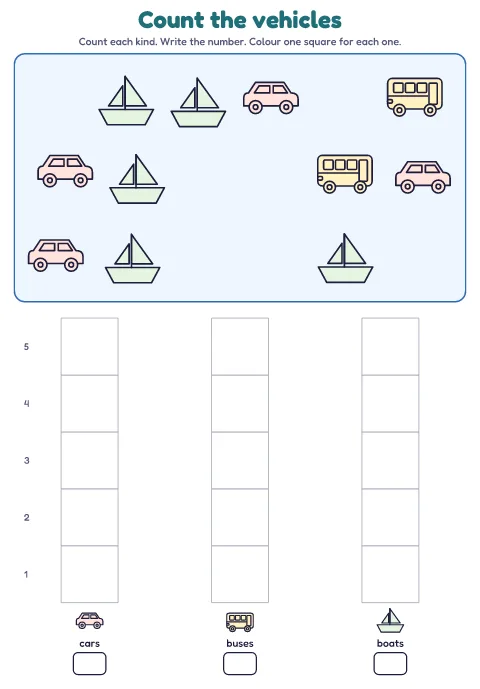
4. Count the vehicles and graph them
Level 1: three kinds of vehicle up to 5, one square of the graph for each. Level 2: four kinds up to 10, then say which has most. Answer pages follow each level.
Count the vehicles and graph them PDF (A4)Count the vehicles and graph them PDF (US Letter)
Advertisement
5. Land, water or air? Cut-and-stick sort with answers
Twelve vehicles to cut out and stick under land, water or air, from a bike and a train to a kayak and a hot-air balloon. The answer page shows each group.
Land, water or air? Cut-and-stick sort with answers PDF (A4)Land, water or air? Cut-and-stick sort with answers PDF (US Letter)
6. How did we get here today? Class pictograph
A whole-class graph: each child colours one square above the way they came today, then you count each column together and talk about most and fewest.
How did we get here today? Class pictograph PDF (A4)How did we get here today? Class pictograph PDF (US Letter)
7. A bus trip
A real journey in order: wait at the bus stop, the bus comes, tap on or pay, sit down, press the bell, get off. Level 1 has four cards, level 2 all six. Answer pages show the order.
8. Safe near roads
Six road habits in big pictures and short words for the door or the outdoor area. Choose the footpath version (New Zealand and Australia), pavement (UK) or sidewalk and curb (US).
Safe near roads PDF, NZ and AU (footpath) (A4)Safe near roads PDF, NZ and AU (footpath) (US Letter)
Ink saver (A4)Ink saver (US Letter)
UK (pavement) (A4)UK (pavement) (US Letter)
UK (pavement) ink saver (A4)UK (pavement) ink saver (US Letter)
US (sidewalk, curb) (A4)US (sidewalk, curb) (US Letter)
US (sidewalk, curb) ink saver (A4)US (sidewalk, curb) ink saver (US Letter)
9. Transport tracing paths
Five lanes from one picture to another: straight, wave, hills, zigzag and loops. The wide page is for first pencil control and the narrow page for steadier hands.
Transport tracing paths PDF (A4)Transport tracing paths PDF (US Letter)
10. Off we go! A little transport reader to cut and staple
An eight-page little book to cut, stack and staple. Each page repeats “I go on” or “I go in” with a big picture, and the last page asks where the child will go.
Off we go! A little transport reader to cut and staple PDF (A4)Off we go! A little transport reader to cut and staple PDF (US Letter)
Advertisement
11. Garage and car wash role play
A one-page set-up for a garage and car wash: what to put out, roles, words to model, questions to ask, a small-world version and safety notes, followed by six signs to cut out.
Garage and car wash role play PDF (A4)Garage and car wash role play PDF (US Letter)
12. Transport observation prompts
Two things to look and listen for in each learning area, with lines for notes and a box for the child’s own words.
Transport observation prompts PDF (A4)Transport observation prompts PDF (US Letter)
The plan at a glance
- Talk and listening. Adult-led: Mystery sound: play or make the sound of a train, a boat horn, a plane and a bike bell. Children guess, then describe it in their own words. Child-initiated: A bus made of chairs in rows with a driver’s seat, tickets, a bell and a bag, so children can take turns being the driver and the passengers.
- Early reading and writing. Adult-led: Read the “Off we go!” book together, then make a class version: each child chooses a vehicle and you write “I go on a…” under their drawing. Child-initiated: Word mat, clipboards and blank tickets on the writing table so children can make signs, tickets and number plates their own way.
- Maths. Adult-led: Count the vehicles on the count-and-graph sheet; older children try level 2. Then take the class survey: how did we get here today? Child-initiated: A car park in the block area with spaces numbered 1 to 10 for children to park each vehicle on the matching number.
- Exploring the world. Adult-led: Land, water or air: test which toy vehicles float in the water tray, then sort them with the cut-and-stick sheet. Child-initiated: Ramps, tubes and planks with toy cars: which one goes furthest? Leave a tape measure or blocks to compare.
- Creative play and art. Adult-led: Paint with toy-car tracks: roll cars through paint and across long paper, then talk about the patterns the wheels make. Child-initiated: Junk modelling with boxes, lids and tubes to build a vehicle; a “garage” shelf where children display what they made.
- Moving and fine motor. Adult-led: Traffic lights game outside: red is stop, amber is slow, green is go. Add a crossing with a stop at the edge to look and listen. Child-initiated: Bikes, scooters and a chalk road with a crossing outside; helmets on for every ride, the way your setting already does it.
Tips
- Use the real journey. The class pictograph turns the trip in this morning into the first maths of the topic; do it again at the end and compare.
- Test before you sort. Float toy boats, cars and planes in the water tray first. Children who have seen a car sink sort it onto land with confidence.
- Keep road safety practical. Practise stopping at a chalk kerb and holding hands outside; the poster is a reminder, not the lesson.
- Follow the wheels. Car-track painting, ramps and junk-model vehicles keep the topic going for children who don’t want to sit at a table.
- Send the reader home. “Off we go!” repeats “I go on a…” so children can read it to their family from memory, then add their own last page.
More topic packs: growing (plants and life cycles), minibeasts, weather and seasons and people who help us. For the room, see sequencing cards, fine motor activities, continuous provision challenge cards and early learning by country.
Related sets
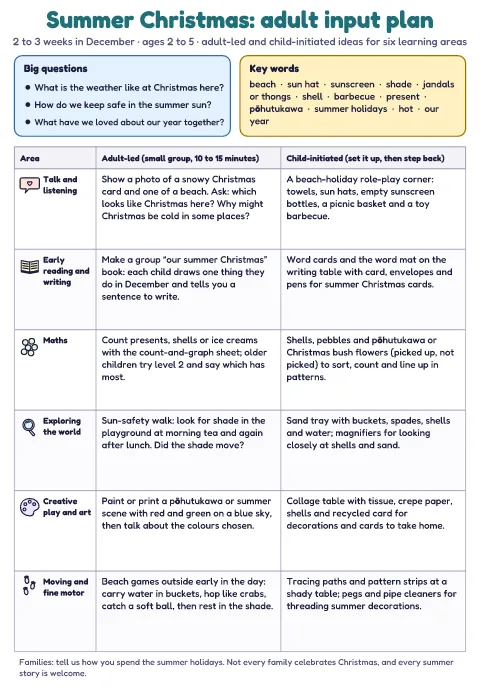 Summer Christmas pack: plan, sun safety, sheets and certificateTemplates · ages 2–6
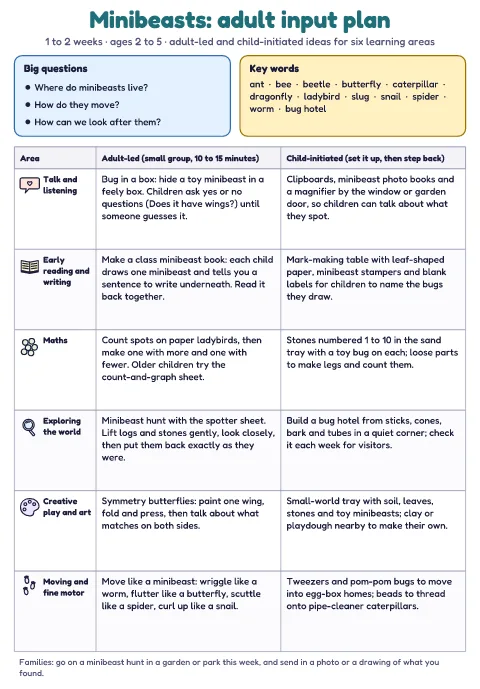 Minibeasts topic pack: adult input plan, word cards, sheetsTemplates · ages 2–5
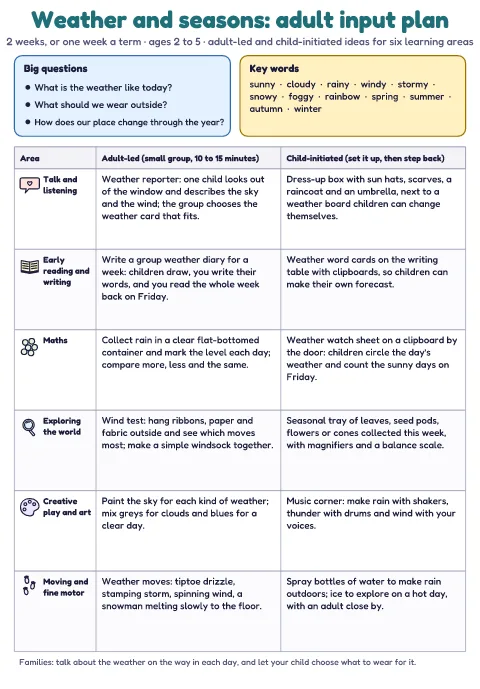 Weather and seasons topic pack (both hemispheres)Templates · ages 2–5
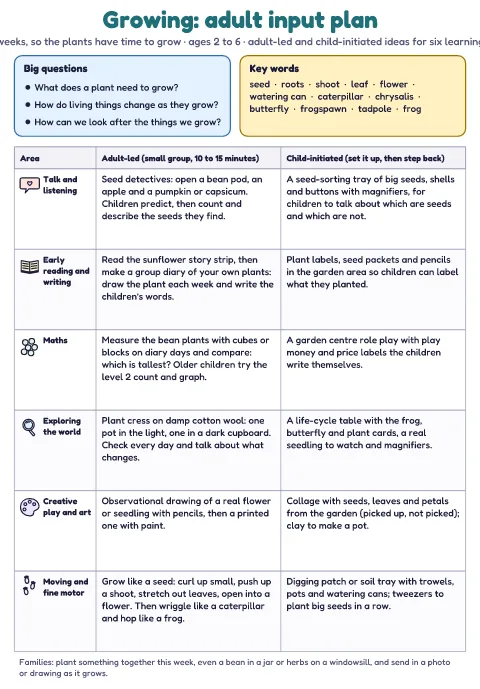 Growing topic pack: plant, butterfly and frog life cyclesTemplates · ages 2–6
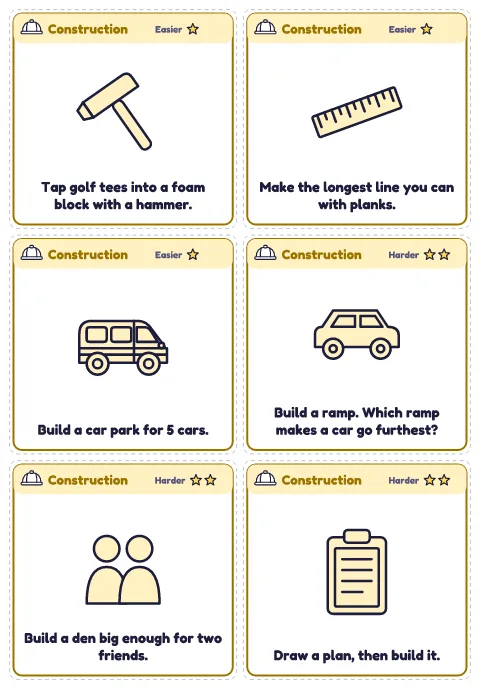 Continuous provision challenge cards for 10 play areasCards · ages 3–5
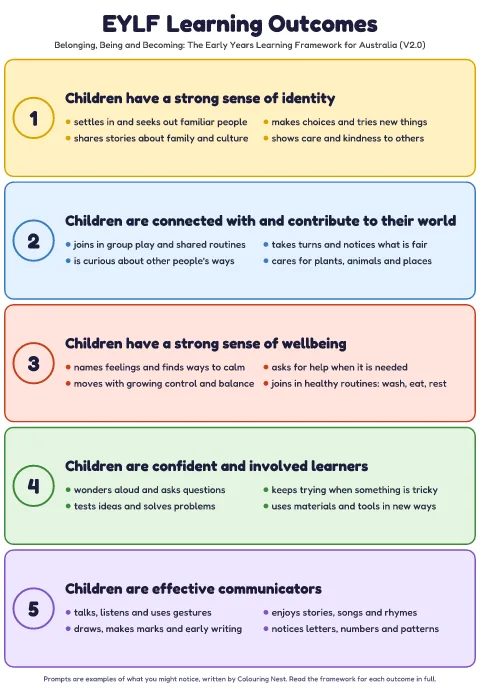 EYLF outcomes poster, cards and templatesTemplates · ages 1–5
Questions
What should a transport topic in early years include?
Talk about how children travel, sorting vehicles by where they go (land, water and air), counting and graphing, road safety habits, role play such as a garage or a bus, building and art with wheels, and a book. This pack gives a plan and a printable for each.
Is it a truck or a lorry?
Both. Truck is the usual word in New Zealand, Australia and the US; lorry is used in the UK. The word cards and word mat come in three versions, and the US version also says airplane, fire truck and crosswalk.
How do you teach road safety to preschoolers?
Practise a few habits often, with an adult every time: hold hands near roads, walk on the footpath, stop at the kerb and look and listen, cross at a crossing, wear a helmet on wheels and buckle up. Young children cannot judge traffic speed, so they should always cross with a grown-up.
Are these free?
Yes. Free for your own centre, kindergarten, school, class and family, with no sign-up. Please don’t resell them or upload them to another site.