 Colouring Nest
Daily care diary and family sheets for babies and toddlers
Free daily care diary sheets for babies and toddlers in a nursery, daycare, childcare centre or with a family day carer: a baby daily diary and a toddler daily diary (tick boxes for sleep, feeds, food, nappies or toileting and play), a two-page “all about me” sheet for families, a weekly newsletter template, a “what I did today” sheet and wow-moment slips for home and the room. Diaries come in a nappy version and a diaper version. A4 and US Letter PDFs, colour and ink saver. These are printables only: nothing you write is sent to us.
Inside this set
- 6 printables
- A4 and US Letter PDFs
- Colour and ink-saver versions
- Free, no sign-up
About this resource
Ages 0–3, prep, what you need and how to use it
- Ages
- Birth to 3 years (babies, toddlers, preschool)
- Prep
- A few minutes: print a stack of the nappy or diaper version for the week.
- You’ll need
- Printer and paper
- A clipboard and a pen by the change table
- A folder or tray for each family
- Supports
- Te Whāriki (NZ), EYLF (Australia), EYFS (England), ELOF (US)
How to use it in the room
- Ask families to fill in the from-home box at drop-off.
- Tick and write times as things happen through the day.
- Hand the diary to the family at pick-up and keep any copies the way you keep other records.
Show resources for
Remembered on this device only. It sets A4 or US Letter as the first download.
Why a paper daily diary still works
Many centres now use an app for daily reports, and many families still ask for paper. A sheet that travels in the nappy bag can be read at the door, stuck on the fridge and kept. It also works in family day care, on a relief day when the app login is missing, and for families who do not use the app at all.
The diaries are built to be filled in during the day with ticks and times, not written up at the end. Each one starts with a short note from home (how the night went, the last feed or breakfast) so the first educator of the day knows where the child is starting from. The baby diary has rows for sleep, bottles and feeds, food and nappies; the toddler diary swaps feeds for drinks (circle a cup for each one) and adds “tried the toilet” and “used the toilet” for children who are toilet learning. Both end with what the child enjoyed, a line for notes and a please-bring list.
Nappy or diaper
Families in New Zealand, Australia, the UK and Ireland say nappy; families in the US and Canada say diaper. Choose the version your families use. Food is ticked as all, most, some or tried it, so there is no “none” box that reads like a failure on a day a child was simply not hungry.
Supports:
- Te Whāriki NZ
- Belonging | Mana whenua
- Contribution | Mana tangata
- Wellbeing | Mana atua
- EYLF Australia
- Outcome 1: Children have a strong sense of identity
- Outcome 2: Children are connected with and contribute to their world
- Outcome 3: Children have a strong sense of wellbeing
- EYFS England
- Personal, social and emotional development
- ELOF US
- Social and Emotional Development
- Approaches to Learning
1. Baby daily diary
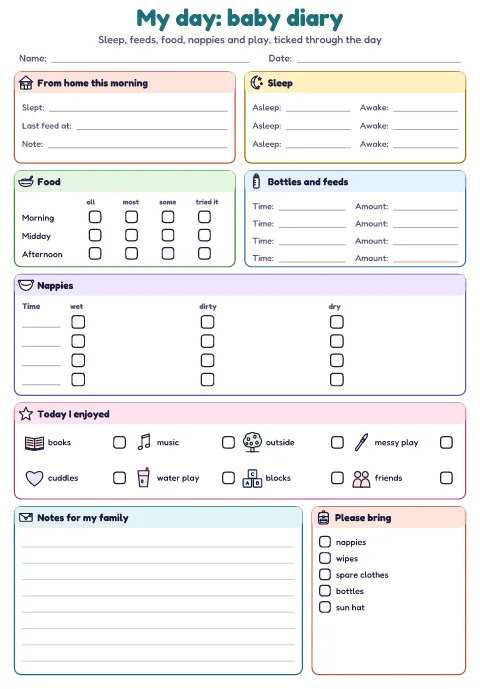
One page per baby per day: a note from home, three sleep rows, four feed rows with time and amount, food tick boxes for morning, midday and afternoon, four nappy rows (wet, dirty or dry), eight pictures of what the baby enjoyed, notes and a please-bring list.
Baby daily diary PDF, Nappy version (A4)Baby daily diary PDF, Nappy version (US Letter)
Ink saver (A4)Ink saver (US Letter)
Diaper version (US) (A4)Diaper version (US) (US Letter)
Diaper version (US) ink saver (A4)Diaper version (US) ink saver (US Letter)
2. Toddler daily diary
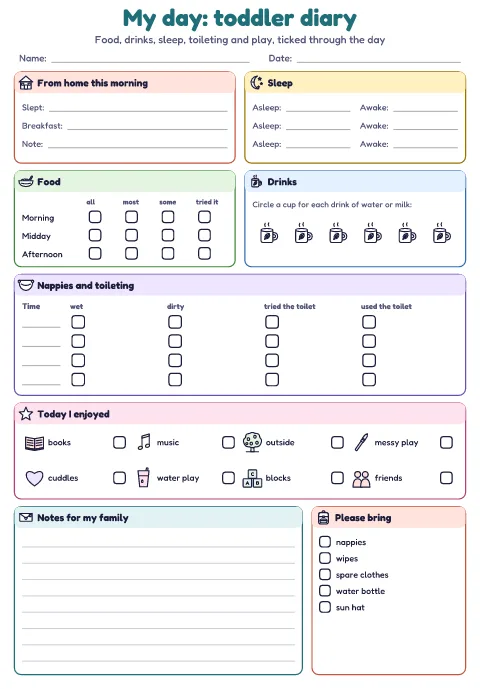
The same day in toddler terms: sleep, food tick boxes, cups to circle for drinks, nappy and toilet tick boxes for children who are toilet learning, play pictures, notes and please-bring.
Toddler daily diary PDF, Nappy version (A4)Toddler daily diary PDF, Nappy version (US Letter)
Ink saver (A4)Ink saver (US Letter)
Diaper version (US) (A4)Diaper version (US) (US Letter)
Diaper version (US) ink saver (A4)Diaper version (US) ink saver (US Letter)
Advertisement
3. All about me
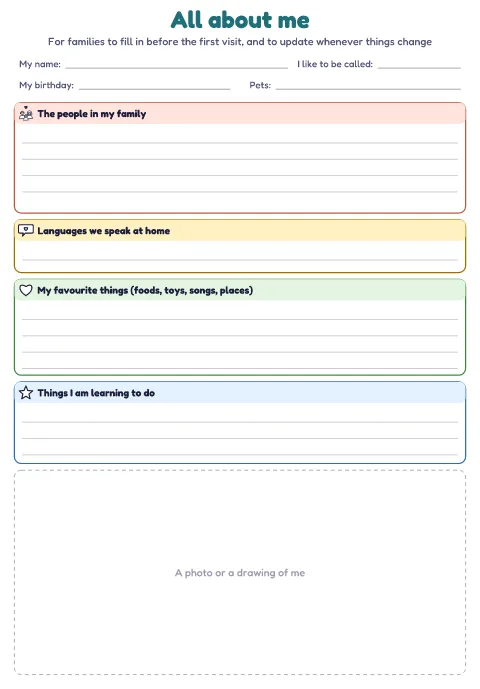
Two pages for families before the first visit: family, languages at home, favourite things and things the child is learning, then how they fall asleep, their comforter, the words they use and what helps when they are upset. Medical details stay on your own enrolment forms.
4. Weekly newsletter template for families
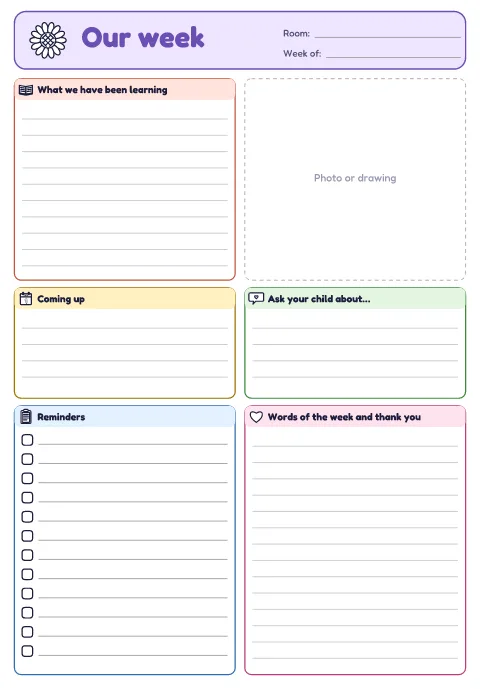
A one-page weekly newsletter: what we have been learning, a photo box, coming up, ask your child about, reminders to tick and words of the week. Photocopy it blank and fill in by hand, or write it once and copy it for every family.
Weekly newsletter template for families PDF (A4)Weekly newsletter template for families PDF (US Letter)
5. What I did today
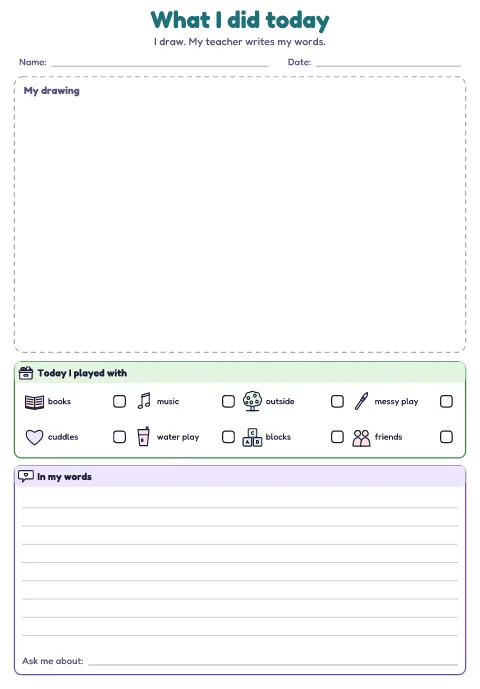
A big drawing box for the child, pictures to tick for what they played with, and lines where an educator writes the child’s own words, plus an “ask me about” line for the journey home.
6. Wow moment slips
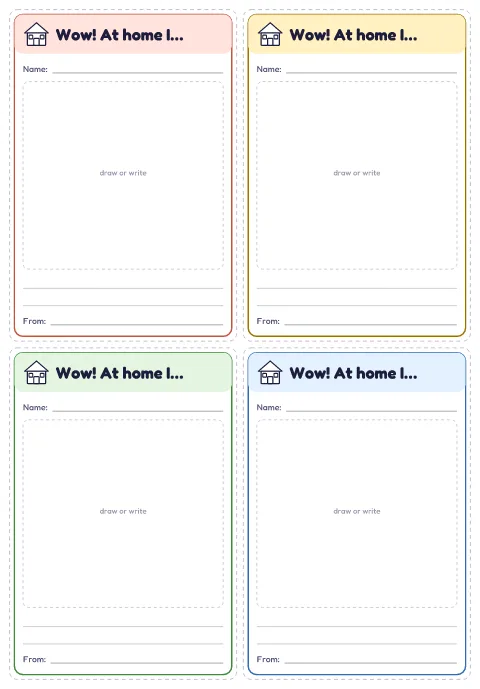
Four slips a page. Families send in “Wow! At home I…” when a child does something new; educators send home “Wow! Today I…”. Pin them up or add them to the child’s portfolio.
Tips for using the sheets
- One clipboard per room. Keep the day’s diaries on a clipboard by the change table and the sleep room, with a pen on a string.
- Times as you go. Write the time when it happens; nobody remembers four nappy changes at 5pm.
- Privacy. The sheets hold personal details, so hand them only to the child’s own family and store copies the way your service stores other records.
- Family voice. The “all about me” sheet and the wow slips give families a way to tell you what they know. In Aotearoa New Zealand, these support whānau voice in learning stories.
- Keep it short. The newsletter works best with three or four lines per box, a photo and one thing to ask at home.
For babies and toddlers: high-contrast cards and first words cards, treasure basket and heuristic play ideas. More for the room: visual timetable, classroom labels with pictures, learning story templates and early learning by country.
Related sets
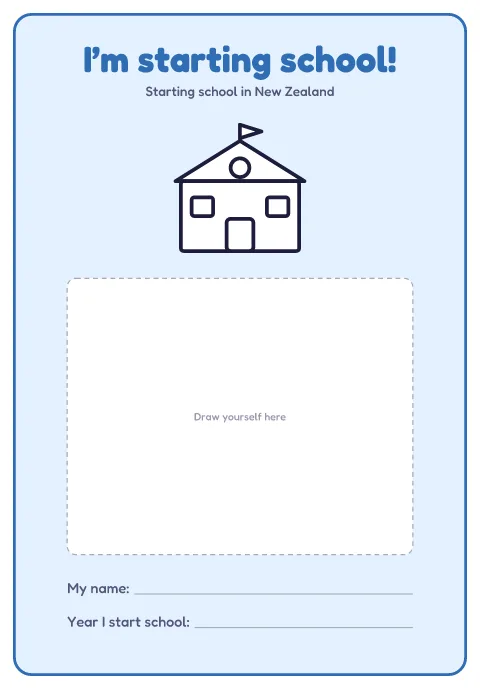 Starting school booklet and all about me for my new teacherTemplates · ages 4–6
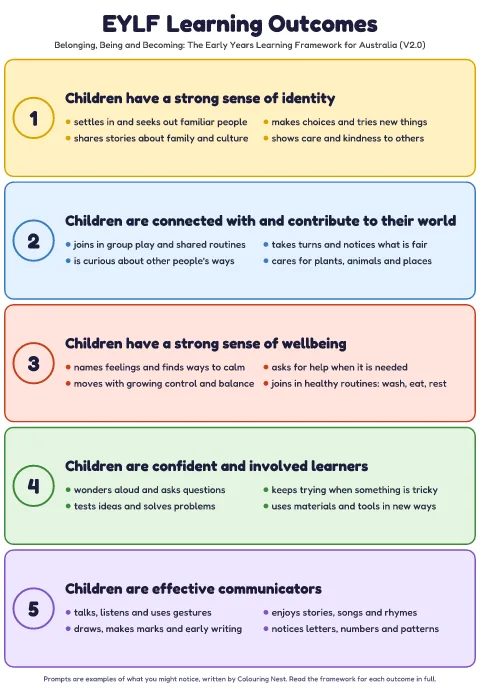 EYLF outcomes poster, cards and templatesTemplates · ages 1–5
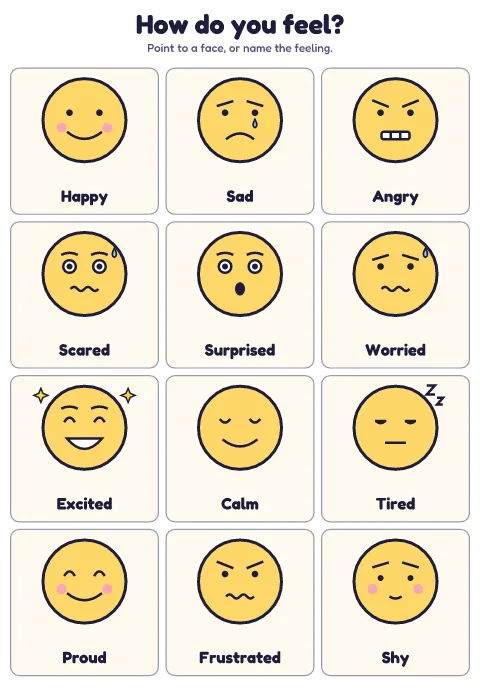 Visual timetable, now and next and feelings chartDisplays and charts · ages 2–6
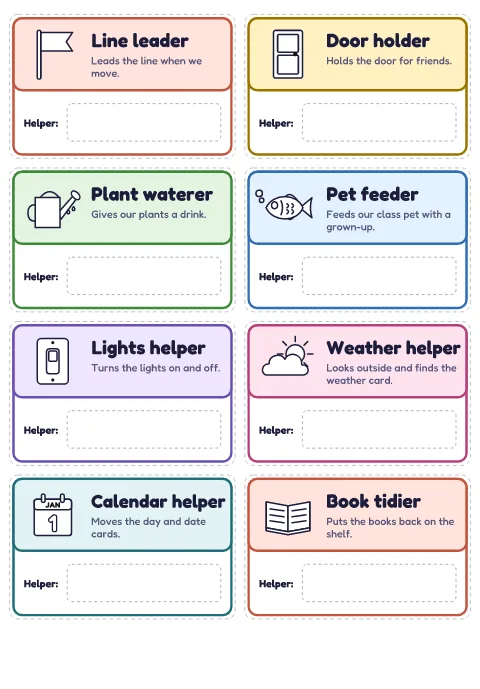 Classroom helper chart, job cards and routine chartsDisplays and charts · ages 3–6
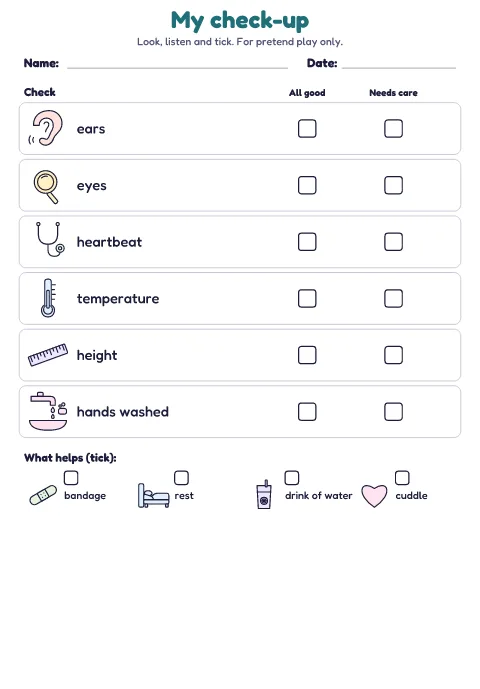 Doctor’s role play: check-up form, eye chart, signsDisplays and charts · ages 2–6
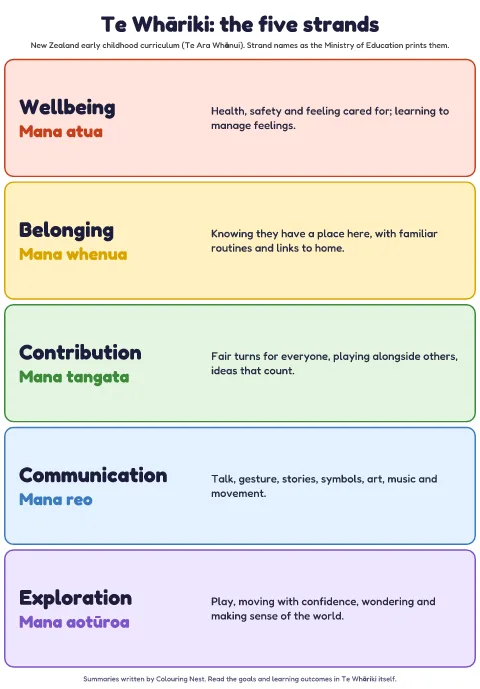 Te Whāriki learning story templatesTemplates · ages 1–5
Questions
What should a daily diary for babies include?
Sleep times, feeds or bottles with times and amounts, food, nappy changes, what the baby enjoyed, and notes for the family, plus a short note from home at drop-off. Our baby diary fits all of that on one page.
What is the difference between the baby and toddler diary?
The baby diary has bottle and feed rows; the toddler diary has drinks to circle and tick boxes for toilet learning (tried the toilet, used the toilet) next to nappy changes.
Do you keep any of the information?
No. These are printable PDFs. You fill them in on paper; nothing is typed into or stored by the website.
Are these free?
Yes. Free for your own centre, kindergarten, school, class and family, with no sign-up. Please don’t resell them or upload them to another site.