 Colouring Nest
Treasure basket and heuristic play ideas for babies and toddlers
Free treasure basket and heuristic play printables for baby and toddler rooms: twelve treasure basket idea cards (what to offer and what to watch for), eight heuristic play cards for toddlers, a treasure basket safety check poster, a tummy time and sensory play idea sheet for educators, and a simple play record. A4 and US Letter PDFs, colour and ink saver.
Inside this set
- 5 printables
- A4 and US Letter PDFs
- Colour and ink-saver versions
- Free, no sign-up
About this resource
Ages 0–2, prep, what you need and how to use it
- Ages
- Birth to 2 years (babies, toddlers)
- Prep
- About an hour to gather and check objects; a few minutes to print the cards and safety check.
- You’ll need
- Printer and card
- A low, sturdy basket
- Everyday objects bigger than a toilet-roll tube opening
- Bags or boxes to store heuristic play collections
- Supports
- Te Whāriki (NZ), EYLF (Australia), EYFS (England), ELOF (US)
How to use it in the room
- Tick the safety check for every item before each session.
- Sit close, watch and stay quiet unless the baby looks to you.
- Change the collection often and note what children explored on the play record.
Show resources for
Remembered on this device only. It sets A4 or US Letter as the first download.
Treasure baskets and heuristic play
A treasure basket is a low, sturdy basket filled with everyday objects made of natural and household materials (wood, metal, fabric, brushes, shells, a lemon) for a baby who can sit up, with support or alone, to explore. The baby chooses, picks up, mouths, bangs and compares; the adult sits close, watches and stays quiet unless the baby looks to them. The idea is usually credited to the educator Elinor Goldschmied, who also described heuristic play: for toddlers who are on the move, sessions with collections of objects and containers (tins, tubes, rings, lids) to fill, empty, fit together and take apart.
Our idea cards give one collection per card, with what to offer and what you might see. Use two or three collections in one basket, or one collection per session, and change the contents often so the basket stays interesting. The blank card is for your own collections: a basket from your local beach, things from the garden, or objects from children’s own cultures at home.
Safety first
Everything in the basket goes in a baby’s mouth, so every item must be bigger than a toilet-roll tube opening, clean, smooth, unbreakable and free of cords, button batteries, magnets and loose parts. Print the safety check poster, put it where the baskets are stored and tick it before each session. An adult sits close and watches the whole time.
Tummy time and sensory play
The idea sheet gives six ways to make tummy time more interesting (face to face, on your chest, with a mirror or a high-contrast strip) and six simple sensory play ideas for babies and young toddlers. It is play guidance for educators and families, not health advice: if you have questions about a baby’s development, talk to the family’s health professional.
Supports:
- Te Whāriki NZ
- Exploration | Mana aotūroa
- Wellbeing | Mana atua
- EYLF Australia
- Outcome 2: Children are connected with and contribute to their world
- Outcome 4: Children are confident and involved learners
- Outcome 3: Children have a strong sense of wellbeing
- Outcome 1: Children have a strong sense of identity
- EYFS England
- Understanding the world
- Physical development
- Personal, social and emotional development
- ELOF US
- Cognition
- Perceptual, Motor, and Physical Development
- Social and Emotional Development
1. Treasure basket idea cards
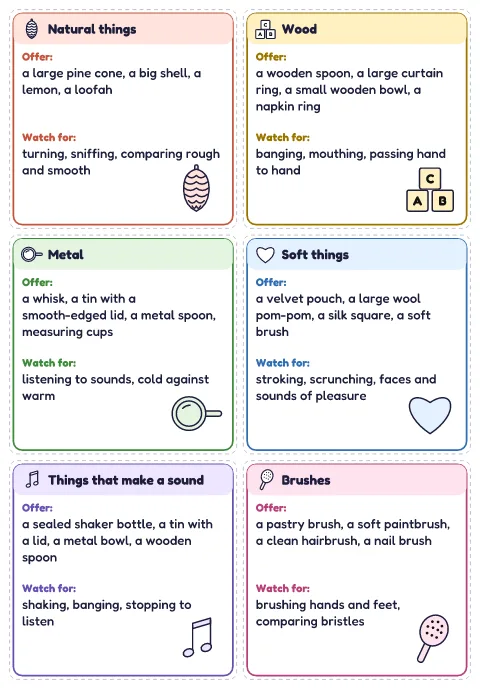
Twelve collections, six cards to a page: natural things, wood, metal, soft things, things that make a sound, brushes, kitchen things, shiny things, rough and smooth, paper and card, light and heavy, and a blank card.
Treasure basket idea cards PDF (A4)Treasure basket idea cards PDF (US Letter)
2. Heuristic play idea cards for toddlers
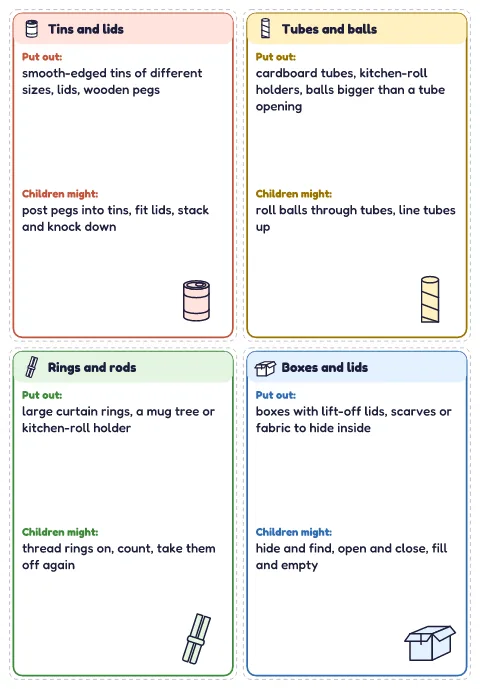
Eight collections for toddlers, four large cards to a page: tins and lids, tubes and balls, rings and rods, boxes and lids, spoons and cups, fabric and baskets, pegs and pots, sponges and bowls.
Heuristic play idea cards for toddlers PDF (A4)Heuristic play idea cards for toddlers PDF (US Letter)
Advertisement
3. Treasure basket safety check poster
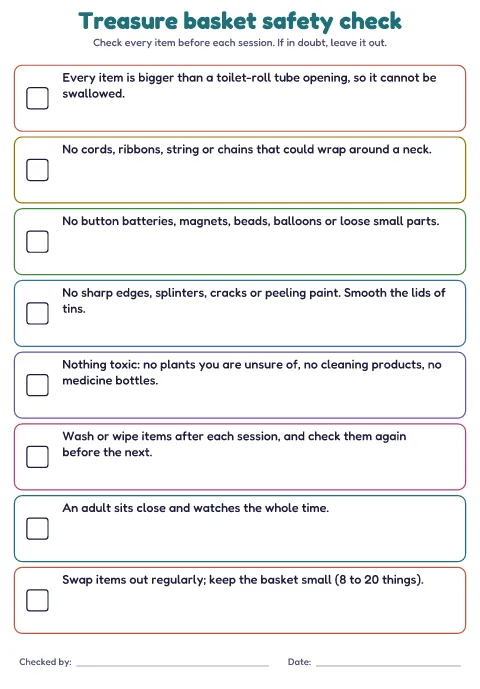
Eight checks with tick boxes and a line for who checked and when. Laminate it and keep it with the baskets.
Treasure basket safety check poster PDF (A4)Treasure basket safety check poster PDF (US Letter)
4. Tummy time and sensory play idea sheet
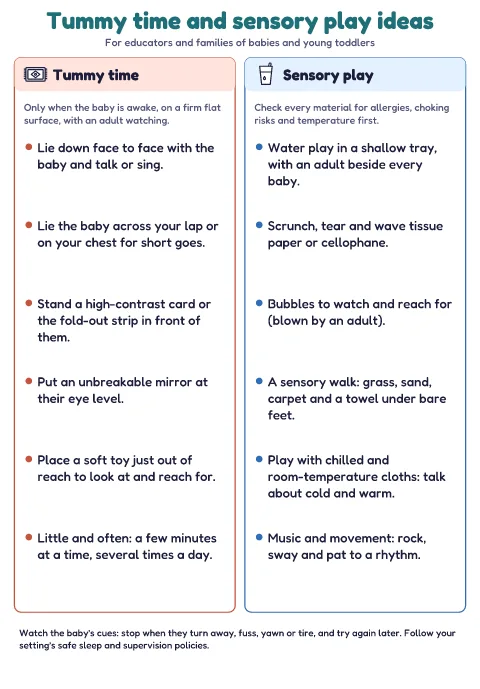
One page for the staff room or a family handout: tummy time ideas on one side, sensory play ideas on the other, with the safety notes for each.
Tummy time and sensory play idea sheet PDF (A4)Tummy time and sensory play idea sheet PDF (US Letter)
5. Play record
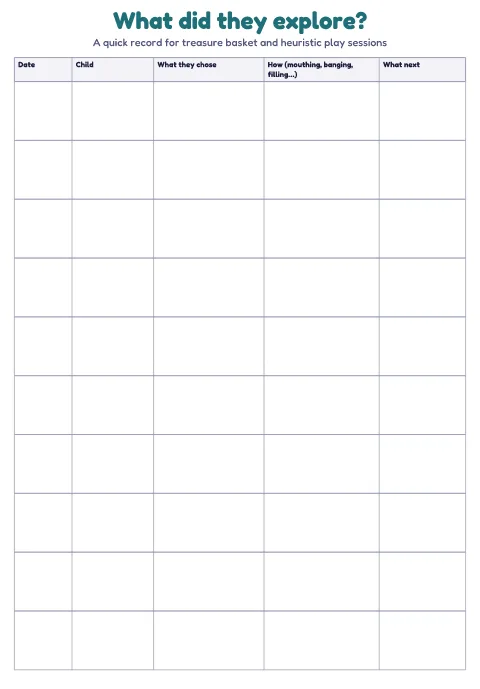
A ten-row table: date, child, what they chose, how they explored it (mouthing, banging, filling, passing) and what you will offer next.
Tips from baby rooms
- Sit back. The hardest part for adults is not to hand things over or name everything. Watch first.
- One basket, two babies. Two or three babies can share a basket; more than that and it turns into grabbing.
- Enough for everyone. In heuristic play, put out lots of each object so toddlers do not have to wait or squabble.
- Tidy up together. At the end of a heuristic session, toddlers can help sort objects back into their bags.
For babies and toddlers: daily care diary and family sheets, high-contrast cards and first words cards. More for the room: visual timetable, classroom labels with pictures, learning story templates and early learning by country.
Related sets
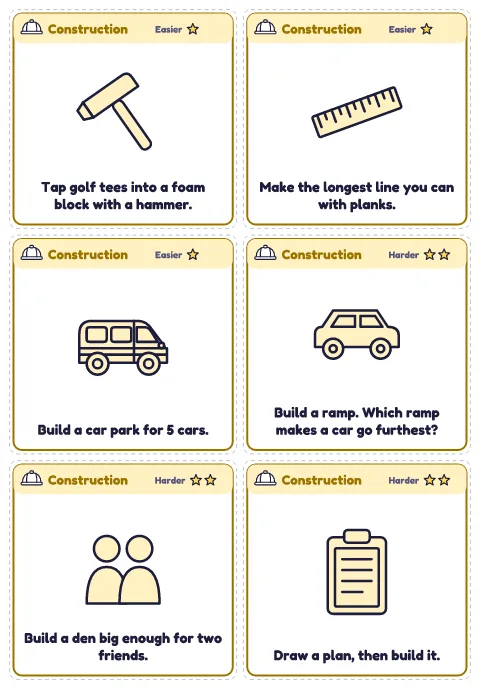 Continuous provision challenge cards for 10 play areasCards · ages 3–5
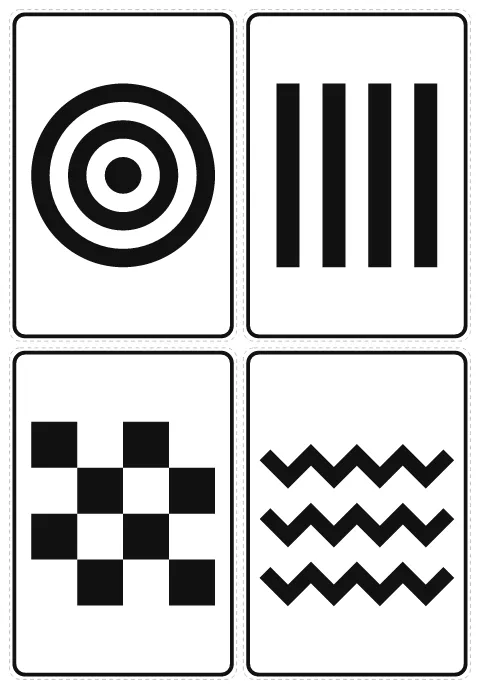 High-contrast cards for babies and first words cardsCards · ages 0–2
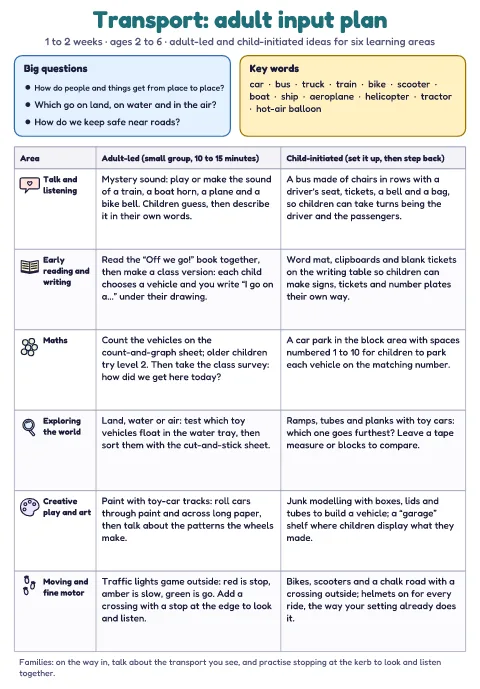 Transport topic pack: plan, word cards, road safety, sortsTemplates · ages 2–6
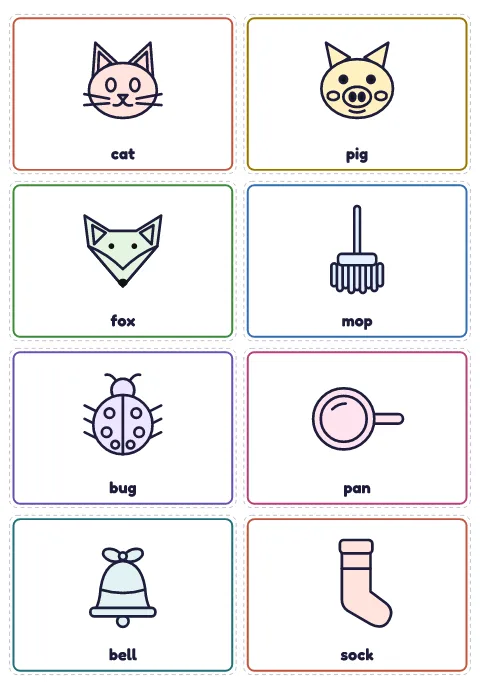 Phase 1 phonics: listening walk, rhyme, syllable and sound cardsCards · ages 2–5
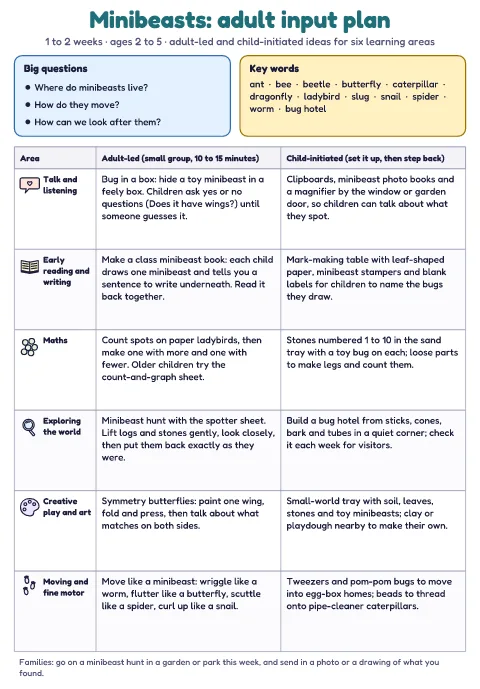 Minibeasts topic pack: adult input plan, word cards, sheetsTemplates · ages 2–5
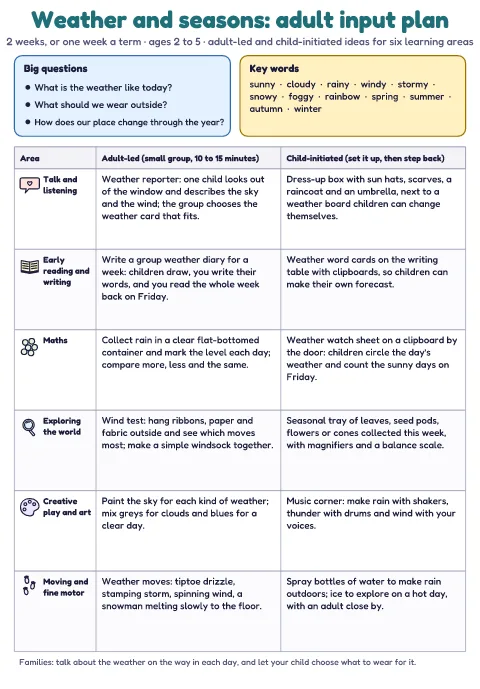 Weather and seasons topic pack (both hemispheres)Templates · ages 2–5
Questions
What goes in a treasure basket?
Everyday objects made of natural and household materials, each bigger than a toilet-roll tube opening: a wooden spoon, a whisk, a large shell, a pine cone, a lemon, a soft brush, a metal bowl. Our twelve idea cards list four for each collection.
What is the difference between a treasure basket and heuristic play?
Treasure baskets are for babies who sit up, exploring one object at a time. Heuristic play is for toddlers who move about, with collections of objects and containers to fill, empty and fit together.
How long should a treasure basket session be?
As long as the baby is interested, often 10 to 30 minutes. Stop when they lose interest or tire.
Are these free?
Yes. Free for your own centre, kindergarten, school, class and family, with no sign-up. Please don’t resell them or upload them to another site.