 Colouring Nest
High-contrast cards for babies and first words cards
Free high-contrast cards for babies to print: eight big black-and-white pattern cards, eight bold picture cards, a tummy time fold-out strip that stands up on the floor, and a black, white and red version of each. For older babies and young toddlers there are two sets of first-words picture cards (at home, and animals and outside). Four big cards to a page, A4 and US Letter PDFs.
Inside this set
- 5 printables
- A4 and US Letter PDFs
- Colour and ink-saver versions
- Free, no sign-up
About this resource
Ages 0–2, prep, what you need and how to use it
- Ages
- Birth to 2 years (babies, toddlers)
- Prep
- About 20 minutes to print on thick card, cut and laminate.
- You’ll need
- Printer and 250 gsm card
- Scissors or a guillotine
- Laminator
- A book ring (optional)
- Supports
- Te Whāriki (NZ), EYLF (Australia), EYFS (England), ELOF (US)
How to use it in the room
- Hold a card 20 to 30 cm from the baby’s face and move it slowly.
- Stand the fold-out strip in front of a baby during tummy time.
- Stop when the baby looks away or fusses, and never leave cards in a cot at sleep time.
Show resources for
Remembered on this device only. It sets A4 or US Letter as the first download.
How to use high-contrast cards
In the first months, many babies look longest at bold, simple shapes with strong edges: black on white, a bullseye, wide stripes. High-contrast cards give a baby something interesting to look at during tummy time, a nappy change or a quiet moment on a play mat. They are a simple play idea, not a treatment or a programme, and babies differ a lot in what holds their interest.
Hold a card about 20 to 30 centimetres (8 to 12 inches) from the baby’s face and move it slowly from side to side. Watch what they do: some babies stare, some kick, some look away. Looking away usually means “enough for now”. Try one or two cards at a time and swap them every few days. Stand the fold-out strip in front of a baby on their tummy, or prop a card against the side of a cot or play gym where they can see it.
Black and white, or black, white and red?
Every design comes in plain black and white and in a black, white and red version. Red is often added for slightly older babies; both are fine to use. Print on thick card at 100% (actual size) and laminate them: babies will grab, wave and mouth them, so check laminated edges and replace anything bent or peeling.
First words cards
From around their first birthday, babies and toddlers love pictures of everyday things they know. The first-words cards show one clear picture and one word per card: ball, cup, shoe, bed and teddy at home; dog, duck, bus, tree and moon outside. Name the picture, point to the real thing in the room, and let children post cards into a box or hide them under a cloth. Words are chosen to be the same in New Zealand, Australia, the UK and the US.
Supports:
- Te Whāriki NZ
- Wellbeing | Mana atua
- Communication | Mana reo
- Exploration | Mana aotūroa
- EYLF Australia
- Outcome 3: Children have a strong sense of wellbeing
- Outcome 1: Children have a strong sense of identity
- Outcome 5: Children are effective communicators
- EYFS England
- Personal, social and emotional development
- Communication and language
- Literacy
- Physical development
- ELOF US
- Social and Emotional Development
- Language and Literacy
- Perceptual, Motor, and Physical Development
1. High-contrast pattern cards
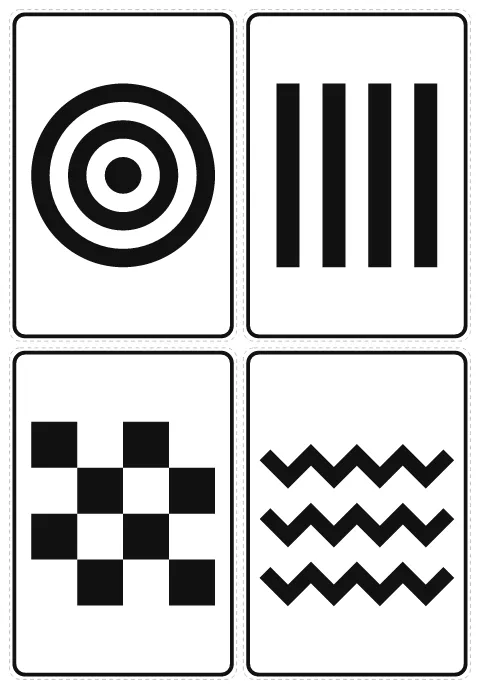
Eight big cards: bullseye, stripes, checkerboard, zigzag, dots, squares, waves and a sunburst. Choose plain black and white, or black, white and red.
High-contrast pattern cards PDF, Black and white (A4)High-contrast pattern cards PDF, Black and white (US Letter)
2. High-contrast picture cards
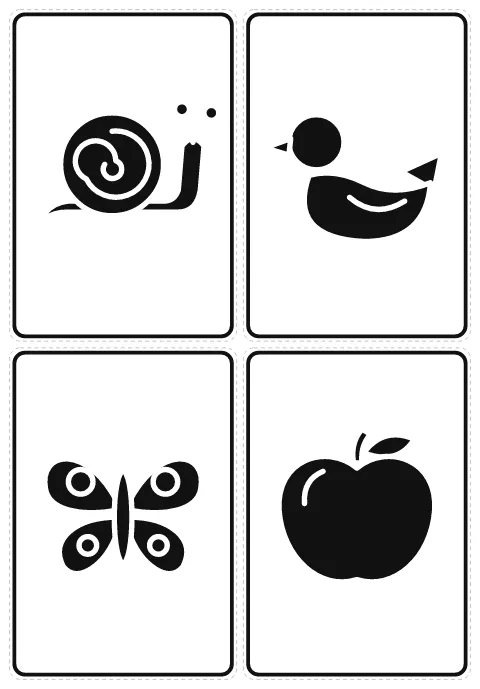
Eight bold pictures as solid shapes with white details: snail, duck, butterfly, apple, house, tree, heart and star.
High-contrast picture cards PDF, Black and white (A4)High-contrast picture cards PDF, Black and white (US Letter)
Advertisement
3. Tummy time fold-out strip
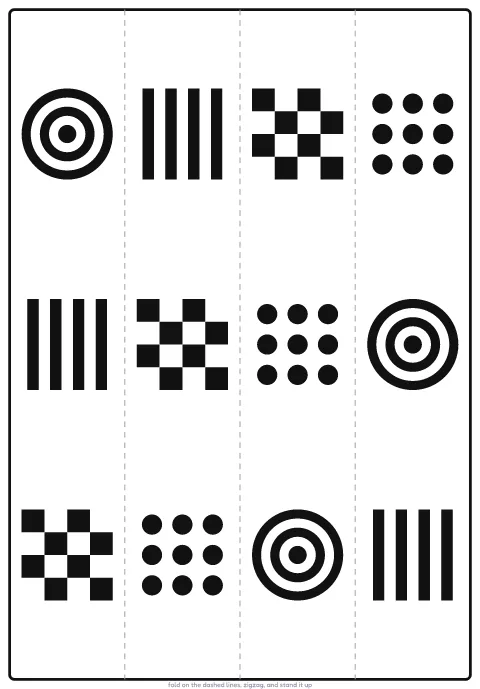
Two pages of four tall pattern panels. Fold on the dashed lines like a zigzag and it stands up on the floor in front of a baby during tummy time.
Tummy time fold-out strip PDF, Black and white (A4)Tummy time fold-out strip PDF, Black and white (US Letter)
4. First words cards: at home
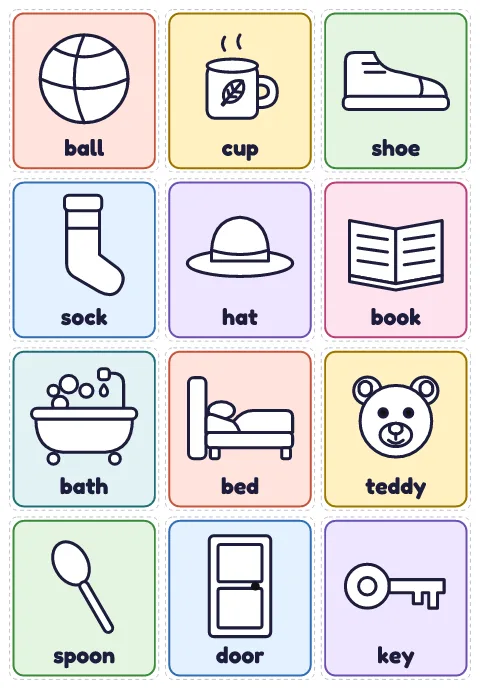
Twelve cards with big pictures of things at home: ball, cup, shoe, sock, hat, book, bath, bed, teddy, spoon, door and key.
First words cards: at home PDF (A4)First words cards: at home PDF (US Letter)
5. First words cards: animals and outside
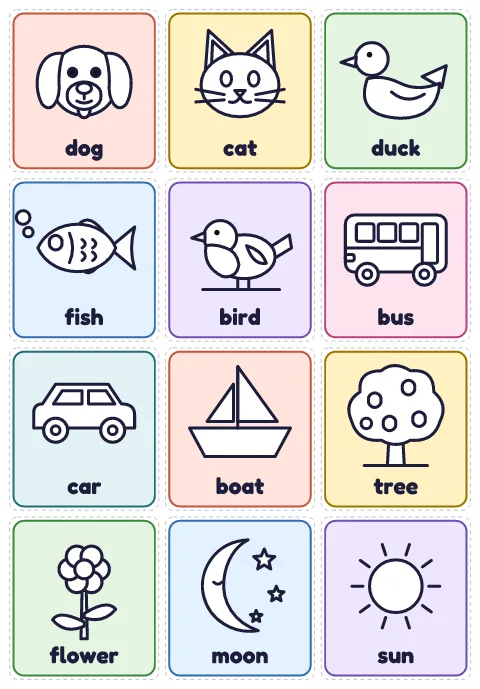
Twelve cards with animals and things outside: dog, cat, duck, fish, bird, bus, car, boat, tree, flower, moon and sun.
First words cards: animals and outside PDF (A4)First words cards: animals and outside PDF (US Letter)
Tips
- Card, not paper. Thin paper flops; 250 gsm card or a laminated sheet stands up and lasts.
- Never in the cot at sleep time. Take cards and strips away when a baby goes down to sleep.
- Follow the baby. If they turn away, fuss or close their eyes, put the cards down and try another time.
- Make a book. Punch a hole in the corner of four cards and join them with a large book ring for a first board book (check the ring regularly).
For babies and toddlers: daily care diary and family sheets, treasure basket and heuristic play ideas. More for the room: visual timetable, classroom labels with pictures, learning story templates and early learning by country.
Related sets
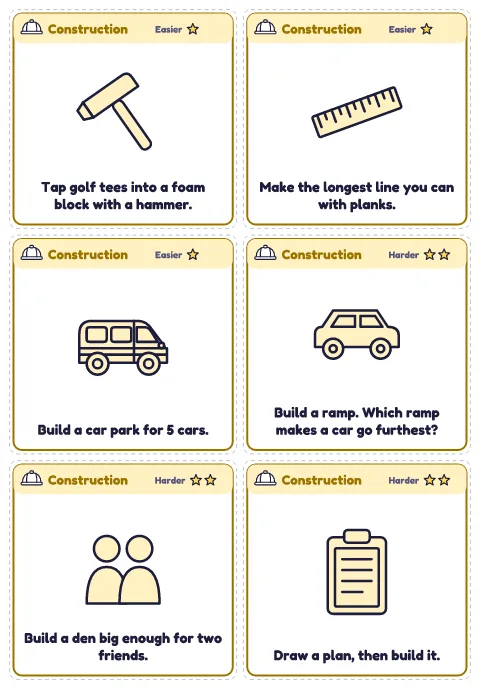 Continuous provision challenge cards for 10 play areasCards · ages 3–5
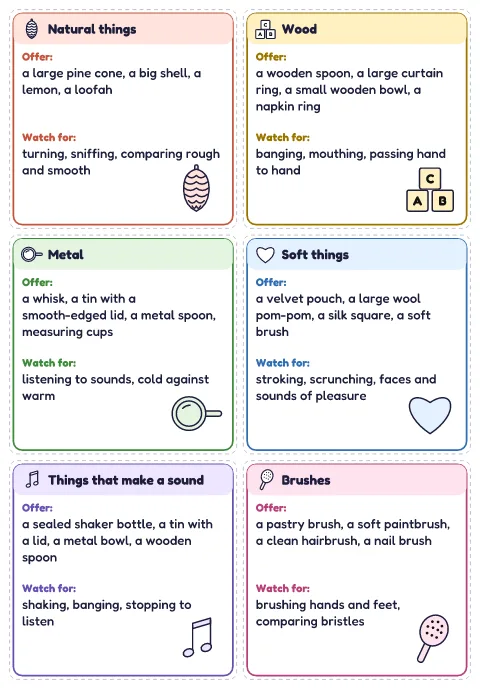 Treasure basket and heuristic play idea cardsCards · ages 0–2
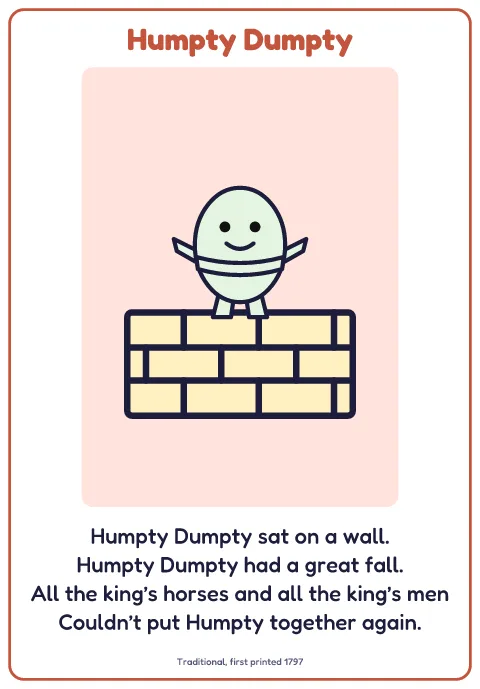 Nursery rhymes: posters, sequencing, actions, rhyming and countingCards · ages 1–6
 Tracing lines and pre-writing patternsWorksheets · ages 3–6
 Letter of the week packs A to Z with letter formationWorksheets · ages 3–6
 Doctor’s role play: check-up form, eye chart, signsDisplays and charts · ages 2–6
Questions
What are high-contrast cards for babies?
Cards with bold black-and-white (or black, white and red) shapes for babies to look at. They are a simple play idea for tummy time and quiet moments.
How far away should I hold the cards?
About 20 to 30 cm (8 to 12 inches) from a young baby’s face. Move the card slowly and watch how the baby responds.
When can babies use first words cards?
Usually from around their first birthday, when they start to point at and name familiar things. Use them as a game, not a test.
Are these free?
Yes. Free for your own centre, kindergarten, school, class and family, with no sign-up. Please don’t resell them or upload them to another site.